

A beauty brand SEO strategy is a targeted system that combines technical site optimization, ingredient-focused content, mobile usability, and video integration to grow organic traffic and capture high-intent shoppers. This is the industry's recognized approach to search engine optimization applied specifically to cosmetics and skincare brands. Your beauty brand digital marketing success depends on getting all four pillars working together. Technical SEO fixes improve rankings by 15–40 positions for 73% of keywords, and 73% of beauty shoppers use mobile devices. Those two facts alone define where your priorities must sit.
What are the key technical SEO elements for beauty brand websites?
Technical SEO is the foundation every other tactic builds on. Without it, your best content stays invisible. For beauty brands, the most critical technical elements are site speed, mobile rendering, schema markup, and structured data for product pages.
Schema markup is especially powerful for cosmetics brands. Adding product schema, review schema, and ingredient schema tells Google exactly what your pages contain. That structured data can generate rich results in search, including star ratings, price ranges, and ingredient callouts, all of which increase click-through rates before a shopper ever reaches your site.

Mobile-first indexing means Google crawls and ranks your site based on its mobile version first. Brands that achieved 40% faster mobile load times through image compression, AMP pages, and touch-friendly navigation also saw 25% higher conversion rates. Speed and structure are not separate concerns. They are the same investment.
AI-powered SEO automation tools now handle technical audits, crawl error detection, and on-page fixes at scale. Platforms like Semrush, Ahrefs, and Screaming Frog surface technical gaps that would take weeks to find manually. New beauty brands can reach page one rankings within six months when they combine autonomous SEO implementation with the content tactics below.
Pro Tip: Run a Core Web Vitals report in Google Search Console every month. Fix Largest Contentful Paint (LCP) issues first. They have the highest direct impact on both rankings and conversion for beauty e-commerce pages.
| Technical element | Why it matters for beauty brands |
|---|---|
| Schema markup | Generates rich results with ingredients, ratings, and price |
| Image compression | Reduces load time without sacrificing product photo quality |
| Mobile-first rendering | Aligns with Google's indexing method and shopper behavior |
| Core Web Vitals | Directly affects page experience ranking signals |
| Crawl error fixes | Prevents indexed pages from returning 404 or redirect errors |
How can ingredient-focused content clusters drive high-intent traffic?
Ingredient transparency is the single most underused SEO asset in the beauty industry. Shoppers no longer search for "moisturizer." They search for "niacinamide benefits for oily skin" or "hyaluronic acid serum for dry skin." Those queries signal buying intent, not casual browsing.
The search volumes confirm the opportunity. "Niacinamide benefits" draws 165,000 monthly searches, and "hyaluronic acid serum" draws 201,000. Ingredient-based content generates 247% higher click-through rates compared to generic product terms. That gap exists because ingredient queries match what shoppers already believe they need.
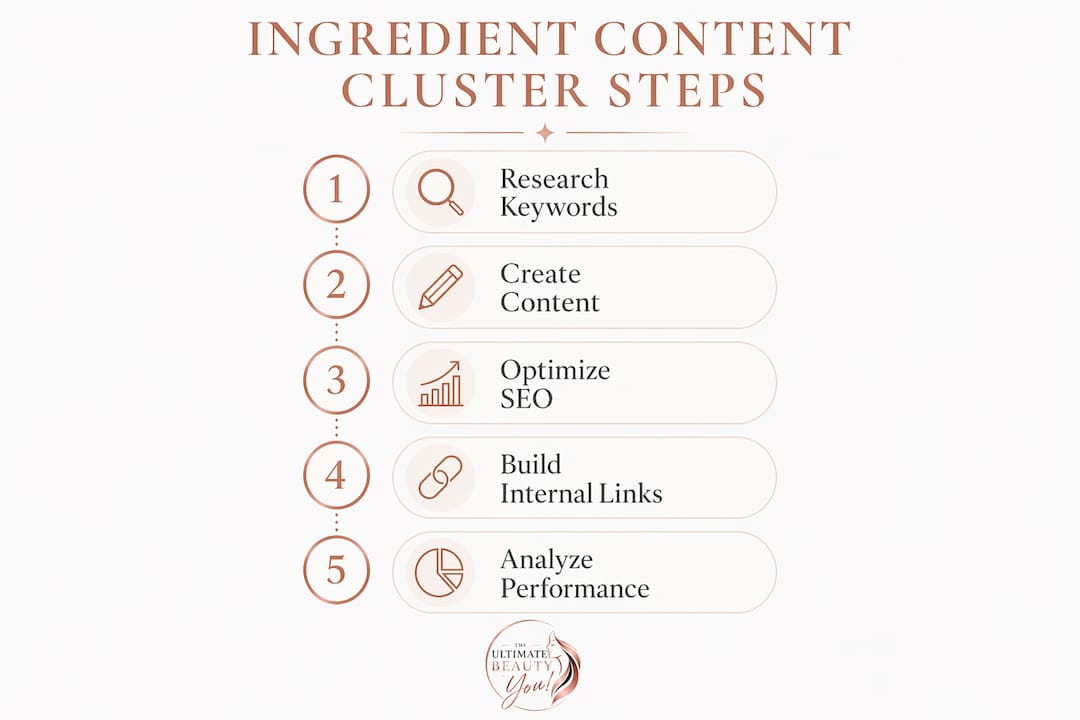
A content cluster strategy builds topical authority around one ingredient at a time. The pillar page covers the ingredient broadly: what it is, how it works, who it suits. Supporting pages go deeper: "niacinamide vs. salicylic acid for acne," "how to layer niacinamide with retinol," "best niacinamide concentration for beginners." Each supporting page links back to the pillar, and the pillar links out to each supporting page. Google reads that structure as expertise.
Effective content types for ingredient clusters include:
- Deep-dive blog posts covering ingredient science, sourcing, and skin benefits
- FAQ pages targeting "People Also Ask" queries around ingredient safety and combinations
- Tutorial content showing how to use the ingredient in a routine
- Comparison posts like "retinol vs. bakuchiol" that capture shoppers weighing options
- Video transcripts embedded on ingredient pages to increase dwell time
Pro Tip: Use Google's "People Also Ask" box as your content brief. Every question that appears for an ingredient query is a sub-page waiting to be written. Map each question to a URL before you write a single word.
Why is a mobile-first approach critical for beauty brand SEO?
Mobile is where beauty shopping happens. 73% of beauty shoppers use mobile devices to discover, research, and buy. Google's mobile-first indexing means your desktop experience is irrelevant if your mobile experience is broken. Rankings reflect the mobile version of your site, full stop.
The gap between a fast mobile site and a slow one is measurable in revenue. Brands that prioritized mobile checkout optimization alongside image compression and touch-friendly navigation achieved 25% higher conversion rates. A one-second delay in mobile load time reduces conversions significantly on beauty e-commerce pages.
Common mobile SEO mistakes beauty brands make include using full-resolution product images without compression, building navigation menus designed for desktop hover states, and placing call-to-action buttons too close together for thumb navigation. Each of these errors costs you both rankings and sales.
Best practices for mobile-first beauty e-commerce SEO:
- Compress all product images to WebP format without visible quality loss
- Use a single-column layout for product pages on screens under 480px
- Place "Add to Cart" buttons within thumb reach, below the fold on mobile
- Test mobile checkout flow monthly using Google's Mobile-Friendly Test
- Avoid pop-ups that trigger immediately on mobile, which Google penalizes
- Enable lazy loading for product gallery images to speed up initial page render
How to integrate video and UGC for beauty brand SEO success
Video content is the most direct way to improve the SEO signals that rankings depend on. Video increases session duration by 64% and dwell time by 2.6x on beauty product pages, improving ranking signals by 34%. Google reads longer sessions and lower bounce rates as evidence that a page satisfies search intent.
The most effective video types for SEO for cosmetics brands follow a three-act structure tied to the buyer's journey. Founder-led stories work for cold traffic, building trust with people who have never heard of your brand. User-generated content (UGC) tutorials work for mid-funnel visitors who are comparing options. Product-focused demos work for retargeting audiences who have already visited your site. Each stage requires different creative, not just different targeting.
Jones Road Beauty demonstrated this with founder-led, authentic video content. Authentic creative reduced customer acquisition cost by 29–31% and significantly increased return on ad spend. The lesson is not just about paid media. Authentic video embedded on organic pages builds the same trust signals that improve SEO.
UGC works as an SEO asset when it is structured, not accidental. Carousel Beauty showed that structured creative briefs for customers improved Meta ROAS by 38% within six months by treating customers as a distributed production team. The same principle applies to organic SEO. Guided UGC generates higher-quality content, more natural backlinks, and stronger on-page engagement than unguided reviews.
- Build a micro-creator brief. Give customers a one-page guide covering lighting, framing, and the specific benefit to highlight.
- Embed UGC directly on product pages. Video testimonials placed above the fold increase dwell time and reduce bounce rates.
- Transcribe all video content. Transcripts give Google text to index and give shoppers with accessibility needs a better experience.
- Request reviews with ingredient mentions. Prompt customers to name the specific ingredient that worked for them. Those reviews become keyword-rich content Google indexes.
- Build a micro-creator network. Identify 20–30 real customers with engaged followings and give them early access to new products in exchange for honest video content.
Pro Tip: Physical packaging design is an overlooked SEO asset. Jolie Skincare engineered its unboxing experience to trigger organic, high-quality UGC. That packaging-driven content became its highest-converting organic asset. Design your packaging to be filmed.
Key Takeaways
A winning beauty brand SEO strategy requires technical precision, ingredient-led content, mobile-first execution, and authentic video working together as one system.
| Point | Details |
|---|---|
| Technical SEO comes first | Fix Core Web Vitals, schema markup, and crawl errors before building content. |
| Ingredient content drives intent | Queries like "niacinamide benefits" generate 247% higher CTR than generic product terms. |
| Mobile is non-negotiable | 73% of beauty shoppers use mobile. Speed and touch-friendly design directly affect rankings. |
| Video extends session depth | Video increases dwell time by 2.6x, sending stronger ranking signals to Google. |
| UGC needs structure to scale | Creative briefs turn customers into a content team that generates authentic, indexable assets. |
What I've learned about beauty SEO that most guides won't tell you
The brands winning in organic search right now are not the ones with the biggest content budgets. They are the ones that stopped treating SEO and creative as separate departments. I have watched beauty founders pour money into polished ad campaigns while their product pages loaded in six seconds on mobile and their ingredient pages answered no real questions. The technical gaps ate the creative investment alive.
The shift I keep seeing work is when founders treat their digital infrastructure the same way they treat their formulations. You would not launch a serum without testing the pH. You should not launch a content cluster without auditing your crawl errors first. L'Oréal's integrated approach linking creator ecosystems, AI data, and commerce APIs shows what treating digital infrastructure as a core competitive advantage actually looks like at scale.
The other thing I believe strongly: authenticity is not a trend. It is a technical SEO signal. Google's E-E-A-T framework, which stands for Expertise, Experience, Authoritativeness, and Trustworthiness, rewards brands that display verifiable credentials and real human voices. Unscripted founder content and genuine customer reviews satisfy that framework better than any polished brand copy. The brands that understand this are building SEO moats that paid media cannot replicate.
— Ava
How Theultimatebeauty-you helps beauty brands grow organically
Theultimatebeauty-you is built for women who are serious about their beauty brand's growth. We connect beauty brand marketers and entrepreneurs with trusted experts, proven resources, and a community that understands the full picture of building a brand from the inside out.
Whether you are refining your content strategy, working through a technical SEO audit, or looking for partners who specialize in beauty brand digital marketing, Theultimatebeauty-you brings the right people and tools to you. Explore our expert solutions and products built specifically for beauty brand growth, or connect with our team to start building a strategy that fits your brand, your audience, and where you are right now.
FAQ
What is a beauty brand SEO strategy?
A beauty brand SEO strategy is a structured plan combining technical site optimization, ingredient-focused content, mobile usability, and video to grow organic search rankings and traffic. It differs from general SEO by targeting beauty-specific search behavior, including ingredient queries and tutorial searches.
How long does it take to see SEO results for a beauty brand?
New beauty brands can reach page one rankings within six months through autonomous SEO implementation, ingredient content clusters, and mobile-first optimization. Consistent technical fixes and content publishing accelerate that timeline.
Why does ingredient-focused content rank better for beauty brands?
Ingredient queries like "niacinamide benefits" and "hyaluronic acid serum" carry high purchase intent and generate 247% higher click-through rates than generic product terms. Shoppers searching by ingredient already know what they want, making them more likely to convert.
How does video content improve beauty brand SEO?
Video increases session duration by 64% and dwell time by 2.6x on beauty product pages, which signals to Google that the page satisfies search intent. Embedding video with transcripts also gives Google additional text to index.
What is E-E-A-T and why does it matter for beauty SEO?
E-E-A-T stands for Expertise, Experience, Authoritativeness, and Trustworthiness. Google uses it to evaluate beauty brand content quality. Displaying third-party certifications, real founder credentials, and verified customer reviews directly improves how Google ranks your pages.