

Beauty brand storytelling is the strategic practice of creating authentic, sensory-rich narratives that emotionally connect with consumers and drive purchase decisions. Consumers are 55% more likely to buy from a brand after connecting with its story. That single fact reframes storytelling from a creative luxury into a core marketing function. This beauty brand storytelling guide gives you the frameworks, systems, and sequencing strategies to build narratives that resonate at every touchpoint, from a retail pitch to a TikTok brief. At Theultimatebeauty-you, we believe beauty is a verb. Your brand story should be too.
What core elements compose a compelling beauty brand story?
A beauty brand narrative is built on four structural pillars: origin tension, a hero (your customer), a villain (the problem or incumbent product), and a transformation arc. These are not optional flourishes. They are the load-bearing walls of every story that earns trust and drives conversion.

The story spine approach gives you a practical starting point. Choose one primary story angle and build from there. The five angles are sensory experience, ritual, ingredient focus, finish, and identity. Each angle speaks to a different emotional need. Sensory stories make the shopper feel the product before they buy it. Identity stories tell her who she becomes when she uses it.
The table below maps each angle to its emotional appeal and its most common pitfall.
| Story angle | Emotional appeal | Common pitfall |
|---|---|---|
| Sensory | Desire, curiosity | Vague descriptions with no texture proof |
| Ritual | Belonging, comfort | Feels generic without a specific routine context |
| Ingredient | Trust, credibility | Reads like a lab report instead of a story |
| Finish | Aspiration, confidence | Overretouched imagery that breaks trust |
| Identity | Self-expression, pride | Abstract slogans that own nothing specific |
Brand equity components from the Aaker model add another layer. Brand loyalty, perceived quality, and proprietary associations are storytelling assets, not just business metrics. When you name your hero ingredient, show your founder's real tension, or document your customer's before-and-after, you are building equity that compounds over time.
Pro Tip: Start every new campaign by naming your primary story angle in writing before you brief a single creator. One angle, stated clearly, prevents the fragmented messaging that dilutes beauty brands at scale.
How do you build a scalable beauty storytelling system?
A scalable storytelling system has three components: a Brand Narrative Document, a Creative Expression Matrix, and a Brief-to-Publish Pipeline. Without all three, your story lives in your head and dies in execution.
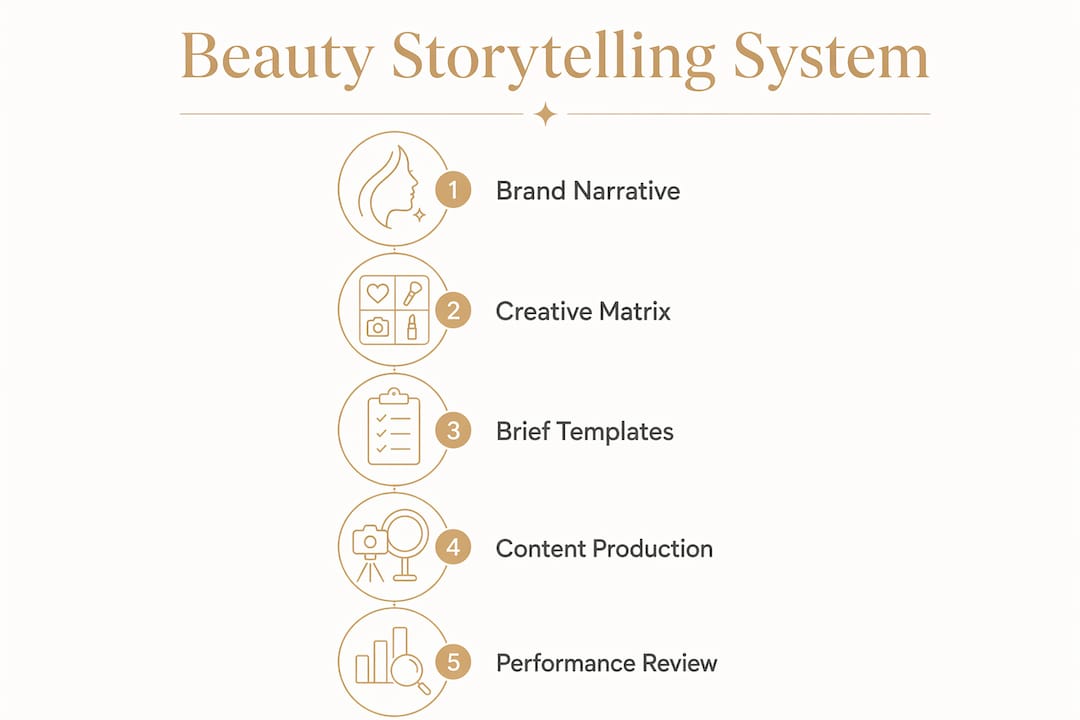
The Brand Narrative Document is your single source of truth. It captures your origin tension, your hero customer, your villain, your transformation promise, and your brand voice. Every creator, agency, and retail partner reads it before they touch your brand. The Creative Expression Matrix maps your narrative themes to specific content formats: short video, editorial photography, email, paid social, and in-store. It tells your team which story angle belongs in which channel and at what volume. The Brief-to-Publish Pipeline translates those decisions into creative briefs that state the story context, the emotional outcome, the key claim, and the legal guardrails. Creators get freedom within a clear frame.
Here is how to build this system in sequence:
- Write your Brand Narrative Document. Include origin tension, hero customer profile, villain, transformation arc, and brand voice in one document under five pages.
- Build your Creative Expression Matrix. List every content channel. Assign a primary story angle and a secondary supporting angle to each one.
- Create a master brief template. The brief must state story context before product information. Emotional outcome comes before feature list.
- Run a story layer audit. Before publishing any asset, check that it connects to at least one narrative theme in your document.
- Review quarterly. As your brand scales, your story deepens. Update the document to reflect new proof points, customer language, and product evolution.
Pro Tip: Treat your Brand Narrative Document as a living story layer, not a one-time deliverable. Brands that build repeatable storytelling architectures consistently outperform those that create one-off assets, because the story compounds with every new piece of content.
How do you pitch your beauty brand story to retail, press, and investors?
The most effective beauty brand pitches follow a three-part narrative arc: problem, shift, and proof. This formula answers three questions your audience is always asking: Why this brand? Why now? Why you?
The pitch narrative formula works because it mirrors how decisions are actually made. Retail buyers need to see a clear gap in their assortment. Press needs a cultural moment to anchor the story. Investors need a credible founder tension and a proof of demand. The same arc serves all three, with the emphasis shifted.
Tailor your pitch by audience using these adjustments:
- Retail buyers: Lead with the customer problem and the gap in their current shelf. Follow with your transformation proof, using repeat purchase data or sell-through rates.
- Press: Lead with the cultural shift your brand represents. Frame the founder origin as the catalyst. Use customer language, not brand language, as your proof.
- Investors: Lead with market tension and timing. Show the shift in consumer behavior your brand captures. Proof means revenue trajectory, retention, and unit economics.
Practical steps for integrating this into a pitch deck:
- Slide one states the problem in one sentence from the customer's perspective.
- Slide two names the shift: what changed in the market or in culture that makes your brand possible now.
- Slide three delivers proof. Choose metrics that directly address the friction your Setup created. As the 3-part data-story framework confirms, proof should answer the skepticism your story raises, not simply present your largest numbers.
How do emotional and cognitive processes shape beauty storytelling?
Beauty shoppers make up to 95% of purchase decisions subconsciously. That figure comes from dual-process theory, which describes two mental systems: System 1 is fast, emotional, and instinctive. System 2 is slow, rational, and evidence-seeking. Effective beauty storytelling engages both, in the right order.
System 1 fires first. Your opening image, your headline, your first three seconds of video must create instant emotional recognition. Fenty Beauty built its entire launch narrative on a single System 1 signal: 40 shades. No woman left out. That message required no explanation. It landed before the rational mind engaged.
System 2 activates when interest is established. This is where ingredient stories, clinical claims, and customer proof earn their place. Sequencing storytelling before evidence reduces friction and builds connection before skepticism has a chance to form.
Story first. Evidence second. This sequence is not a creative preference. It is how the human brain buys.
Pro Tip: On product pages, lead with a sensory or identity story in the hero section. Place ingredient evidence and clinical proof below the fold. This mirrors the System 1 to System 2 sequence and reduces the cognitive resistance that kills conversions.
The Setup, Catalyst, and Proof framework maps directly onto this sequence. Setup creates empathy. Catalyst creates momentum. Proof closes the loop with evidence that speaks to the exact friction your story raised.
What are the most common beauty storytelling mistakes?
The most damaging mistake in beauty brand storytelling is treating story assets as one-off deliverables. A single campaign video, a founder interview, or a launch lookbook does not constitute a storytelling system. Without architecture, each new asset starts from zero and fragments your narrative over time.
Watch for these specific pitfalls:
- Overretouched imagery. When your visuals do not show real texture, real skin, or real product behavior, you break trust before the copy has a chance to build it. Every image needs a clear job: texture proof, in-routine context, or brand mood. Vague beauty shots do none of these.
- Abstract slogans without an ownable frame. Phrases like "feel your best" or "beauty redefined" own nothing. Strong brand positions endure by claiming a specific, credible frame that holds up under scrutiny.
- Skipping the story layer in briefs. When you brief creators on product features without story context, you get accurate content that feels disconnected. The brief must state the emotional outcome first.
- Measuring story assets by reach alone. Reach tells you how many people saw the content. It does not tell you whether the story moved them. Track repeat purchase rates, time on page, and save rates as story engagement signals.
Pro Tip: Create a one-sentence "story goal" for every content asset before production begins. Write it at the top of every brief: "This asset builds trust by showing real texture on diverse skin tones." That sentence keeps every creator aligned without restricting their creative expression.
Key takeaways
Beauty brand storytelling works when it combines emotional sequencing, systematic architecture, and clear story goals for every asset.
| Point | Details |
|---|---|
| Story spine first | Choose one primary angle (sensory, ritual, ingredient, finish, identity) before briefing any creator. |
| Build a three-part system | A Brand Narrative Document, Creative Expression Matrix, and Brief-to-Publish Pipeline create consistent narratives at scale. |
| Pitch with problem, shift, proof | Tailor this arc for retail buyers, press, and investors by shifting emphasis, not structure. |
| Sequence emotion before evidence | Lead with System 1 storytelling, then layer in clinical proof to reduce skepticism without losing connection. |
| Give every asset a clear job | Define the story goal of each visual before production to prevent vague imagery that weakens the narrative. |
Why I think most beauty brands are telling the wrong story
After years of working with beauty brands across every stage of growth, I keep seeing the same pattern. The brand has a genuinely powerful origin story. The founder lived the problem. The product solves it in a real, demonstrable way. But the marketing leads with the product, not the person. The story gets buried under ingredient lists and shade counts.
Effective brand storytelling is an ongoing practice rooted in authentic customer conversations, not a one-time tagline exercise. The brands I have seen scale past the noise are the ones that treat their Brand Narrative Document as a living document. They update it when a customer says something in a review that captures the transformation better than any copywriter could. They listen, then they build.
The other thing I have learned is that emotional sequencing is not a soft skill. It is a conversion strategy. When you put the story first and the evidence second, you are not being less rigorous. You are being smarter about how the brain actually buys. Fenty Beauty did not launch with a clinical study. It launched with a mirror moment. The proof came after the connection was made.
My honest encouragement to you: stop waiting for the perfect campaign to tell your story. Start with one clear angle, one customer transformation, and one brief that puts the emotional outcome above the feature list. Build from there. The story compounds. You will feel it.
— Ava
Bring your beauty brand story to life with Theultimatebeauty-you
Your brand story deserves a platform that lives it, not just tells it.
Theultimatebeauty-you is a women-centered beauty, confidence, and wellness platform built on the belief that beauty is becoming. Every product in our curated product collection is chosen because it embodies a real transformation story, not a manufactured one. Our expert partners bring deep knowledge in beauty marketing, brand narrative, and consumer connection to support your storytelling work at every stage. Whether you are building your first Brand Narrative Document or scaling a system past your first major retail placement, we are here as your guide and your community. Beauty is not perfection. Beauty is a verb. Come build yours with us.
FAQ
What is beauty brand storytelling?
Beauty brand storytelling is the practice of crafting authentic narratives that emotionally connect consumers to a brand through sensory detail, transformation arcs, and clear identity. Consumers are 55% more likely to purchase from a brand after engaging with its story.
What story angles work best for beauty brands?
The five primary story angles are sensory experience, ritual, ingredient focus, finish, and identity. Choosing one primary angle per campaign creates consistent messaging aligned with how shoppers learn and decide.
How do you structure a beauty brand pitch?
The most effective pitch follows a problem, shift, proof arc that answers why this brand, why now, and why you. Tailor the emphasis for retail buyers, press, or investors while keeping the three-part structure intact.
Why does emotional sequencing matter in beauty marketing?
Beauty shoppers make up to 95% of purchase decisions subconsciously, meaning System 1 emotional recognition fires before rational evaluation. Leading with story and following with evidence mirrors this process and reduces purchase friction.
What is a Brand Narrative Document?
A Brand Narrative Document is a single reference file capturing your origin tension, hero customer, villain, transformation promise, and brand voice. It serves as the foundation for every creative brief, pitch, and content asset your brand produces.