
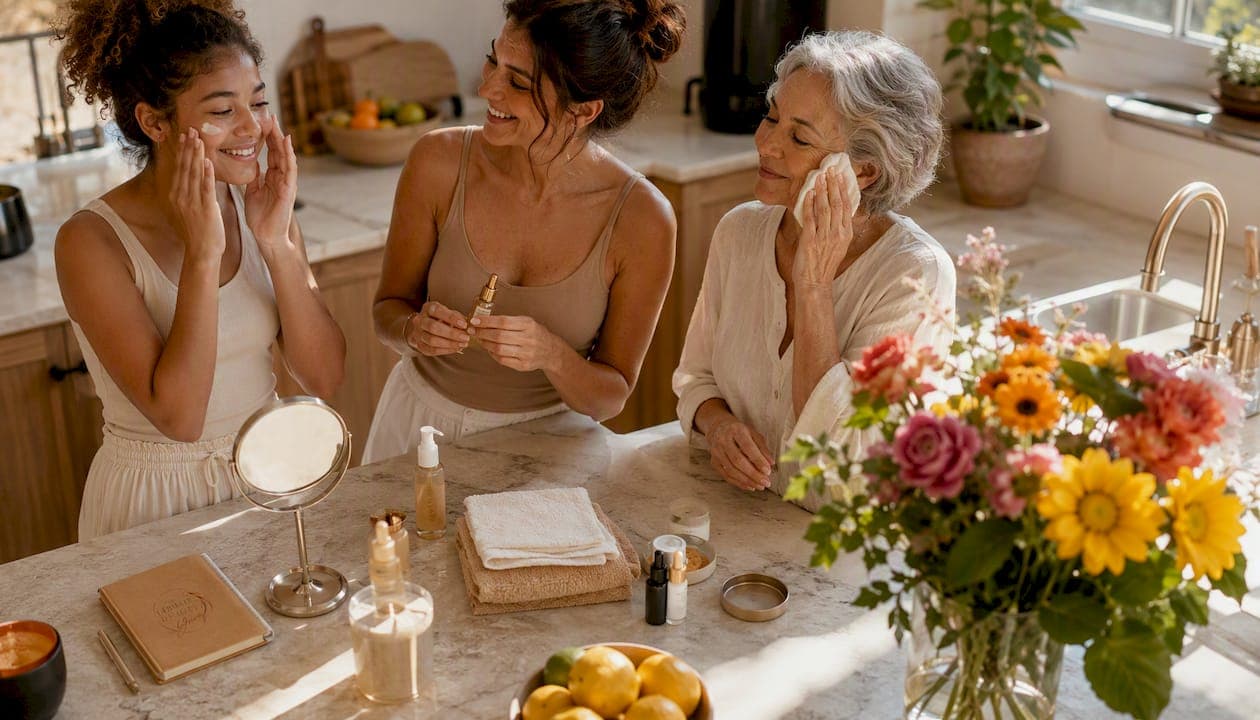
Age-specific beauty routines share the same four priorities: cleanse, protect, hydrate, and treat. What shifts across every decade is the emphasis, the actives, and how much your skin needs to work to stay resilient. Find your bracket below, then build from there.
Your age group at a glance:
- Teens (13–19): Establish cleansing and sun protection; manage acne safely with gentle actives.
- 20s: Prevention first. Daily SPF, vitamin C, and consistent hydration lay the groundwork.
- 30s: Protect and correct. Introduce low-dose retinoids and periodic exfoliation.
- 40s–50s: Replenish and reinforce. Barrier repair, peptides, and richer hydration take priority.
- 60+: Nourish and simplify. Ceramide-rich formulas, gentle actives, and comfort-first textures.
Most routines take 8–12 weeks of consistent use before you see meaningful change. Patience and consistency matter far more than product price.
Table of Contents
- What do beauty routines by age group actually have in common?
- Teen skin (13–19): how to build healthy habits that last
- Your 20s: prevention and protection that pay off later
- Your 30s: how to introduce targeted actives and protect what you've built
- Your 40s–50s: replenish, reinforce, and repair
- Your 60s and beyond: nourish, simplify, and listen to your skin
- How do you adapt your routine for skin type, hormones, and life events?
- What does the evidence actually say about skincare by age?
- Key Takeaways
- Why age-aware routines are worth taking seriously
- What Theultimatebeauty-you offers for your age-specific routine
- Sources and further reading
What do beauty routines by age group actually have in common?
Four fundamentals apply at every age, no exceptions: a gentle cleanser, broad-spectrum SPF, a moisturizer that supports your barrier, and one or two targeted actives suited to your current skin needs. Everything else is layering. Skin type still matters more than age in many cases — a 25-year-old with dry, sensitive skin may need richer products than a 45-year-old with oily skin.

What changes biologically is significant, though. Cell turnover slows through your 30s. Collagen declines gradually each year after the mid-20s. Oil production drops in your 40s and 50s, and the outer skin layer thins and becomes less elastic with age. Hormonal shifts, particularly around menopause, accelerate dryness and sensitivity. Lifestyle factors compound all of this: UV history, smoking, chronic stress, and poor sleep each affect how your skin ages and how it responds to actives.
The practical flow looks like this: prevention → protection → maintenance → targeted repair. You start with prevention in your teens and 20s, layer in protection and early correction in your 30s, shift toward maintenance and repair in your 40s and 50s, and prioritize comfort-first nourishment in your 60s and beyond.
Pro Tip: The single most impactful habit at any age is daily SPF. After that, avoid stacking multiple high-strength actives at once — barrier damage from overuse sets routines back by weeks.
Teen skin (13–19): how to build healthy habits that last
The goal for teens is simple: establish cleansing and sun protection, and address acne safely without disrupting the skin barrier. Less is genuinely more here.
Morning routine
- Gentle, fragrance-free cleanser (gel or foaming for oily skin; cream for dry or sensitive)
- Lightweight, oil-free moisturizer
- Broad-spectrum SPF 30+ (non-comedogenic formula)
Evening routine
- Gentle cleanser to remove sunscreen and makeup
- Spot treatment with benzoyl peroxide (2.5%) or salicylic acid (0.5–2%) for acne-prone areas
- Same lightweight moisturizer
Ingredient priorities and warnings:
- Use: Benzoyl peroxide (2.5%), salicylic acid (0.5–2%), niacinamide for redness and oil control, gentle physical or chemical SPF.
- Avoid: High-strength retinoids without a dermatologist's guidance, aggressive physical scrubs, strong chemical peels, and fragrance-heavy products that can trigger sensitivity.
Parental guidance:
- Always patch test a new product on the inner arm for 48 hours before applying to the face.
- Persistent or cystic acne warrants a visit to a pediatric dermatologist, not a stronger over-the-counter product.
- Introduce one new product at a time, spaced two weeks apart, so you can identify what causes a reaction.
- Children's Hospital of Orange County recommends keeping teen routines to three to four steps maximum to reduce the risk of overuse and irritation.
Your 20s: prevention and protection that pay off later
The 20s are deceptively formative. Skin looks resilient, but environmental damage accumulates beneath the surface during this decade. The habits you build now determine what you're working with at 40.
Morning routine
- Gentle cleanser (or a water rinse if skin isn't oily)
- Vitamin C serum (10–15% L-ascorbic acid or a stable derivative)
- Lightweight moisturizer
- Broad-spectrum SPF 30+ (non-negotiable, every day)
Evening routine
- Cleanser (double-cleanse if wearing sunscreen or makeup)
- Niacinamide serum, or salicylic acid on alternate nights if treating acne
- Moisturizer
Ingredient priorities:
- Daily: SPF, vitamin C (AM), niacinamide, hyaluronic acid
- Weekly or as needed: A gentle AHA exfoliant (1–2 times per week) if texture is a concern
- Optional: Low-strength retinoid (0.025%) if you have acne or want early prevention; introduce slowly under guidance from the American Academy of Dermatology
Cost-wise, this decade's routine works well at the drugstore level. A gentle cleanser, a vitamin C serum, a basic moisturizer, and a mineral or chemical SPF can all be found in the $10–$30 range per product. You don't need a clinical-grade lineup yet.
Common mistakes in your 20s:
- Skipping SPF on cloudy days or indoors near windows
- Over-exfoliating (more than twice a week disrupts the barrier)
- Rotating products too frequently before they have time to work
- Assuming resilient skin means invincible skin
Your 30s: how to introduce targeted actives and protect what you've built
Cell turnover slows noticeably in your 30s, and early signs of collagen loss begin to appear: finer lines, slightly uneven texture, and pigmentation from past sun exposure. This is the decade to add correction alongside protection.
Morning routine
- Gentle cleanser
- Vitamin C serum
- Hyaluronic acid serum (or a moisturizer with HA)
- Moisturizer
- Broad-spectrum SPF 30+
Evening routine
- Double-cleanse (oil cleanser, then gel or cream cleanser)
- AHA or BHA exfoliant (1–2 nights per week, on non-retinol nights)
- Retinol (2–4 nights per week, building up from 0.025–0.05%)
- Peptide serum (optional, on non-retinol nights)
- Moisturizer with ceramides
How to introduce retinoids safely:
- Start at 0.025–0.05% retinol, two nights per week.
- Apply moisturizer first (buffering technique) if you experience dryness or flaking.
- Build up over 8–12 weeks before increasing frequency or concentration.
- Dermatologists recommend gradual introduction to maintain adherence and avoid the irritation that causes people to quit.
Key actives for your 30s:
- Retinol (0.025–0.05%): supports cell turnover and collagen stimulation
- Vitamin C: continue from your 20s; still the best daytime antioxidant
- Hyaluronic acid: hydration starts to feel less automatic in this decade
- AHA (glycolic or lactic acid) or BHA (salicylic acid): 1–2 times per week for texture
- Peptides: a gentler complement to retinol for collagen support
When to see a professional: Persistent acne scarring, early pigmentation that isn't responding to topicals, or interest in stronger clinical options (chemical peels, microneedling) are all good reasons to book a consultation. A board-certified dermatologist can assess whether prescription-strength retinoids or in-office treatments are appropriate for your skin.
Expect 8–12 weeks of consistent use before visible texture improvement. Pigmentation takes longer, often 3–6 months.
Your 40s–50s: replenish, reinforce, and repair
Oil production and skin thickness both decline in your 40s and 50s, making barrier repair a daily priority rather than an occasional one. Ceramides, peptides, and richer moisturizers become the foundation, not the finishing touch.
Morning routine:
- Gentle cream cleanser
- Vitamin C serum
- Niacinamide serum (5%) or peptide serum
- Moisturizer with hyaluronic acid and ceramides
- SPF 30+ (consider a moisturizing formula)
- Eye cream with peptides (if using one)
Evening routine:
- Double-cleanse
- Retinol (most nights) or retinaldehyde if retinol causes irritation
- Peptide serum (on non-retinol nights, or layered if skin handles it)
- Rich moisturizer with ceramides
- Facial oil or occlusive balm on dry areas
Ingredient priorities:
- Ceramides and fatty acids: barrier repair is now a daily need
- Peptides (matrixyl, copper peptides, palmitoyl tripeptide): among the best-studied for collagen support
- Niacinamide (5%): barrier strengthening and pigmentation control
- Retinol (step up to 0.05–0.1% if tolerated): still highly effective; if you haven't started, now is not too late
- Hyaluronic acid: layer it; skin holds less water on its own now
Pro Tip: If retinol causes persistent irritation, switch to retinaldehyde or bakuchiol. Both offer collagen-supporting benefits with a gentler profile, and gradual introduction remains the key regardless of which retinoid you choose.
Professional options: Lasers, microneedling, and professional chemical peels can address pigmentation, texture, and laxity more effectively than topicals alone. If you're using strong actives, pause them 5–7 days before and after any procedure. Downtime varies: a light chemical peel may mean 2–3 days of peeling; fractional laser can mean 5–7 days. Costs vary widely by provider and treatment type. Always coordinate with your dermatologist before combining in-office treatments with your at-home actives.
Your 60s and beyond: nourish, simplify, and listen to your skin
Skin in the 60s and beyond becomes thinner, produces less oil, and loses elasticity more visibly. The National Institute on Aging notes that the outer skin layer gets thinner and less elastic with age, and that oil and sweat gland activity decreases. Comfort and tolerance come first. A shorter routine done consistently beats an elaborate one that irritates.
Morning routine:
- Cream or oil cleanser (very gentle, no foaming)
- Vitamin C serum (if tolerated; switch to niacinamide if it irritates)
- Peptide serum
- Rich moisturizer with ceramides, cholesterol, and fatty acids
- Facial oil (a few drops, patted in)
- Mineral SPF 30+ (often gentler and more moisturizing than chemical formulas)
- Eye cream
Evening routine:
- Oil cleanser (gentle massage, no tugging)
- Cream cleanser (second cleanse)
- Lactic acid (1–2 nights per week; gentler than glycolic for mature skin)
- Retinaldehyde or low-dose retinol (2–3 nights per week, if tolerated)
- Peptide serum
- Rich night cream with ceramides
- Facial oil or sleeping mask
- Eye cream
Barrier and hydration focus:
- Layer humectants (hyaluronic acid, glycerin) under occlusives (shea butter, squalane, petrolatum) to lock moisture in.
- Use a humidifier in dry climates or during winter months.
- Avoid drying cleansers, alcohol-based toners, and anything that leaves skin feeling tight.
When to see a specialist: New or rapidly changing lesions, severe skin atrophy, or significant symptomatic dryness that doesn't respond to topicals all warrant a dermatologist visit. Skin cancer risk increases with age, and the National Institute on Aging recommends using broad-spectrum sunscreen and checking skin regularly for changes.
How do you adapt your routine for skin type, hormones, and life events?
Age is a guide, not a prescription. Board-certified dermatologists emphasize that lifestyle, hormones, and medical history shape the optimal routine just as much as the number of candles on your birthday cake.
Customization by skin type:
- Oily skin: Use gel or foaming cleansers, lightweight water-based moisturizers, and niacinamide to regulate sebum. Even oily skin needs SPF and hydration.
- Dry skin: Prioritize cream cleansers, humectant serums, and occlusive moisturizers. Introduce actives more slowly and buffer retinoids with moisturizer.
- Combination skin: Use a gentle cleanser across the whole face; apply targeted treatments (salicylic acid, niacinamide) only to oily zones.
- Sensitive skin: Patch test everything. Favor fragrance-free, minimal-ingredient formulas. Introduce one new product every two weeks.
Pregnancy and menopause cautions:
- During pregnancy, avoid retinoids (all forms), high-dose salicylic acid, and hydroquinone. Stick to vitamin C, niacinamide, azelaic acid, and SPF. Always confirm with your OB-GYN.
- During menopause, estrogen decline accelerates dryness and thinning. Richer moisturizers, ceramide-heavy formulas, and gentle retinoids (introduced slowly) are typically well-tolerated. A dermatologist can advise on prescription options if topicals aren't enough.
Red flags that mean pause and consult:
- Sudden severe breakouts or rashes after introducing a new product
- Persistent stinging, burning, or peeling that doesn't resolve in 48 hours
- Rapidly changing moles, lesions, or new dark patches
- Signs of barrier compromise: tight, raw, or inflamed skin
How to test new actives safely:
- Apply a small amount to the inner arm for 48 hours before using on your face.
- Introduce one new product at a time, waiting at least two weeks before adding another.
- Keep a simple log: product name, date introduced, and any reactions.
What does the evidence actually say about skincare by age?
The strongest evidence-based recommendations hold across every decade: daily broad-spectrum SPF is the single most effective anti-aging strategy available without a prescription. Retinoids have the deepest clinical backing for improving collagen, texture, and pigmentation. Niacinamide and hyaluronic acid support barrier function with a strong safety profile across all skin types.
Dermatology literature supports introducing retinoids in the late 20s to early 30s for most people, but the evidence also shows benefit when started later. The key is consistent application over time, not the starting age. Routines that worked five years ago can become counterproductive as skin biology shifts, which is why industry experts recommend re-evaluating your routine every few years rather than following a fixed protocol indefinitely.
One cautionary note worth repeating: overuse of strong actives (high-concentration AHAs, retinoids, and vitamin C used simultaneously) is one of the most common causes of barrier damage seen in clinical practice. Consistency beats intensity every time. A simple daily routine maintained for months outperforms an aggressive one abandoned after two weeks.
Sleep quality is another underestimated factor. Research on sleep architecture and skin recovery shows that the repair processes your PM routine supports happen most effectively during deep sleep cycles. Your evening routine and your sleep habits work together.
Key Takeaways
Every age group benefits from the same four fundamentals: a gentle cleanser, daily SPF, barrier-supporting hydration, and one or two targeted actives matched to your current skin needs.
| Point | Details |
|---|---|
| Four fundamentals apply at every age | Cleanse, protect with SPF, hydrate, and treat with one or two targeted actives. |
| Collagen declines roughly 1% per year after the mid-20s | This supports introducing low-dose retinoids and periodic exfoliation in your 30s. |
| Consistency beats intensity | A simple daily routine maintained for months outperforms an aggressive one abandoned after two weeks. |
| It is never too late to start | Clinical evidence shows retinoids and niacinamide produce measurable improvements regardless of starting age. |
| Theultimatebeauty-you supports every stage | This platform connects you with vetted experts, age-specific product discoveries, and a community built around real women's routines. |
Why age-aware routines are worth taking seriously
There's a version of skincare advice that treats every decade like a problem to solve. More actives, stronger formulas, earlier intervention. I find that framing exhausting, and honestly, counterproductive.
What actually works is simpler: understand what your skin needs right now, build a routine around those needs, and give it time. The evidence for this is clear. A 50-year-old who starts a consistent retinoid and SPF routine today will see real improvement. A 22-year-old who commits to daily vitamin C and sunscreen is making a decision her 40-year-old self will appreciate. Age-aware routines aren't about chasing youth. They're about meeting your skin where it is and giving it what it genuinely needs at each stage.
The women I most admire in this space aren't the ones with the most elaborate routines. They're the ones who've learned to embrace natural beauty at every age with curiosity rather than anxiety. That mindset, more than any serum, is what makes a routine sustainable.
If you have questions, experiences, or a routine that's working beautifully for your age and skin type, share it. This community grows when we learn from each other.
What Theultimatebeauty-you offers for your age-specific routine
You've got the framework. Now the real work is finding products, experts, and a community that match where you actually are, not where a generic guide assumes you should be.

Theultimatebeauty-you is built for exactly this: a women-centered platform where age-specific guidance meets vetted product discovery and real expert access. Whether you're a teen building your first routine, a woman in her 40s navigating hormonal shifts, or someone in her 60s simplifying toward comfort-first care, the platform connects you with the resources that fit your stage.
What you get:
- Vetted age-specific product recommendations curated by real experts
- Access to a directory of beauty and wellness professionals for consultations and personalized guidance
- A community of women at every life stage sharing what's actually working
- Expert content updated to reflect current evidence, not outdated trends
Your next step: browse the product discovery page to find starter kits and targeted recommendations matched to your decade and skin type.
Sources and further reading
The recommendations throughout this guide draw on peer-reviewed dermatology literature, clinical practice guidelines, and authoritative health organizations. These are the primary sources used.
- Skin Care and Aging — National Institute on Aging: Covers how skin changes structurally with age, sun protection guidance, and when to consult a dermatologist.
- Skincare Routine by Age: 20s, 30s, 40s, and 50s — HadaBuddy: Decade-by-decade AM/PM routines with ingredient comparison tables and retinoid introduction guidance.
- How to Build the Perfect Skincare Routine for Your 20s, 30s, 40s and Beyond — Urban Skin Care Clinic: Evidence-based breakdown of collagen decline, barrier damage from overuse, and the consistency-over-intensity principle.
- Dermatologists' Guide to Skincare by Age — Financial Express: Practitioner guidance on introducing retinoids at later ages and using bakuchiol as a gentler alternative.
- Skin Care Through the Ages — Dermacare: Clinical recommendations for barrier lipids, ceramides, and peptides in midlife skin.
- Women's Skincare Routine by Age Guide — Belldiva: Meta-analysis summary supporting the benefits of retinoids and niacinamide regardless of starting age.
- How Your Skincare Routine Should Change at Every Age — Times of India: Expert perspectives on re-evaluating routines as skin biology shifts.
- The Best Skin Care Routine by Age — Lébo Aesthetics & Spa: Board-certified dermatologist emphasis on personalization over age-template approaches.
- Preteens and Skincare: What Parents Should Know — Children's Hospital of Orange County: Pediatric guidance on teen routines, patch testing, and when to seek professional advice.
- Skin Care in Your 20s — American Academy of Dermatology: AAD guidance on SPF, retinoid introduction, and building prevention habits in the 20s.
- Beyond Skincare: Aging Reversal Methods That Actually Work — TIMELESS Journal: Longevity-focused perspective on how lifestyle and clinical interventions interact with topical skincare.