
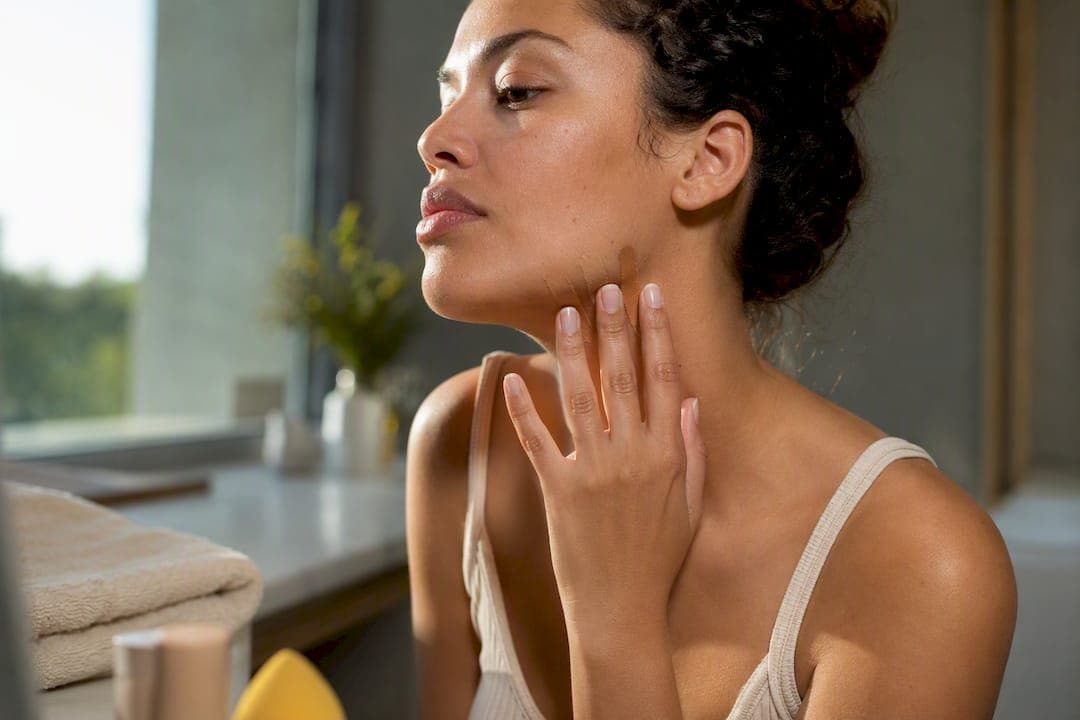
The fastest reliable route to your foundation shade match starts with identifying your undertone and depth, then running that information through a digital shade matcher to narrow the field. From there, validate with the three-stripe jawline test in natural daylight, waiting 20 to 30 minutes for oxidation before you commit. Digital and AI tools speed up discovery, but they still need a real-world swatch check to confirm they got it right.
TL;DR:
- Digital shade matchers provide a good starting point but should be treated as a shortlist due to potential discrepancies caused by lighting, camera calibration, and database differences.
- The three-stripe jawline test in natural daylight with a 20 to 30-minute oxidation period is the most reliable method to confirm foundation shade accuracy.
- Combining undertone tests, including vein color, jewelry preference, and white paper comparison, helps identify correct undertones, especially for olive complexions.
- Choosing the right foundation finish, such as matte for oily skin or dewy for dry skin, can affect how the shade appears on your face, requiring adjustments for slight mismatches.
- Using a hybrid approach that combines digital recommendations with real-world swatch testing offers the highest chance of finding a perfect match, especially when supported by expert advice.
Table of Contents
- How Digital Shade Finders and AI Scans Actually Work
- How Do You Test Your Foundation Shade Match Yourself?
- Getting Photo Scans Right for a More Accurate AI Match
- How to Order Foundation Samples Without Wasting Money
- Why Finish and Formula Change How Your Shade Looks
- What the Data Says About Combining Tech and Touch
- Why the Hybrid Method Beats Pure DIY or Pure Digital
- Get Guided Help Beyond the DIY Routine
- Sources
How Digital Shade Finders and AI Scans Actually Work
Every digital matcher runs on the same basic logic, even when the interface looks different. You feed it information. It gives you back a shade, a confidence level, and sometimes a shortlist of close alternatives.
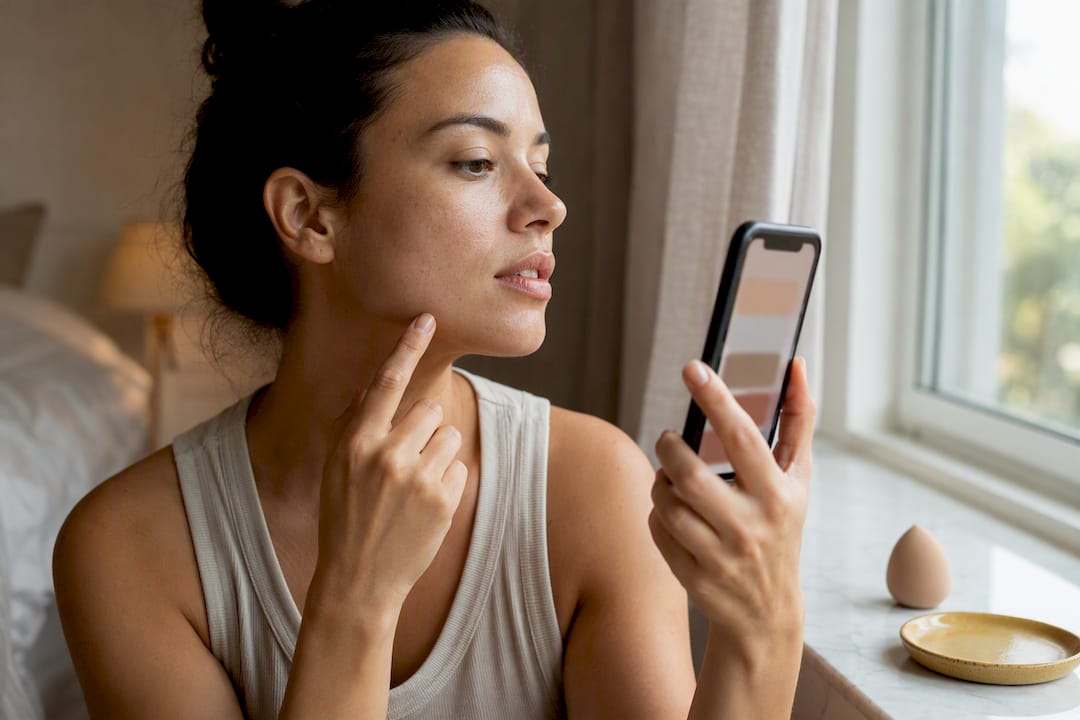
Three formats dominate the space right now. Quiz-based tools ask you questions about your current foundation, your skin's reaction to sun, and how your skin looks in the mirror. Cross-brand converters take a shade you already own and love, then map it mathematically to equivalent shades in other lines using color data and formula composition. One platform built entirely on this model, Match My Makeup, has helped over 5 million people find matches across more than 150 brands using this kind of color science. Then there are AI scan tools, which analyze a selfie or a 360-degree facial scan and generate a suggested shade directly from your skin's pixels.
Here's where it gets interesting: two tools can look at the same face and disagree. That's not a glitch. It happens because:
- Each brand's shade database uses different depth scales and undertone labeling conventions
- Confidence scores reflect how closely your input matches the tool's training data, not how "correct" the answer is
- Camera sensors and screen calibration shift color rendering from phone to phone
- Selfie lighting almost never matches the daylight conditions your foundation will actually be worn in
None of this makes these tools useless. It means you should treat their output as a strong shortlist, not a verdict. L'Oréal Paris's shade finder and similar brand tools are explicit about this: they hand you suggested shades and expect you to confirm the match at home.
How Do You Test Your Foundation Shade Match Yourself?
Digital tools narrow your options. Your skin makes the final call. This is the pro routine makeup artists use before they ever open a bottle on a client's face.
Step 1: Run two undertone tests, not one. The vein test (blue veins suggest cool, green suggests warm, a mix suggests neutral) is a decent starting point, but it's unreliable on its own. Pair it with the jewelry test: gold flatters warm undertones, silver flatters cool, and if both look equally good, you're likely neutral. Add the white paper test: hold white paper next to your bare face in daylight, and see whether your skin reads yellow/golden (warm), pink/rosy (cool), or ashy/grayish against it. If you consistently get contradictory signals across all three, olive is often the missing category. Olive undertones read green or muted next to true warm or cool skin, and they're frequently misclassified as one or the other.
Step 2: Establish your depth before you worry about brand names. Depth is simply how light or dark your skin is, independent of undertone. Most brand shade codes combine both, but marketing names ("Honey," "Porcelain," "Café") vary wildly between brands. Depth and undertone codes are more reliable for cross-referencing than the poetic name on the label.
Step 3: Run the three-stripe jawline test. Buy or sample three candidate shades, ideally the one your digital matcher recommended plus one shade lighter and one darker. Swatch a vertical stripe of each on your jawline, right where your face meets your neck. Go outside or stand near a window in natural daylight.
Step 4: Wait 20 to 30 minutes before deciding anything. Many formulas oxidize as they sit on skin, shifting warmer or darker than they appeared fresh out of the tube. The stripe that "disappears" into your neck after that wait, rather than the one that looked best at minute one, is your match.
Pro Tip: If your face and neck are noticeably different tones, always match to your neck and upper chest, not your face. A face-matched foundation on a lighter neck creates a visible "mask" effect that's obvious at conversation distance, even when it looked perfect in a magnified mirror.
Getting Photo Scans Right for a More Accurate AI Match
An AI matcher is only as good as the photo you feed it. Garbage input, garbage shade recommendation. A few adjustments make a real difference in what the tool returns.
- Shoot in indirect natural daylight near a window, ideally midday. Overhead store lighting and bathroom fluorescents shift undertones toward yellow or blue and will actively mislead the algorithm.
- Skip beauty filters and skin smoothing entirely. They alter pixel color data, which defeats the entire purpose of a color-matching scan.
- Go bare-faced or close to it. Remove old foundation, heavy SPF residue, and facial oil buildup, since all three cast a color layer over your actual skin tone.
- Use your phone's rear camera when possible, since front-facing selfie cameras tend to apply more aggressive automatic color correction.
- Hold steady during a requested 360-degree scan, and keep the same lighting setup if you rescan later to track seasonal changes accurately.
Save your scan results once you get a match you trust. Consistent lighting conditions across scans make it much easier to tell whether your skin has actually changed tone or your camera is just behaving differently that day.
How to Order Foundation Samples Without Wasting Money
Don't order one shade and hope. Order a small spread and let your jawline decide.
- Order three samples: the shade your digital matcher recommended, one shade lighter, and one shade darker. If your undertone reading was ambiguous, order a neutral and a warm or cool variant instead of three depths of the same undertone.
- Run the three-stripe jawline test on all three, then wait 20 to 30 minutes in natural light to account for oxidation before judging any of them.
- Photograph the swatches in daylight and log the brand, exact shade code, and formula type somewhere you'll actually find again later.
- Decide: keep, mix, or return. If two shades are close but neither is perfect, a tint drop or a small mix between the two often solves it faster than ordering a fourth sample. Keep in mind that adding a matte, fuller-coverage product on top of your test swatch can read slightly deeper than a sheer, dewy one in the same shade code.
Why Finish and Formula Change How Your Shade Looks
Getting the color right is only half the job. The finish you choose changes how that color actually reads on your skin.
Matte finishes tend to suit oily skin, since they absorb shine instead of amplifying it. Dewy or hydrating formulas work better on dry skin, where a matte finish can look flat or cakey. Combination skin usually does best with a balanced, semi-matte finish that doesn't fight either extreme.
- A luminous, dewy formula can look slightly lighter or brighter than a matte version of the exact same shade code, purely because of how light bounces off it.
- Matte formulas sometimes oxidize differently than luminous ones in the same shade family, so don't assume identical shade names behave identically across finishes.
- If a shade is close but slightly off in one small area, like around the nose or chin, blending a touch of a second finish or formula there, or setting with a warm-toned powder, can correct it without a full product swap.
What the Data Says About Combining Tech and Touch
The reach of digital tools is genuinely impressive. Millions of people have found workable matches without ever visiting a counter, largely because cross-brand color-matching platforms now have enough product composition data to make solid predictions. But the tools themselves point you back toward physical validation, and that's not a weakness in the technology. It's an acknowledgment that skin, light, and formula chemistry are variables no algorithm fully controls yet.
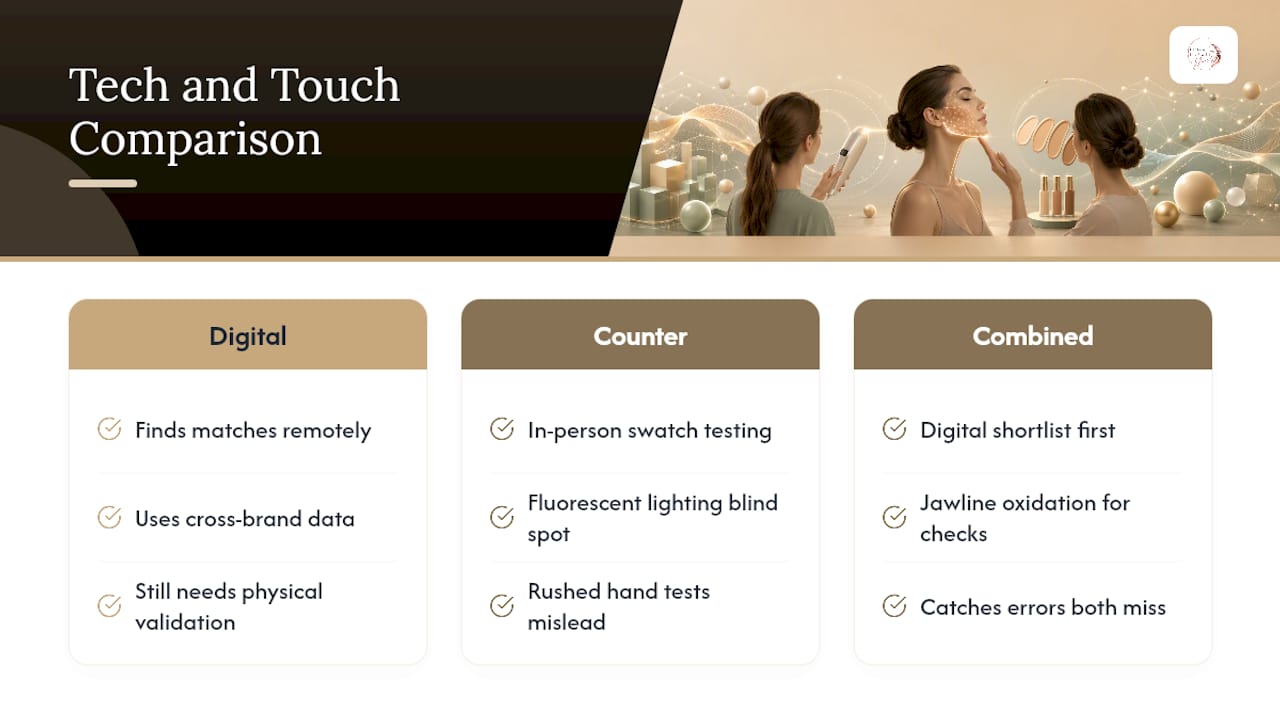
Counter testing alone has its own blind spot: fluorescent store lighting and rushed testing on the back of your hand routinely produce mismatches that only show up once you're home in daylight. Combining a digital shortlist with the jawline oxidation test catches errors both approaches miss on their own.
Pro Tip: If you keep landing between two undertone categories no matter what test you run, search specifically for shades labeled "neutral-olive." Olive skin has a muted green cast that gets lost when forced into a straight warm or cool bucket, and it's one of the most consistently mismatched undertones in the entire shade-matching process.
Why the Hybrid Method Beats Pure DIY or Pure Digital
Most guidance on this topic treats shade matching as an either/or choice: trust the algorithm, or trust your own eye at a counter. Both extremes fail a meaningful number of people. Pure digital matching skips the oxidation and lighting variables that only show up on real skin over time. Pure in-person testing skips the cross-brand data that makes narrowing hundreds of shade options down to three actually manageable.
The conventional wisdom oversells the "one test settles it" idea, whether that test is an AI scan or a single swatch on the hand. Depth and undertone identification deserve more weight than most quizzes give them, because a tool can only narrow options as well as the input you hand it.
If you take one thing from this: prioritize the jawline test and the wait time over how confident any app sounds about its recommendation. A tool's confidence score measures pattern-matching, not your actual skin under actual daylight. Trust the stripe that disappears after 30 minutes over the algorithm that sounded certain in the first five seconds.
— Ava
Get Guided Help Beyond the DIY Routine
Running your own undertone tests and jawline swatches gets you most of the way there. But if you want a second opinion, curated brand recommendations, or someone to help you interpret a confusing scan result, that's where Theultimatebeauty-you fits in.

Theultimatebeauty-you connects you with beauty experts and partner brands who understand shade ranges across formulas, not just one line's naming system. Our platform brings together trusted resources, expert connections, and an upcoming app designed to assist with beauty and shade-matching needs. Save your shade notes, browse our expert and partner network, and explore current resources built for exactly this kind of decision. Start at Theultimatebeauty-you and see what guided support looks like next to the DIY routine.
Sources
- Match My Makeup | How does our foundation shade matcher work?
- Test Foundation Shade at Home: Pro Matching Guide
- Foundation Shade Finder: Your Exact Match, Step by Step | L'Oréal Paris