

Start with a few simple exercises today: a strengths inventory, a short evidence-based affirmation practice, and a brief gratitude entry before bed. Each takes only a few minutes. Do them daily, not sporadically, and expect small, noticeable shifts in your self-talk within a couple of weeks, with steadier confidence building over time.
TL;DR:
- Small, daily exercises like strengths inventories and gratitude logs can lead to noticeable confidence improvements within a few weeks.
- Combining cognitive exercises such as thought reframing with behavioral actions, like boundary setting, produces more consistent self-esteem gains.
- Using specific facts in affirmations and completing quick, honesty-based thought records helps undermine negative beliefs effectively.
- Tracking progress weekly through mood ratings, wins, and boundary adherence fosters sustained growth and awareness of patterns.
- If low self-esteem significantly hampers daily functioning or worsens, seeking professional help is crucial, especially when thoughts of self-harm or withdrawal occur.
Table of Contents
- Self Esteem Exercises You Can Start in the Next 10 Minutes
- Worksheets and Templates You Can Use Right Now
- How Do You Do CBT-Style Reframing Correctly?
- What Does a 30-Day Self-Esteem Practice Actually Look Like?
- When Should You Seek Professional Help Instead?
- Ava's Perspective: Practice That Fits a Real Life
- How Theultimatebeauty-you Supports the Work Between Exercises
- Sources
Self Esteem Exercises You Can Start in the Next 10 Minutes
Confidence rarely arrives in one dramatic breakthrough. It builds through small, repeated actions, and NHS guidance on raising low self-esteem backs that up: combining cognitive work (how you think) with behavioral work (what you do) produces steadier results than either alone. Here are eight self esteem exercises, ordered from fastest win to deepest work.
- Strengths inventory. List several things you do well, no matter how small. Why it works: most women underestimate their own competence until they see it written down.
- Evidence-based affirmation (90 seconds). Instead of "I am confident," try "I handled a hard conversation well last Tuesday." Specific, provable statements land better than generic ones.
- One-line gratitude log. Write one thing that went right today. Consistency matters more than length.
- Achievement journal. Note one accomplishment, even a tiny one, before you sleep.
- Values check-in. Ask: did today's actions match what I actually care about?
- Self-respect audit prompt. Identify one moment this week your boundaries were crossed and how you responded.
- Power pose primer. Standing tall briefly before a stressful moment is a quick mood primer some people find useful, though the research behind it is mixed. Treat it as a short-term nudge, not a fix.
- Behavioral activation step (10 minutes). Do one small task you've been avoiding. Momentum builds self-trust faster than thinking does.
Pro Tip: Affirmations only work when your brain believes them. If "I'm amazing" feels hollow, replace it with a fact your brain can't argue with, like "I finished that project on time." Specific beats grand every time.
Worksheets and Templates You Can Use Right Now
Writing things down changes how your brain processes them. Psychology format, built around strengths inventories and thought reframing, is one of the most widely used tools in this space because it turns vague self-doubt into something you can edit.
Here's what to build and how often to revisit each one:
- Strengths inventory template: Five columns labeled Skill, Evidence, When I Used It, Who Noticed, How It Helped. Fill it once, then add one entry weekly.
- CBT thought record: Four columns: Situation, Automatic Thought, Evidence For/Against, Balanced Reframe. Use it whenever a self-critical thought hits hard, not on a fixed schedule.
- Self-Respect Audit worksheet: List five life areas (work, family, friendships, romantic relationships, self-talk). For each, ask: "Where did I let a boundary slide this week, and what will I do differently next time?"
- 7-day tracker: A simple grid with mood rating (1 to 10), one win, and one boundary held, filled daily and reviewed every Sunday.
HelpGuide's self-esteem guide points to recognizing strengths and practicing self-kindness as two of the most consistently effective self-help strategies, and both map directly onto the templates above. Review your tracker weekly rather than daily. Daily review of raw data feels like grading yourself; weekly review feels like noticing a pattern.
How Do You Do CBT-Style Reframing Correctly?
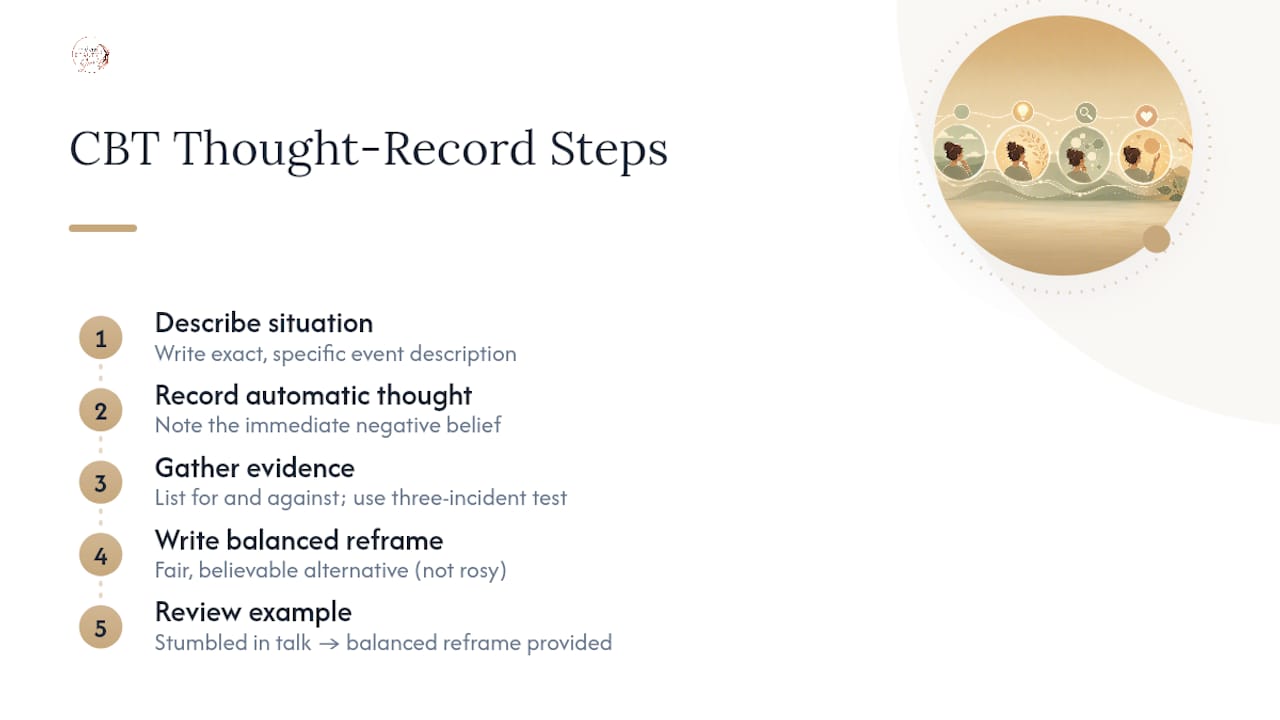
Thought records only work if you fill them out honestly, not optimistically. The steps below follow the structure Mayo Clinic recommends: identify the negative belief, then challenge it directly rather than trying to think positive over it.
Step 1: Write the situation exactly as it happened. Not "I failed," but "I sent an email with a typo in it." Specificity keeps you from spiraling into global judgments.
Step 2: Record the automatic thought. Usually something like "Everyone thinks I'm careless" or "I always mess this up."
Step 3: Gather evidence for and against it. This is where most people skip steps and stay stuck. A useful rule: apply the three-incident test. Can you name three separate times, this month, where the opposite was true? If your automatic thought says "I always mess up," and you can list three recent tasks you completed cleanly, the thought loses its grip. This objective evidence gathering directly undermines the attributional bias that keeps low self-esteem locked in place, because the mind tends to remember failures more vividly than routine successes.
Step 4: Write a balanced reframe, not a rosy one. "I made one typo in an otherwise solid email" beats "I'm perfect," because your brain can actually accept it.
Example entry: Situation: presented in a meeting and stumbled over a sentence. Automatic thought: "I sounded incompetent." Evidence against: two colleagues followed up with questions afterward, which people rarely do for a presentation they dismissed. Balanced reframe: "I stumbled once in a ten-minute talk that people still engaged with."
Inner critic mapping works alongside thought records. For one week, log every time your inner critic speaks up: the trigger, the emotion, the physical sensation (tight chest, clenched jaw), and one alternative response you could try next time. Patterns show up fast. Most people find their inner critic has two or three favorite triggers, not dozens.
Values-to-actions work rebuilds identity from the outside in. Pick one core value (honesty, creativity, connection) and prescribe yourself one tiny action that expresses it this week, like texting a friend you've been meaning to reach or speaking up once in a meeting you'd normally stay quiet in. Peer-reviewed research on self-related constructs supports cognitive and behavioral interventions like these as legitimate mechanisms for shifting self-view over time, not just feel-good exercises. For people who function well on paper but privately doubt themselves, aligning daily behavior with stated values tends to shrink that gap faster than more thinking does.
Pro Tip: Keep your thought record entries under three sentences each. Long entries turn into venting sessions instead of evidence-gathering, and venting rarely changes the belief underneath.
What Does a 30-Day Self-Esteem Practice Actually Look Like?
Structure beats intensity. A realistic month looks like this:
- Days 1 to 7: Strengths inventory plus one gratitude line daily (5 to 8 minutes). Goal: build the habit, not the insight.
- Days 8 to 14: Add the CBT thought record whenever a hard moment hits (10 to 15 minutes as needed). Goal: catch automatic thoughts in real time.
- Days 15 to 21: Introduce the Self-Respect Audit once, then one values-aligned tiny action daily (5 to 10 minutes). Goal: connect self-talk to real behavior.
- Days 22 to 30: Full 7-day tracker with weekly review. Goal: notice trends, not single days.
Every Sunday, check three things: your average mood rating, two concrete wins from the week, and whether any boundary got held instead of crossed.
| Week | Focus | Daily Time |
|---|---|---|
| 1 | Strengths and gratitude | 5-8 minutes |
| 2 | Thought records | 10–15 minutes |
| 3 | Self-respect and values | 5–10 minutes |
| 4 | Full tracking and review | 10–15 minutes |
If a thought record surfaces something heavier than expected, a memory, a grief, a pattern tied to a past relationship, pause the exercise and give yourself space before returning to it. The goal is steady progress, not forcing every hard feeling to surface on a schedule.
When Should You Seek Professional Help Instead?
Exercises like these help with everyday self-doubt, but they aren't built for everything. Watch for these red flags:
- Low self-esteem is interfering with work, school, or relationships in a way that's getting worse, not better.
- Persistent thoughts of self-harm or feeling like life isn't worth living.
- Significant withdrawal from people or activities you used to care about.
- No improvement after several weeks of consistent, honest practice.
If any of these apply, look for a therapist trained in cognitive behavioral therapy, or start with a primary care provider for a referral. If you're in crisis, contact a crisis line or emergency services immediately rather than waiting on a worksheet to help.
Ava's Perspective: Practice That Fits a Real Life
What strikes me most about this work is how undramatic it looks day to day. A five-minute strengths list doesn't feel like progress in the moment. It only becomes visible weeks later, when you notice you spoke up in a meeting without rehearsing it first, or caught a self-critical thought before it spiraled. That's the realistic outcome: quieter mornings, fewer spirals, not a personality transplant. The idea is that becoming happens in small, repeated acts, not one grand overhaul. Pair these exercises with a self-care routine that already fits your week, and the habit sticks longer than either practice would alone.
— Ava
How Theultimatebeauty-you Supports the Work Between Exercises
A worksheet gets you started, but staying consistent for 30 days is easier with a community that expects you to show up, not just a page you close and forget. This is a women-centered platform built around exactly that kind of ongoing support, connecting you with experts, resources, and other women working through the same inside-out growth.

If confidence work has felt like something you start over and over without traction, structured support changes that pattern more than another checklist ever will. Beyond the exercises here, the platform offers confidence-building habits that pair naturally with your 30-day tracker, plus a growing library of tools on the products page for readers who want more structure than a worksheet alone provides. A gentle body-care habit, like the kind explored in this facial massage research, can round out a self-esteem practice that already covers mind and behavior.
Visit Theultimatebeauty-you to see what's available now, and check the For Women page for a closer look at how the community fits into your week.