

Start with three channels: national platforms like Lean In Connect and eWomenNetwork, local chapters through groups like Cobb Women in Business, and industry-specific peer groups tied to your field. The one rule that saves you months of wasted meetings: match the group's meeting format and cadence to your actual goal. Want mentorship? Look for small recurring Circles. Want referrals? Look for chapter-based networks with regular events. Want skill-building? Look for structured programming with speakers and workshops.
Here's your first move, today:
- Search Lean In Connect for a Circle in your city or industry.
- Check your local chamber of commerce or association event calendar for this month's listings.
- Register for one virtual meeting this week, no commitment required, just to see the format.
Key Takeaways
The fastest path to a valuable women's networking group is matching meeting format and cadence to your specific goal, then evaluating fit before paying any fee.
| Point | Details |
|---|---|
| Start with three channels | Search national platforms, local chapters, and industry groups before committing to one format. |
| Match format to goal | Choose Circles for mentorship, chapters for referrals, industry groups for sector leads. |
| Vet before joining | Check meeting cadence, format, fees, and a named leader contact on the group's page. |
| Prepare for the format | A 20 to 30 second intro and one measurable goal make your first event count. |
| Prioritize relationships | Follow-ups, small value exchanges, and volunteering outperform direct pitching. |
Table of Contents
- What Types of Women Networking Groups Should You Consider?
- How Do You Find Women's Networking Groups Near You?
- How Do You Choose the Right Networking Group for You?
- How Do You Register for and Prepare for Your First Event?
- How Do You Turn Networking Connections Into Real Opportunities?
- Which Trusted Groups Should You Know About?
- What Do Women's Networking Groups Typically Cost?
- What Event Formats Should You Expect?
- How Do Women's Networking Groups Support Diversity and Inclusion?
- What Challenges Come Up in Women's Networking Groups?
- Get More Than Networking: Community That Grows With You
- What the Research Actually Tells You to Prioritize
- Frequently Asked Questions
- Sources
What Types of Women Networking Groups Should You Consider?
Not every group serves the same purpose, and picking the wrong format wastes your time. Peer Circles, popularized by Lean In, typically run 8 to 12 women who meet regularly for accountability and honest feedback. That size is intentional. Small enough for trust, large enough for perspective.
National networks with local chapters, like eWomenNetwork or Cobb Women in Business, work differently. They're built for scale, referrals, and events. You get access to a bigger pool of contacts, but the relationships take longer to deepen.
Industry-specific peer groups, such as ACG St. Louis's Women's Peer Group, concentrate on sector expertise and leads within your field. Virtual networks solve a different problem entirely: they remove geography as a barrier, letting you connect across time zones on your own schedule.
- Peer Circles: best for mentorship and accountability.
- National chapter networks: best for referrals and scale.
- Industry groups: best for sector-specific leads.
- Virtual networks: best for flexibility and reach.
Pro Tip: Join one Circle-style group and one larger chapter network at the same time. The small group builds depth; the large one builds breadth. You need both.
How Do You Find Women's Networking Groups Near You?
Finding the right group isn't about luck. It's about knowing where the good ones list themselves and what to look for once you find them.
Start with national platforms built specifically for this. Lean In Connect combines Circles, broader Networks, and a resource library in one place, so you can search by location or interest and land on both a small group and meeting guides in the same visit. eWomenNetwork operates chapter-based programming across North America with CEO mentoring built into its events, useful if you're further along in your career and want peer-level connections.
From there, widen your search:
- Check general event platforms like Eventbrite and Meetup for "women networking group + [your industry]" listings.
- Visit your local chamber of commerce site for member-only or public networking calendars.
- Search professional association pages directly. Groups like ACG St. Louis list structured events with clear formats and schedules.
- Look at city-scale communities like Boston Business Women, which blend an active online group with frequent in-person and virtual sessions.
- Sign up for newsletters from two or three groups that interest you, since many events fill fast and get announced there first.
Professionals often find better matches by filtering for region or industry alignment rather than running generic searches, since a chapter tied to your city or field tends to produce sharper referrals than a broad national scroll.
Before you commit to any group, scan its page for four signals:
- Meeting cadence: weekly, monthly, or quarterly.
- Format: Circle, speed networking, mixer, or workshop.
- Fee structure: free, paid, or tiered.
- Leader contact: a named person you can actually email.
If a group's page is missing all four, that's your answer. Move on.
How Do You Choose the Right Networking Group for You?
Every group looks appealing on its landing page. The difference between a good fit and a wasted year shows up in the details.
Run this checklist before joining anything:
- Does the group's stated purpose match your specific goal (mentorship, referrals, or skill-building)?
- Does the member profile resemble your industry, career stage, or region?
- Is the group small enough for real conversation, or large enough for volume?
- What's the actual format: recurring Circle, chapter meeting, or one-off event?
- Who leads it, and can you find that person's name and contact easily?
- What does it cost, and is there a refund or transfer policy if it's not a fit?
Ask these questions directly, either in an intro call or at your first meeting:
- How many members typically attend a session?
- What happens after the first meeting, is there a next step or application?
- How are introductions or referrals facilitated, if at all?
- Is there a trial period or guest visit before paying?
Watch for red flags. No clear contact person, a high-pressure ask to pay before you've seen a single session, or fee structures that are vague or buried in fine print. Legitimate groups, from Cobb Women in Business to smaller regional chapters, list their pricing and membership tiers openly.
Speaking of tiers: many organizations run a free or digital-access level alongside a paid "insider" tier, which usually comes with early registration windows and event discounts. That structure isn't a scam. It's how most sustainable groups fund their programming, and it's worth paying for once you know a group delivers real value.
How Do You Register for and Prepare for Your First Event?
Getting in the door is only step one. Showing up prepared is what actually pays off.
- Register as early as possible. Popular events fill quickly, and groups with insider or member tiers often open registration to paying members first.
- Watch the group's newsletter or email list closely in the week before an event. Last-minute spots and waitlist openings usually go to whoever responds fastest.
- Write and practice a 20 to 30 second introduction that names what you do and one specific thing you're looking for, not a vague "always open to connecting."
- Set one measurable goal for the event: three new contacts, one mentor conversation, one referral lead.
- Polish your LinkedIn or relevant social profile before you go. People will look you up within the hour.
- Follow up with every meaningful contact within 48 to 72 hours, while the conversation is still fresh.
Pro Tip: If a structured event like a speed-networking session offers a prep call beforehand, take it. Knowing the exact format ahead of time, as ACG St. Louis structures its events, lets you craft sharper questions instead of fumbling through your first few conversations.
How Do You Turn Networking Connections Into Real Opportunities?
The biggest mistake in any women's networking group is treating it like a sales floor. Long-term members consistently say the opposite approach works better: build the relationship first, and the referrals follow on their own timeline.
Small, low-pressure actions build trust faster than a pitch ever will:
- Send a short follow-up message referencing something specific from your conversation.
- Share an article, contact, or resource that helps the other person, with nothing asked in return.
- Offer an introduction before you ask for one.
Use a simple tracking system so contacts don't disappear into your inbox. A basic note, a follow-up date, and a next action, tracked in a spreadsheet or lightweight CRM, is enough to keep dozens of relationships moving without feeling like a chore.
Experienced members and group leaders report that relationship-first behavior produces more sustainable referrals than immediate pitching. Volunteering to present, host a breakout session, or help organize an event multiplies your visibility inside the group. You go from "new face" to "person everyone recognizes" in a fraction of the time.
Which Trusted Groups Should You Know About?
A handful of organizations consistently show up as reliable starting points, each solving a slightly different need.
- Lean In: small Circles of 8 to 12 women for recurring peer support, plus a Connect platform with meeting guides.
- Cobb Women in Business: regional chapters with structured meeting schedules and free plus paid insider tiers.
- ACG St. Louis Women's Peer Group: structured speed-networking events with clear schedules and prep calls.
- eWomenNetwork: a large national network with chapter programming and entrepreneur mentoring.
- Boston Business Women: a city-scale community mixing in-person and virtual events with an active online group.
Theultimatebeauty-you complements every option above rather than competing with it. The platform connects women with vetted experts, brands, and a growing community built around confidence, wellness, and personal growth, the layer that supports you between networking events. If a Circle gives you accountability and a chapter gives you referrals, a community like this gives you the resources and expert access to act on what you learn.
| Resource | Best For |
|---|---|
| Lean In Circles | Small-group mentorship and accountability |
| Cobb Women in Business | Regional chapter meetings and tiered membership |
| ACG St. Louis | Structured, sector-specific speed networking |
| eWomenNetwork | National scale and entrepreneur mentoring |
| Boston Business Women | City-wide events plus online community |
What Do Women's Networking Groups Typically Cost?
Membership costs vary widely depending on structure, but the pattern across most reputable groups is consistent: a free or low-cost entry tier, plus a paid tier that unlocks priority access.
Peer Circles through platforms like Lean In are typically free to join, since the model relies on volunteer facilitators and a shared resource library rather than paid staff. Regional chapter organizations, such as Cobb Women in Business, commonly run modest annual membership fees, often in the range of a nice dinner out, with an Insider tier that adds registration priority and event discounts on top.
Larger national networks and city-scale communities tend to charge per-event fees on top of, or instead of, annual dues. A single structured event, like a speed-networking session, might run a flat registration fee that covers the venue, materials, and sometimes a reception afterward.
Registration practices follow a common rhythm. Announcements go out to email subscribers first, insider or paid members get early access windows, and general registration opens to the public closer to the event date. Popular sessions can fill within days, which is exactly why monitoring a group's newsletter matters more than checking its website sporadically.
Before paying anything, confirm whether the group offers a free trial visit or guest pass. Most well-run organizations do, precisely because they want you to experience the room before committing your money.
What Event Formats Should You Expect?
Walking into an unfamiliar format is the fastest way to feel lost. Knowing what's coming changes everything.
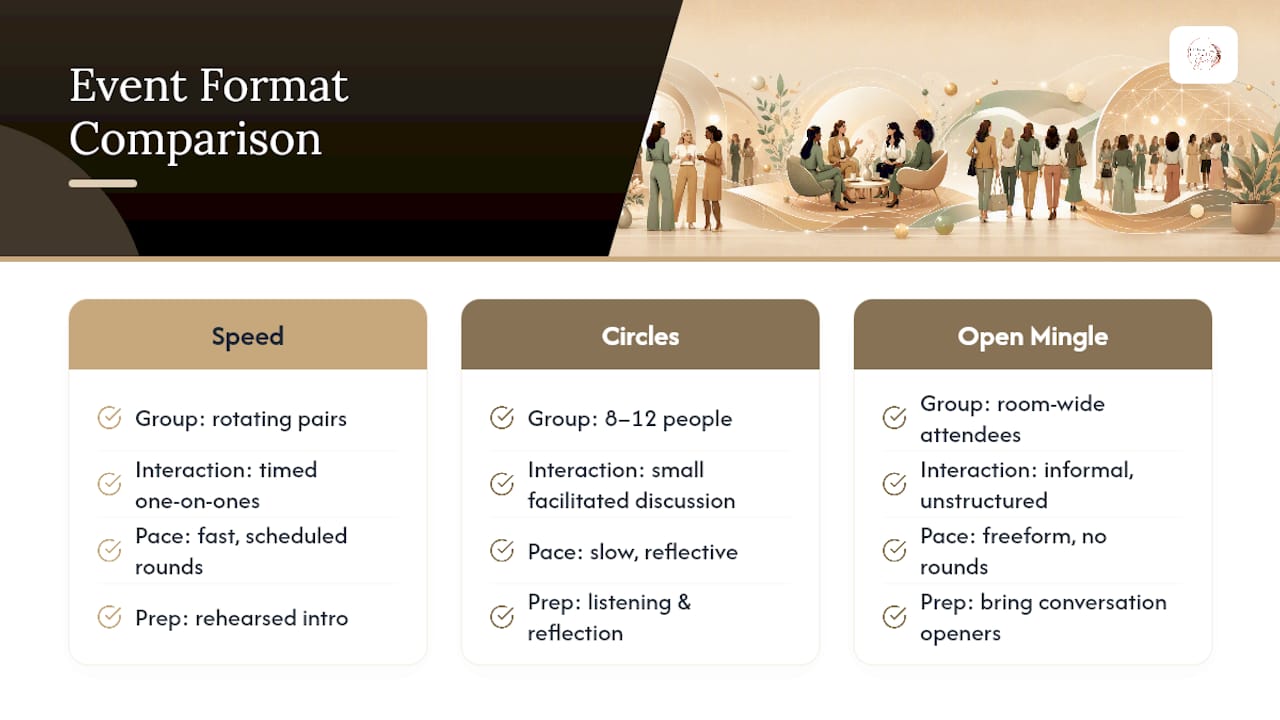
Speed networking structures the room into timed one-on-one conversations, often just a few minutes each, before rotating to the next person. ACG St. Louis runs its Women's Peer Group events this way, with a clear schedule: arrival, timed conversation rounds, then open reception time. Some sessions even offer a preparatory call beforehand, which is worth taking if it's available.

Facilitated circles are the opposite of speed and volume. A small group, often the standard 8 to 12 members you'll find in Lean In Circles, meets with a loose agenda or discussion prompt, and a facilitator keeps the conversation focused and equitable so no one voice dominates.
Open mingles are the least structured format: a room, refreshments, and no assigned conversation partners. These work best once you've built some comfort with networking, since they reward people who can approach strangers confidently. If you're newer to this, pair an open mingle with a wingwoman or arrive early when the room is smaller.
Knowing the format in advance shapes how you prepare. A speed-networking event calls for a tight, rehearsed introduction. A facilitated Circle calls for genuine reflection and listening. An open mingle calls for a handful of easy conversation openers ready to go.
How Do Women's Networking Groups Support Diversity and Inclusion?
Women's networking groups exist, at their core, as a response to structural gaps: fewer women in senior leadership, fewer informal referral pipelines, fewer rooms where women set the agenda. Closing that gap is baked into how these groups operate.
Many chapters actively recruit across industries, career stages, and backgrounds rather than clustering around a single sector, which widens the referral pool and exposes members to perspectives outside their usual circle. Groups like eWomenNetwork build entrepreneur-focused programming specifically because women-owned businesses have historically had less access to capital, mentorship, and visibility than their peers.
Facilitated formats, like Lean In Circles, also serve an inclusion function structurally. A trained facilitator in a small group setting ensures quieter members get airtime and dominant voices don't crowd out newer participants. That's a deliberate design choice, not an accident.
Local and regional chapters extend this further by lowering the barrier to entry. A city-based group with modest dues and flexible meeting times is far more accessible to a woman balancing caregiving responsibilities or a nontraditional work schedule than a national conference requiring travel and time off. Virtual networks push that accessibility even further, removing geography entirely as a barrier to participation.
What Challenges Come Up in Women's Networking Groups?
Even good groups have friction points, and knowing them in advance helps you navigate around them instead of quitting after one bad meeting.
The most common complaint is mismatch: joining a group whose format or member profile doesn't fit your actual goal. A woman looking for deep mentorship who joins a large mixer-style network will likely feel unseen. The fix is the same evaluation checklist covered earlier, applied before you pay any fee, not after.
Inconsistent attendance is another recurring issue, especially in smaller Circles where the whole model depends on the same faces showing up regularly. If members drop off, the group loses momentum fast. Ask directly during a trial visit how the group handles attrition and whether there's a waitlist of new members ready to fill gaps.
Cost and access can also be barriers, particularly for insider tiers that gate the best events and referral opportunities behind a paywall. If budget is tight, start with free tiers or Circles, which cost nothing, and reassess a paid tier once you've confirmed the group delivers value.
Finally, some groups drift toward transactional pitching rather than genuine relationship-building, which burns out members fast. If a group feels more like a sales floor than a community, that's a sign to look elsewhere, not a sign that networking itself doesn't work for you.
Get More Than Networking: Community That Grows With You
Networking groups give you contacts. They don't always give you the fuller support system that makes a career, and a life, actually feel sustainable. That's where Theultimatebeauty-you steps in as a complement, not a replacement.
Theultimatebeauty-you connects women with vetted experts and partners across beauty, wellness, and personal growth, alongside a community built specifically around confidence and becoming your fullest self. If you're a beauty industry professional, resources like the beauty summit networking guide or social media growth strategies for beauty experts pair naturally with the connections you build in a professional network. And if you're weighing how a women-centered community fits alongside traditional networking, the women's community platform guide walks through exactly that.
Explore what's available through Theultimatebeauty-you's platform, or reach out directly to learn how the community fits into the network you're already building.
What the Research Actually Tells You to Prioritize
The conventional advice on this topic treats networking groups like a checklist: join more, attend more, collect more contacts. That's backwards. The groups that actually move careers forward are the ones where the format matches your specific goal, not the ones with the biggest membership numbers.
Where most guides fall short is treating national platforms and local chapters as competing choices. They're not. A Lean In Circle and a Cobb Women chapter serve entirely different functions, and the strongest networkers use one for depth and the other for breadth simultaneously.
If you take one thing from this: stop evaluating groups by size or prestige, and start evaluating them by cadence and format against your actual goal. A monthly mentorship Circle will outperform a massive quarterly mixer if mentorship is what you need. Prioritize the evaluation checklist over the impulse to join everything at once. Quality of fit beats quantity of memberships, every time.
Frequently Asked Questions
What are the best women's networking groups to start with? Lean In Circles work well for mentorship in a small group, while eWomenNetwork suits entrepreneurs wanting national scale and referrals. Regional chapters like Cobb Women in Business fit women who want consistent local meetings.
How do I find women's networking groups near me? Search Lean In Connect and eWomenNetwork chapter directories first, then check Eventbrite, Meetup, and your local chamber of commerce for listings tied to your city.
Are women's networking groups free to join? Many are free at the entry level, particularly peer Circles, while chapter organizations and national networks often charge modest annual dues or per-event fees with a paid insider tier for priority access.
How often do women's networking groups meet? It varies by group. Circles typically meet monthly, chapter networks often hold events weekly to quarterly, and large national organizations run a mix of virtual sessions and in-person conferences throughout the year.
What should I say at my first women's networking event? Prepare a 20 to 30 second introduction covering what you do and one specific thing you're seeking, whether that's a mentor, a referral, or a particular type of connection.
Sources
- Lean In - Frequently asked questions
- Cobb Women in Business
- 2026 STL | Women's Peer Group Speed Networking Event | ACG St. Louis
- eWomenNetwork
- Boston Business Women - Networking for Successful Female Professionals