

The best first step when someone is upset is to be present and listen, then offer one concrete act of help. You don't need perfect words. You need presence, a calm voice, and the willingness to stay.
Three things you can do right now:
- Sit with them. Put your phone down. Breathe slowly. Your steady presence signals safety before a single word is spoken.
- Say one validating phrase. Try: "I'm here. You don't have to go through this alone." That's enough to start.
- Offer something specific. Not "let me know if you need anything" but "I can bring you dinner tonight at 6" or "I'll stay on the phone as long as you need." Specific offers reduce decision fatigue and produce real help.
If the person may be in crisis, call or text 988 (the Suicide and Crisis Lifeline) or call 911 for immediate danger. SAMHSA confirms that supportive conversations matter, but trained crisis counselors are available 24/7 when the situation exceeds what a friend can handle.
Key Takeaways
Comforting someone well comes down to five things: presence, validation, one concrete offer, consent, and knowing when to escalate.
| Point | Details |
|---|---|
| Lead with presence | Sit with them, slow your breathing, and say "I'm here" before anything else. |
| Validate before advising | Reflect feelings back first; advice lands only after the person feels understood. |
| Make specific offers | Concrete offers like "I can bring dinner soon" produce more real help than general statements like "let me know if you need anything." |
| Ask before touching | Consensual touch raises oxytocin and reduces stress; always ask permission first. |
| Escalate when needed | Call or text 988 for mental-health crises; call 911 for immediate physical danger. |
| Theultimatebeauty-you | Ongoing wellness resources, expert guidance, and community support are available at the platform for sustained care beyond the immediate moment. |
Table of Contents
- How to comfort people in the first few minutes
- Active listening: how to make someone feel truly heard
- Exact phrases to use for grief, anxiety, failure, and breakups
- How to comfort someone over text, phone, or video
- How to recognize a crisis and what to do next
- Why presence, listening, and touch actually work
- What not to say: phrases that backfire and what to use instead
- How to support someone without losing yourself
- What being present actually costs — and why it's worth it
- Find ongoing wellness support at Theultimatebeauty-you
- Sources
How to comfort people in the first few minutes
The opening minutes set the emotional tone for everything that follows. Move through this sequence and you'll avoid the most common mistakes.
- Arrive quietly. Reduce noise, sit at their level, and soften your posture. A tense body communicates urgency; a relaxed one communicates safety.
- Validate before anything else. Say what you see: "You look really shaken. That makes complete sense."
- Ask permission before you act. Before touching, advising, or problem-solving, ask: "Is it okay if I sit closer?" or "Do you want me to listen, or would it help to think through options?"
- Offer one concrete thing. Mental Health America notes that small, specific acts like check-ins and practical help often have measurable positive effects. Meals, errands, and simply staying nearby count.
- Stay until the acute moment passes. You don't need to fix anything. Presence is the intervention.
Two quick examples of how this plays out:
Your friend just got devastating medical news. You arrive, sit beside her, and say: "I'm so sorry. I'm not going anywhere." You don't ask what happened yet. You let her lead.
A coworker is visibly distressed after a meeting. You step outside with her, lower your voice, and say: "That looked really hard. Do you want to talk, or just take a minute?" You follow her cue.
Pro Tip: Read the room before reaching out physically. A hand on the shoulder can feel grounding to one person and intrusive to another. Ask first: "Would a hug help right now?" That one question protects the other person's sense of control.
Active listening: how to make someone feel truly heard
Most people instinctively try to fix problems. Therapists consistently find that advice lands better only after the person feels understood; rushing to solutions often leaves someone feeling dismissed. Active listening is the skill that closes that gap.
Core techniques:
- Reflective listening. Mirror back what you heard: "So it sounds like you're feeling completely overwhelmed and unsure where to turn."
- Minimal encouragers. Small signals like "mm-hmm," "I hear you," and "go on" keep the person talking without redirecting.
- Open-ended questions. "What's been the hardest part?" opens more than "Are you okay?"
- Summarizing. After a few minutes, reflect back the whole picture: "It sounds like the job loss hit hard, and the timing makes it even worse."
The Psychology Today "Four States of Distress" model offers a useful framework: people cycle through shock, not-ready-to-feel-better, ready-to-feel-better, and ready-for-solutions. Match your response to their state. Someone in shock needs presence, not perspective. Someone ready for solutions will feel frustrated if you only validate.
| Say this | Not this |
|---|---|
| "That sounds really painful." | "At least it wasn't worse." |
| "Tell me more about what happened." | "Here's what you should do…" |
| "Your feelings make total sense." | "I know exactly how you feel." |
| "I'm here for whatever you need." | "Everything happens for a reason." |
| "What's been the hardest part?" | "You'll get through this, trust me." |

When you're unsure whether to keep listening or gently shift toward problem-solving, ask directly: "Do you want me to just listen, or would it help to think through next steps together?" That single question prevents the most common mismatch in support.
Exact phrases to use for grief, anxiety, failure, and breakups
Scripts aren't scripts in the robotic sense. They're starting points that free you from the paralysis of not knowing what to say.
For grief and loss:
- "I'm so sorry. There are no words. I'm just here."
- "You don't have to be strong right now."
- "Tell me about them, if you want to." (Invites memory without pressure.)
For anxiety or panic:
- "You're safe. I'm right here with you."
- "Let's breathe together. In for four, out for four."
- "What would feel most helpful right now?"
For job loss or failure:
- "That's a real loss, and it's okay to feel awful about it."
- "You don't have to have it figured out today."
- "I believe in you, and I'm not going anywhere."
For a breakup:
- "Breakups hurt. Full stop. You don't need to minimize this."
- "What do you need most right now — to vent, distract, or just not be alone?"
For small daily disappointments (don't underestimate these):
- "That's genuinely frustrating. I get it."
- "Want to talk it through, or just decompress together?"
A short roleplay: You say, "That sounds really hard." She says, "I just feel like such a failure." You respond: "That feeling makes sense after what happened. Can you tell me more about what's going through your mind?" You've opened the door without rushing to reassure. That's the move.
Guideposts and similar support communities consistently highlight that practical gestures alongside words, like bringing a meal or walking someone's dog, carry real weight. Words open the door; actions keep it open.
How to comfort someone over text, phone, or video
Remote comfort works. The CDC confirms that presence, open-ended questions, and closing with connection translate across text, phone, and video when the medium fits the person's needs.
Choosing the right format:
- Text works for initial check-ins, low-pressure follow-ups, and when the person needs space but wants to know you're thinking of them.
- Phone works when tone matters and the person needs to hear a calm voice.
- Video works when the person is isolated and needs to see a face.
Text templates you can copy:
- "Hey. I heard what happened. I'm thinking of you. No need to respond — just wanted you to know."
- "Checking in. How are you holding up today?"
- "I'm free Thursday evening if you want to talk or just hang. No pressure either way."
Phone and video tips:
- Open with presence, not questions: "I just wanted to call and be here for a minute."
- Slow your own voice down. A calm, measured tone helps regulate the other person's nervous system.
- Avoid multitasking. They can hear it.
- End with a plan: "I'll check in again Friday. Is that okay?"
Dos and don'ts for remote comfort:
- Do keep messages brief and low-pressure.
- Do follow up. One text is kind; a second one a few days later shows you mean it.
- Don't send unsolicited advice in a text thread.
- Don't go silent after the first message and assume they're fine.
How to recognize a crisis and what to do next
Some moments go beyond what a friend can handle alone. Knowing the difference protects both of you.
Red flags to watch for:
- Talking about suicide, self-harm, or feeling like a burden to others
- Giving away possessions or saying goodbye in unusual ways
- Extreme disorientation, inability to care for themselves
- Sudden calm after a period of severe distress (can signal a decision has been made)
If you see these signs, follow this sequence:
- Stay with them. Don't leave them alone.
- Ask directly. "Are you thinking about hurting yourself?" Asking does not plant the idea; it opens the door.
- Remove access to means if possible and safe to do so.
- Call or text 988 for immediate mental-health crisis support. Chat is also available at 988lifeline.org.
- Call 911 if there is immediate physical danger.
- Contact a trusted person in their life who can help share the responsibility.
SAMHSA is clear: supportive conversations are meaningful, but they are not a substitute for professional care. You cannot force someone into treatment, but you can stay present, keep them safe, and connect them to trained help.
HelpGuide's trauma-informed guidance adds: avoid retraumatizing questions, offer practical support, and encourage professional care when the situation calls for it.
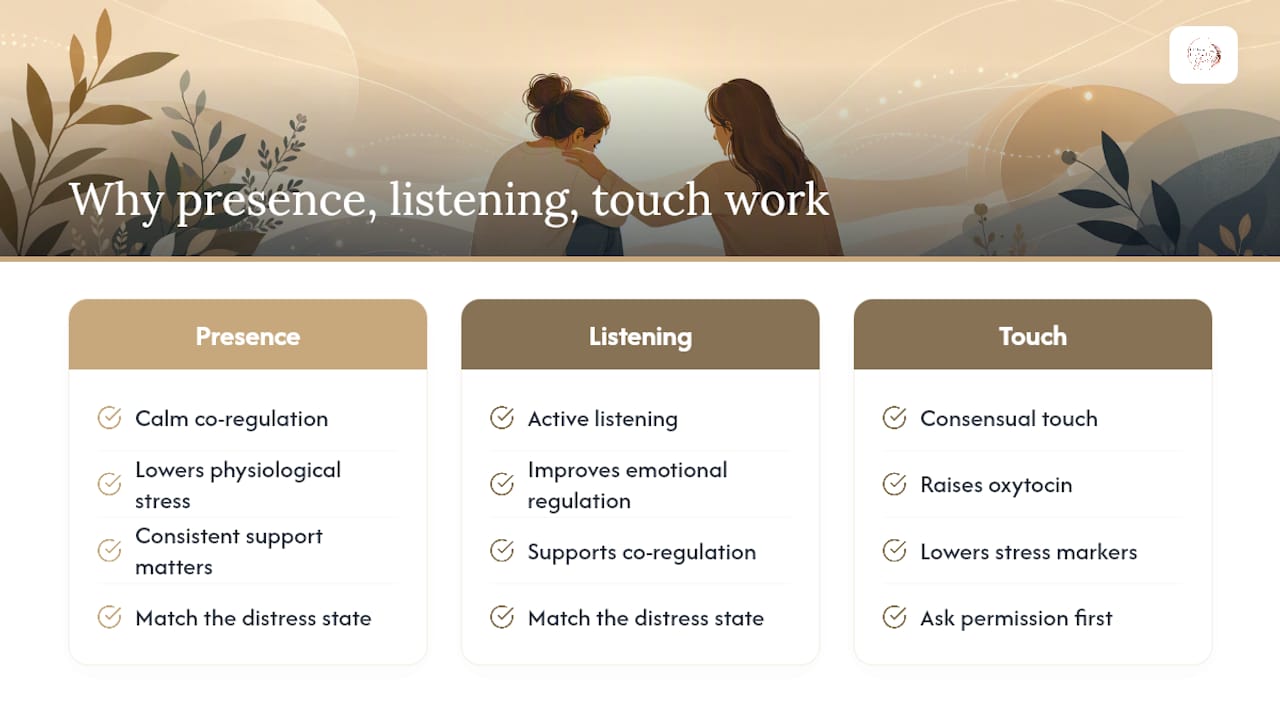
Why presence, listening, and touch actually work
The practical advice in this guide isn't intuition. It's grounded in how the nervous system responds to human connection.
Peer-reviewed research links social support and presence to stress-regulation effects and improved emotional outcomes, supporting active-listening and co-regulation practices. When one person stays calm and present, the other person's nervous system can begin to follow. This is co-regulation: your steadiness becomes a resource.
Physical touch, when consensual, is associated with increased oxytocin and reduced stress. A hug, a hand on the arm, or simply sitting close can shift the physiological experience of distress. The key word is consensual. Touch that isn't wanted has the opposite effect.
Earlier research also links social support behaviors to emotional regulation and reduced physiological stress markers, reinforcing that showing up consistently matters beyond the first conversation.
The Four States of Distress model explains why one-size-fits-all comfort fails: someone in shock needs something entirely different from someone ready to problem-solve. Matching your approach to their state isn't just kind. It's effective.
Pro Tip: Before any physical comfort, ask: "Would it help if I held your hand?" or "Can I give you a hug?" One gentle question makes touch a gift rather than an imposition.
What not to say: phrases that backfire and what to use instead
Good intentions don't protect against harmful phrasing. These responses feel natural but consistently make things worse.
- "Everything happens for a reason." This dismisses real pain with abstract philosophy. Try instead: "This is really hard, and it makes sense that you're hurting."
- "I know exactly how you feel." You don't. It redirects the spotlight to you. Try: "I can only imagine how difficult this is."
- "At least…" (silver linings). Minimizing comparisons signal that their pain is inconvenient. Try: "This is a lot to carry."
- "You should…" (unsolicited advice). Therapists warn that advice before understanding leaves people feeling dismissed. Wait until they ask.
- "Just stay positive." Toxic positivity shuts down honest expression. Try: "It's okay to feel exactly what you're feeling."
- Silence after one check-in. Disappearing after the first message communicates that your concern was performative.
If you've already said something unhelpful, you can recover. Say: "I realize that came out wrong. What I meant to say is that I'm here and I care. Can we start over?" Acknowledge it, correct it, and return the focus to them. That's enough.
HelpGuide's trauma-informed approach reinforces this: avoid language that retraumatizes or minimizes, and prioritize listening over explaining.
How to support someone without losing yourself
Offering steady support is an act of strength. It also has a cost. Protecting your own wellbeing isn't selfish; it's what makes sustained support possible.
Boundary scripts that are kind and clear:
- "I care about you deeply. I can talk tonight, but I'll need to sign off by 9."
- "I'm not the right person to help with this part, but I can help you find someone who is."
- "I want to be here for you. I also need to take care of myself so I can keep showing up."
A short self-care checklist for supporters:
- Sleep. Emotional labor depletes you faster when you're tired.
- Take breaks between heavy conversations. Even 10 minutes outside helps.
- Talk to your own trusted friend or therapist about what you're carrying.
- Know your limits. You are not a crisis counselor unless you are trained as one.
When the person you're supporting needs more than you can give, making the referral practical is an act of care. Offer to sit with them while they call a therapist, help them search for a provider, or look up local resources together. Arcadia University's counseling guidance reinforces that showing up, listening, and offering specific help are high-impact acts, and so is knowing when to hand off.
For your own resilience, the mental health habits that sustain you long-term are worth building now, not just when you're in a support role.
What being present actually costs — and why it's worth it
There's a version of comfort advice that makes it sound effortless: just listen, just be there, just say the right thing. That version is incomplete.
Real presence costs something. It asks you to sit with someone else's pain without rushing to resolve it, to resist the instinct to fix, and to stay when leaving would be easier. That's not a small ask. It's one of the most genuinely generous things one person can do for another.
What I've come to believe, after thinking carefully about how emotional support actually works, is that the practical tools in this guide matter most because they give you something to do with the discomfort of not being able to fix things. Scripts aren't a substitute for care. They're a way to channel care when you're too overwhelmed to find your own words. Consent isn't a formality. It's how you make sure your support lands as support and not as an intrusion.
The connection between emotional wellbeing and the fullest expression of who you are runs through everything we believe at Theultimatebeauty-you. Mental health and confidence are inseparable. Supporting the people around you is part of the same inside-out work. It's becoming.
Find ongoing wellness support at Theultimatebeauty-you
When the immediate moment passes, sustained support matters just as much as the first response. Theultimatebeauty-you brings together expert-backed wellness resources, a warm community of women, and practical guidance across every stage of life, so you're never navigating the hard moments alone or without tools.

Whether you're looking for expert wellness resources and community to share with someone you care about, or you need support for yourself after a difficult season of showing up for others, the platform connects you with trusted voices and real guidance. Articles, experts, and community are all in one place, built around the belief that beauty and wellbeing grow from the inside out.
If you or someone you know is in immediate crisis, call or text 988 or call 911. For everything else, visit Theultimatebeauty-you and find the ongoing support that keeps you strong.
Sources
These are the authoritative resources cited throughout this guide. Bookmark the ones most relevant to your situation.
- Caringbridge
- How to Support Someone Without Giving Advice
- Cdc
- Samhsa
- Ncbi
- Psychologytoday
- Helpguide
- Mhanational