

Becoming your best self means living in alignment with your core values, not chasing perfection or measuring yourself against someone else's expectations. It is an ongoing, identity-oriented process, one where you close the gap between who you are today and the version of yourself you genuinely aspire to be. According to Boyatzis & Dhar's ideal self concept, your ideal self is a vision of your best future where you feel fulfilled in both life and career. That vision is shaped by your purpose, your values, and your sense of self in relation to others.
Here are three micro-actions you can take in the next 24 hours:
- Write down three values that feel most like you (not what you think you should value).
- Name one behavior from yesterday that aligned with those values, and one that did not.
- Choose one small, specific action for tomorrow that moves you closer to who you want to be.
A concrete example: a woman who values creativity but spends every evening scrolling instead of sketching is not living her best self in that moment. Choosing to sketch for 10 minutes is not a grand gesture. It is the whole point.
Table of Contents
- What does becoming your best self look like every day?
- What does research say about the "best self" vs. the "ought self"?
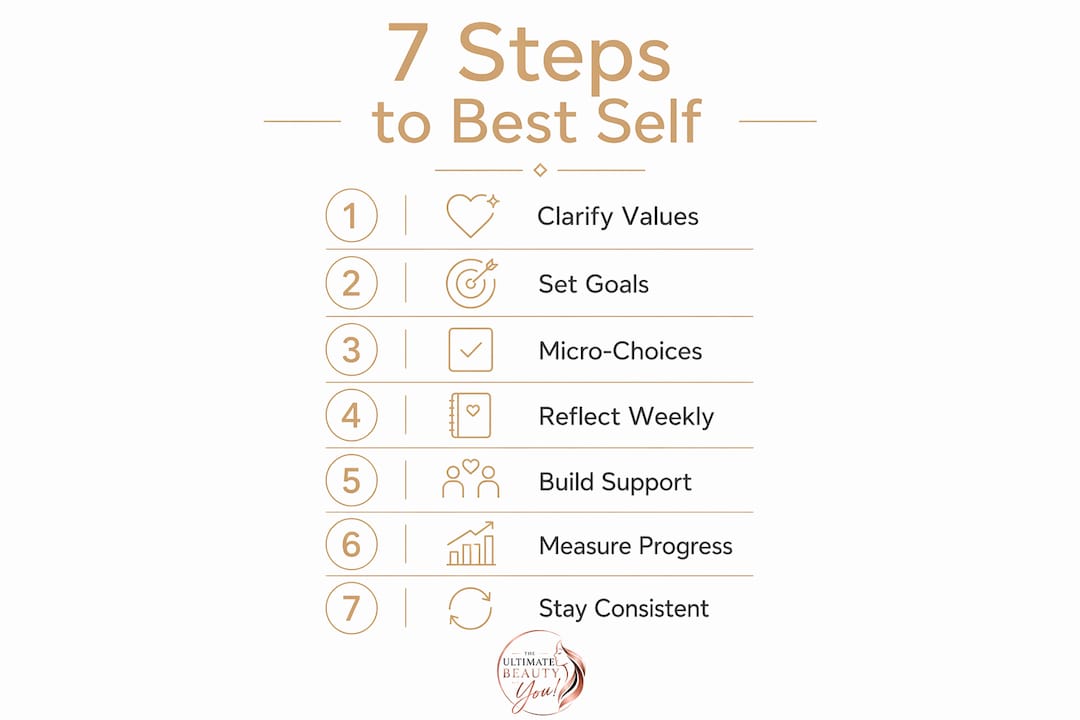
- How to start becoming your best self: a 7-step plan
- Why micro-choices matter more than big routines
- How do you measure progress and what timeline is realistic?
- Common obstacles and how to move through them
- Reflection exercises to clarify your personal best self
- Key Takeaways
- Why values-aligned growth matters more than self-improvement trends
- Ready to go deeper with Theultimatebeauty-you?
- Further reading and key sources
What does becoming your best self look like every day?
The phrase can sound abstract until you see it in action. At work, it might look like speaking up in a meeting when you would normally stay quiet, because honesty is one of your core values. In relationships, it could mean setting a boundary kindly rather than either caving or snapping. In self-care, it shows up as choosing sleep over a late-night scroll because you know rest makes you a better version of yourself the next morning.

None of these are dramatic. That is what makes them real.
Consider this kind of moment: you are exhausted after a long week, and a friend asks for a favor that would cost you your only free afternoon. Your instinct is to say yes automatically. Your best self pauses, checks in with what you actually need, and says, "I love you and I can't make it this weekend, but let's plan something next week." That pause, that small course correction, is personal growth in motion.
A few micro-choices that show up in daily life:
- Saying no kindly, without over-explaining or apologizing excessively
- A 10-minute evening routine that closes the day with intention (a brief journal entry, a skincare ritual, three slow breaths)
- Choosing one conversation where you listen more than you speak
- Replacing one automatic complaint with a specific observation
These micro-choices compound. One intentional decision rarely changes your life. A thousand of them, made consistently, absolutely does.
What does research say about the "best self" vs. the "ought self"?
The distinction between your best self and your ought self is one of the most clarifying ideas in personal growth research. Your ought self is the version of you driven by obligation: what you feel you should do, who you feel you should be, based on external expectations from family, culture, or comparison. Your best self, by contrast, emerges from internal desire and authenticity. Psychology Today notes that values-aligned goals support well-being in ways that obligation-driven goals simply do not.
Chasing ought goals tends to feel exhausting and hollow, even when you achieve them. Values-aligned goals feel different. They sustain motivation because they are yours.
The Personal Growth Process (PGP) model offers a practical framework for understanding how this growth actually unfolds. Developed from Carl Rogers's organismic valuing process, the PGP model describes personal growth as a sociocognitive, embodied process involving a series of mental shifts: self-awareness, openness to change, existential courage, autonomy, responsibility, self-compassion, and compassion toward others. Psychological safety is the prerequisite. Without it, the courage required for authentic change is unlikely to emerge.
Importantly, the PGP model ties growth to your social environment, not just your internal psychology. Who you spend time with, and whether that environment feels safe enough to be honest in, shapes how far and how fast you grow.
Pro Tip: Write one paragraph describing a specific scene from your ideal future, not a list of achievements, but a sensory moment: where you are, how you feel, who is with you. Research on the ideal self suggests this kind of vivid, narrative writing fuels motivation more reliably than abstract goal statements.
How to start becoming your best self: a 7-step plan
This plan is designed to be started today. Each step builds on the last.
- Clarify your values. List five values that feel genuinely yours. Narrow to two or three that you want to lead with right now. These become your compass.
- Define one or two goals. Choose goals that connect directly to your values. Specific beats vague: "I will write for 15 minutes every morning" beats "I want to be more creative."
- Design micro-habits. Attach each goal to a small, repeatable daily action. Micro-habits lower the activation energy required to show up consistently.
- Create your Best Self Blueprint. Name the version of yourself you are growing into. List two or three activation cues you can use before high-stakes moments: a phrase, a posture, a breath. This technique helps bridge the gap between your default self and your aspirational self under pressure.
- Practice activation techniques. Use your blueprint before a difficult conversation, a presentation, or a moment when you know you tend to shrink. The goal is consistency under pressure, not just in easy moments.
- Build in weekly reflection. A short, structured review at the end of each week keeps you honest and aligned. Five minutes is enough.
- Adjust without judgment. Growth is not linear. When a habit slips or a goal shifts, revise the plan rather than abandoning it.
Your 1-week starter:
- Day 1: Write your values list and choose your top two.
- Day 2: Write one specific goal tied to each value.
- Day 3: Design one micro-habit per goal and attach it to an existing routine.
- Day 4: Write your Best Self Blueprint (name + two activation cues).
- Day 5: Use your blueprint before one real-life moment.
- Day 6: Notice and record one moment where you acted from your best self.
- Day 7: Complete your first weekly reflection using the five questions in Section 8.
Adapting to your life stage:
- Busy parent: Focus on one value and one micro-habit. Five minutes of intentional action beats a 30-minute routine you never start.
- Early-career: Use the Blueprint before job interviews, feedback conversations, or networking moments where you tend to second-guess yourself.
- Midlife: This plan works especially well as a subtraction exercise. What commitments, habits, or expectations are you maintaining for the wrong reasons? Letting those go is often the first real step.
Why micro-choices matter more than big routines
The most common misconception about personal growth is that it requires dramatic effort. BetterUp's guidance is direct on this: sustainable change comes from shifting mindset and aligning daily habits with values, not from doing more. Grand routines feel motivating to plan and exhausting to maintain. Micro-choices, by contrast, fit inside real life.
Habit stacking is one of the most practical tools here. Linking a new micro-habit to an existing routine dramatically improves the chance it will stick. The cue is already built in; you are just adding a small behavior to something you already do.
A few habit stacks that support values-aligned growth include pairing a mindful skincare routine with a single grounding breath before bed.
- Morning: While your coffee brews, write one sentence about what kind of person you want to be today.
- Work: Before opening your inbox, spend 60 seconds reviewing your top priority for the day.
- Evening: After brushing your teeth, note one thing you did well and one thing you want to do differently tomorrow.
- Self-care: Pair a mindful skincare routine with a single grounding breath before bed.
For habit cadence, one-week trials work better than open-ended commitments. Tell yourself you will try a new micro-habit for seven days, then evaluate. This removes the pressure of permanence and makes it easier to start.
Pro Tip: The biggest habit trap is all-or-nothing thinking. Missing one day does not break a habit; deciding the streak is ruined and quitting does. Build a "never miss twice" rule instead of a "never miss" rule. It is far more forgiving and far more effective.

How do you measure progress and what timeline is realistic?
Progress toward your best self is rarely visible in the short term, and that is normal. The PGP model describes growth as a fluctuating, non-linear process where people often get temporarily stuck before moving forward. Expecting a straight line sets you up for discouragement.
Practical metrics to track:
- Process measures: How many days did you practice your micro-habit this week? This is more useful than outcome measures in the early stages.
- Strengths used: Did you use a core strength today? Noticing this builds confidence and reinforces identity.
- Subjective well-being: On a simple 1–10 scale, how aligned did you feel with your values this week?
- Behavior anchors: Can you name one specific moment where you acted from your best self?
| Growth stage | What it feels like | Approximate timeframe |
|---|---|---|
| Awareness | Noticing the gap between actual and ideal self | Weeks 1–2 |
| Experimentation | Trying new behaviors, some awkward | Weeks 3–8 |
| Consolidation | New habits feel more natural, less effortful | Months 3–6 |
| Integration | Values-aligned behavior becomes default | 6 months |
Personal growth research consistently shows that deliberate action, reflection, and goal-setting support flourishing, even when the process involves difficulty. The challenge is not a sign something is wrong. It is part of the process.
Common obstacles and how to move through them
Knowing the obstacles in advance takes away some of their power. Here are the most common ones, paired with practical responses:
- Perfectionism: You delay starting because the conditions are not ideal. Fix: Set a minimum viable version of your habit. Two minutes of journaling counts. Starting imperfectly beats not starting.
- Social comparison: Someone else's growth makes yours feel inadequate. Fix: Audit your inputs. If a social media account consistently makes you feel behind, mute or unfollow it. Your path has a different shape than theirs.
- The ought trap: You pursue goals that feel like obligations rather than desires. Fix: Ask yourself, "Would I still want this if no one knew I had it?" If the answer is no, it may be an ought goal, not a best-self goal.
- Resistance to change: You know what you want to do and still do not do it. This is normal. Carl Jung's insight, widely cited in wellbeing literature, is that what you resist persists. Fighting resistance often amplifies it. Accepting that discomfort is part of growth, and moving forward anyway in small steps, tends to work better than trying to eliminate the feeling first.
- Overcommitment: You take on too much and growth gets crowded out. Fix: Subtraction is a legitimate growth strategy. Removing one misaligned obligation often frees more energy than adding a new habit.
Pro Tip: Do a monthly "influence audit." List the five accounts, people, or media you consume most. Ask honestly: do they reflect the values and identity you are growing into? If not, that is where the social comparison problem starts, and where you have the most control.
Reflection exercises to clarify your personal best self
These prompts and templates are designed to be used, not just read. Copy them, write in them, and return to them weekly.
Journaling prompts
- Who do I most admire, and what specific quality in them do I want to develop in myself?
- What does a day lived fully in alignment with my values look like, from morning to night?
- When do I feel most like myself? What conditions make that possible?
- What am I holding onto, a habit, a commitment, a belief, that no longer fits who I am becoming?
- What would I do differently this week if I fully trusted myself?
Future-self letter template
Write this in first person, present tense, as if you are already living it:
Read this letter before your weekly review. It functions as an activation cue, pulling your present behavior toward your future identity.
Weekly review (10 minutes, every Sunday)
- What did I do this week that aligned with my values?
- Where did I drift from who I want to be, and why?
- What is one thing I want to do differently next week?
- What am I grateful for about my growth right now?
- What is my one focus for the coming week?
Small weekly review rituals consistently increase clarity and adherence to values-based goals. Five to ten minutes is all it takes. The ritual matters more than the length.
Key Takeaways
Becoming your best self is a values-first, ongoing process built on small, intentional choices, honest reflection, and the courage to grow at your own pace.
| Point | Details |
|---|---|
| Values come first | Clarify your top two or three values before setting any goal; they are your compass for every decision. |
| Micro-choices beat grand routines | Sustainable growth comes from small, repeatable habits aligned with your values, not dramatic overhauls. |
| The PGP model normalizes non-linearity | Growth fluctuates; getting temporarily stuck is part of the process, not a sign of failure. |
| Reflection drives alignment | A 10-minute weekly review reliably increases clarity and keeps behavior connected to values. |
| Theultimatebeauty-you supports the whole process | The platform connects women with trusted experts, curated resources, and a community built around becoming your best self. |
Why values-aligned growth matters more than self-improvement trends
Most self-improvement content gets one thing wrong: it treats growth as addition. Do more. Add habits. Stack routines. But the research, and the lived experience of real growth, points in a different direction. The women who make lasting change are usually the ones who subtract first. They identify what they are doing out of obligation, fear, or habit, and they stop. That clearing creates space for something genuine.
The distinction between the ought self and the best self is not academic. It is the difference between a life that looks good from the outside and one that feels right from the inside. Chasing external validation is exhausting because the finish line keeps moving. Growing toward your own values is different. It feels like coming home.
What I find most compelling about the PGP model is its insistence on psychological safety as a prerequisite. You cannot grow authentically in an environment, or a relationship, or even a mindset, that punishes honesty. Building safety through small wins, self-compassion, and predictable rituals is not soft. It is the foundation. And mental health and confidence are not separate from becoming your best self. They are the conditions that make it possible.
The guide you just read is a starting point. Your version of "best" will look different from anyone else's, and it should.
Ready to go deeper with Theultimatebeauty-you?
Growth feels clearer when you have the right resources around you. Theultimatebeauty-you is a women-centered platform built for exactly this: connecting you with trusted experts, curated products, and a community of women at every age and stage who are actively becoming their best selves.

Whether you are just starting to clarify your values or you are deep into building new habits, the platform's expert network and partners offer guided support that meets you where you are. From self-care products that reinforce your daily rituals to community connections that make growth feel less solitary, every resource is chosen with the whole woman in mind. Inside-out. Head-to-toe. 360-degree becoming.
Visit The Ultimate Beauty - You! to explore what is available for your stage of growth, and take the next step on your own terms.
Further reading and key sources
These are the sources that shaped this guide, organized by what they offer:
- Personal Growth Process (PGP) Model, ScienceDirect — The foundational academic model for understanding how growth unfolds as a sociocognitive process. Start here if you want the research framework.
- How Becoming Your Best Self Can Boost Well-Being, Psychology Today — Accessible summary of the ideal self concept and the ought/best self distinction. Good for understanding the "why."
- 7 Steps to Become the Best Version of Yourself, BetterUp — Practical, step-by-step guidance with emphasis on micro-habits and mindset shifts. Best for readers who want immediate tools.
- Personal Growth & Wellbeing: A Blueprint for Happiness, PositivePsychology — Research-backed overview of growth stages, flourishing, and the role of reflection. Useful for timeline and measurement questions.
- Personal Growth, Berkeley Wellbeing — Covers resistance, acceptance-based strategies, and practical growth tools. Helpful for the obstacles section.
- The Best Self Blueprint, Josh Linkner — Practical technique for naming and activating your best self before high-stakes moments. Short and immediately applicable.
- How I Define 'Best Version' and How You Should Define Yours, David Daniels — A practitioner's perspective on subtraction as a growth strategy. Worth reading if you feel overcommitted.
- Your Best Self: Activities, Journaling & Tips, Berkeley Wellbeing — Journaling prompts, activities, and a clear definition of the best self. Good companion to the reflection section of this guide.
If you want to go further with the research, start with the ScienceDirect PGP paper. If you want quick tools, BetterUp and Josh Linkner are your fastest path to action. For reflection support, PositivePsychology and Berkeley Wellbeing offer the most practical exercises.