
Inclusive beauty brand marketing is the practice of crafting campaigns and products that authentically represent and serve diverse consumer demographics across every brand platform. Brands like Fenty Beauty, Rare Beauty, and e.l.f. Beauty have proven this is not just an ethical choice. It is a growth strategy. Certified inclusive brands grew 1.8x faster in sales than less inclusive competitors in 2025. That gap is widening. For marketing professionals and brand strategists, the question is no longer whether to prioritize inclusion. It is how to execute it with consistency, cultural depth, and measurable results.
What core principles define effective inclusive beauty brand marketing?
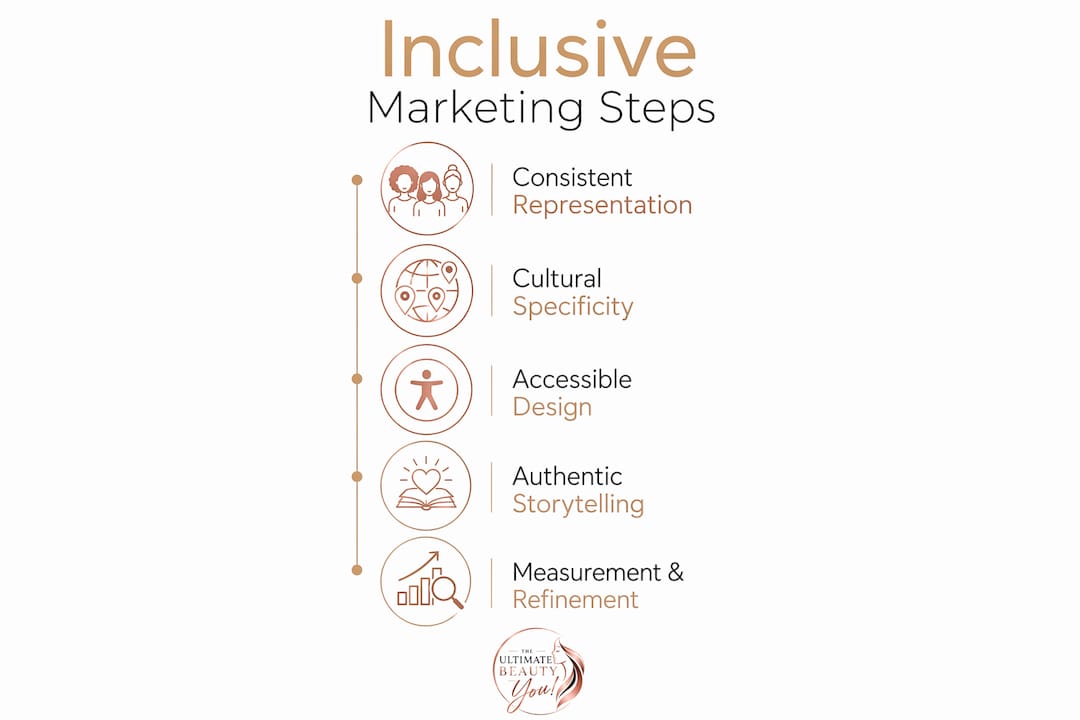
Effective inclusive beauty brand marketing rests on four pillars: consistent representation, cultural specificity, accessibility, and full-funnel reach. Miss any one of them and the whole effort reads as performative.

Consistency across every touchpoint. Representation in a single ad campaign does not count. The SeeMe 2025 Inclusivity Index evaluated brands on diverse representation across ads, websites, and stated brand purpose simultaneously. Brands that scored high on all three grew faster. Brands that checked one box did not.
Cultural specificity over generic diversity. Showing a range of skin tones is a starting point, not a finish line. Rare Beauty's "48 shades. 48 stories. One community." campaign honored Latina, Indigenous, and Afro-Latina women by pairing each woman with her specific shade and her specific story. That level of nuance prevents tokenism and builds real community.
Accessibility as a design standard. Packaging that a woman with arthritis cannot open is not inclusive, regardless of how diverse the ad campaign looks. Accessibility must be built into product development from day one.
Authentic influencer partnerships. Ongoing creator partnerships outperform one-off diversity campaigns in both conversion and retention. The creators you work with should genuinely reflect your audience, not just approximate it.
- Audit all brand touchpoints quarterly for representation gaps
- Replace generic identity labels with culturally specific storytelling
- Build accessibility testing into every product development cycle
- Prioritize long-term influencer contracts over single sponsored posts
- Measure engagement and sales lift by audience segment, not just overall
Pro Tip: Map your brand's representation across your website, paid ads, social content, and retail media in a single spreadsheet. Gaps become obvious fast when you see all channels side by side.
How does accessibility shape inclusive cosmetic product design?
Accessibility is the most underused growth lever in beauty brand diversity. Most brands treat it as a compliance checkbox. The brands that treat it as a design standard win loyalty from a consumer segment that is rarely courted.
The Arthritis Foundation's Ease of Use certification is the gold standard for accessible beauty packaging. It requires independent testing and detailed design feedback before a product earns the seal. That process is rigorous by design. It signals to consumers that the brand did the work, not just the marketing.
Rare Beauty's foundation packaging is the clearest case study in the industry. The team used a highly iterative design process that included usability testing with real consumers. The result was a lock-unlock cap and a wider pump that allows multi-finger use. That is not a minor tweak. It is a fundamental rethinking of who the product is for.
Here is how to build accessibility into your product development process:
- Involve accessibility testers in the earliest prototype stage. Retrofitting accessible design after a product is nearly finalized is expensive and usually superficial.
- Seek Ease of Use certification feedback before launch. The Arthritis Foundation's program provides specific design notes, not just a pass or fail score.
- Test with a range of users. Include women with limited grip strength, low vision, and fine motor challenges in every usability round.
- Document every design iteration. This documentation becomes a marketing asset and a proof point for your brand's commitment.
"Accessibility-first design in beauty requires resource-intensive, repeated prototyping and cross-functional collaboration to move beyond superficial inclusivity." — Rare Beauty's development team approach, as reported by Yahoo Shopping
Inclusive packaging design certified by the Ease of Use program does not just meet ethical standards. It strengthens loyalty and broadens reach to consumers who have been ignored by the category for decades.
Pro Tip: Partner with occupational therapists during product testing. They bring a clinical perspective on grip, dexterity, and fine motor function that standard consumer panels miss entirely.
Which strategies optimize diverse representation in beauty advertising campaigns?
Authentic representation in beauty advertising requires more than diverse casting. It requires culturally rooted storytelling placed at the right moment in the consumer's path to purchase.
The Code3 campaign for POND'S demonstrates this precisely. By reflecting beauty as a cultural ritual for Hispanic and Latina consumers directly on Amazon product pages, the campaign reached 75% of that audience segment. The insight is critical: placing culturally rich storytelling inside commerce moments, not just top-of-funnel awareness, drives both emotional resonance and conversion.
Diverse representation in advertising also requires intentional casting decisions informed by data. The SeeMe Inclusivity Index tracks representation across age, ethnicity, gender expression, and body type. Brands that score well on the index do not leave casting to chance. They set measurable targets and hold creative teams accountable.
Here is a framework for representation across campaign types:
| Campaign element | Tokenistic approach | Culturally specific approach |
|---|---|---|
| Casting | Range of skin tones, no context | Specific cultural backgrounds with personal stories |
| Shade naming | Neutral descriptors | Undertone and ethnicity-informed naming |
| Influencer selection | Follower count priority | Audience alignment and cultural credibility |
| Retail media copy | Generic product benefits | Culturally resonant rituals and language |
| Website imagery | Stock diversity photos | Community-sourced, authentic photography |
- Use colorimetry data to build shade portfolios that reflect real skin tone distribution across your audience
- Brief creative teams on specific cultural contexts, not just visual diversity targets
- Audit retail media assets, including Amazon listings and Sephora product pages, for representation consistency
- Assign a representation lead who reviews all campaign assets before launch
Inclusive influencer marketing with authentic creators generates approximately 3 times more social shares than standard campaigns. That multiplier comes from genuine community trust, not production quality.
How do you build a full-funnel omnichannel inclusive beauty campaign?
A full-funnel approach to diverse beauty marketing means your brand shows up for every consumer, at every stage, on every platform they use. Awareness without conversion is a missed opportunity. Conversion without retention is a leaky bucket.
Full-funnel omnichannel advertising that blends social media, search, streaming TV, retail media, and physical stores drives measurable incremental growth for beauty brands. The key is not just presence on every channel. It is message consistency adapted to each channel's format and audience behavior.
| Channel | Primary role in funnel | Inclusive marketing tactic |
|---|---|---|
| TikTok and Instagram Reels | Awareness and community | Creator-led content with authentic diverse voices |
| Google Search | Consideration | Shade-finder tools and accessibility-focused copy |
| Streaming TV | Broad awareness | Diverse casting with culturally specific narratives |
| Amazon and retail media | Conversion | Culturally rooted product page storytelling |
| Loyalty programs | Retention | Exclusive content and early access for community members |
e.l.f. Beauty's TikTok campaigns are the clearest example of this in practice. The brand built viral reach by pairing authentic creator voices with a clear brand identity that resonated across age groups and ethnicities. The result was not just views. It was a measurable lift in brand consideration among younger, more diverse consumers.
Measurement is where most inclusive campaigns fall short. Inclusive marketing underperforms when it is only creative-focused without full-funnel measurement and adaptive spend strategies. You need to track engagement, conversion, and loyalty uplift by audience segment, then rebalance spend toward the segments and channels that perform best.
Pro Tip: Build a separate reporting dashboard for each key audience segment. Aggregate metrics hide the performance differences that tell you where your inclusive strategy is actually working.
A strong beauty brand SEO strategy amplifies every channel in this mix. Organic search captures consumers who are actively looking for inclusive options, and that intent is high-value.
How do you measure and refine inclusive beauty marketing over time?
Measurement is not the end of an inclusive marketing strategy. It is the engine that keeps it honest. Without clear metrics and feedback loops, even well-intentioned campaigns drift toward tokenism.
- Track sales growth by demographic segment. Overall sales growth masks whether your inclusive efforts are actually reaching the audiences you intend to serve.
- Monitor engagement rates by community. A campaign that performs well overall but underperforms with Black, Latina, or Asian consumers signals a representation gap.
- Use third-party benchmarks. The SeeMe Inclusivity Index and the Arthritis Foundation's Ease of Use certification provide external validation that your internal metrics cannot replicate.
- Audit audience sentiment quarterly. Social listening tools surface language and concerns from underrepresented communities that standard surveys miss.
- Iterate creator partnerships continuously. Ongoing creator relationships with continuous learning and contract iteration maintain authentic representation far better than annual campaign refreshes.
Avoiding tokenism requires structural discipline. One diverse campaign per year is not a strategy. It is a signal that inclusion is a marketing tactic rather than a brand value. The brands that grow fastest treat representation as a permanent operating standard, not a seasonal initiative.
Key takeaways
Inclusive beauty brand marketing grows sales 1.8x faster when representation is consistent, culturally specific, and embedded across every brand touchpoint from product design to retail media.
| Point | Details |
|---|---|
| Consistency drives growth | Represent diversity across ads, websites, and brand purpose simultaneously, not in isolation. |
| Accessibility is a growth lever | Earn Ease of Use certification and test packaging with diverse users early in development. |
| Cultural specificity prevents tokenism | Use specific cultural narratives and shade stories rather than generic diversity casting. |
| Full-funnel measurement is non-negotiable | Track engagement and sales lift by audience segment and rebalance spend based on results. |
| Long-term creator partnerships outperform | Ongoing influencer contracts generate stronger conversion and retention than one-off campaigns. |
Why I believe most inclusive beauty campaigns stop too soon
The brands I have watched succeed at this, Rare Beauty, e.l.f. Beauty, MAC Cosmetics, share one quality that most brands skip. They treat inclusion as an operating standard, not a campaign theme. The moment a brand frames diversity as a "moment" or a "launch," it has already limited its impact.
What I find most telling is the accessibility gap. Brands will spend millions on diverse casting and zero dollars on packaging usability testing. A woman with rheumatoid arthritis who cannot open your foundation is not your customer, no matter how many shades you offer. That is a missed consumer and a missed revenue opportunity.
The cultural specificity piece is where I see the most growth potential in 2026. Generic "multicultural" targeting is not a strategy. It is a shortcut that flattens real identities into a single bucket. The Code3 and POND'S example proves that treating Hispanic and Latina consumers as a cultural community with specific beauty rituals, rather than a demographic checkbox, produces dramatically better results.
The brands that will lead this category in the next three years are the ones building cross-functional teams where product designers, marketers, and community managers work from the same inclusion brief. That kind of brand storytelling does not happen by accident. It requires structure, accountability, and a genuine belief that every woman deserves to see herself in the brand.
— Ava
Theultimatebeauty-you: where inclusive beauty lives
Theultimatebeauty-you is built on the belief that beauty belongs to every woman, at every age, at every stage. The platform brings together trusted experts, carefully curated brands, and a community of women who know that beauty is not a destination. It is a becoming.
If you are a marketer or brand strategist looking for a real-world example of inclusive beauty done right, the Theultimatebeauty-you product collection showcases accessible, diverse, and thoughtfully designed offerings that reflect the full spectrum of womanhood. You will also find a network of beauty experts and partners who specialize in inclusive brand development. Whether you are seeking inspiration, partnership, or community, Theultimatebeauty-you is where the conversation starts.
FAQ
What is inclusive beauty brand marketing?
Inclusive beauty brand marketing is the practice of representing and serving diverse consumer demographics authentically across all brand platforms, including advertising, product design, and retail media. It goes beyond diverse casting to include cultural specificity, accessibility, and consistent representation at every touchpoint.
How much faster do inclusive beauty brands grow?
Certified inclusive brands grew 1.8x faster in sales than less inclusive competitors in 2025, according to the SeeMe Inclusivity Index. That growth gap reflects the purchasing power of underrepresented consumers who actively seek brands that reflect them.
What is the Arthritis Foundation Ease of Use certification?
The Ease of Use certification is an independent program that evaluates beauty product packaging for accessibility, particularly for consumers living with arthritis or limited dexterity. Earning it requires rigorous testing and design iteration, making it a credible signal of genuine accessibility commitment.
How do you avoid tokenism in beauty advertising?
Tokenism occurs when diversity is treated as a visual checkbox rather than a cultural commitment. Rare Beauty's 48 shades campaign avoided tokenism by pairing each shade with a specific woman's cultural story, demonstrating that specificity and community connection are the antidote to surface-level representation.
What metrics should you track for inclusive beauty campaigns?
Track sales growth, engagement rates, and loyalty uplift broken down by demographic segment rather than aggregate totals. Combine internal data with third-party benchmarks like the SeeMe Inclusivity Index to identify representation gaps and rebalance spend toward the channels and audiences that respond best.