
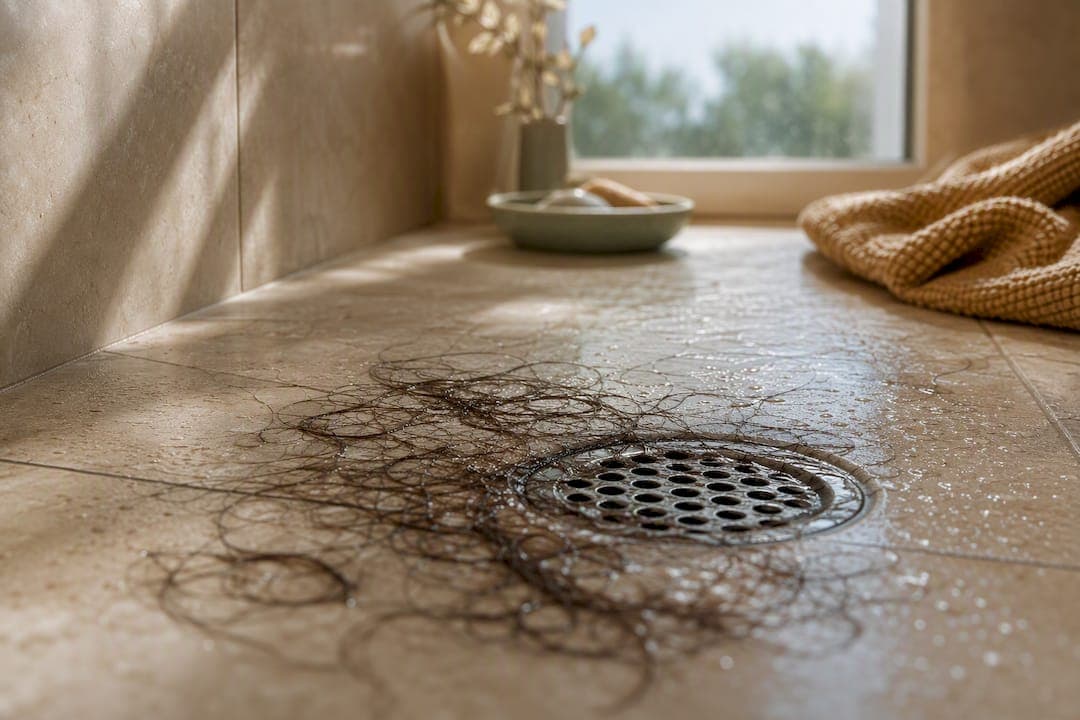
Postpartum hair loss is common, temporary, and driven by hormones, not disease. Most new mothers notice shedding starting a few months after birth, peaking around month four, and easing off by their baby's first birthday. It's called telogen effluvium, and it almost always resolves on its own. See a clinician if shedding is patchy, comes with scalp symptoms, or continues past 12 months.
TL;DR:
- Most postpartum hair shedding begins around three months after birth, peaks at four months, and usually resolves within the first year.
- Factors like iron deficiency, thyroid issues, stress, and genetics can worsen or prolong shedding beyond the typical hormonal pattern.
- Gentle hair care, avoiding tight styles, and confirming iron and thyroid levels help manage shedding, but persistent or patchy loss warrants medical evaluation.
- Shedding tends to be even across the scalp; patchy baldness, scalp inflammation, or hair loss patterns may indicate other conditions needing diagnosis.
- Loose hair around the house can pose a rare risk of hair tourniquets for infants, requiring immediate medical attention if a strand is tightly wrapped around a digit.
Table of Contents
- What Is Postpartum Hair Loss, Really?
- When Does Postpartum Hair Shedding Start and Stop?
- What Causes Postpartum Hair Loss to Get Worse?
- How to Manage Postpartum Hair Shedding at Home
- When Should You See a Doctor About Hair Loss?
- Behind This Article: Ava and The Ultimate Beauty - You!
- Is This Normal Shedding or Something Else?
- The Hair Tourniquet Risk Nobody Warns You About
- What I Want New Mothers to Actually Hear
- A Nonmedical Resource While You Wait It Out
- Sources
What Is Postpartum Hair Loss, Really?
Your hair doesn't grow all at once. Every strand cycles through three phases: anagen (active growth, lasting years), catagen (a short transition), and telogen (a resting phase before the strand releases). On any given day, the majority of your hair sits in that active growth phase, which is why hair loss usually flies under the radar.
Pregnancy changes the math. Rising estrogen during those nine months holds more hairs in the anagen phase than usual, which is part of why so many women describe their pregnancy hair as thicker and shinier than ever. That's not an illusion. It's a hormonal hold pattern.
Then delivery happens, and estrogen drops fast. That drop releases the hairs that pregnancy had been holding onto, and they all shift into the telogen phase at roughly the same time. A few months later, those synchronized resting hairs let go, and the result is the clump-in-the-shower, hair-on-the-pillow experience so many new mothers describe. This is telogen effluvium, and it's a temporary, self-correcting response to a hormone shift, not a sign anything is wrong with your follicles.
When Does Postpartum Hair Shedding Start and Stop?
Shedding typically begins a few months after delivery, with the heaviest loss showing up around month four, according to the American Academy of Dermatology. If your baby is three months old and you're suddenly finding hair everywhere, that's right on schedule, not a red flag.
Recovery follows a wider window. Most mothers see their hair regain its former fullness within the first year postpartum, often lining up with their child's first birthday. That's a broad range, and where you land in it depends on a few things.
Nutrition status matters. So does thyroid function, which shifts naturally after birth and can either mask or mimic postpartum shedding. Breastfeeding also plays a role for some mothers: because lactation keeps certain hormone levels different from a non-breastfeeding recovery pattern, shedding can stretch out longer while nursing continues. None of this means something is broken. It means the timeline is a range, not a deadline, and comparing your month-five shed to a friend's month-eight regrowth isn't a useful measure of anything.
What Causes Postpartum Hair Loss to Get Worse?
The root cause is universal: the sharp decline in estrogen after childbirth. That's the trigger for nearly every case of postpartum shedding, and it's why the Cleveland Clinic treats it as an expected, predictable event rather than a disorder.
A few conditions can pile on top of that baseline shed and make it feel heavier or last longer:
- Iron deficiency, common after blood loss during delivery, can worsen shedding and slow regrowth.
- Low vitamin D has been linked to weaker hair cycling in general.
- Thyroid dysfunction, either hypothyroidism or hyperthyroidism, frequently emerges or shifts in the postpartum period and can compound hormonal shedding.
- Severe or prolonged stress, including sleep deprivation, can extend the telogen phase for more hairs than hormones alone would.
- Genetics determines how visible your shedding is. Fine or already thin hair shows loss faster than dense hair does.
Breastfeeding deserves its own note here. Some experts see a longer shedding window in nursing mothers, tied to how lactation hormones interact with the return of a normal cycle. Others argue the link is weaker than assumed and that individual variation explains more than feeding method does. Either way, breastfeeding is not a cause of hair loss on its own. It's a possible modifier of timing.
How to Manage Postpartum Hair Shedding at Home
You can't stop the hormonal shift, but you can protect the hair you have and make regrowth easier on itself. Start with the basics of gentle handling, since postpartum hair is more fragile and more prone to breakage than usual.
- Wash with a volumizing shampoo and keep conditioner concentrated on the ends, not the scalp, so fine regrowth doesn't get weighed down.
- Lower your heat tools by a notch and cut back on daily blow drying where you can.
- Switch to a wide-tooth comb or a spoolie brush for detangling, especially near the hairline, where new growth is shortest and most fragile.
- Choose looser styles. A tight ponytail or braid pulls on hair that's already shedding and can add breakage on top of natural loss.
- A shorter cut or strategic layers add the appearance of volume while regrowth catches up.
- Lightweight, root-lifting conditioners and cosmetic hair fibers can mask thinning without adding weight.
Before reaching for supplements, get the basics checked. Iron and thyroid levels are worth confirming with your clinician, since supplementing blindly can mask a deficiency without correcting it or, in the case of iron, cause its own problems if you're not actually low. Biotin is popular in postpartum hair products, but talk it through with a clinician first. Evidence supporting biotin for hair shedding in people without a documented deficiency is thin.
Pro Tip: Scalp care matters as much as hair care. A few minutes of gentle scalp massage while shampooing increases blood flow to the follicle and costs nothing but time, though it won't speed up the hormonal timeline itself.
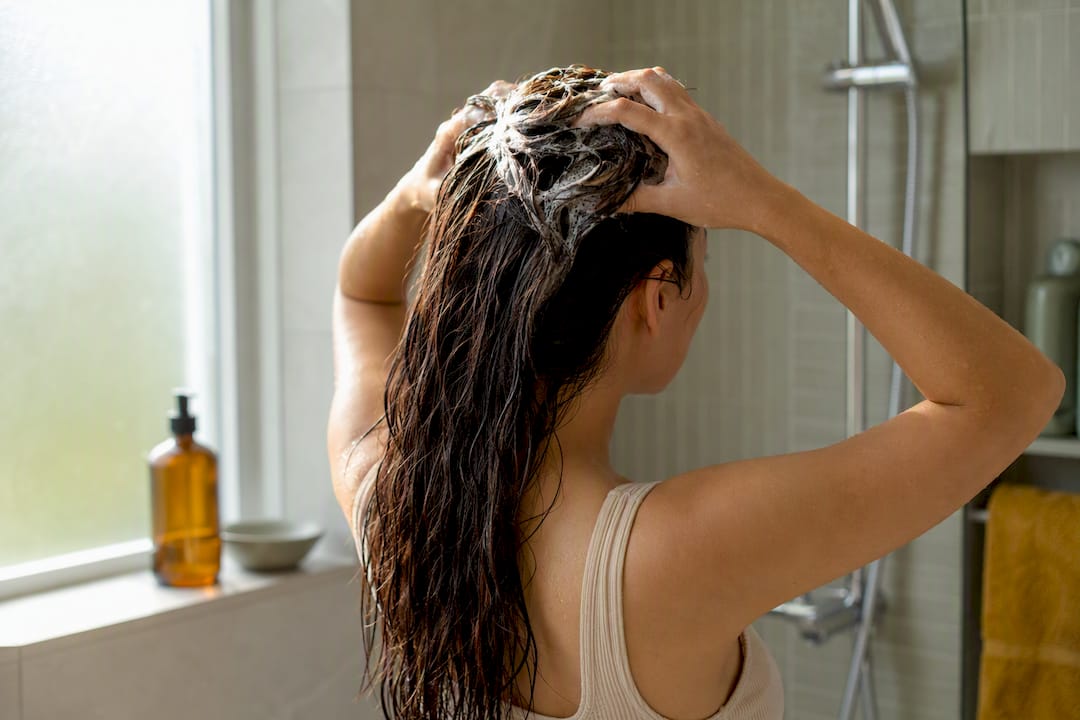
If shedding hasn't started turning around by the 12 month mark, or if you're seeing patchy loss rather than diffuse thinning, that's the point to loop in a dermatologist rather than wait it out further.
When Should You See a Doctor About Hair Loss?
Most postpartum shedding needs nothing more than reassurance and time. A handful of signs mean it's worth booking an appointment instead of waiting it out:
- Shedding that continues, unchanged, past the 12-month mark
- Patchy or localized bald spots rather than overall thinning
- Scalp inflammation, redness, itching, or scaling alongside the hair loss
- Systemic symptoms like fatigue, weight changes, or heat or cold intolerance that suggest a thyroid issue
A clinician evaluating persistent shedding will usually start with a complete blood count and iron studies, plus a thyroid panel (TSH). A scalp exam, and occasionally a biopsy, rules out other causes if the pattern looks unusual. In the vast majority of cases, this workup comes back clean and simply confirms what you already suspected: ordinary postpartum telogen effluvium that will resolve with time. The testing isn't about finding a problem. It's about ruling one out.
Behind This Article: Ava and The Ultimate Beauty - You!
This piece was written by Ava, a contributing writer at Theultimatebeauty-you focused on postpartum wellness, hair and scalp health, and the emotional side of body changes after childbirth.
Theultimatebeauty-you exists as a women-centered platform connecting you with vetted experts, curated product recommendations, and a community that understands what postpartum recovery actually feels like. Use it for the nonclinical layer of your recovery: styling guidance, product picks, and connection with other women navigating the same stage. For anything with a medical dimension, whether that's thyroid symptoms or shedding that won't quit, your dermatologist or OB-GYN stays the right first call.
Is This Normal Shedding or Something Else?
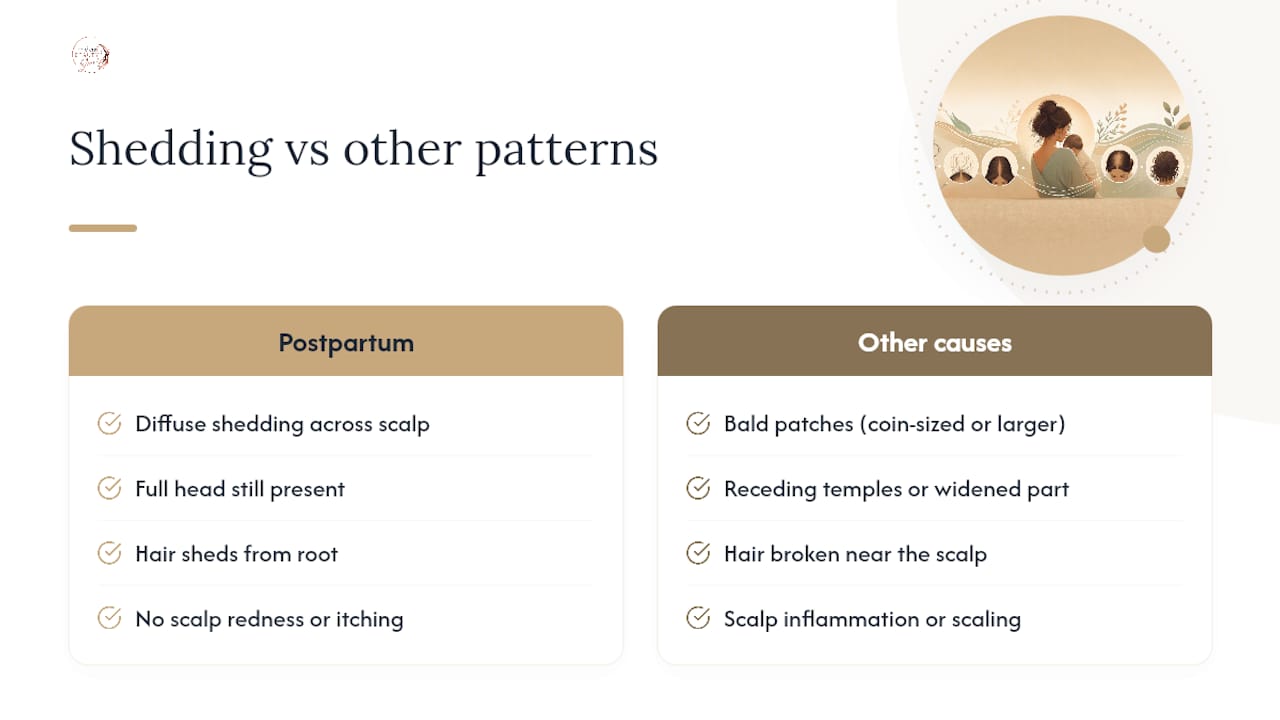
Ordinary postpartum shedding has a specific look to it: hair coming out evenly across your whole scalp, mixed in with your regular hair, showing up in the shower drain, on your pillow, and in your brush. You'll likely still have a full head of hair even during the heaviest shedding weeks. That's diffuse thinning, and it's the hallmark of telogen effluvium.
What doesn't fit that pattern deserves a closer look. Bald patches, whether smooth, coin-sized spots or broader areas of missing hair, point toward a different process, such as alopecia areata, and won't resolve the way postpartum shedding does. Hair breaking off close to the scalp, rather than shedding from the root, suggests a hair shaft problem or damage from tight styling rather than a hormonal cycle. Scalp symptoms are another dividing line: normal postpartum shedding does not come with redness, scaling, burning, or itching. If your scalp itself feels irritated or looks inflamed, that points toward a scalp condition like seborrheic dermatitis or psoriasis riding alongside the hair loss, not causing it.
One more distinction worth knowing: postpartum shedding affects hair density evenly, not your hairline specifically. If you're seeing recession at the temples or a widening part that doesn't match the rest of your scalp, that pattern looks more like androgenetic alopecia, which can coexist with postpartum shedding but needs its own conversation with a dermatologist. When in doubt, the fastest way to sort normal from not is simple: even thinning across the whole head, no scalp symptoms, timeline under a year. If any of those three don't check out, it's worth getting evaluated.
The Hair Tourniquet Risk Nobody Warns You About
Here's a detail that catches new parents off guard: all that shed hair doesn't just disappear into your hairbrush. Loose strands end up on blankets, in car seats, and around your baby without you noticing, and a single strand can wrap tightly around an infant's finger, toe, or even other small body parts. This is called a hair tourniquet, and it can cut off circulation.
It's uncommon, but it's serious enough that pediatric guidance treats it as an urgent concern rather than a curiosity. A baby with a hair tourniquet often becomes fussy or cries persistently for no obvious reason, and the affected finger or toe may look swollen, discolored, or noticeably different from the others. Because postpartum shedding puts more loose hair into circulation around your house than usual, the window when this risk goes up lines up almost exactly with your peak shedding months.
Check your baby's fingers and toes if you notice unexplained fussiness, particularly during diaper changes or when dressing them. If you spot a hair wrapped around a digit, try removing it right away. If it's wound too tightly to unwind by hand, seek urgent medical care rather than trying to force it loose, since a healthcare provider has tools and techniques to remove it safely without further injury to the skin.
What I Want New Mothers to Actually Hear
Feeling upset about handfuls of hair in the shower is not vanity; it is a common part of postpartum recovery that you can get professional support for at Unity by MD. It's a reasonable response to watching your body change again, on top of everything else postpartum recovery already asks of you, and that reaction deserves acknowledgment, not dismissal.
Here's what actually helps in the moment: a shorter cut that hides thinning better than long layers ever will, a looser hold on how you style it day to day, and a mental shift from "something's wrong with me" to "this is a phase, and it has an end date." Connecting with other mothers going through the same shed, whether that's a friend, a platform community, or a support group, tends to do more for how you feel about it than any product will. If the distress runs deeper than frustration with your hair, a therapist familiar with postpartum mental health is worth involving, too.
— Ava
A Nonmedical Resource While You Wait It Out
While your follicles work through their own timeline, Theultimatebeauty-you gives you somewhere to go for the parts of this experience that don't need a prescription: styling ideas that actually work on regrowth, product recommendations vetted for postpartum hair, and a community of women who've been exactly where you are. Think of it as the support layer that sits alongside, not instead of, your clinician's care.

A few starting points on the platform:
- Browse curated product picks built for fragile postpartum hair and scalp care
- Connect with vetted experts and partners if you want a professional consult beyond your dermatologist
- Explore resources for women navigating postpartum changes beyond just hair
If your shedding fits the patterns described here, patience and gentle care are your best tools, and this community is a good place to find both. If it doesn't, or if you're seeing any of the red flags covered above, a clinician's evaluation comes first. Ready to find your people and your products in one place? Join Theultimatebeauty-you and start building your postpartum support system today.
This article is general information, not a substitute for advice from a qualified doctor. Consult a qualified healthcare professional about your own circumstances before acting on anything here.
Sources
- Hair loss in new moms: Dermatologist tips — American Academy of Dermatology (AAD)
- Postpartum Hair Loss: Causes, Treatment & What to Expect — Cleveland Clinic
- Postpartum Hair Loss — Johns Hopkins Medicine