

A capsule wardrobe is a small, intentional set of clothes that all mix together, so you get dozens of outfits from a handful of pieces instead of a closet full of things you never wear. Here is the fastest path there: audit what you own, define your real lifestyle in percentages, choose a primary layer plus two bottoms and two base tops, mix them into outfits and test the results for real, then spend money only to fill the gaps that show up. That five-step order matters more than any specific item list, because it forces you to build around your actual life before you buy a single new thing.
You can start this in the next hour. Not finish, start, and starting is what breaks the cycle of a stuffed closet and "nothing to wear."
Here is what to do right now:
- Do the bed test: pull everything from one category (say, tops) onto your bed and sort into keep, maybe, donate, and repair piles.
- Pick your primary layer: the one blazer, cardigan, or jacket you reach for most, since it will set the tone for everything else.
- Choose three neutrals already living in your closet, so your first outfit combinations exist before you spend a dollar.
Key Takeaways
A working capsule wardrobe comes from auditing what you own, building around one primary layer, testing outfits for 30 to 90 days, and shopping only to fill proven gaps.
| Point | Details |
|---|---|
| Audit before you shop | Run the bed test and sort every category into keep, maybe, donate, and repair. |
| Start with one layer | Choose your primary layer first, then add two bottoms and two base tops around it. |
| Run the 30 to 90 day test | Live with your draft capsule and log what you actually wear before buying anything new. |
| Use the Ten-Outfit Rule | If a piece can't build ten real outfits with what you own, it hasn't earned a permanent spot. |
| Get the printable system | Theultimatebeauty-you offers a printable checklist and expert partners to guide the full process. |
Table of Contents
- What a Capsule Wardrobe Really Is (and the Mindset Shift That Makes It Work)
- How Do You Actually Build a Capsule Wardrobe Step by Step?
- How Do You Pick a Color Palette That Actually Mixes?
- How Do You Test a Capsule Before Committing to It?
- How Do You Fill Gaps Without Overspending?
- What Should Your Capsule Actually Contain?
- What Mistakes Should You Avoid, and How Do You Maintain It?
- Frequently Asked Questions
- Sources
What a Capsule Wardrobe Really Is (and the Mindset Shift That Makes It Work)
A capsule wardrobe is not a rigid number, and it's not about owning as little as possible. It's a curated set of clothing where nearly every piece can pair with several others, built around occasions you actually have, not occasions you imagine you might have someday.
The mindset shift is the part most people skip, and it's the part that determines whether this sticks past week two. Instead of asking "what should I buy for a capsule," start by asking "what do I already reach for." A wear-first method that builds around your existing favorites before shopping for anything new tends to produce capsules that last longer and waste less money, because you're working from proven data about your own habits rather than guessing at a trend. Treat your first draft as a test, not a final answer. Prioritize fit and fabric compatibility over brand names or what's trending this season; a $40 t-shirt that fits your shoulders correctly earns more wears than a $200 one that doesn't.
Three benefits show up fast once the system is running: you spend less time deciding what to wear each morning, you spend less money because you stop buying duplicates, and you avoid the mental fatigue of staring at a full closet with "nothing" in it. A capsule isn't the right move for everyone, though. If your work or social life genuinely spans wildly different dress codes week to week (a corporate job plus weekend rodeo plus black-tie events), you may need a slightly larger working wardrobe with distinct sub-sections rather than one tight capsule.
How Do You Actually Build a Capsule Wardrobe Step by Step?
This is the operative playbook. Follow it in order, because each step feeds the next one.
- Audit what you own. Run the bed test category by category (tops, bottoms, dresses, outerwear, shoes). For each item, ask three honest questions: Have I worn this in the last 12 months? Does it fit me right now, not the me from two sizes ago? Would I buy this again today? Anything that fails two of three questions goes into maybe, donate, or repair.
- Define your life in percentages. Map your actual two week schedule. If you spend roughly 60% of your time at work, 25% on errands and casual outings, and 15% at events or exercising, your capsule should reflect that ratio. A capsule built for a social calendar you don't have is a capsule that sits unworn.
- Choose your core pieces using the layer-first method. Start with one primary layer, a blazer, cardigan, or jacket, because that single piece dictates the texture, color, and form of everything else you build around it. From there, add two bottoms and two base tops, each one able to stand on its own without the layer. That's five anchor pieces before you've spent much money at all.
- Build outfits, not just a pile of clothes. Combine your pieces into repeatable formulas and keep a small photo album on your phone of the combinations that actually worked.
- Live-test the draft for 30 to 90 days. Wear it in real conditions and log what you reach for. Practical guides consistently recommend this longer window because a single week rarely surfaces the real gaps, weather changes, laundry day crunches, and unexpected events all reveal weak spots that a quick trial misses.
Pro Tip: Run the Ten-Outfit Rule on any piece you're unsure about. Before it earns a permanent spot, see if you can build at least ten distinct outfits using that item with things you already own. If you can't get past four or five, it's not pulling its weight yet, no matter how much you like it on the hanger.
How Do You Pick a Color Palette That Actually Mixes?
The simplest system is the 3+2 rule: three neutrals plus one or two accent colors. This isn't arbitrary. When most of your pieces share a small color story, the number of viable outfit combinations multiplies because nothing has to be matched perfectly, it just has to belong to the same family.
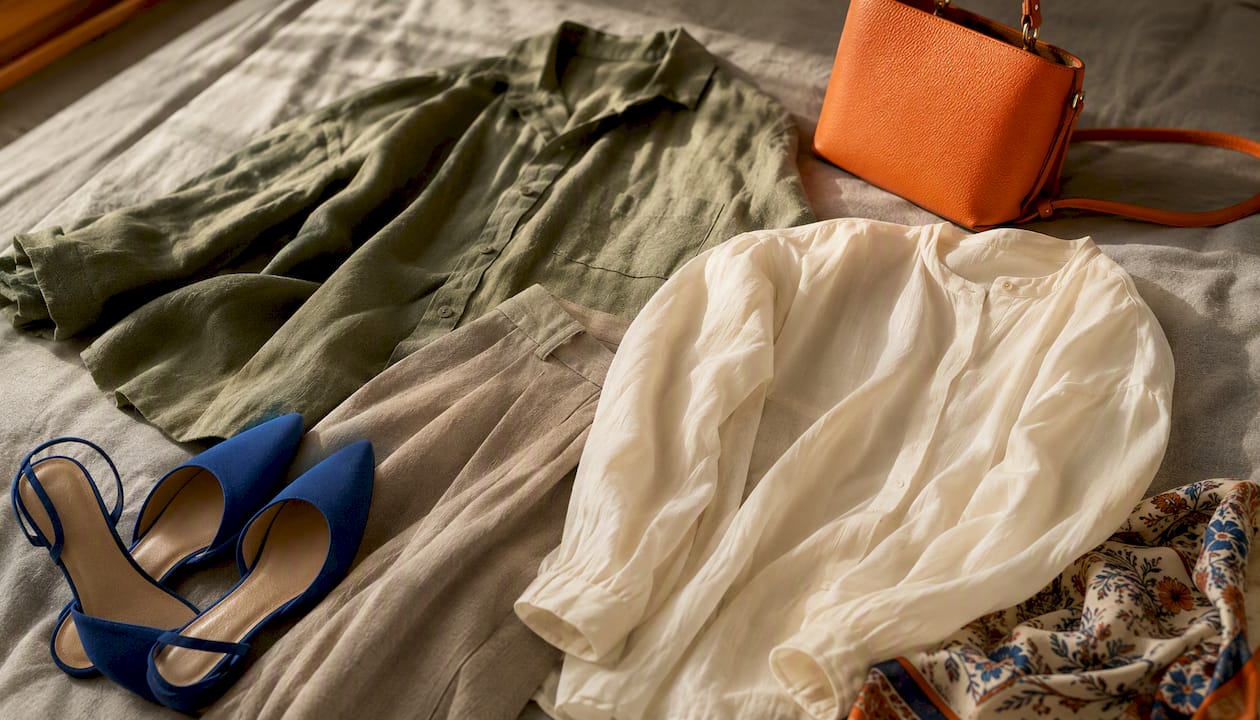
Pick your three neutrals from what's already dominant in your closet, not from a Pinterest board. If you already own six navy pieces and two camel pieces, your neutrals are probably navy, camel, and white or black, not gray and beige just because a style guide said so. Then choose one or two accent colors that show up in your favorite pieces already, a shade of green, a specific red, a mustard yellow, and use them sparingly in tops, scarves, or shoes rather than head to toe.
Seasonal adjustments are minor, not a full rebuild. Warmer months lean toward lighter neutrals like ivory, tan, and light gray; colder months shift toward charcoal, black, and deep browns. Keep your accent colors consistent year round if you can, since that consistency is what makes a personal color story feel intentional rather than accidental. Laundering matters here too: wash dark neutrals inside out in cold water to slow fading, and rotate pieces rather than wearing the same navy sweater four days straight, since heavy rotation is what strips color fastest.
Pro Tip: Texture does a lot of the work that color usually gets credit for. A cream sweater and a cream blouse in the same shade look intentional when one is chunky knit and the other is smooth silk. If two outfits feel flat, check whether every piece has the same texture instead of assuming the color is the problem.
One more trick worth building into your rotation: pick a single accessory color, a cognac bag, a gold necklace, a burgundy shoe, and use it to "pull" together outfits that otherwise feel disconnected. It gives your eye one consistent anchor point across dozens of different combinations.
How Do You Test a Capsule Before Committing to It?
Photograph every outfit you build during your first two weeks and keep them in one dedicated album on your phone, not scattered across camera roll chaos. A simple folder structure works: one album per season, with subfolders or tags for "work," "weekend," and "dressed up." This turns your capsule into a visual reference you can flip through on a rushed morning instead of standing in front of your closet reinventing the wheel.
Outfit formulas speed this up dramatically. A few starting templates:
- Everyday: base top + jeans + primary layer + sneakers.
- Elevated casual: blouse + tailored bottoms + flats + one accent accessory.
- Work: base top + trousers or skirt + blazer + closed-toe shoe.
- Weekend: tee + denim + layer + crossbody bag.
- Travel: same formulas, scaled down to pieces that pack flat and don't wrinkle.
During your 30 to 90 day test, track four things for each piece: how many times you actually wore it, whether it stayed comfortable through a full day, whether it needed ironing or steaming before every wear, and whether it earned an unprompted compliment. Pieces that show up constantly across all four measures are your real capsule. Pieces that sat untouched for three weeks are your real gaps, and now you know exactly what to shop for instead of guessing.
This is where the Ten-Outfit Rule earns its keep again. At the end of your test window, revisit any piece you were unsure about and count the outfits it genuinely appeared in. If it hit ten or more real combinations, it's proven. If it sat at two or three, it's a candidate to donate, no matter how good it looked in the store.
How Do You Fill Gaps Without Overspending?
Once your test surfaces real gaps, write a precise description of what's missing before you shop. "I need a top" is too vague and leads to impulse buying. "I need a short sleeve top in navy or white that pairs with my gray trousers and doesn't need ironing" tells you exactly what to look for and what to skip.
Fit and fabric matter more than brand name for both longevity and versatility. A well-tailored $60 pair of trousers that fits your waist and length will outlast and outperform an ill-fitting $150 pair, and a quick trip to a tailor often solves what a bigger budget can't. Natural fibers like wool, cotton, and linen tend to hold shape and color better over repeated wears than cheap synthetic blends, which pill and lose their form fast.
Spend your money in priority tiers rather than evenly across every category:
- Anchor pieces first: your coat, your everyday shoes, your primary bag. These carry the most outfits and deserve the largest share of your budget, since cost-per-wear on a well-made coat you wear 80 times a season beats cost-per-wear on nearly anything else you own.
- Mid-tier next: blazers, tailored trousers, one good dress.
- Filler last: basic tees, tanks, and camisoles, which are the easiest and cheapest to replace as they wear out.
Before any purchase, run three quick checks: the three-outfit test (can you picture at least three outfits with pieces you already own), the one-week rule (wait a week before buying anything that isn't a true anchor replacement), and a rough cost-per-wear estimate (price divided by realistic number of wears over a year). A $180 coat worn 60 times a season costs $3 a wear. A $25 top worn twice before it's donated costs far more than that per wear, even though the sticker price looks smaller.
What Should Your Capsule Actually Contain?
Here's a category-by-category starting checklist. Adjust counts up or down based on your climate and the percentages you mapped in step two of the build process.
- Tops: 6 to 10 pieces, mixing base layers (tees, tanks) with a few dressier blouses.
- Bottoms: 4 to 6 pieces, split between jeans, tailored trousers, and one skirt if your life calls for it.
- Outerwear: 2 to 3 pieces, one primary layer plus a heavier coat for cold weather.
- Shoes: 3 to 5 pairs, covering everyday walking, a dressier option, and one athletic pair.
- Accessories: 3 to 5 pieces, a bag, a scarf, and jewelry that pulls your accent color through outfits cheaply and easily.
There's no single correct total item count, and ranges commonly run from about 25 to 40 pieces for a full seasonal capsule, with smaller counts working for travel and slightly larger ones for work-heavy schedules. Here are three sample builds you can copy directly:
| Capsule Type | Item Count | Best For |
|---|---|---|
| Travel | 10 to 14 items | A one to two week trip covering multiple climates or activities |
| Monthly seasonal | 25 to 40 items | A single season of everyday life, mixing casual and semi-dressy needs |
| Work-focused | 30 to 40 items | A schedule where professional dress dominates most weekdays |
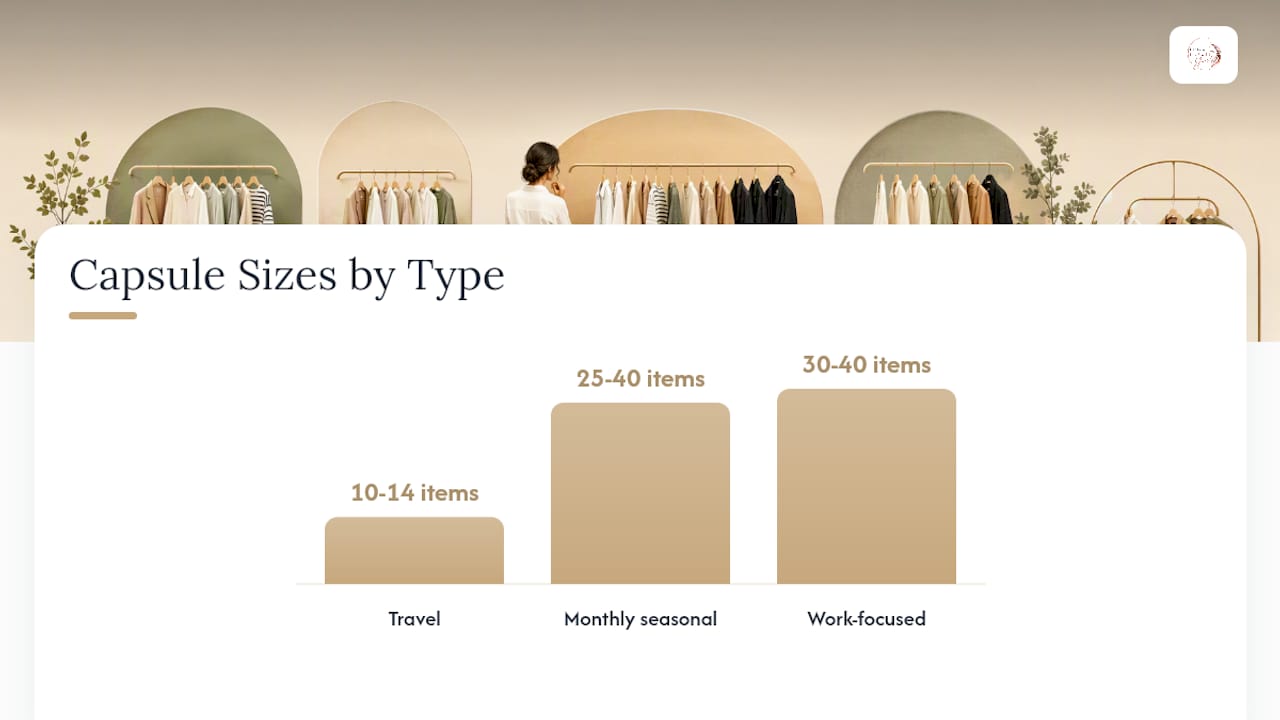
The travel capsule leans hardest on the 3+2 color rule since every piece has to pair with nearly everything else in a tight suitcase. The monthly seasonal build gives you room for a couple of statement pieces alongside your basics. The work-focused capsule needs the most mid-tier investment, since blazers and trousers get worn hardest and most often.
What Mistakes Should You Avoid, and How Do You Maintain It?
The most common mistake is shopping before auditing. People see a capsule wardrobe checklist online, buy everything on it, and end up with pieces that don't reflect their actual life or existing closet. A close second is chasing a specific number, treating "33 items" as a sacred rule rather than a rough guideline shaped by your own schedule. Ignoring shoes and outerwear until the end is another one; these anchor pieces take the longest to source well and deserve early attention, not an afterthought. And skipping fit checks on secondhand or online purchases fills a capsule with pieces that technically match the color story but never actually get worn.
Building a capsule that genuinely holds up takes longer than a weekend, and that's normal.
| Phase | Realistic Timeframe |
|---|---|
| Audit and sort existing closet | 1 to 3 days |
| Living-test with current pieces | 30 to 90 days |
| Targeted shopping to fill real gaps | 2 to 6 weeks |
| Finalizing a seasonal capsule | 3 to 4 months total |
Maintenance is what protects your cost-per-wear math over time. Wash on cold and air dry delicate knits to prevent shrinking and pilling. Rotate your pieces deliberately rather than reaching for the same three favorites daily, since even rotation extends the life of every item. Get a tailor you trust for quick fixes, a hem, a button, a taken-in waist, rather than replacing pieces at the first sign of wear. Find a reliable cobbler for resoling shoes; a $20 resole often adds a full year of wear to a $150 pair. Twice a year, do a seasonal swap: store off-season pieces, re-run your bed test on what's left, and repeat the audit questions from step one.
Pro Tip: Set a recurring reminder for the first week of each new season to re-run your ten-outfit check on your three least-worn pieces. Capsules drift over time as your life changes, and a quick seasonal check keeps yours honest.
Why This Method Actually Sticks
I've watched enough closets get reorganized to notice a pattern: the capsules that survive past the first month are never the ones built from a rigid item list pulled off the internet. They're the ones built from what a woman already reaches for on her busiest, most honest days. That's not a coincidence. Confidence doesn't come from owning the "correct" 33 pieces, it comes from opening your closet and knowing, without a second thought, that everything in there works and fits the life you're actually living.
The women in the Theultimatebeauty-you community consistently tell us that the mental clearing that comes from a working capsule shows up everywhere else, in how they show up for meetings, for dates, for themselves in the mirror. That's the real thread connecting a well-built closet to Theultimatebeauty-you's larger mission: practical self-care, done in small honest steps, builds real confidence.
Get the Printable Checklist and Expert Support
You don't have to run this entire system with a notebook and guesswork. Theultimatebeauty-you gives you a printable version of this exact audit-to-outfit process, so you can check off each step instead of trying to hold five stages in your head while you're also sorting laundry.

Beyond the checklist, the platform connects you with vetted styling experts and partners if you'd rather get a second set of eyes on your gap list before you shop, and it's building out planner and tracking features inside the upcoming app to make the 30 to 90 day test genuinely easy to log instead of scattered across sticky notes. If your style questions go beyond your closet into your broader personal style direction, that's exactly the kind of guidance Theultimatebeauty-you was built to offer. Head to the product page to grab the checklist and see what's available now.
Frequently Asked Questions
How many pieces should be in a capsule wardrobe? Most useful capsules land between 25 and 40 pieces for a full season, though a travel capsule can work with as few as 10 to 14 items. The right count depends on your lifestyle percentages, not a fixed rule.
How long does it take to build a capsule wardrobe? Expect about one to three days for the initial audit, followed by a month or more living with your draft to identify gaps; completing a seasonal capsule often takes several months overall.
What is the Ten-Outfit Rule? It's a quick test for any piece you're unsure about: if you can build at least ten distinct outfits using that item with things you already own, it earns a permanent spot in your capsule. If it can't clear that bar, it's likely a candidate to donate.
Do I need to buy new clothes to start a capsule wardrobe? No. The most durable capsules are built primarily from pieces you already own and wear often, with new purchases reserved for real gaps that show up during your living test.
How do I choose colors for a capsule wardrobe? Pick three neutrals that already dominate your closet, then add one or two accent colors from pieces you already love. This 3+2 approach keeps almost everything mixable without matching perfectly.
Sources
- How to Create a Capsule Wardrobe | Wardrobe Oxygen
- How to Build a Capsule Wardrobe — Madison Effect
- Capsule wardrobe essentials — TheCapsulist
- Areyoufashion
- How to Build a Capsule Wardrobe in 7 Steps (Wear-First Method) — Capsulee Wardrobe