

The boundaries that matter most fall into six categories: time and work, physical and bodily, emotional, digital, financial, and relational. Boundary-setting is a skill, not a personality trait, and you build it the same way you build any skill: through practice, small stakes first, repeated until it feels less like conflict and more like self-respect. What follows are the scripts and stepwise practice that make it real.
TL;DR:
- Setting specific boundaries around work hours, physical touch, and digital communication helps protect your time, body, and attention from ongoing intrusions.
- Women often struggle with boundary-setting due to childhood conditioning and workplace double standards that praise over-functioning over limits.
- Practicing boundaries in low-stakes situations and using simple scripts with repeated reinforcement builds the confidence needed to enforce limits effectively.
- Repeating boundaries calmly and consistently, especially when faced with pushback, reinforces your self-trust and discourages disrespectful behaviors.
- Boundaries are about your commitments to your own behavior, not about controlling others, and consistent practice helps your nervous system accept limits as self-respect.
Table of Contents
- Boundaries for Women: The Six Types That Protect What Matters
- Why Boundary-Setting Feels So Hard for Women
- How to Set a Boundary and Actually Hold It
- Setting Boundaries at Work Without Torching Your Reputation
- Scripts for Friends, Family, Partners, and Coworkers
- When Someone Pushes Back and How to Hold the Line
- What a Clinical Lens Adds to the Boundary Conversation
- An Editorial Take on Boundaries as Self-Respect
- Sources
- FAQ
Boundaries for Women: The Six Types That Protect What Matters
Boundaries work best when you know exactly which one you're setting. Vague limits get ignored. Specific ones get respected.
- Time and work boundaries. These protect your hours and your focus. Example: not answering work messages after 7 p.m., or blocking two hours a day with no meetings.
- Physical and bodily boundaries. These protect your body and personal space. Example: telling a relative you don't want a hug right now, or declining a medical opinion you didn't ask for.
- Emotional boundaries. These protect your feelings from being managed by someone else's mood. Example: refusing to take responsibility for a friend's anger when you didn't cause it.
- Digital boundaries. These protect your attention and privacy online. Example: muting a group chat during work hours or not replying to texts within minutes just because you're expected to.
- Financial boundaries. These protect your money and generosity from becoming an obligation. Example: saying no to lending money without offering a justification.
- Relational boundaries (friends, family, romantic partners). These protect the terms of closeness itself. Example: declining a last-minute favor that would derail your weekend, even for someone you love.
Most women find that one or two categories cause repeated trouble, often related to work and family. For practical guidance on maintaining these boundaries effectively, see Balance Your Nursing Career and Family Obligations. That's normal. Common boundary categories also include intellectual, sexual, and material limits, all worth naming once you notice the pattern in your own life.
Why Boundary-Setting Feels So Hard for Women
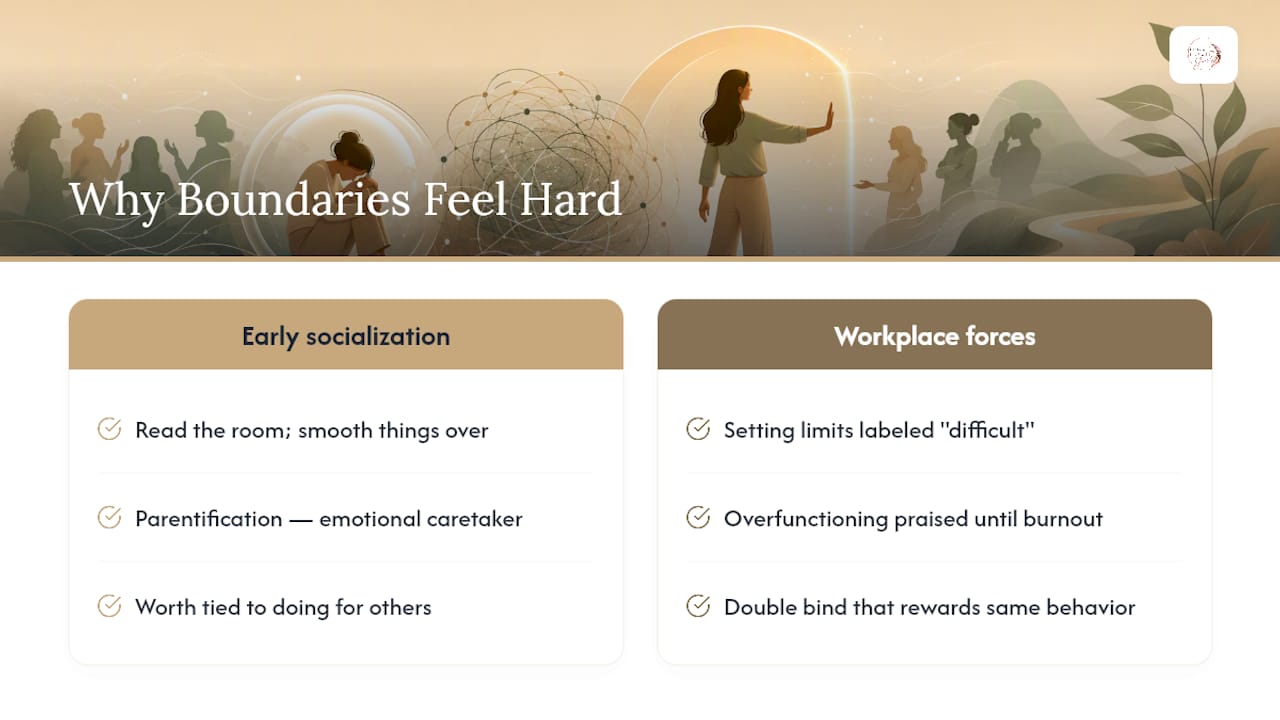
If asking for a limit makes your stomach drop, you're not overreacting. Many women were raised to read the room, smooth things over, and put their own needs last. That training doesn't disappear at adulthood. It shows up as guilt every time you try to say no.
Therapist Annie Wright's work with high-achieving women traces a lot of this discomfort to childhood roles, including parentification, where a child becomes the emotional caretaker of a parent, and chronic self-silencing to keep the peace. Many driven women struggle with boundaries because the pattern traces back to how they learned to survive relationally, not because something is wrong with them now.
Women who over function at work often learned early that their worth was tied to what they could do for others, not what they needed for themselves.
Workplaces compound the problem. Women who set limits are sometimes labeled difficult, while women who over function get praised right up until burnout. That double bind rewards the exact behavior boundaries are meant to interrupt.
How to Set a Boundary and Actually Hold It
Setting a boundary is a process, not a single conversation. Skipping steps is why so many limits collapse the first time someone pushes back.
- Decide ahead of time. Pick a low-stakes situation to practice on, like declining a coffee catch-up you don't have energy for. Don't start with your hardest relationship.
- Write a one-sentence script. Keep it short: "I can't take that on this week." No justification required.
- Rehearse it out loud. Say it in the mirror or to a trusted friend before you say it to the person who needs to hear it. This is graduated exposure, and practicing small boundary steps helps build tolerance for the discomfort that comes with holding limits.
- Follow through calmly. State the boundary once, without escalating your tone. If it's tested, repeat it rather than defending it.
- Track your wins. Note every time you held a limit, even a small one. This builds the self-trust that makes the next boundary easier.
Pro Tip: Practice your boundary on someone low-risk first, like a delivery driver or a cashier. A stranger who doesn't push back is the easiest way to build the muscle before you use it on people who might.
Setting Boundaries at Work Without Torching Your Reputation
Workplace boundaries protect the two things your job actually depends on: your time and your ability to think clearly. A calendar with no white space and an inbox that never closes will wear down even the most capable woman.
- Set explicit hours for email and set an auto-response if you need backup: "Responses outside 9 to 5 will come the next business day."
- Block focus time on your calendar and treat it the same as a meeting you can't skip.
- When a project starts expanding past its original scope, say so directly: "This wasn't part of the original ask. Let's talk about what moves to make room for it."
- If you lead a team, model the limit yourself. Setting boundaries as a leader signals capacity protection, not low commitment, and teams tend to copy whatever their manager does.
- If a limit gets ignored more than once, document it in writing and escalate to HR or your manager rather than absorbing it quietly.
Scripts for Friends, Family, Partners, and Coworkers
Having the exact words ready matters more than having the perfect reasoning. Short, simple sentences function as complete boundaries on their own, with no explanation attached.
- To a friend who overshares without asking: "I can't be your only support on this. Can we talk to a professional too?"
- To family pressuring you at a gathering: "I'm not discussing that tonight."
- To a partner who wants an answer right now: "I need until tomorrow to answer that."
- To a coworker asking for a favor that isn't yours to do: "That's outside what I can take on this week."
- If someone pushes past your first sentence, repeat it once, then add the follow-through: "I said I can't. I'm going to head out now."
Notice none of these scripts apologize or over-explain. The instant you add a paragraph of justification, the other person has something to argue with.
When Someone Pushes Back and How to Hold the Line
Pushback isn't proof your boundary was wrong. It's often proof the boundary was needed. People who benefited from your lack of limits will usually test the new ones at least once.
- Repeat the boundary in the same words rather than negotiating a new version of it.
- Shorten your response each time. The first "no" can have a sentence of context; the third doesn't need one.
- Enforce the natural consequence. If you said you'd leave the conversation, leave it.
- Limit access where the pattern continues. Fewer calls, shorter visits, less availability.
Pro Tip: If someone in your life reacts to every boundary with anger or guilt trips, that reaction is data. It tells you what kind of relationship you're actually in, not what kind of person you are.
If the pushback turns into repeated disrespect, protecting your own well-being sometimes means reducing contact or bringing in outside support, whether that's a therapist, a coach, or a trusted friend who can help you hold steady.
What a Clinical Lens Adds to the Boundary Conversation
Annie Wright's clinical work reframes boundary struggles as learned, not innate. Boundaries are commitments about your own behavior, not rules you hand another person to follow, which is exactly the distinction that keeps a limit from turning into an ultimatum.
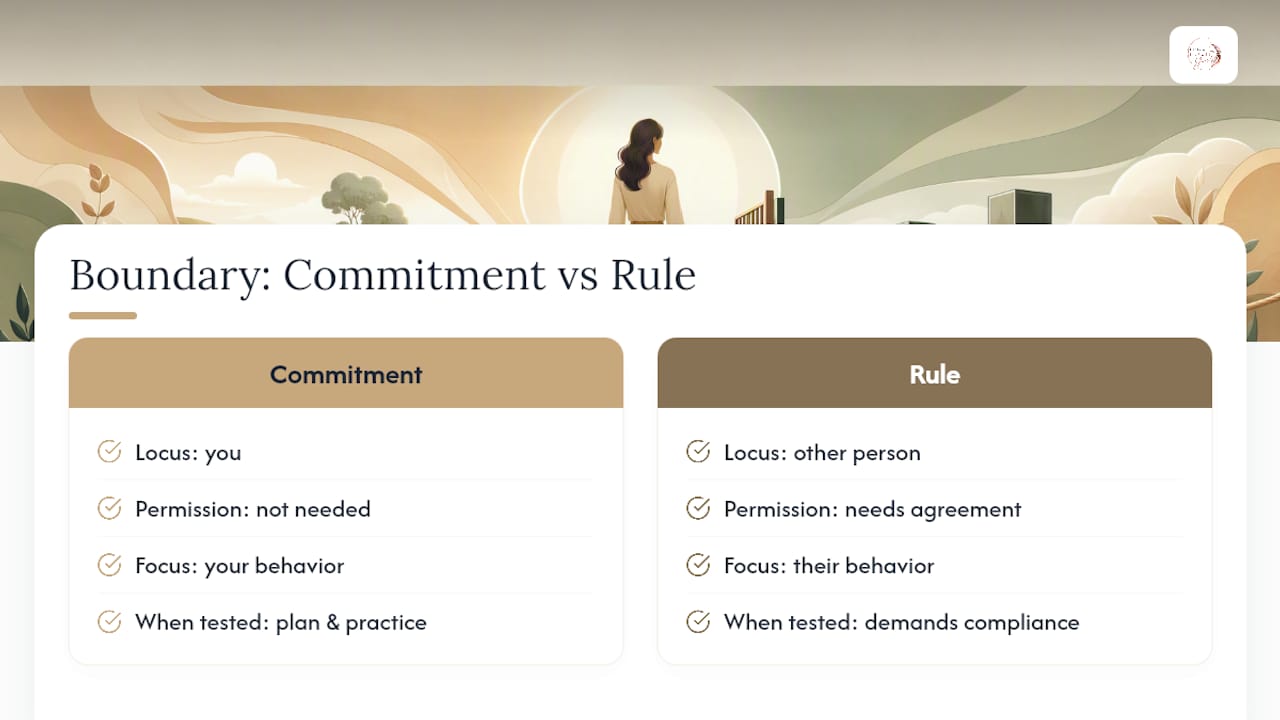
That reframe matters because it puts the control back where it belongs: with you. You don't need someone else's permission or agreement to hold a limit. You need clarity about what you'll do next time it's tested, and enough practice that saying it doesn't feel like a fight.
A platform connects women with vetted experts and practical resources for exactly this kind of work, from therapists to coaches who specialize in confidence and self-advocacy.
An Editorial Take on Boundaries as Self-Respect
Most boundary advice tells women what to say. Almost none of it tells them why saying it feels so hard, and that gap is where people give up. The scripts in this piece aren't the hard part. The hard part is the half second before you say them, when guilt tells you that a limit makes you selfish or difficult.
Conventional advice oversells the one perfect conversation and undersells the fifty small ones. Boundaries built during a single tense confrontation rarely last. Boundaries built on declining a coffee catch-up, muting a chat, or logging off at 7 p.m. do, because they train your nervous system that a limit won't cost you the relationship.
If you take one thing from this, prioritize low-stakes practice before you tackle your hardest relationship. Confidence in your own limits comes from evidence, not intention, and evidence only accumulates through repetition. Start smaller than feels necessary. It works faster than starting big.
— Ava
Sources
For deeper reading on this topic, Annie Wright's therapist's guide to setting boundaries and Nancy GLO's boundary guide for women both offer practical grounding beyond this article. Explore Theultimatebeauty-you's resource platform for tools, experts, and support as you practice.
- Boundaries at work for women who were raised not to have any | Annie Wright
- The Complete Guide to Setting Boundaries as a Woman | Nancy GLO
- Setting boundaries | University Counseling Services (KU CAPS)
FAQ
What are some examples of healthy boundaries for women?
Common examples include not answering work email after set hours, declining physical affection you don't want, refusing to justify how you spend money, and limiting access to people who consistently disrespect your time.
What are 5 healthy boundaries to focus on first?
Time, physical, emotional, digital, and financial boundaries cover most day-to-day friction points and are the easiest categories to start practicing in low-stakes situations.
What are the different types of boundaries?
Boundaries generally fall into physical, emotional, intellectual, digital, sexual, material or financial, and professional categories, and most people need practice across several of them, not just one.
What are signs of unhealthy boundaries?
Chronic people-pleasing, resentment you can't quite name, frequent burnout, saying yes when you mean no, and a creeping loss of trust in your own judgment are all common signs boundaries have broken down.
How do I set a boundary without feeling guilty?
Guilt tends to fade with repetition, not with finding the perfect words. Practice on low-stakes situations first, keep your script short, and remember a boundary is a statement about your own behavior, not a request for permission.