

Women experience stress differently than men, and the gap is not subtle. Women are more likely than men to report physical symptoms of stress, including headaches and upset stomach, and are more vulnerable to stress-related depression and anxiety. The good news: once you understand what's driving your stress, you have real options.
Effective stress management for women starts with recognizing that your body, hormones, and social roles shape how stress hits you and how you recover. These strategies give you a strong starting point:
- Move your body. Aim for about 2.5 hours of moderate aerobic exercise per week. Even short walks count.
- Prioritize sleep. Adults need 7–9 hours per night to regulate stress hormones and support immune function.
- Practice relaxation techniques. Deep breathing, progressive muscle relaxation, and meditation all calm the nervous system quickly.
- Lean on your people. Social connection measurably reduces perceived stress, especially for women navigating caregiving or chronic illness.
- Set firm boundaries. Saying no to non-essential demands protects your mental health. It is not optional; it is clinical.
- Eat to support your nervous system. Foods rich in B vitamins, like bananas, avocados, and leafy greens, help regulate stress hormones.
- Seek professional support when needed. A therapist, counselor, or physician can offer tools that go beyond self-help.
How stress shows up differently in women
Women don't just feel more stress. They feel it in distinct ways, driven by biology and the weight of social expectations that still fall disproportionately on female shoulders.
Symptoms to watch for
The Cleveland Clinic identifies stress symptoms in women across four dimensions:
- Physical: Headaches, muscle tension, sleep disruption, digestive issues, skin flare-ups, low energy, changes in appetite
- Emotional: Anxiety, irritability, mood swings, depression, feeling out of control
- Mental: Forgetfulness, difficulty concentrating, negative thinking, loss of motivation
- Social: Withdrawal, isolation, reduced intimacy, family conflict
What's causing it
Caregiving sits at the top of the list. Many women spend more time meeting others' needs than their own, and that imbalance accumulates. Hormonal shifts across the menstrual cycle, pregnancy, and menopause amplify the stress response at every life stage. Workplace pressures, financial strain, and the persistent expectation to "do it all" compound the load.
The health stakes
Chronic stress is not just exhausting. It raises blood pressure, suppresses the immune system, and worsens cardiovascular recovery in women compared to men after cardiac events. The link between stress and weight gain is also stronger for women, driven by elevated cortisol that promotes fat storage. Stress can disrupt menstrual cycles, worsen PMS, reduce fertility, and increase the risk of irritable bowel syndrome, which is twice as common in women as in men.
12 proven strategies for managing stress as a woman
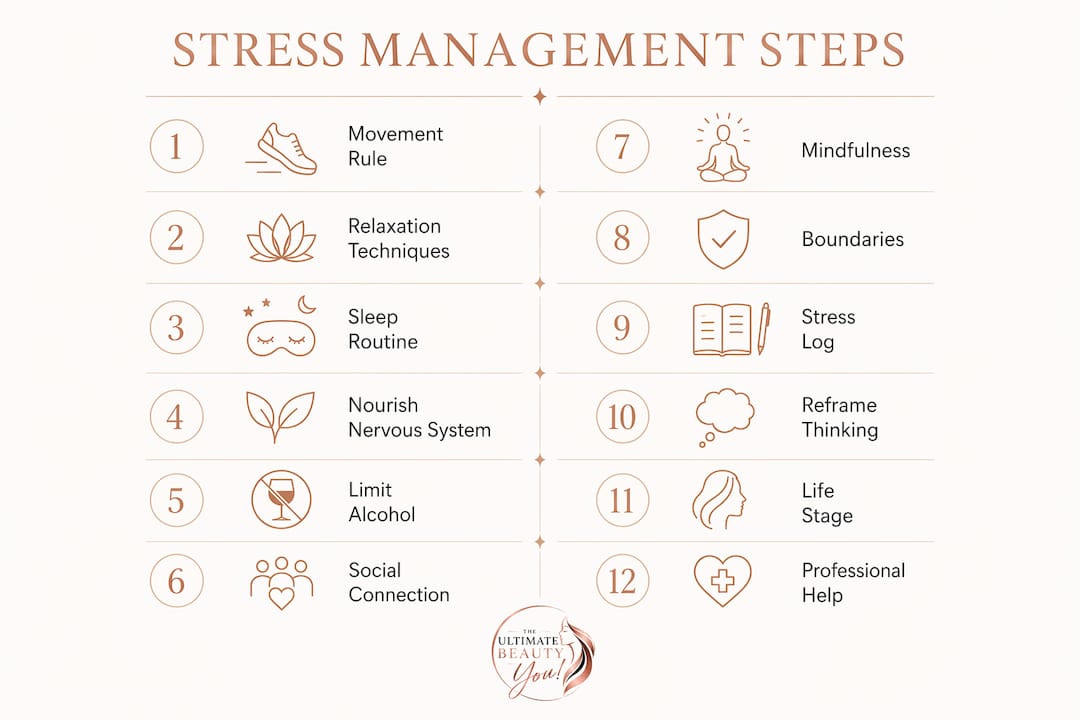
1. Use the 20-2-8 movement rule
Sitting for long stretches amplifies stress on the body. Johns Hopkins Medicine recommends the "20-2-8" rule: for every 20 minutes of sitting, spend 8 minutes standing and 2 minutes walking. Pair this with a goal of roughly 2.5 hours of moderate aerobic exercise per week, and you get a meaningful boost to both mood and heart health.
2. Try body-first relaxation techniques
When stress peaks, your rational brain often can't talk you down. That's where body-focused techniques come in. The 4-7-8 breathing method (inhale for 4 counts, hold for 7, exhale for 8), progressive muscle relaxation, and even splashing cold water on your face activate the parasympathetic nervous system and calm acute stress fast.
Pro Tip: Progressive muscle relaxation works best when you start from your feet and work upward, tensing each muscle group for 5–10 seconds before releasing. Five minutes before bed can dramatically improve sleep quality.
3. Build a real sleep routine
Quality sleep of 7–9 hours per night is one of the most powerful stress regulators available. Women, who are more prone to insomnia during hormonal shifts, benefit especially from consistent sleep and wake times, limiting screens before bed, and keeping the bedroom cool and dark. Think of sleep as the foundation everything else rests on.
4. Eat for your nervous system
Cortisol, the primary stress hormone, drives cravings for fat and sugar during chronic stress. Countering that with B-vitamin-rich foods like fish, eggs, avocados, and dark leafy greens gives your brain and nervous system the raw materials to regulate mood. The American Psychological Association also cautions against using alcohol to dampen stress, since it doesn't address the root cause and creates new health risks.
5. Limit alcohol intentionally
The CDC recommends no more than one drink per day for women and warns that using alcohol to cope actively worsens stress over time. A glass of wine might feel like relief in the moment, but it disrupts sleep architecture and raises cortisol the following day.
6. Cultivate social connection
Women with strong social networks recover from stress faster. Stanford Medicine psychiatrist Dr. David Spiegel's foundational research found that women with metastatic breast cancer who participated in peer support groups reported less anxiety and better quality of life than those who did not. You don't need a formal group. Regular, honest conversations with people you trust create the same buffer.

7. Practice mindfulness and meditation
Mindfulness-based stress reduction, or MBSR, has a strong clinical track record. Even five minutes of focused breathing in a quiet space, where you acknowledge stray thoughts without judgment and return to the present, produces measurable reductions in anxiety. Apps like Calm and Insight Timer make this accessible without a therapist's appointment. For a deeper look at mindfulness practices for women, Theultimatebeauty-you has a dedicated 2026 guide worth bookmarking.
8. Set non-negotiable boundaries
Saying no to non-essential demands is not a personality trait. It's a clinical stress management tool. Women who face hormonal fluctuations and caregiving pressures need intentional, protected time. Start small: one boundary per week, whether that's declining an extra work task or protecting a Saturday morning for yourself.
9. Keep a stress log
Tracking your stress triggers in a journal helps you spot patterns you'd otherwise miss. Audit-based planning like this, combined with tech-free time blocks and scheduled recovery periods, gives you concrete control points rather than vague intentions. Clarity about what drains you is the first step toward changing it.
10. Reframe your thinking
Cognitive reframing, the practice of shifting how you interpret a stressor, is one of the most research-supported anxiety management tools available. Instead of "I have to do this," try "I get to do this." Instead of catastrophizing, ask what you can actually control. This isn't toxic positivity. It's a practiced skill that gets easier with repetition.
11. Adapt your approach by life stage
Stress management looks different at 22, 35, and 52. Adolescent women benefit from building emotional vocabulary and peer connection early. During pregnancy and postpartum, physical self-care and professional support become critical, since hormonal volatility is at its peak. Perimenopause and menopause bring new stressors, including sleep disruption and mood shifts, that respond well to mindfulness, intentional self-care, and, when appropriate, medical guidance. The strategies don't change entirely, but the emphasis does.
12. Know when to get professional help
Self-help strategies work for everyday stress. When stress is affecting your relationships, your ability to work, or pushing you toward substance use, a licensed therapist or counselor is the right next step. The Substance Abuse and Mental Health Services Administration (SAMHSA) offers a treatment locator at findtreatment.samhsa.gov. Reaching out is not a last resort. It's a sign of self-awareness.
A holistic approach to stress: the Theultimatebeauty-you perspective
At Theultimatebeauty-you, we believe that caring for yourself is not indulgent. It is the foundation of everything else you do well.
Our approach to stress connects beauty, confidence, and wellness as one continuous practice, not separate boxes to check. Here's what that looks like in practice:
- Emotional regulation: Name what you're feeling before you try to fix it. Journaling, breathing, and honest conversation all help.
- Self-advocacy: Know your limits and communicate them. Your needs are as valid as anyone else's.
- Community support: Surround yourself with women who lift rather than drain. Connection is medicine.
- Beauty as self-care: A skincare ritual, a walk in natural light, or a moment of stillness with your favorite scent all signal to your nervous system that you are worth caring for. Explore how lifestyle choices shape both your skin and your stress levels.
- Consistency over perfection: You don't need a flawless routine. You need a real one that you return to, even after hard days.
Key Takeaways
Women's stress is shaped by hormones, caregiving roles, and social pressures that require targeted, consistent strategies to address effectively.
| Point | Details |
|---|---|
| Women experience stress differently | Hormonal shifts and caregiving roles intensify stress symptoms and increase risk of depression and anxiety. |
| Sleep is a clinical priority | Adults need 7–9 hours per night; consistent sleep directly regulates cortisol and immune function. |
| Body-first techniques work fast | Breathing exercises and progressive muscle relaxation activate the parasympathetic system during acute stress. |
| Boundaries and social support matter | Saying no to non-essential demands and maintaining strong social networks measurably reduce chronic stress. |
| Theultimatebeauty-you offers a holistic path | The platform connects beauty, confidence, and wellness as one integrated practice for women at every life stage. |
Why stress management is really about becoming yourself
Here's what most stress advice misses: it treats stress as a problem to eliminate rather than a signal to understand. For women especially, chronic stress is often the body's way of saying the current arrangement isn't working. The caregiving load is too heavy. The boundaries are too porous. The self-care is too far down the list.
The most powerful shift isn't finding the perfect breathing technique. It's deciding, firmly, that your wellbeing belongs at the center of your life, not the edges. Every boundary you set, every hour of sleep you protect, every honest conversation you have with a friend, these are not small acts. They are the practice of becoming the version of yourself who handles hard things with grace instead of depletion.
Stress management is not a destination. It's a daily practice of choosing yourself, imperfectly and persistently. That's what resilience actually looks like.
Your wellness starts here, with Theultimatebeauty-you
Stress doesn't have to be the background noise of your life. Theultimatebeauty-you was built for exactly this moment, for women who are ready to stop running on empty and start building a life that actually feels good from the inside out.

Whether you're looking for wellness products that support your body and mind, expert guidance tailored to your life stage, or a community of women who get it, Theultimatebeauty-you brings it all together. Our platform connects you with trusted experts, evidence-backed resources, and a warm, inclusive space where your growth is celebrated. You deserve more than survival mode. Come find what thriving looks like for you at Theultimatebeauty-you.