

The fastest way to feel better in a hard moment is a 1 to 5 minute Self-Compassion Break, and it works because it activates all three components of self-compassion at once. If that one does not fit your moment, try the treat-a-friend exercise or a two-line journal prompt instead. All three are covered below, with exact scripts, and this guide is built so you can pick one right now and actually do it.
TL;DR:
- Self-Compassion Break can reduce anxiety and depression with just one minute, using specific phrases tailored to the moment's needs.
- Writing a compassionate letter or journal prompt helps slow critical thoughts and fosters self-kindness over a few minutes daily.
- Supportive touch such as self-hugs or grounding techniques activate calming hormones, especially when words feel too difficult.
- Consistent practice, starting small and attaching practices to existing routines, increases long-term adherence and effectiveness.
- Short scripts and imagery exercises are accessible tools that can be integrated into busy or overwhelming days for immediate relief.
Table of Contents
- 8 Self-Compassion Exercises To Try Today
- How Do You Do a Self-Compassion Break?
- What Would You Say to a Friend Struggling Like This?
- Self-Compassion Letters and Journaling Prompts That Work
- Can Touch and Grounding Actually Calm You Down?
- How Do You Quiet a Harsh Inner Critic?
- Which Meditations Build Self-Compassion Fastest?
- Building a Daily Self-Compassion Habit: A 4-Week Plan
- Scripts and Tools Ava Uses for Daily Practice
- What Guided Imagery Helps You Feel Self-Compassion?
- How Does a Body Scan Support Self-Compassion?
- Why Is Self-Compassion So Hard To Practice Consistently?
- An Honest Note on Practicing This Imperfectly
- Bring Self-Compassion Into Your Daily Routine
- Sources
8 Self-Compassion Exercises To Try Today
Some moments call for something instant. Others call for a slower practice you return to daily. Here are eight exercises, sorted by how fast they work.
- Self-Compassion Break. Say three short phrases (suffering, common humanity, kindness) out loud or in your head. Use it the moment you notice distress. Takes about a minute.
- Treat-a-friend writing exercise. Write how you'd respond to a friend in your situation, then read it back to yourself. Best for recurring self-criticism, not emergencies.
- Compassionate letter. Write a full letter to yourself from the voice of an unconditionally loving friend. Do this once a week, not in the heat of the moment.
- Self-compassion journaling. Answer three short prompts tied to mindfulness, common humanity, and self-kindness. Works well as a five-minute nightly ritual.
- Supportive touch. Place a hand over your heart or cross your arms in a gentle self-hug. Use it anytime, especially when words feel like too much.
- Reframing critical self-talk. Catch a harsh thought and rewrite it in the voice you'd use with someone you love. Practice this as it happens, throughout the day.
- Loving-kindness meditation. Repeat phrases like "may I be safe, may I be kind to myself" for two to twenty minutes. Good for a calmer, scheduled sit.
- Caregiver micro-practice. A 30 second hand-on-heart pause between tasks, adapted for people with no spare time. Built for parents, shift workers, and anyone mid-crisis.
Reach for numbers 1, 5, and 8 in the middle of a bad moment. Save numbers 3, 4, and 7 for a quieter part of your day, when you have five to twenty minutes to actually sit with the practice.
How Do You Do a Self-Compassion Break?
The Self-Compassion Break is a three-line script built around mindfulness, common humanity, and self-kindness, and research on Mindful Self-Compassion programs that include it links the practice to greater life satisfaction and reduced anxiety and depression. Here's the exact script:
- Mindfulness line: "This is a moment of suffering." (Or: "This really hurts right now.")
- Common humanity line: "Suffering is part of life." (Or: "Other people feel this too. I'm not alone in this.")
- Self-kindness line: "May I be kind to myself." (Or: "May I give myself the compassion I need.")
Three variations change the third line depending on what you actually need in the moment:
- Tender variation: "May I accept myself as I am."
- Protective variation: "May I keep myself safe."
- Motivating variation: "May I have the strength to do what's needed."
Try the full Break once a day for one week, out loud if you can, even when nothing is wrong. That repetition is what makes the script available to you automatically once something is wrong. After the first week, use it as needed instead of on a schedule.
Pro Tip: Say the lines while brushing your teeth for one week straight. It sounds small, but pairing a new script with an existing routine is one of the easiest ways to make it stick.
What Would You Say to a Friend Struggling Like This?
This is a writing exercise, and it works because most people are far kinder to others than to themselves. It only takes four steps.
- Write the situation. In two or three sentences, describe exactly what's bothering you, without softening it.
- Write your typical self-response. What do you actually say to yourself about this? Write it verbatim, even if it's harsh.
- Write the friend response. Imagine someone you love came to you with this exact problem. Write what you'd say to them, in full sentences.
- Compare the two, then extract a phrase. Pull one line from the friend response, something that fits in ten to fifteen seconds. That becomes your mantra.
A typical friend response sounds like "You're doing your best with a hard situation, and that counts for something," not "You always mess this up." The gap between those two tones is usually the whole point of the exercise. Once you have your short mantra, use it the next time the same self-response shows up.
Self-Compassion Letters and Journaling Prompts That Work
Writing slows down the inner critic long enough for a kinder voice to get a word in. Two formats do most of the work: a longer compassionate letter, and short daily prompts.
Compassionate letter template:
- Open with: "Dear [your name], I'm writing to you from a place of love and without judgment."
- Middle section: describe the struggle the way an unconditionally loving friend would, naming what's hard without minimizing it.
- Close with: "You are worthy of compassion, especially right now. I love you."
Daily journaling prompts, grouped by the three components self-compassion research identifies (self-kindness, common humanity, mindfulness), from structured self-compassion exercises and worksheets:
- Self-kindness: "What do I need to hear right now that I haven't said to myself?"
- Common humanity: "Who else has likely felt exactly this?"
- Mindfulness: "What am I feeling in my body at this exact moment, without fixing it?"
Write for five minutes a day, then check in weekly: are the prompts getting easier to answer, or does the same one keep resisting you?
Can Touch and Grounding Actually Calm You Down?
Yes, and the mechanism is physical, not just mental. A gentle hand on your heart or a self-hug can trigger a release of oxytocin and engage the parasympathetic nervous system, according to Harvard Health, which is part of why supportive touch works even when you can't find the right words.
- Hand over heart: Place one or both hands on your chest, breathe slowly, and let your shoulders drop. Use this when a thought spirals faster than you can write.
- Gentle self-hug: Cross your arms and give your own upper arms a light squeeze. Good for public moments when writing isn't an option.
- Soles-of-the-feet grounding: Sit, feel both feet flat on the floor, and notice the sensation for three slow breaths. This works better than writing when you're too activated to think in words.
Choose touch over journaling when your body feels tense before your mind has named why.
How Do You Quiet a Harsh Inner Critic?
The inner critic isn't a flaw to eliminate. It's a normal pattern, and self-compassion changes how you respond to it rather than trying to silence it outright, per Cleveland Clinic.
- Name it. Say, silently or out loud, "That's my inner critic talking." Naming creates a half-second of distance.
- Use a micro-script. Try: "I notice I'm being hard on myself. What would I say to someone I love right now?" or simply "This is a hard moment, not a character flaw."
- Build a cue-response plan. Pick one recurring trigger (a mirror, a work mistake, a scale) and attach one script to it in advance, so you're not improvising mid-spiral.
Pro Tip: Skip generic positive affirmations like "I am amazing" if they feel false. Try a releasing statement instead: "I don't have to believe this thought right now." It's easier to accept and just as effective at breaking the loop. Pairing this with self-talk techniques built for women can round out your script library.
Which Meditations Build Self-Compassion Fastest?
Two scripts cover most needs: loving-kindness meditation and affectionate breathing, both standard practices in self-compassion training.
- Loving-kindness, short version: Silently repeat, "May I be safe. May I be kind to myself. May I accept myself as I am." Three breaths, done.
- Loving-kindness, extended version: The same phrases repeated slowly for 10 to 20 minutes, eyes closed, often extended outward to others afterward.
- Affectionate breathing, micro version: Breathe in for four counts, out for six, silently thinking "kindness in, tension out," for one minute.
- Affectionate breathing, extended version: The same breath pattern for 10 minutes, paired with a hand on your heart.
Each version touches all three components: the pause is mindfulness, the shared phrasing acknowledges common humanity, and the wish itself is self-kindness.
Building a Daily Self-Compassion Habit: A 4-Week Plan
Consistency beats intensity, especially early on. This roadmap starts small on purpose.
- Week 1: One Self-Compassion Break daily, paired with an existing habit like brushing your teeth.
- Week 2: Add a 5 minute journal prompt at night, tied to the three components.
- Week 3: Add supportive touch (hand on heart) anytime you notice tension, no fixed schedule.
- Week 4: Write your first compassionate letter, then choose your two or three strongest practices to keep long term.
Adherence rises when practices attach to rituals you already have, whether that's morning skincare or evening tea, so anchor each new step to something automatic instead of something you have to remember.
| Week | Focus | Minimum daily time |
|---|---|---|
| 1 | Self-Compassion Break | 1 minute |
| 2 | Journaling prompts | 5 minutes |
| 3 | Supportive touch | As needed |
| 4 | Compassionate letter + review | 15 minutes (one time) |
If a week feels like too much, repeat it rather than skip ahead. A missed day doesn't restart the plan.
Scripts and Tools Ava Uses for Daily Practice
A few copy-ready lines make the difference between knowing a practice and actually doing it.
- Morning mirror script: "This face carries me through every day. That's worth some kindness."
- Mid-day reset script: "I'm allowed to be tired and still be doing enough."
- Evening wind-down script: "Today was hard in places. I still showed up."
Ava's quick habit checklist: pick one script, attach it to one daily ritual, and give it seven days before judging whether it "works." Small rituals count, whether that's saying a line while applying moisturizer or repeating it during a mindful beauty routine. For readers building resilience around appearance-related stress specifically, beauty anxiety coping strategies pair naturally with these scripts.
What Guided Imagery Helps You Feel Self-Compassion?
Guided imagery works by giving your mind a concrete scene to settle into, rather than an abstract instruction to "be kind to yourself." One common version: picture a compassionate figure, real or imagined, sitting beside you. It could be a grandmother, an old friend, or simply an unnamed warm presence. Picture them not fixing your problem, just being there.
Another version imagines your future self, five or ten years from now, looking back at this exact struggle with tenderness rather than judgment. Ask what she would want you to know right now.
A third option pictures your pain as something you can physically set down for a moment, a heavy bag placed gently on the ground, just long enough to breathe. You pick it back up if you need to, but the image gives your nervous system a break.
Run any of these for two to five minutes, eyes closed, in a quiet spot. None of them require special training or a specific voice recording. The imagery only needs to be vivid enough that you can hold it steady for a few slow breaths, and specific enough that it feels like yours rather than a generic scene borrowed from somewhere else.
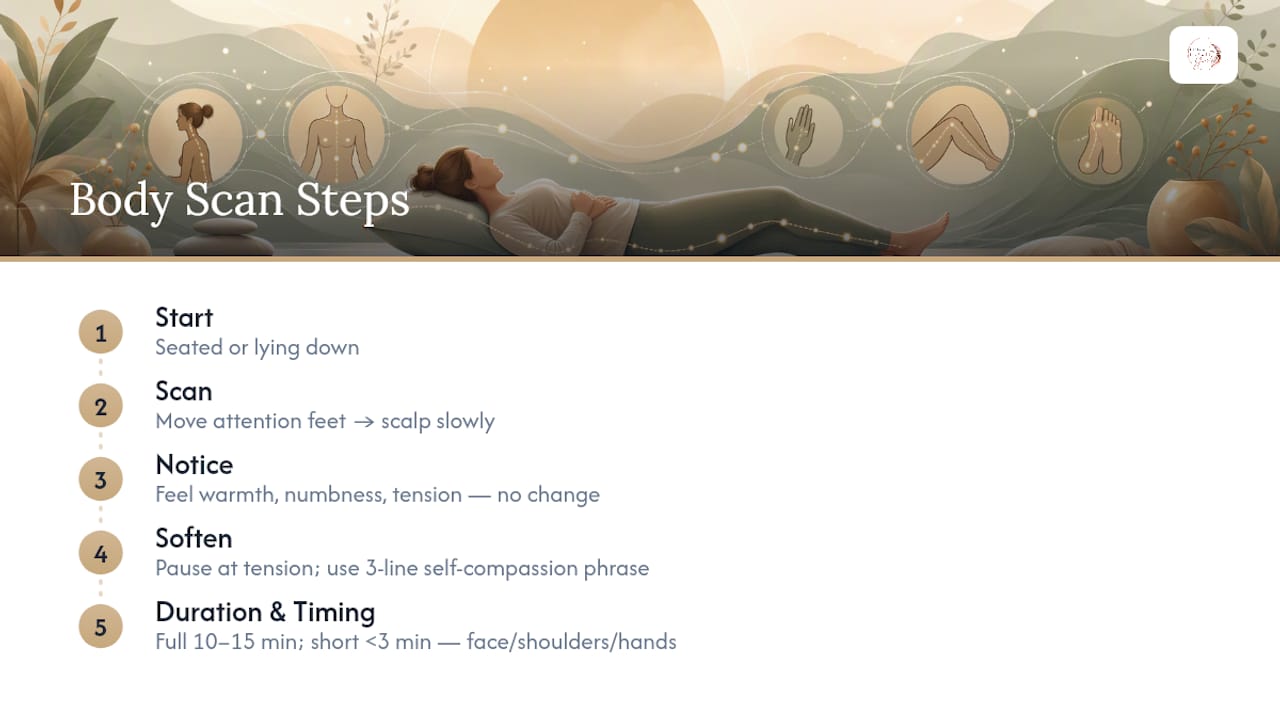
How Does a Body Scan Support Self-Compassion?
A body scan works because most self-criticism happens in your head, disconnected from what's actually happening physically. Slowing down enough to notice bodily sensation interrupts that loop.
Start seated or lying down. Move attention slowly from your feet up to your scalp, noticing tension, warmth, or numbness in each area without trying to change it. When you reach an area holding tension, a clenched jaw, tight shoulders, a knotted stomach, pause there and silently offer it the same three-part Self-Compassion Break language: "This is tension. Tension is common. May I soften here."
A full scan takes 10 to 15 minutes, but a short version works in under three: scan just your face, shoulders, and hands, the three places most people carry visible stress. Do this before bed or right after a stressful meeting, whichever fits your day better. The goal isn't to eliminate the tension. It's to notice it with curiosity instead of frustration, which is often the actual doorway into self-kindness.
Why Is Self-Compassion So Hard To Practice Consistently?
Three obstacles come up constantly, and each has a specific workaround.
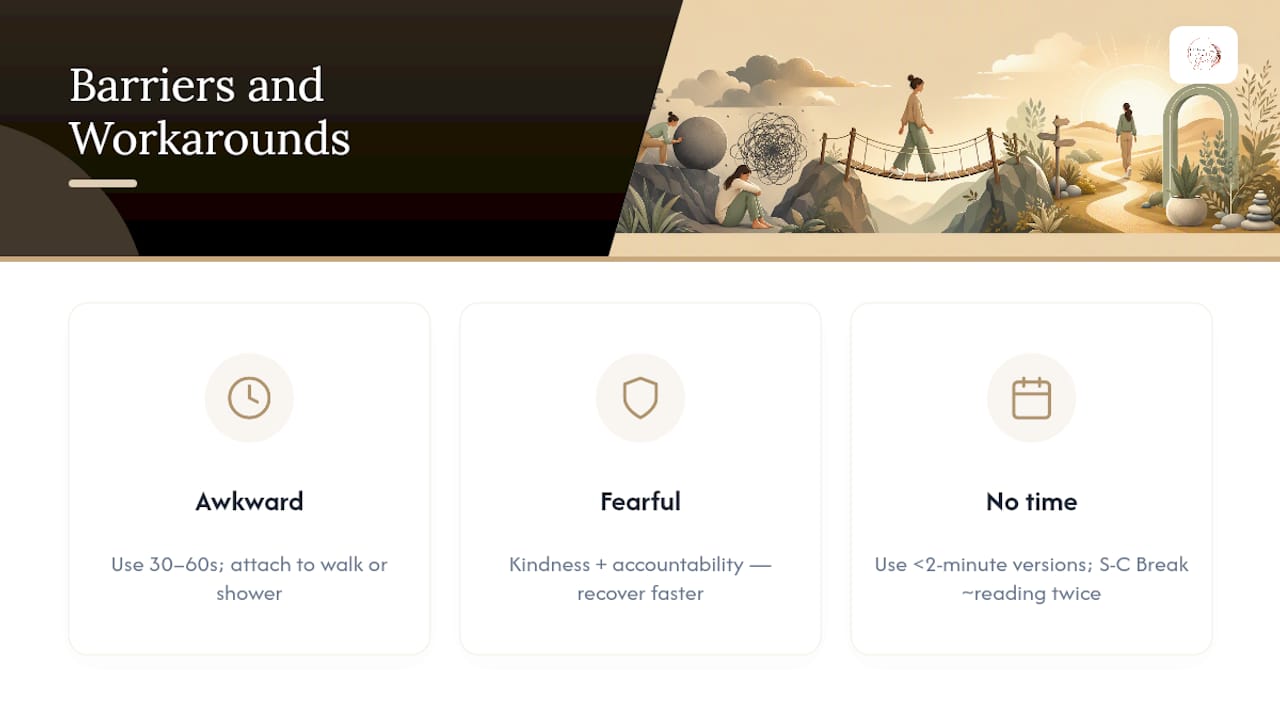
"It feels awkward or fake." This is the most common early barrier, and the fix is to shrink the practice rather than push through it. Try 30 to 60 seconds instead of five minutes, and attach it to a neutral routine like a walk or shower, according to Self-compassion. Scale up the duration only once it stops feeling forced.
"Won't this make me lazy or let myself off the hook?" No. People who practice self-compassion still take responsibility for mistakes, and they tend to recover from setbacks faster than people who rely on harsh self-criticism, according to Greater Good Magazine. Accountability and kindness are not opposites here.
"I don't have time." Every exercise in this guide has a version under two minutes. The Self-Compassion Break takes about as long as reading this sentence twice.
Sometimes the most self-compassionate move in an overwhelming moment isn't a script at all. It's a short walk, a cup of tea, or ten minutes of rest, per Harvard Health. Give yourself permission to count that as practice, too. And when the friction is really just forming a new habit, a resource like Mindpanda's guide to low-friction self-care offers useful ideas for keeping rituals small enough to stick.
An Honest Note on Practicing This Imperfectly
I resisted the Self-Compassion Break for weeks. The lines felt scripted, almost silly, said out loud in my kitchen. What changed it wasn't a breakthrough moment, just noticing one Tuesday that I'd said the third line automatically, without thinking, right when I needed it.
Three things helped: starting smaller than felt necessary, attaching the practice to something I already did daily, and expecting some days to feel forced. That's not failure. That's just what practice looks like before it becomes automatic.
— Ava
Bring Self-Compassion Into Your Daily Routine
Reading scripts is one thing. Actually returning to them on a hard Tuesday is another, and some platforms aim to close that gap. Some platforms gather guided practices, habit challenges, and a supportive community in one place you can return to.

Consider this an optional support system, not a required course or a substitute for professional care when you need it. If today's guide gave you one script worth keeping, the next step is simple: visit the The Ultimate Beauty - You! platform to see the guided practices and community resources available, or check the products page for tools designed to help the habit actually stick past week one.
Sources
- Self-Compassion Practices: Cultivate Inner Peace and Joy
- Self-Compassion Break | Practice | Greater Good in Action
- 4 ways to boost your self-compassion - Harvard Health
- The five myths of self-compassion - Greater Good Magazine
- 8 Powerful Self-Compassion Exercises & Worksheets (+ PDF)