
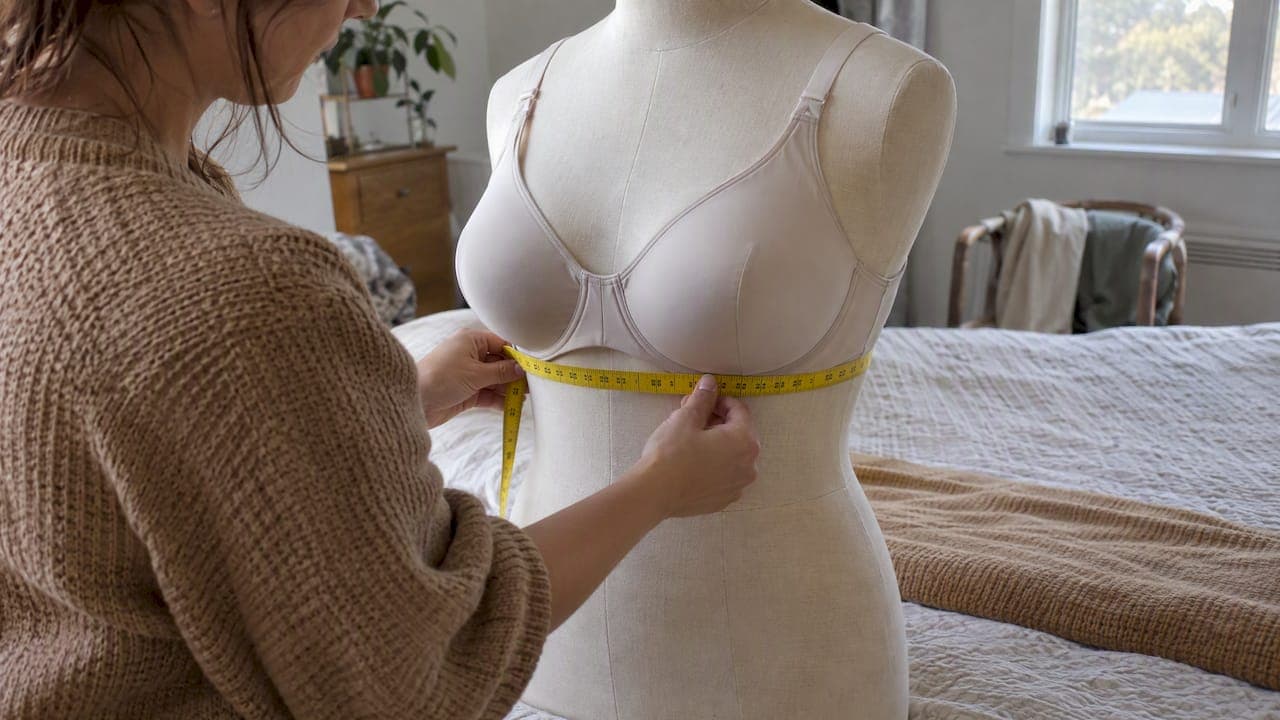
You can measure your bra size at home with a soft tape and about five minutes. Measure snugly around your ribcage for the band. Measure around the fullest part of your bust for the cup. The difference between the two gives you a starting size.
Notice the words starting size. A tape measure gives you a strong first guess. Your body, the style and the brand do the rest. We will walk you through the math, the fit checks and the fixes, so you can trust your own read.
TL;DR
- Measure two numbers: snug under the bust (band) and around the fullest part of the bust (cup). Each inch of difference moves you up one cup letter.
- Sister sizes (like 34C, 36B and 32D) share a cup volume on different bands. They are your best fix when one part fits and the other does not.
- Sizing is not standardized, so treat the tape as a baseline. Judge the fit by how the bra sits on your body.
- Re-measure often. Hormones, pregnancy, weight changes and menopause all change your size.
Table of Contents
- Why it is worth getting this right
- What you need before you start
- Step 1: Measure your band
- Step 2: Measure your bust
- Step 3: Do the math
- Is a 36C bigger than a 34C?
- Sister sizes: your most useful trick
- Measure your bra size without a tape
- The fit check: trust your body over the tape
- When your numbers do not match any bra
- One breast bigger than the other?
- How often to re-measure
- When to see a professional fitter
- Our perspective
- Find experts who fit your life
- FAQ
- Sources
Why it is worth getting this right
Most of us were never taught how a bra should fit. Research suggests around 80% of women wear an incorrectly sized bra, most often one that is too small in the cup or too large in the band. That is a lot of women quietly tolerating straps that dig, bands that ride up and cups that gape.
The cost is not only comfort. In a study of mature-aged women, each one-size increase in breast size score was linked to a 13% higher likelihood of reporting upper back pain. That is a correlation, not a promise that a new bra will cure pain. If you have ongoing back, shoulder or chest pain, please see your doctor. A bra is support, not treatment.

Beauty Is Not Perfection. Beauty Is a Verb. Beauty Is Becoming. A bra that fits is one small way to act on that: you feel supported, so you stand taller and get on with your day.
What you need before you start
- A soft measuring tape, the kind used for sewing. A flexible one lies flat and does not twist.
- A mirror, so you can check the tape stays level.
- A thin, lightly lined or unlined bra, or no bra at all. Padding and heavy push-up inserts add inches that are not yours.
- A pen and paper, or your phone notes.
Stand relaxed with your arms down. Breathe normally. Do not hold your breath or pull your shoulders back to look "perfect."
Step 1: Measure your band
Your band does most of the work. Roughly the bulk of your bra's support comes from it, not the straps.
- Wrap the tape directly underneath your bust, where the bottom edge of a bra band would sit.
- Keep the tape level all the way around. Check the mirror: it should not dip in front or climb up your back.
- Pull it snug, firm but not digging in.
- Round to the nearest whole number. That is your band measurement in inches.
Many US brands want an even band number, so if you land on 33, try 32 or 34 and see which feels better. Some brands add inches to this number. Others do not. Check the size chart of the brand you are buying from, because the instructions differ.
Step 2: Measure your bust
- Wrap the tape around the fullest part of your bust, usually across the nipple line.
- Keep it level and straight across your back. Do not pull it tight or let it sag.
- Round to the nearest whole number.
Standing upright works for most women. If your breasts are fuller or softer, some fitters also measure leaning forward at the waist. Try both and write both numbers down. You will learn something from the gap.
Step 3: Do the math
Subtract your band measurement from your bust measurement. The difference in inches gives your cup letter in the common US system.
| Difference | Cup |
|---|---|
| 0 to under 1 inch | AA |
| 1 inch | A |
| 2 inches | B |
| 3 inches | C |
| 4 inches | D |
| 5 inches | DD (sometimes called E) |
| 6 inches | DDD (sometimes called F) |
An example: your band is 34 inches and your bust is 37 inches. The difference is 3, so you start with a 34C.
Letters past DD vary by brand. Some labels go DDD, then G, then H. Others go DD, E, F, G. If you are in that range, use the chart on the brand's own page, and look for brands that make a full range of sizes.
Is a 36C bigger than a 34C?
This is one of the most common questions, and the answer surprises people. A cup letter is not a fixed volume. It describes the cup relative to the band. A larger cup letter means more volume on the same band size, so a 34D holds more than a 34C.
But a 36C and a 34C are different. The 36C has a wider band, and its cup is scaled up to match. So yes, a 36C holds a little more than a 34C, though the difference is small. Which leads to sister sizes.
Sister sizes: your most useful trick
Sister sizes share about the same cup volume on different bands. The rule is simple: go up a band, go down a cup. Or go down a band, go up a cup.
| If your size is | Your sisters are |
|---|---|
| 34C | 32D and 36B |
| 36B | 34C and 38A |
| 32D | 30DD and 34C |
| 38C | 36D and 40B |
When do they help?
- The cups fit but the band is too loose: go down a band and up a cup.
- The cups fit but the band is too tight: go up a band and down a cup.
- The brand you love is out of your size: a sister size may fit the same shape.
Stay within one step of your usual size. Going further changes more than volume: wire width, strap placement and the center panel all shift.
Measure your bra size without a tape
No tape? You have options.
- String or a phone charging cord: wrap it where you would use the tape, mark it with a pen or pinch it, then lay it flat against a ruler. Use string that does not stretch.
- A strip of paper or a ribbon: the same method works.
- Your best-fitting bra: check its tag and run the fit checks below. If the band sits level and the cups are smooth, that size is a solid baseline.
The string gives you the same numbers as a tape. The only thing to watch is stretch. A stretchy cord will give you a falsely large reading.
The fit check: trust your body over the tape
This is the part most guides skip. Sizing is not standardized: even within one brand, different styles and fabrics fit differently. Try the bra on, then check each of these.
The band
The band should sit level and snug around your ribcage, parallel to the floor. Fasten a new bra on the loosest hook, because bands stretch with wear and you will tighten as you go.
Signs the band is wrong, according to Good Housekeeping's fit experts: the band rides up your back, even on the tightest hook. That means it is stretched out or too big. Women's Health adds that you should not be able to pull the band out more than an inch, and the center of the bra should lie flat against your chest, not float away from it.
The cups
- Spilling over the top or sides: the cup is too small. Go up a cup size.
- Gaping or wrinkling: the cup is too big, or the shape does not suit you. Try a smaller cup or a different style.
- The underwire sits on breast tissue: the wire should sit around the breast, against your ribcage, not on top of the tissue.
The straps
If your straps constantly slip, or dig into your shoulders, the band is probably doing too little. Straps are the finishing touch. They should not carry the load alone.
The center
The center panel between the cups should rest flat against your sternum. If it floats, try a smaller band, a different cup size, or a style with a different shape.
When your numbers do not match any bra
The tape is a formula. You are not.
Experienced fitters look beyond the measurement at how a specific cup shape interacts with your breast tissue. Shape matters: fuller on the bottom, fuller on top, wide-set, close-set. If your size is right but the bra still feels wrong, try a different style before you change size.
A few common fixes:
- Band fits, cups do not: switch cup shape (a plunge, balconette or full coverage).
- Cups fit, band rides up: go down a band and up a cup.
- Two measurements that differ a lot standing and leaning: try the larger cup in a stretchy or soft style.
- Between sizes: try both and pick the one that feels better after a few hours.
And remember: when a bra fits on the very first try, practitioners call it a lucky gift. Trying on a few is normal.
One breast bigger than the other?
Very normal. Many women have a slightly larger breast. Fit for the larger side, then adjust the strap on the smaller side or use a removable insert to balance the look. This is a common practitioner technique.
For younger readers and parents: during puberty, breasts often grow at different rates, and one may look larger than the other. Breast development usually starts around age 10, but it can begin anywhere from 8 to 13. ACOG notes that breast size, shape and symmetry are strongly influenced by genetics and that normal covers a wide range. A well-fitting, comfortable first bra is plenty of support at this stage.
How often to re-measure
Your size is not fixed. Pregnancy and weight fluctuations change it, and many of us forget to re-check. Hormones play a part too: a study of young women found bra fit was moderately linked to menstrual cycle stage. That is why a bra can feel perfect one week and snug the next.
A sensible rhythm:
- Re-measure every six months, or whenever a bra stops feeling right.
- Re-measure after pregnancy, after nursing, and after a significant change in weight.
- Re-measure around menopause and beyond.
Preferences change with age as well. In one study, more than half of mature women said they would no longer wear the bra they wore in their twenties. In research on ageing and bra preferences, the things women ranked highest were comfort, staying in place, fit and support. That is a good checklist at any age.
Menopause is a time when your whole body is asking for attention, not only your bra size. If that is where you are, our guide to bone health for women, from menopause to DXA scans is a good next read.
When to see a professional fitter
A home measurement is a great start. A professional fitting is worth it when:
- You have measured several times and nothing feels right.
- You are fuller in the bust. Research found that larger-breasted women are more likely to seek professional fittings but are less satisfied with their fit, which is a sign that this is an ongoing process, not a failure on your part.
- You are pregnant, postpartum, or post-surgery.
- You want a bra for a particular purpose, like sport or a special outfit.
A fitter looks at your shape, not only your numbers. Go in wearing a thin bra, and take along an outfit you want the bra to work under.
Our perspective
We hear one thing from women again and again: "I have no idea if I am wearing the right size." Bra fit sits where beauty, comfort and confidence meet, and it is rarely discussed with kindness.
Here is what we believe. A size is information, not a verdict. It is not a number to be proud of or ashamed of. It is the number that helps you feel supported, so you can think about something else.

We also believe fit is part of an inside-out approach. When your body is comfortable, you carry yourself differently. Your posture, your mood and your energy follow.
So measure. Try on. Adjust. Come back in six months and do it again, because your body is evolving, and your bras should evolve with it. Inside-Out. Head-to-Toe. 360-Degree Beauty.
— Ava
Find experts who fit your life
Our platform brings together trusted experts and brands for women at every age and stage. If you are a fit specialist, a lingerie or wellness brand, or another service provider who wants to reach women looking for guidance they can trust, explore Experts & Partners. To see what we are building for women, visit The Ultimate Beauty - You!.
FAQ
Does bra size change with age?
Yes. Hormones, pregnancy, weight changes, menopause and ageing all change breast size and how a bra feels. In one study, over half of mature women said they would not wear the bra of their twenties. Re-measure about every six months, and any time a bra stops feeling right.
Is my cup size B or C?
Subtract your band measurement from your full bust measurement. A 2-inch difference is a B, and 3 inches is a C. If you land between them, try both, and check whether you spill over the top or gape. Cup size is relative to the band, so a size change in the band can change which cup letter works for you.
What happens during a bra fitting?
A fitter measures you, usually with a tape, then brings you several bras in your estimated size and its sister sizes. You try them on and they check the band, cups, wires and straps. Expect to try a few styles, because the tape is only the starting point.
Can I measure my bra size without a measuring tape?
Yes. Use a piece of string or a non-stretchy cord, mark where it meets, and lay it flat against a ruler. Do the same two measurements: snug under the bust and around the fullest part. You can also check the tag of your best-fitting bra and run the fit checks.
Is a 34C bigger than a 34D?
No. On the same band, the larger cup letter holds more, so a 34D has a larger cup volume than a 34C. Moving to a different band, such as 36C, changes the cup volume a little as well.
Sources
- Breast size, bra fit and thoracic pain in young women: a correlational study
- The influence of ageing on bra preferences and self-perception of breasts among mature women
- The relationship between breast size and aspects of health and psychological wellbeing in mature-aged women
- How To Measure Bra Size Guide, Vogue
- How to Measure Your Bra Size, According to Fit Experts, Good Housekeeping
- How To Measure Your Bra Size: Bra Size Chart And Fit Tips, Women's Health
- Your Changing Body: Puberty in Girls, ACOG
- Breast and Labial Surgery in Adolescents, ACOG
- Custom Bras: How much does it cost, and why?, Medium