

The most effective approach to choosing natural beauty products is evidence-first and concern-led: match the active ingredient to your specific skin need, verify safety through third-party certification, and confirm that the formulation can actually deliver the active where your skin needs it. That sequence cuts through the noise of marketing claims and gets you to products that genuinely work for you.
Before you read another label, run these three checks:
- Match the active to your concern. Look for a named, clinically studied ingredient (bakuchiol for anti-aging, squalane for hydration, niacinamide for acne) in the first half of the INCI list, which signals a meaningful concentration.
- Verify safety and certification. Confirm at least one third-party seal, such as EWG VERIFIED, USDA Organic, or Leaping Bunny, rather than relying on the brand's own "natural" or "clean" claims.
- Check formulation and shelf life. Water-based formulas need preservatives and have shorter open-jar life. Anhydrous (water-free) balms do not require preservatives and typically last longer unopened. Know which you are buying.
Table of Contents
- What do 'natural,' 'organic,' and 'clean' actually mean?
- How to read ingredient lists and a practical safety checklist
- Which certifications should you actually trust?
- How to compare two natural products fairly
- What to look for by skin concern
- What should you expect to pay, and where should you buy?
- How Theultimatebeauty-you vets and curates natural beauty products
- Key Takeaways
- The gap between "natural" and actually good for your skin
- Your curated path to vetted natural beauty picks
- Useful sources for verifying product and ingredient claims
What do 'natural,' 'organic,' and 'clean' actually mean?
These three words appear on nearly every shelf in the beauty aisle, yet they carry very different weight, and only one of them has a regulated definition in the United States.
"Natural" has no single legal or regulatory definition in U.S. cosmetics law. Any brand can print it on a label without meeting a specific standard. In practice, it signals that a formula leans on plant-derived or mineral ingredients, but it says nothing about concentration, purity, or safety testing.
"Organic" is a tighter claim. Organic cosmetics are subject to restricted ingredient lists that exclude many synthetic or controversial substances, and they must meet certification standards (USDA Organic being the most recognized in the U.S.). Organic is a subset of natural, not a synonym. A product can be natural without a single certified organic ingredient, and a certified organic product still qualifies as natural. Prioritize the certification, not the word.
"Clean" is the most fluid of the three. Brands and retailers define it differently. Some clean-beauty standards ban specific synthetic chemicals; others focus on transparency and sourcing. Naturopathica, for example, defines clean beauty as fusing plant extracts and botanicals with science-backed ingredients that are skin-friendly, planet-friendly, and proven to drive real results. That is a thoughtful definition, but it is still a brand's own definition, not a regulated one.
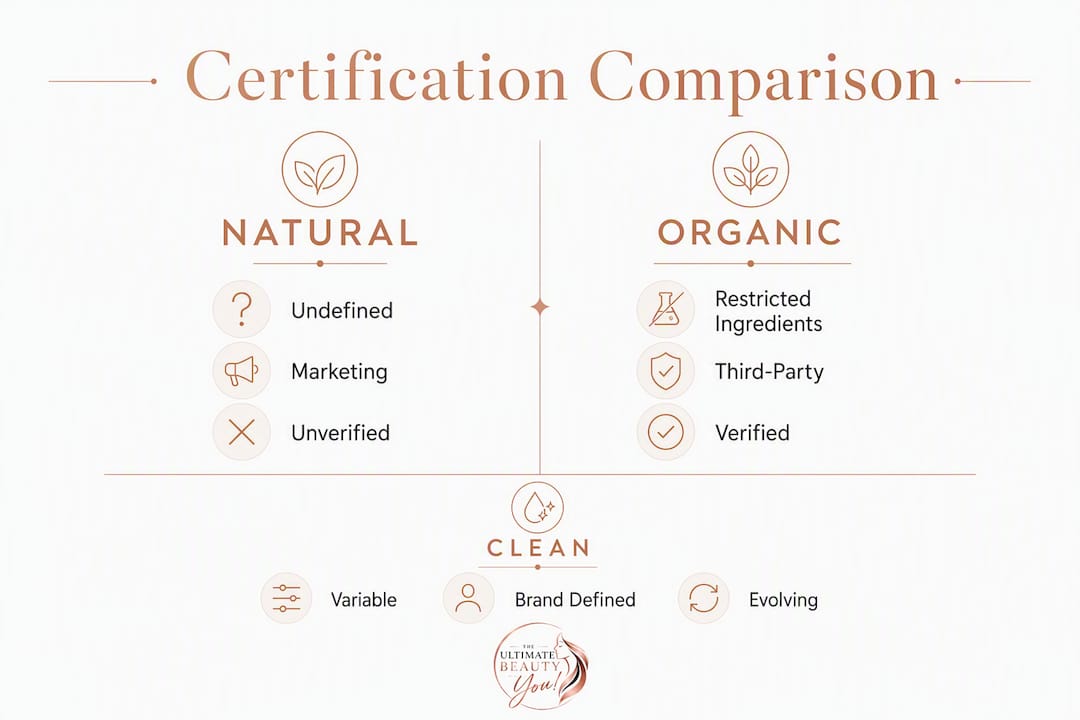
The practical takeaway: "natural" and "clean" are marketing terms until a third-party body verifies them. "Organic" has teeth only when a recognized certification backs it up. Understanding this distinction is the foundation of any honest natural beauty products comparison.
How to read ingredient lists and a practical safety checklist
The INCI (International Nomenclature of Cosmetic Ingredients) list on every U.S. product is listed in descending order of concentration. The first five to seven ingredients typically make up the bulk of the formula. If the hero active you are paying for appears near the bottom, after the preservatives and fragrance, its concentration is likely below 1%.

Natural actives worth knowing
Different hero actives target different concerns, so knowing what each one does helps you shop with intention:
- Squalane (plant-derived, usually from sugarcane or olives): a lightweight, non-comedogenic oil that mimics the skin's own sebum. Excellent for hydration across all skin types.
- Bakuchiol: a plant-derived retinoid alternative from the babchi plant. Research supports its ability to reduce fine lines and improve skin texture with less irritation than conventional retinol.
- Vitamin C derivatives (ascorbic acid, sodium ascorbyl phosphate, ascorbyl glucoside): brightening and antioxidant actives. Stability varies by derivative; ascorbic acid is most potent but degrades quickly in water-based formulas.
- Niacinamide: a water-soluble B vitamin that addresses pore appearance, uneven tone, and oil control. Works well in natural formulas and is generally well-tolerated.
- Zinc oxide: a physical UV filter and anti-inflammatory active used in mineral sunscreens and some acne formulas.
Red flags and common irritants
Natural does not equal hypoallergenic. Essential oils, citrus extracts, and some botanical preservatives are among the most common contact allergens in cosmetics. Watch for high concentrations of lavender, lemon, bergamot, or clove oil, especially in leave-on products. Fragrance, even when derived from plants, is a leading cause of skin sensitization.

Natural preservatives such as rosemary extract, vitamin E (tocopherol), and phenoxyethanol (semi-synthetic but widely used in "clean" formulas) each carry their own risk profiles. Phenoxyethanol is generally considered safe at concentrations up to 1%, but some sensitive-skin users react to it.
Step-by-step ingredient checklist
- Identify the hero active. Find it in the INCI list. Is it in the top half? If not, its effect may be minimal.
- Check the preservative system. Water-based formulas must have one. Look for phenoxyethanol, sodium benzoate, potassium sorbate, or caprylhydroxamic acid. Absence of any preservative in a water-based product is a red flag for safety.
- Scan for fragrance and essential oils. If you have sensitive skin, look for "fragrance-free" or formulas where essential oils appear at the very end of the list.
- Note the base type. Water (aqua) as the first ingredient means the formula is emulsified and needs preservatives. An oil, butter, or wax as the first ingredient signals an anhydrous formula.
- Check the pH clue. Vitamin C and AHA actives need a low pH (around 3.5–4.5) to work. If a brand does not disclose pH and the formula contains these actives, ask or look for third-party reviews that tested it.
Pro Tip: Anhydrous (water-free) balms, such as those formulated without any water in the ingredient list, do not require preservatives and typically have a longer unopened shelf life than water-based creams. If you buy natural products slowly, anhydrous formats are a practical choice.
Which certifications should you actually trust?
Third-party certifications are the most reliable signal that a brand's claims have been independently verified. Here is what each major seal actually guarantees for U.S. shoppers.
| Certification | What it verifies | Scope and limits | Best for |
|---|---|---|---|
| EWG VERIFIED | Ingredients meet EWG's safety standards; no chemicals of concern; full transparency | U.S.-focused; hazard-based scoring, not exposure-based; does not verify organic sourcing | Safety-first shoppers |
| USDA Organic | Certified organic ingredients proportion varies by certification standards | Regulated by USDA; applies to ingredient sourcing, not finished-product safety testing | Organic-sourcing priority |
| COSMOS | Organic and natural cosmetics standard covering ingredients, manufacturing, and packaging | European standard, increasingly adopted by U.S. brands; rigorous but less recognized by U.S. consumers | Comprehensive organic + natural verification |
| Leaping Bunny | No animal testing at any stage of production, including ingredients | Cruelty-free only; does not address ingredient safety or organic sourcing | Cruelty-free priority |
| Non-GMO Project Verified | Ingredients are not derived from genetically modified organisms | Ingredient-level only; does not address safety, organic status, or cruelty-free practices | GMO-free sourcing |
A few important limits to keep in mind. Certification costs money, so some excellent small-batch brands cannot afford every seal. Absence of a seal does not automatically mean a product is unsafe or non-organic. Conversely, a product can carry a USDA Organic seal and still contain irritating essential oils. Use certifications as a starting filter, not a final verdict.
How to prioritize: If safety is your primary concern, EWG VERIFIED is the most directly relevant U.S. standard. If organic sourcing matters most, look for USDA Organic or COSMOS. If cruelty-free is non-negotiable, Leaping Bunny is the gold standard. For a well-rounded product, look for two or more overlapping seals.
How to compare two natural products fairly
A fair side-by-side evaluation uses the same dimensions for every product. Here is a reproducible framework you can apply at home or on a brand's product page.
Six dimensions to score (1–5 each):
- Skin concern match: Does the formula contain a named, evidence-backed active for your specific concern? Score higher when the active appears in the top half of the INCI list.
- Active ingredients and likely concentration: Is the active named and positioned to suggest a meaningful dose? Brands that disclose percentages earn a higher score.
- Safety and hazard concerns: Cross-reference key ingredients in the EWG Skin Deep database. Products with no high-hazard ingredients and a clean preservative system score higher.
- Certifications and third-party verification: One credible seal scores a 3; two or more overlapping seals score a 4–5.
- Price and value: Compare cost per ounce or per application, not sticker price. A $60 serum used twice daily for 60 days costs $1 per use; a $20 moisturizer used four times daily costs more per application.
- Sustainability and packaging: Packaging choices matter. Aluminum tins, glass with refillable systems, and post-consumer recycled materials score higher than single-use plastic. Check whether the brand publishes a sustainability report or packaging policy.
Weigh dimensions by your priorities. Sensitive skin? Weight safety and hazard concerns at double value. Focused on anti-aging results? Weight active ingredient evidence and concentration most heavily. Budget-conscious? Price and value becomes your tiebreaker. The framework stays the same; the weights shift to fit you.
What to look for by skin concern
Natural actives are not one-size-fits-all. Matching the right ingredient to your skin concern is where the real work happens, and where most shoppers get lost.
Anti-aging
Bakuchiol is the most clinically supported plant-based retinoid alternative, with published research showing improvements in fine lines, skin texture, and firmness. Pair it with a vitamin C derivative for antioxidant support and a physical SPF (zinc oxide) to prevent further photoaging. Delivery matters here: bakuchiol is oil-soluble, so it performs best in a serum or facial oil, not a thin water-based lotion. Patch-test first, especially if your skin is reactive.
High-performance natural brands often center their anti-aging lines on organic botanical extracts and marine-derived ingredients like algae and sea kelp, which are rich in minerals and antioxidants. These can complement bakuchiol well in a layered routine.
Dry and dehydrated skin
Understand the difference between a humectant and an occlusive. Humectants (glycerin, hyaluronic acid, aloe vera) draw water into the skin. Occlusives (shea butter, beeswax, plant-based squalane) seal it in. Dry skin needs both. Look for glycerin or aloe in the first half of the list, followed by a plant butter or oil to lock in moisture.
Anhydrous balms skip the water entirely and rely on oils and waxes to nourish and protect. They are particularly useful for very dry or compromised skin barriers because they avoid the emulsifiers and preservatives that can sometimes irritate. Apply to slightly damp skin for best absorption.
Sensitive and reactive skin
Minimalism is your best strategy. Look for formulas with fewer than 15 ingredients, no added fragrance (synthetic or natural), and essential oils listed only at the very end of the INCI list, if at all. Anhydrous formats can also reduce exposure to emulsifier allergens. The slow beauty approach of introducing one new product at a time and patch-testing for 48 hours before full application is especially valuable for reactive skin types.
Acne-prone and oily skin
Squalane is one of the few plant oils that is genuinely non-comedogenic, meaning it does not clog pores, making it a strong choice for oily or breakout-prone skin. Lighter textures, such as serums and gels, outperform heavy creams for this skin type. Look for natural antimicrobial actives like tea tree oil (at low concentrations, around 1–2%) or willow bark extract (a natural source of salicylates). Avoid formulas heavy in coconut oil or cocoa butter, which rank high on the comedogenic scale.
What should you expect to pay, and where should you buy?
Natural skincare spans a wide price range, and cost does not always track with quality. Here is a realistic picture of what you will find at each tier.
Typical price bands (U.S. market):
- Drugstore and mass-market natural: $8–$25 per product. Brands at this tier often carry USDA Organic or EWG VERIFIED seals and are widely available at Target, Whole Foods, and CVS. Freshness can be a concern with high-turnover retail.
- Mid-range indie and direct-to-consumer: $25–$65. This is where you find most certified natural brands with transparent ingredient sourcing and a stronger sustainability story. Buying direct from the brand's website usually means fresher stock and better return policies.
- Premium and artisan small-batch: $65 and above. Small-batch artisan brands emphasize scientifically backed natural actives and freshness as core differentiators. Higher price often reflects lower production volume and higher-quality raw materials, not just packaging.
Where to buy, and what to watch for:
- Mass retailers (Target, Whole Foods, Ulta): Convenient and return-friendly, but check the batch code on the bottom of the product to estimate manufacturing date. High turnover does not guarantee fresh stock.
- Indie boutiques and natural apothecaries: Staff tend to know the products well and can advise on skin concerns. Stock is often fresher because turnover is lower.
- Brand direct (brand website or app): Best for freshness, authenticity, and access to Certificates of Analysis (COAs) or third-party test results. Most reputable natural brands will share these on request.
- Practical tips: Always check the full ingredient list on the product page before buying online, not just the marketing copy. Confirm the return policy before purchasing a premium item. If a brand offers third-party testing documentation or a COA, that is a strong transparency signal worth noting.
Sustainability and packaging choices also factor into value. A refillable aluminum tin or glass jar with a take-back program reduces long-term cost and environmental impact compared to single-use plastic.
How Theultimatebeauty-you vets and curates natural beauty products
Trust is earned through process, not promises. At Theultimatebeauty-you, every product and brand that appears in our curated resources goes through a structured vetting process before it reaches you.
Our editorial vetting includes:
- Ingredient audits: We review full INCI lists against the EWG Skin Deep database and flag any high-hazard ingredients or undisclosed fragrance components.
- Certification checks: We verify that claimed seals (EWG VERIFIED, USDA Organic, Leaping Bunny, COSMOS) are current and apply to the specific product, not just the brand.
- Independent testing review: Where available, we review third-party test results or COAs provided by brands. We note when this documentation is absent.
- Expert consultation: Our expert partners include licensed estheticians, dermatology-trained advisors, and formulation specialists who review recommendations for clinical plausibility.
- Community feedback: We aggregate real user experiences from our platform community to surface patterns in real-world performance, not just lab results.
Sponsorship transparency: Some brands featured on Theultimatebeauty-you are paid partners. Sponsored content is always clearly labeled. Our editorial team maintains independent control over vetting criteria and recommendations. A brand's paid status does not guarantee a favorable review, and products that do not meet our ingredient and certification standards are not featured regardless of commercial relationship.
Key Takeaways
Choosing natural beauty products well comes down to three non-negotiable steps: match the active ingredient to your skin concern, verify safety through third-party certification, and understand how the formulation affects both efficacy and shelf life.
| Point | Details |
|---|---|
| Lead with the active ingredient | Find your hero active in the top half of the INCI list; low placement signals a minimal, likely ineffective concentration. |
| Certifications over claims | EWG VERIFIED, USDA Organic, and Leaping Bunny are independently verified; "natural" and "clean" on their own are unregulated marketing terms. |
| Formulation determines shelf life | Anhydrous (water-free) formulas do not require preservatives and last longer unopened; water-based creams need a preservative system and have a shorter open-jar life. |
| Match texture to skin type | Squalane and lightweight serums suit oily and acne-prone skin; occlusives and anhydrous balms serve dry or compromised skin barriers best. |
| Theultimatebeauty-you as your starting point | The platform's curated lists, expert Q&A, and upcoming personalized app feature are vetted against ingredient, certification, and sustainability criteria before reaching you. |
The gap between "natural" and actually good for your skin
There is a version of the natural beauty conversation that stays entirely on the surface: pretty packaging, a short ingredient list, a few botanical names you recognize. And then there is the version that actually changes your skin. The gap between those two is formulation science.
What most natural beauty guides underestimate is how much the delivery system matters. Bakuchiol in a poorly stabilized formula at 0.1% concentration will do almost nothing. The same active at 0.5–1% in a well-formulated oil-based serum, applied consistently, can genuinely rival conventional retinol for texture improvement over 12 weeks. The ingredient is not the whole story. The formula is.
There is also a sensory dimension that rarely gets discussed honestly. Organic moisturizers feel different from conventional ones because they rely on plant oils and butters rather than silicones. That richer, sometimes heavier texture is not a flaw; it just requires a different application technique and a moment of patience while it absorbs. If you switch to a natural formula and give up after three days because it "feels different," you are not giving it a fair trial. The most sustainable product, as Naturopathica puts it, is the one you actually use until the last drop. Sensory pleasure and routine fit are not vanity considerations. They are efficacy considerations.
The brands worth your attention are the ones that publish their full ingredient lists, disclose their certifications, and do not hide behind vague "clean" language. That transparency is the real signal. Everything else is packaging.
Your curated path to vetted natural beauty picks
Sorting through hundreds of natural beauty products on your own takes time you probably do not have. Theultimatebeauty-you exists to do that work for you, with a community and expert team behind every recommendation.

The platform brings together curated product lists built on the ingredient-audit and certification-check process described above, expert Q&A with licensed estheticians and formulation advisors, and a growing community of women sharing real-world results. A personalized recommendation feature is in development for the upcoming app, designed to match vetted products to your specific skin concerns and values without the research burden.
Every featured product has been reviewed for ingredient transparency, certification status, and sustainability practices. Sponsored partnerships are clearly disclosed, and editorial standards apply equally to paid and unpaid brands. You get honest guidance, not a catalog dressed up as advice.
Ready to find your next vetted pick? Explore curated collections on Theultimatebeauty-you, or join the community to connect with experts and women who have already done the comparison work.
Useful sources for verifying product and ingredient claims
These are the primary tools and databases U.S. shoppers can use to research ingredients and verify brand claims independently.
| Resource | What it tells you | How to use it |
|---|---|---|
| EWG Skin Deep Database | Hazard scores for individual ingredients and finished products based on published safety data | Search by ingredient or product name; note that scores reflect hazard potential, not exposure levels — context matters |
| EWG Toxic Twelve | A list of high-concern chemicals and contaminants found in cosmetics | Use as a quick red-flag checklist when scanning an INCI list |
| Research supports | Peer-reviewed clinical research on cosmetic ingredients and skin biology | Search by ingredient name plus "skin" or "cosmetic" to find clinical trial data; look for randomized controlled trials for strongest evidence |
| USDA Organic Integrity Database | Verifies whether a brand's organic certification is current and which certifier issued it | Search by brand or product name at ams.usda.gov/organic-integrity |
| Leaping Bunny Program | Confirms cruelty-free status for brands and their ingredient suppliers | Search the Leaping Bunny brand directory at leapingbunny.org |
| Brand COAs and transparency pages | Third-party test results for heavy metals, microbial safety, and ingredient purity | Request directly from the brand; reputable brands share these on request or publish them on their website |
A practical note on saving your research: Most of these databases allow you to bookmark or export searches. Keep a running note of batch codes (usually stamped on the bottom of the product) alongside your purchase date. This lets you track product freshness and cross-reference any skin reactions with specific batches, which is especially useful when you are rotating multiple natural products.