

Micro-influencers are defined as content creators with 10,000–100,000 followers who specialize in a specific niche, and their role of micro-influencers in beauty has become one of the most measurable forces in modern brand marketing. These creators deliver 3–5x higher engagement rates than macro-influencers, at up to 60% lower cost per engagement. That performance gap is not an accident. It reflects a fundamental shift in how women discover, evaluate, and buy beauty products. Trust now travels through community, not celebrity. And micro-influencers sit at the center of that community.
What is the role of micro-influencers in beauty today?
Micro-influencers function as trusted advisors inside tightly connected beauty communities. They are not distant celebrities promoting a product between red carpet appearances. They are real women showing their actual skincare routines, testing foundations on their real skin tone, and responding to comments in real time. That responsiveness is the engine behind their influence.
The psychological mechanism at work is called parasocial interaction. Consumers view micro-influencers as trusted friends rather than distant celebrities, which creates a stronger emotional connection and a more direct path to purchase. When a follower feels like she knows the creator personally, a product recommendation carries the weight of a friend's advice.
The numbers confirm this dynamic. 78% of digital-native consumers aged 18–25 bought a product recommended by a micro-influencer in the last six months. Only 22% did the same after seeing a celebrity endorsement. That 56-point gap tells you everything about where purchase influence actually lives.
Micro-influencers also produce content that performs differently. Their posts show product texture, application technique, and real results under natural lighting. This "raw" user-generated content is rated 4x more trustworthy than high-budget celebrity commercials. Polished production signals advertising. Unpolished authenticity signals truth.
Here is what separates the best micro-influencer content from average posts:
- Detailed application demos showing how a serum absorbs into mature or sensitive skin
- Honest before-and-after comparisons with no filters or retouching
- Direct audience Q&A responding to product questions in comments and stories
- Routine integration showing products used consistently over weeks, not just once
Pro Tip: When evaluating a micro-influencer for a beauty collaboration, scroll through their comment section first. High comment volume with genuine questions and personal replies signals real community trust, not just passive scrolling.
Why micro-influencer collaborations deliver stronger ROI

The cost structure of micro-influencer marketing is fundamentally different from celebrity campaigns. A single macro-influencer post can cost tens of thousands of dollars. A micro-influencer partnership typically runs under $1,000 per post. That price difference creates room to run campaigns that no celebrity budget could replicate.
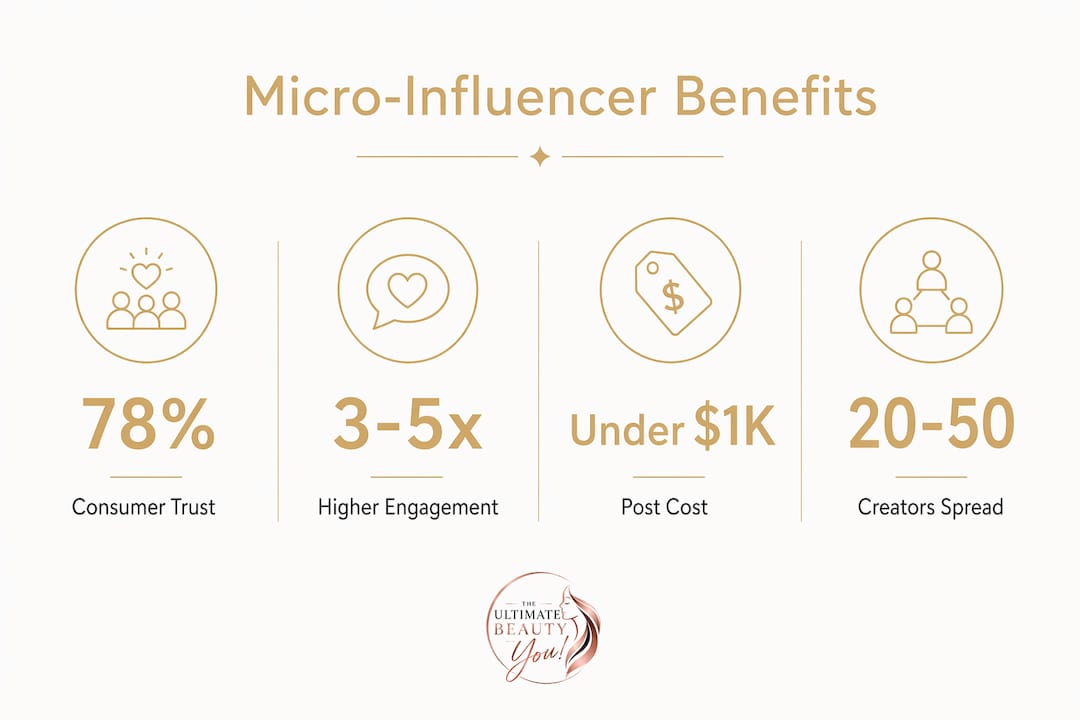
The real advantage is not just lower cost. It is the ability to spread budget across 20–50 creators simultaneously. This multi-creator approach creates a "surround sound" effect on social media, where a brand appears across multiple feeds, communities, and content formats at the same time. Social algorithms favor this kind of distributed, consistent posting over a single high-spend spike.
Brands that focus on engagement quality over follower count consistently achieve better conversion rates. A creator with 30,000 highly engaged followers in the clean beauty space will outperform a creator with 500,000 passive followers every time. The metric that matters is not reach. It is relevance.
Here is how smart beauty brands structure their micro-influencer budgets:
| Budget approach | What it looks like | Why it works |
|---|---|---|
| Single macro-influencer | One post, broad audience, high cost | Awareness spike, low conversion |
| 5–10 micro-influencers | Targeted niches, moderate cost | Better conversion, moderate reach |
| 20–50 micro-influencers | Distributed posts, similar total cost | Surround sound effect, algorithm boost |
The most common pitfall in micro-influencer selection is chasing follower count instead of community fit. A creator who posts about everything from travel to food to skincare has no niche authority. Her beauty recommendations carry no more weight than a random ad. Niche specificity is what creates credibility.
Pro Tip: Before signing any micro-influencer collaboration agreement, request the creator's audience demographic data. Age range, location, and gender breakdown tell you whether her followers match your actual buyer profile.
How does niche specialization shape beauty marketing outcomes?
Niche expertise is the defining advantage micro-influencers hold over larger creators. A macro-influencer might cover beauty broadly. A micro-influencer who focuses exclusively on K-Beauty, clean beauty, mature skin care, or sensitive skin formulations speaks directly to a specific woman with a specific concern. That specificity converts.
Expertise and perceived similarity are more powerful engagement drivers than physical attractiveness. Women respond to creators who look like them, share their skin concerns, and use products that fit their life stage. A 52-year-old woman searching for a retinol serum trusts a creator who has navigated perimenopause skin changes far more than she trusts a 24-year-old with perfect skin.
Influencer-brand value congruence is equally critical. A clean beauty brand that partners with a creator who openly promotes synthetic fragrance-heavy products sends a contradictory message. Audiences notice the mismatch. Trust erodes fast when the partnership feels forced.
The beauty niches where micro-influencers generate the strongest results include:
- K-Beauty and glass skin routines for audiences seeking multi-step, ingredient-focused content
- Clean and green beauty for consumers prioritizing non-toxic formulations and sustainability
- Mature skin care for women 40 and older navigating aging, hormonal changes, and product sensitivity
- Textured hair and melanin-rich skin for underrepresented audiences seeking products tested on their actual skin type
- Sensitive and reactive skin for women managing conditions like rosacea, eczema, or post-procedure recovery
Each of these niches has a dedicated audience that feels chronically underserved by mainstream beauty advertising. Micro-influencers who speak authentically to these communities build loyalty that no mass campaign can replicate. For brands committed to inclusive beauty marketing, niche micro-influencers are the most direct path to underrepresented buyers.
How to integrate micro-influencers into a full beauty marketing strategy
Micro-influencers perform best when they are part of a larger, coordinated strategy rather than a standalone tactic. Hybrid campaigns that combine micro- and macro-influencers consistently outperform single-tier approaches. The two types of creators serve different functions, and the best beauty brands use both deliberately.
Here is a practical framework for building a hybrid influencer strategy:
- Define your campaign goal first. Awareness campaigns call for macro-influencer reach. Conversion campaigns call for micro-influencer trust. Knowing which outcome you need determines which creator tier leads.
- Launch macro-influencer content first. Use a high-reach creator to introduce a new product to a broad audience. This creates the initial visibility spike.
- Follow with micro-influencer waves. Deploy 15–30 niche creators in the two weeks after launch. Their detailed, authentic content converts the curious audience the macro-influencer reached.
- Track engagement rate, not just impressions. Impressions measure exposure. Engagement rate measures resonance. A campaign with 2 million impressions and 0.5% engagement underperforms one with 400,000 impressions and 6% engagement.
- Build long-term creator relationships. One-off posts produce one-off results. Brands that work with the same micro-influencers across multiple campaigns build compounding credibility. The creator's audience sees consistent endorsement, not a paid placement.
- Review beauty industry trends regularly. The platforms, formats, and audience behaviors that drive micro-influencer performance shift every year. What worked in 2024 may underperform in 2026.
A practical example: a clean beauty skincare brand launching a new vitamin C serum could open with a macro-influencer "first look" post, then activate 25 micro-influencers across the mature skin, sensitive skin, and clean beauty niches over the following three weeks. Each creator posts her own honest four-week results. The macro post builds awareness. The micro wave builds conviction.
Key Takeaways
Micro-influencers outperform celebrity endorsements in beauty marketing because niche trust, authentic content, and distributed reach consistently drive higher engagement and stronger conversion than mass-audience campaigns.
| Point | Details |
|---|---|
| Engagement advantage | Micro-influencers deliver 3–5x higher engagement rates than macro-influencers in beauty. |
| Consumer trust gap | 78% of digital-native consumers bought from micro-influencer recommendations vs. 22% from celebrity endorsements. |
| Budget efficiency | Spreading spend across 20–50 creators creates a surround sound effect that outperforms single high-cost posts. |
| Niche fit over follower count | Influencer-brand value congruence drives trust; mismatched partnerships erode audience credibility fast. |
| Hybrid strategy wins | Combining macro-influencers for awareness with micro-influencers for conversion produces the strongest overall results. |
What I have learned from watching micro-influencer campaigns succeed and fail
I have watched beauty brands spend six figures on a single macro-influencer post and walk away with flat sales. I have also watched a clean beauty founder activate 30 micro-influencers with a $15,000 budget and sell out her first product run in three weeks. The difference was never the budget. It was the fit.
The mistake I see most often is treating micro-influencer collaboration as a numbers game. Brands count posts, count followers, and count impressions. They rarely ask whether the creator's audience actually needs the product. A hyaluronic acid serum promoted by a 22-year-old with oily skin to an audience of 22-year-olds with oily skin will not move units for a brand targeting women over 40 with dry, mature skin. The math looks fine. The strategy is broken.
The future of micro-influencer marketing in beauty is moving toward long-term creator partnerships and community co-creation. The brands winning in 2026 are not running one-off campaigns. They are building creator networks that function like brand ambassadors, producing content across formats, seasons, and product launches. That consistency is what builds the kind of trust that turns a follower into a loyal buyer.
My strongest recommendation: stop auditing creators by their follower count and start auditing them by their comment quality. Real engagement lives in the comments. Fake engagement does not.
— Ava
Beauty products worth exploring at Theultimatebeauty-you
At Theultimatebeauty-you, we believe beauty is not a destination. It is a practice. It is becoming. The women in our community deserve products and partners that reflect their real lives, their real skin, and their real confidence.
Our product collection brings together brands and formulations that align with the values our community lives by: authenticity, inclusion, and real results. We also connect you with our expert partner network, where trusted voices in beauty, wellness, and self-care share the kind of grounded, honest guidance that micro-influencers have proven women actually want. You deserve recommendations from people who understand your skin, your stage, and your story.
FAQ
What are micro-influencers in beauty marketing?
Micro-influencers are content creators with 10,000–100,000 followers who specialize in a specific beauty niche. They deliver higher engagement and stronger purchase influence than celebrity endorsers because their audiences view them as peers, not advertisers.
Why do micro-influencers outperform celebrities in beauty?
Micro-influencer content is rated 4x more trustworthy than high-budget celebrity commercials. Audiences respond to authentic product demonstrations and genuine results over polished, high-production advertising.
How much does a micro-influencer beauty campaign cost?
Individual micro-influencer posts typically cost under $1,000. Spreading a campaign budget across 20–50 creators produces a surround sound effect that delivers broader, more sustained visibility than a single high-cost macro post.
What niches work best for micro-influencers in skincare?
The strongest performing niches include clean beauty, mature skin care, K-Beauty, sensitive skin, and textured hair. These audiences are underserved by mainstream advertising and respond strongly to creators who share their specific concerns.
How do you measure micro-influencer campaign success?
Track engagement rate, not impressions. A campaign with high impressions and low engagement signals passive exposure. High engagement rates, quality comments, and measurable conversion data signal real audience influence and purchase intent.