

The simplest safe postpartum routine is five steps: gentle cleanser, a hydrating serum, a ceramide moisturizer, an occlusive seal on dry patches, and mineral sunscreen every morning. The one rule that governs everything else is breastfeeding status: skip retinoids and hydroquinone while nursing, and lean on azelaic acid instead. Give your hormones 6 to 12 months to settle before expecting your old skin back.
TL;DR:
- Postpartum skin recovery mainly involves barrier repair with moisturizer and SPF, as hormonal fluctuations can last 6 to 12 months.
- Safe active ingredients during breastfeeding include azelaic acid, niacinamide, vitamin C, and tranexamic acid, while retinoids and hydroquinone should be deferred until weaning.
- A minimal routine consisting of gentle cleansing, hydrating serum, ceramide moisturizer, and mineral sunscreen is sufficient for busy new mothers.
- Treatment of specific issues like acne, melasma, and dryness should focus on products with low systemic absorption, avoiding harsh exfoliants and strong acids during early postpartum.
- Supportive measures like quick routines, strategic product placement, and multi-tasking products help maintain skincare on demanding days with little sleep.
Table of Contents
- Your Postpartum Skincare Routine, Step by Step
- When Can You Reintroduce Stronger Actives After Birth?
- Treating Acne, Melasma, Dryness, and Postpartum Shedding
- Making It Work When You Have No Time or Sleep
- Why Dermatologists Recommend Barrier Repair First
- A Note From Ava
- Find More Postpartum Skincare Support at Theultimatebeauty-you
- Sources
- FAQ
Your Postpartum Skincare Routine, Step by Step
Nobody has twenty minutes for a ten-step routine when a newborn is crying in the next room. The good news: you do not need one. A pared-down routine that leans on consistency, just moisturizer and sunscreen done daily, beats a fussy multi-active routine when your skin barrier is already compromised, according to postpartum skin care guidance from Healthline. This is not about doing less because you are tired. It is about doing the right things, in the right order.
Morning routine (about two minutes):
- Cleanse with a gentle, fragrance-free formula, or just rinse with lukewarm water if your skin feels raw.
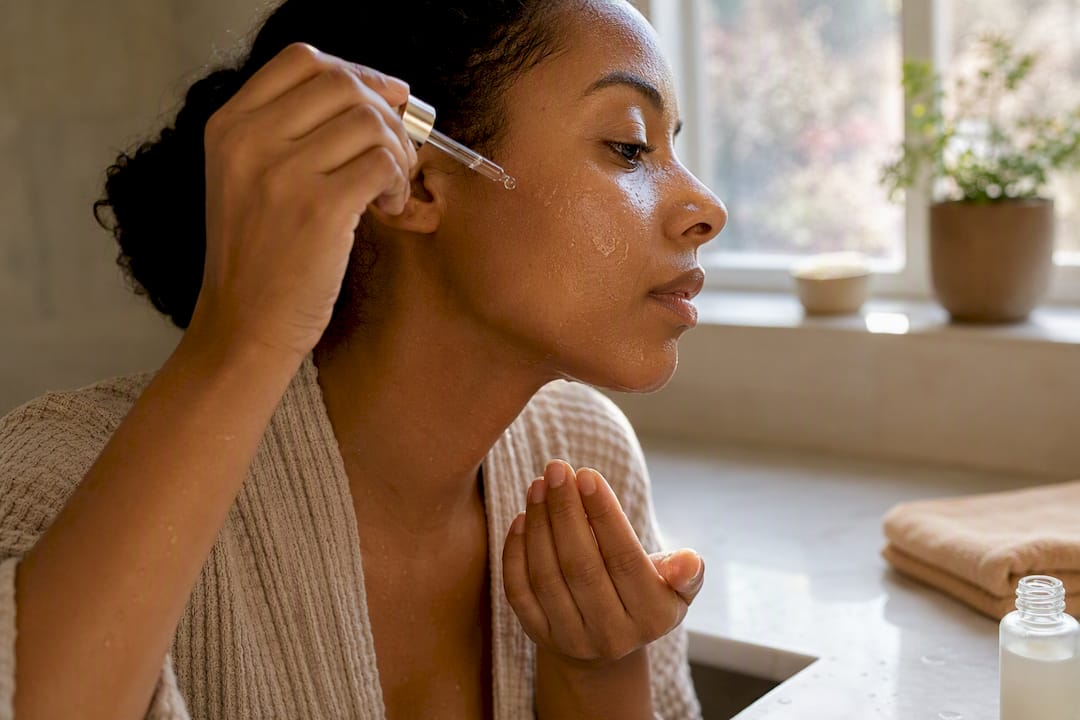
- Apply a hydrating serum with hyaluronic acid or glycerin while skin is still damp.
- Follow with a ceramide-rich moisturizer to reinforce the barrier.
- Finish with mineral sunscreen containing zinc oxide or titanium dioxide, which carries minimal systemic absorption according to Nebraska Medicine.
Evening routine (about three minutes):
- Cleanse again to remove the day's buildup.
- Apply a targeted, breastfeeding-safe active only if you need it, azelaic acid is the standard workhorse for acne or dark spots.
- Moisturize with the same ceramide formula.
- Seal with an occlusive balm on any cracked or flaking patches.
Layer products from thinnest to thickest: humectant on damp skin, then moisturizer, then occlusive on top where needed. Keep everything fragrance-free and low-irritant, and avoid the nipple and areola area with new products, especially if you are breastfeeding.
Pro Tip: Apply your hydrating serum within sixty seconds of washing your face. Damp skin absorbs humectants like hyaluronic acid far more efficiently than dry skin does, which means the same product works harder without costing you extra time.
When Can You Reintroduce Stronger Actives After Birth?
Retinoids, strong acids, and in-office treatments all have a waiting period, and the timeline splits depending on whether you are breastfeeding.
- Weeks 0 to 6: Stay minimal. This is a barrier-repair window, not the time to experiment.
- Week 6 to 8, not breastfeeding: Many providers clear a gradual return to actives after your postpartum checkup, according to timeline guidance from VeriMom. Start a retinoid at 0.01 to 0.025 percent twice weekly, holding for two weeks before increasing frequency, and keep at least two nights of separation between retinoid and acid-exfoliant use.
- If breastfeeding: Many experts recommend waiting until weaning to introduce retinoids or hydroquinone, or using breastfeeding-safe alternatives in the meantime with your OB or dermatologist's sign-off.
Safe substitutes while nursing include azelaic acid, niacinamide, vitamin C, and tranexamic acid. Actives to avoid: retinoids, hydroquinone, and high-dose leave-on salicylic acid. When you do call your OB or dermatologist, mention your breastfeeding status, any medications, and whether you have open wounds or cracked skin from nursing.
Treating Acne, Melasma, Dryness, and Postpartum Shedding
Postpartum skin rarely misbehaves in just one way. Here is how to handle the four complaints that come up most.
- Hormonal acne: Reach for azelaic acid at 10 to 20 percent, which fights inflammatory acne with low systemic absorption. Benzoyl peroxide spot treatments can work too, but get OB clearance first if you are nursing, and skip harsh, stripping cleansers that only aggravate breakouts.
- Melasma and dark spots: Daily mineral sunscreen is non-negotiable here. Without it, UV exposure keeps reactivating pigment cells and no brightening ingredient will hold, per guidance from MadeWithINE. Pair nightly azelaic acid with morning vitamin C if your skin tolerates it, and expect improvement to unfold over months, not weeks. Stronger treatments like chemical peels can wait for a dermatologist visit after weaning.
- Severe dryness: Layer humectant, ceramide moisturizer, and occlusive together, applied to damp skin. Avoid hot showers and any exfoliation, and consider overnight occlusion with a thin layer of petrolatum or jojoba oil, shown to meaningfully raise skin water content for a quick rescue.
- Postpartum hair shedding: Telogen effluvium typically peaks at 12 to 16 weeks and resolves within 6 to 9 months for most people, according to research from HadaBuddy. Support it with good nutrition and hydration. If shedding drags on far longer or comes with fatigue or other symptoms, get your thyroid checked. Our guide to postpartum hair loss walks through the full timeline.
Making It Work When You Have No Time or Sleep
A routine only helps if you actually do it. Here is how to keep it running on autopilot.
- Trim your morning routine to sixty seconds: moisturizer and SPF, nothing else, if that is all you can manage.
- Keep your evening routine under ninety seconds by skipping any step that is not cleanse, moisturize, and treat.
- Wash your hands before picking up the baby if you have just applied a new active ingredient, and keep actives off your chest and nipple area entirely.
- Store your sunscreen next to the diaper bag and your moisturizer at the nursing station so the products are exactly where your hands already are.
- Set a phone reminder for SPF if mornings are a blur. It works better than relying on memory at 6 a.m.
Pro Tip: Keep one multitasking product, like a tinted moisturizer with SPF, on your nightstand. On the days you barely make it out of bed before the baby wakes, one product covers two steps.
For more ideas on trimming self-care down to what actually fits into new-parent life, this postpartum self-care checklist from Baby Bare Essentials covers the basics well.
Why Dermatologists Recommend Barrier Repair First
Your body drops estrogen and progesterone sharply after birth while cortisol spikes, a hormonal shift that leaves skin more sensitive, more prone to breakouts and melasma, and slower to hold onto moisture. Full hormone-driven skin recovery typically takes 6 to 12 months, which is why patience matters as much as product choice.
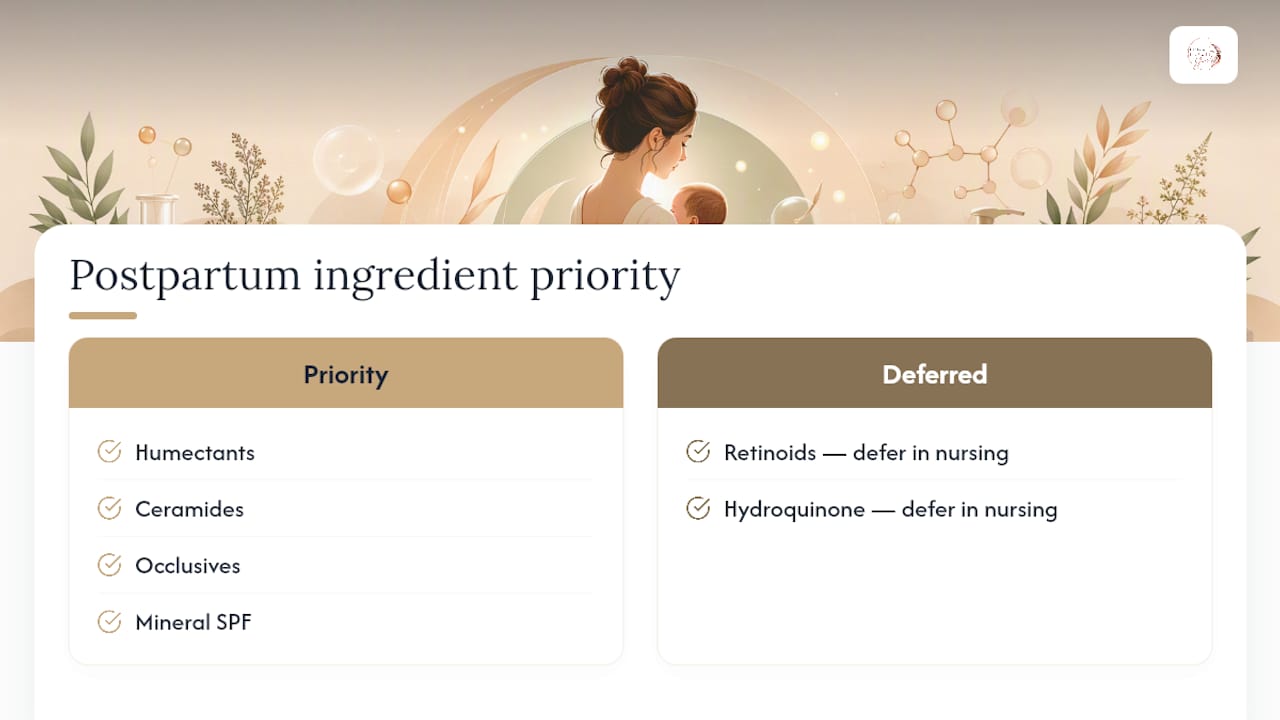
Humectants, ceramides, occlusives, and mineral SPF get priority because they rebuild the skin's water-retention ability instead of fighting the hormonal tide. Azelaic acid earns its spot as the go-to active during breastfeeding: it calms inflammatory acne and inhibits the pigment-producing enzyme behind melasma, with minimal systemic absorption. Retinoids and hydroquinone get deferred simply because the safety data for nursing is not there yet. For more on the emotional and physical shifts behind these changes, see our piece on what postpartum beauty really means.
A Note From Ava
Early postpartum life does not leave room for a ten-step ritual, and you should not feel guilty about that. Your skin is recovering from something enormous, and slower routines are not a failure. If you do only two things, make it moisturizer and SPF. Everything else can wait. A supportive community exists for exactly these moments, when you need a straight answer instead of another overwhelming list.
— Ava
Find More Postpartum Skincare Support at Theultimatebeauty-you
This platform brings together expert-backed routines, curated product picks, and a community of women who have been exactly where you are, all in one place instead of scattered across a dozen tabs at 2 a.m.

Beyond this routine, the platform's postpartum and life-stage resources cover everything from barrier repair to hormone-driven hair changes, with guidance built for real schedules, not idealized ones. If you want curated product recommendations that already meet the breastfeeding-safe criteria covered here, browse the product picks instead of guessing at ingredient labels alone. And if your skin needs more than a routine can fix, the platform's network of experts and partners can point you toward a dermatologist or OB who understands postpartum skin specifically. Start by exploring the postpartum section and see which resource fits your week.
Sources
This routine draws on postpartum dermatology guidance from Nebraska Medicine, Healthline, and HadaBuddy. For pregnancy-specific ingredient rules, see our pregnancy-safe skincare guide.
This article is general information, not a substitute for advice from a qualified doctor. Consult a qualified healthcare professional about your own circumstances before acting on anything here.
- Skin care dos and don'ts when pregnant or breastfeeding – Nebraska Medicine
- Postpartum skin care: Tips for nurturing your skin and hair after pregnancy – Healthline
- Postpartum skincare routine: a Japanese minimalist guide – MadeWithINE
- Postpartum skincare recovery guide – VeriMom
- Postpartum skincare: The first three months – HadaBuddy
FAQ
What Is the "3 3 3" Rule for Postpartum Care?
The "3 3 3" rule is a general newborn-care guideline, not a specific skincare protocol, and it varies by source. In skincare terms, the closest equivalent is a rule of three priorities: cleanse gently, repair the barrier, and protect with SPF, before adding anything more complex.
What Is the 4 2 4 Rule in Skincare?
There is no established dermatological rule with numbers that applies to postpartum skincare specifically, and definitions of such phrases vary widely online. Stick to the proven framework instead: a minimal routine built around a gentle cleanser, hydration, barrier repair, and daily mineral SPF.
What Is the Recommended Postpartum Skincare Routine?
The recommended postpartum skincare routine is a five-step sequence: gentle cleanser, hydrating serum like hyaluronic acid, ceramide moisturizer, an occlusive seal on dry areas, and daily mineral SPF, according to Nebraska Medicine. Breastfeeding status determines which active ingredients are safe to add on top of that base.
What Is the 5-5-5 Rule in Postpartum?
The "5-5-5 rule" typically refers to postpartum recovery timing for rest, not skincare, and the specifics vary by who is citing it. For skin, a more reliable marker is the 6 to 12 month window most sources cite for hormone-driven skin changes to fully resolve.
When Should I See a Dermatologist for Postpartum Skin Issues?
See a dermatologist or your primary care provider if melasma persists despite consistent SPF use, if dryness cracks or bleeds, or if you notice symptoms beyond typical postpartum shedding, like patchy bald spots or signs of eczema and psoriasis flaring. A provider can also guide safe, stronger treatment options once you finish breastfeeding.