

You become happy alone by intentionally building a steady relationship with yourself and a few daily habits that reliably regulate your mood. That's the core of it. Not a personality trait. Not luck. A learnable skill, and therapists back this up.
Three things you can try right now:
- Put your phone in another room for 15 minutes. No notifications, no scrolling. Just you and whatever's around you.
- Schedule a solo date this week. A coffee shop, a walk, a museum. Treat it like a real appointment.
- Do a 15-minute solitude session today. Sit quietly, notice what you feel, and write one sentence about it afterward.
The plan below is grounded in therapist guidance and research from labs studying solitude directly. Every step is testable, time-boxed, and built for real life.
Key Takeaways
Happiness alone grows from a steady, practiced relationship with yourself, supported by daily self-regulation habits and a clear distinction between chosen solitude and imposed loneliness.
| Point | Details |
|---|---|
| Start with 15 minutes | Research shows roughly 15 minutes of chosen solitude measurably lowers anxiety and increases calm. |
| Solitude vs. loneliness | Chosen solitude builds wellbeing; persistent, unwanted loneliness is linked to adverse health outcomes and needs attention. |
| Self-care is the foundation | A 30-minute walk, consistent sleep, and reduced late-night screens all directly support mood and make solitude sustainable. |
| Build the relationship gradually | Move through curiosity, compassion, and commitment — journaling prompts and a 5-minute self-witnessing check-in accelerate the process. |
| Seek help when needed | Persistent low mood, withdrawal, or thoughts of self-harm are red flags; call or text 988 (U.S.) or contact a sliding-scale therapist. |
| Theultimatebeauty-you | The platform offers expert-backed wellness resources and community for women building self-care and solitude practices at every life stage. |
Table of Contents
- How to be happy alone: a practical short-term plan for this week
- Durable rituals and practices that create lasting contentment
- What's the difference between loneliness and solitude?
- How to build a real relationship with yourself
- Which self-care basics actually support your mood?
- The 15-minute solitude practice you can start today
- How long does it take to feel comfortable alone?
- When does alone time become harmful? Red flags and how to get help
- How to use technology mindfully during solitude
- How to stay connected while valuing your solitude
- How to cultivate self-compassion and genuine acceptance
- What does research say about the psychological benefits of solitude?
- How to manage negative thoughts and self-criticism when alone
- Mindfulness and meditation techniques that work in solitude
- What I've learned about being alone with yourself
- Theultimatebeauty-you supports your growth from the inside out
- Sources
How to be happy alone: a practical short-term plan for this week
The biggest mistake people make when trying to enjoy solitude is waiting until it feels natural. It won't, not at first. You build comfort through small, repeated exposure, not through willpower or insight.
Healthline's practical guide identifies three entry-level tactics that consistently help people new to solitude:
- Phone breaks: Set a timer for 15–30 minutes and put your device out of reach. Start once a day.
- Solo dates: Take yourself somewhere you genuinely enjoy. A bookstore, a trail, a café with good light. The point is intentionality, not isolation.
- Micro-solitude sessions: Five to fifteen minutes of quiet, unstructured time. No podcast, no background TV. Just presence.
A sample Week 1 schedule you can copy
- Monday: 15-minute phone-free morning. Sit with your coffee. Notice three things in the room.
- Tuesday: Write three sentences in a journal before bed. No topic required.
- Wednesday: Take a 20-minute solo walk. Leave earbuds home.
- Thursday: Repeat the phone-free morning. Add five minutes.
- Friday: Plan your solo date for the weekend. Book it like a meeting.
- Saturday: Go on the solo date. Bring a journal or a book, not your phone.
- Sunday: Spend 10 minutes reflecting. What felt good? What felt hard?
Pro Tip: Use "training wheels" when early discomfort spikes. A book, a journal, or a comfort item (a warm drink, a favorite blanket) gives your nervous system something to anchor to while you adjust. The goal, per Prevention's guidance on embracing alone time, is gradual desensitization — not white-knuckling through discomfort.
Durable rituals and practices that create lasting contentment
Short-term tactics build momentum. Long-term practices reshape identity. The difference, as therapists frame it, is moving from self-soothing (temporarily distracting yourself from discomfort) to self-regulation (changing how you respond to stress at the source). That shift takes weeks, not days, and it's worth every one of them.
Therapist-backed practices that hold up over time include:
- Morning check-ins: Two minutes before you pick up your phone. Ask yourself: how do I feel right now, and what do I need today?
- Evening reflection: Three sentences in a journal. What went well, what was hard, what you're grateful for.
- Weekly solo outing: One intentional hour alone outside your home, doing something you chose for yourself.
- Creative projects: Drawing, cooking a new recipe, writing, gardening. The medium matters less than the act of making something.
- Boundary rituals: A specific phrase or action that signals the start of your alone time (closing a door, making tea, putting on a playlist). Rituals tell your brain: this time is mine.
Psychology Today's research summary notes that chosen solitude tends to improve emotional regulation and relationship quality over time. The key word is chosen. The same hours feel entirely different when they're imposed rather than selected.
Pro Tip: Pair your mindful beauty rituals with your alone-time practice. A skincare routine done slowly and intentionally is a form of self-regulation, not just self-care.
What's the difference between loneliness and solitude?
This distinction is the hinge everything else turns on. Get it wrong and you'll apply the wrong tools.
Solitude is chosen aloneness. You decide to be alone, and that decision carries a sense of agency. Loneliness is the painful feeling of disconnection, whether you're physically alone or surrounded by people. You can feel lonely in a crowded room and deeply content in an empty one.
Peer-reviewed research consistently links persistent loneliness to worse physical and mental health outcomes, including elevated cardiovascular risk. That's not a reason to fear being alone. It's a reason to distinguish between the two states clearly.
A quick self-check. Answer yes or no:
- Did I choose to be alone right now, or did it happen to me?
- Do I feel curious and calm, or restless and cut off?
- Am I looking forward to reconnecting with others later, or dreading it?
- Does this time feel restorative, or does it feel like waiting?
Mostly "yes" to the first option in each pair points toward solitude. Mostly "yes" to the second points toward loneliness that needs addressing, not more alone time.
The practical shift: if your aloneness feels imposed, start by adding one small act of choice to it. Pick what you eat, what you listen to, where you sit. Agency, even in small doses, begins to convert isolation into something you own.
How to build a real relationship with yourself
Most people have never been taught to treat themselves as someone worth knowing. That changes with practice. The progression moves through three stages: curiosity, compassion, and commitment.
Stage 1: Curiosity
- Ask "what do I actually enjoy?" without filtering for what sounds impressive or productive.
- Spend one week noticing what makes you feel alive versus what drains you.
- Write it down. Don't analyze it yet. Just collect data on yourself.
Stage 2: Compassion
- Notice your inner critic. When it speaks, write down what it says.
- Write one countering appreciation for each harsh thought. This "reverse gratitude" practice, drawn from Psychology Today's research synthesis, rewires self-talk over weeks.
- Self-compassion-focused practices are linked with lower depression and anxiety symptoms. You're not being soft. You're being strategic.
Stage 3: Commitment
- Protect your alone time the same way you'd protect an appointment with someone you respect.
- Revisit your journal monthly. Look for patterns in what you wrote.
- Adjust your rituals as you grow. What worked at week one may not be what you need at month three.
Journaling prompts to start with:
- What did I feel today that I didn't say out loud?
- What would I do this weekend if no one had an opinion about it?
- What's one thing I've been avoiding thinking about?
Pro Tip: Try a 5-minute "self-witnessing" check-in each evening. Sit quietly, close your eyes, and simply observe your emotional state without judging it. Name the feeling, locate it in your body, and let it be there. This is the mental health habit that builds the most durable inner stability over time.
Which self-care basics actually support your mood?
Emotional work doesn't happen in a vacuum. Your body is the container. When sleep is poor, movement is absent, and screens run late into the night, solitude feels harder than it needs to. These habits aren't optional add-ons — they're the foundation.
NIMH's guidance is direct: regular exercise, consistent sleep, healthy meals, and reducing late-night screen use all support mental health. A 30-minute walk reliably boosts mood and energy. That's not a suggestion. That's a starting point.
Harvard Health's self-care framework frames these habits as pillars of wellbeing and a practical foundation for resilience. You can find healthy beauty habits that weave movement and skincare into a single daily rhythm.
Quick self-rating checklist (score yourself today):
- Sleep: Am I getting 7–9 hours most nights?
- Movement: Did I move my body for at least 20 minutes today?
- Hydration: Have I had water consistently throughout the day?
- Nutrition: Did I eat at least one real, nourishing meal?
- Screens: Did I put devices away at least 30 minutes before bed last night?
| Habit | Simple target | Why it helps your mood |
|---|---|---|
| Walking or movement | Daily movement | Reduces stress hormones, boosts energy |
| Sleep consistency | Consistent schedule | Stabilizes mood and emotional regulation |
| Hydration | Regular water intake | Supports focus and reduces irritability |
| Late-night screens | Limit before bed | Protects sleep quality and morning mood |
| Nourishing meals | Balanced meals regularly | Steadies blood sugar and reduces anxiety |
The 15-minute solitude practice you can start today
Research from Thuy-vy Nguyen's Solitude Lab, covered in depth by Vice, found that roughly 15 minutes of chosen solitude produced measurable emotional shifts in experimental settings: lower high-arousal feelings like anxiety and excitement, and a meaningful increase in calm. Fifteen minutes. That's the entry point.
Here's the practice, step by step:
- Choose your space. Somewhere you won't be interrupted. It doesn't need to be quiet, just free from demands.
- Set a timer for 15 minutes. Phone face-down or in another room.
- Sit or lie comfortably. No agenda. No task.
- Notice what arises. Thoughts, feelings, physical sensations. Don't chase them. Don't suppress them. Just observe.
- Use a grounding prompt if needed. "What do I notice in my body right now?" or "What's one thing I can see, hear, and feel?"
- When the timer ends, write one sentence: "Right now I feel ___." Rate your mood 1–10.
Mindfulness research confirms that brief grounding practices reduce rumination and improve the ability to sit with uncomfortable inner states. The practice above combines both. Do it daily for two weeks and your baseline tolerance for solitude will shift noticeably.
Measurement tip: Keep a simple daily log. Date, mood before (1–10), mood after (1–10). After 14 days, look at the pattern. Most people see a consistent lift in the "after" score by day 7 or 8.
How long does it take to feel comfortable alone?
Adjustment is real, and it follows a rough arc. Knowing what to expect at each stage keeps you from quitting during the uncomfortable middle.
| Stage | Timeline | What it typically feels like | Milestone to look for |
|---|---|---|---|
| Early discomfort | Days 1–7 | Restlessness, urge to fill silence, self-consciousness | Completing one full 15-minute session |
| Settling | Weeks 2–4 | Less urgency to reach for the phone, occasional calm | Enjoying one solo activity without distraction |
| Growing ease | Months 1–3 | Solitude starts to feel restorative, not just tolerable | Looking forward to alone time |
| Integration | Month 3 onward | Solitude becomes a chosen resource, not a default | Protecting alone time proactively |
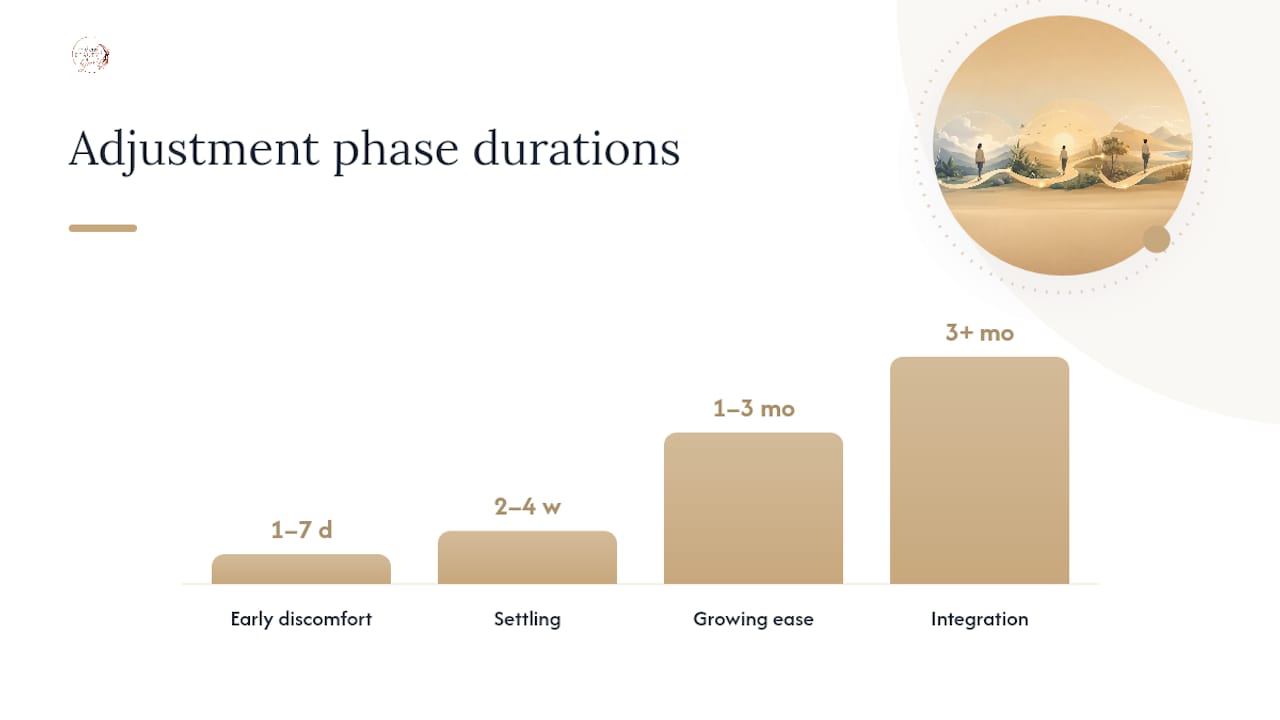
Individual pace varies. Introverts often move through early stages faster; people recovering from a major loss or transition may need more time in the settling phase. Neither is wrong.
A few notes on adjusting your pace:
- If week one feels unbearable, shorten sessions to 5 minutes. Progress is progress.
- If you plateau at "tolerable but not enjoyable," add a creative element to your alone time. Making something shifts the experience.
- If you reach month three and still dread being alone, that's useful information. It may point toward loneliness rather than a practice gap.
When does alone time become harmful? Red flags and how to get help
Solitude is healthy. Isolation is not. The line between them matters, and crossing it doesn't mean you've failed. It means you need a different kind of support.
Red flags to take seriously:
- Persistent low mood lasting more than two weeks
- Withdrawing from people you used to enjoy
- Difficulty with basic daily tasks (eating, sleeping, hygiene)
- Thoughts of self-harm or suicide
- Feeling like a burden to others
- Numbness or emotional flatness that doesn't lift
If you're experiencing thoughts of self-harm or suicide, reach out now. 988 Suicide and Crisis Lifeline: call or text 988 (U.S.). Crisis Text Line: text HOME to 741741. You don't have to be in immediate danger to use these resources — they're for anyone who's struggling.
Finding affordable therapy in the U.S.:
- Open Path Collective (openpathcollective.org): sessions from $30–$80 for individuals in financial need
- SAMHSA's National Helpline: 1-800-662-4357, free, confidential, 24/7
- Community mental health centers: search SAMHSA's treatment locator at findtreatment.gov
- Teletherapy platforms: many offer sliding-scale pricing and same-week availability
How to use technology mindfully during solitude
Technology is not the enemy of solitude. Mindless technology use is. The distinction shapes everything about how you structure your alone time.
Passive scrolling, especially through social media, tends to pull you outward — into comparison, performance, and other people's curated lives. That's the opposite of what solitude builds. Prevention's guidance specifically flags over-reliance on electronics, particularly social media, as a disruption to presence during solo time.
Active, intentional technology use is different. A guided meditation app, a journaling app, a playlist you chose deliberately, a podcast that teaches you something you're genuinely curious about — these support solitude rather than undermine it. The test is simple: does this bring me inward or pull me outward?
Practical boundaries that work:
- Designate your 15-minute solitude practice as phone-free, always.
- Use app timers to cap social media to 30 minutes a day during weeks when you're building your practice.
- Treat your meditation and relaxation practices as screen-free by default, unless you're using a guided audio.
- Charge your phone outside your bedroom. The first and last 20 minutes of your day belong to you.
How to stay connected while valuing your solitude
Choosing solitude doesn't mean choosing isolation. The healthiest relationship with alone time includes a clear, maintained web of social connection. These aren't competing values. They reinforce each other.
Psychology Today's research frames the ability to be alone as a relationship skill, one that actually improves the quality of your connections because you show up less depleted and more self-aware.
Ways to maintain connection without sacrificing your solitude:
- Protect one recurring social commitment. A weekly call with a friend, a monthly dinner, a standing walk with a neighbor. Consistency matters more than frequency.
- Volunteer. Structured, purposeful contact with others gives connection without the social pressure of unstructured socializing. Local food banks, literacy programs, and community gardens all offer this.
- Be honest about your needs. Telling people "I need some quiet time this weekend" is not rejection. It's self-knowledge communicated clearly.
- Invest in non-romantic relationships. Friendships, mentorships, and community ties are often the most durable sources of belonging. They don't require a partner to exist.
The goal is a life where solitude and connection are both chosen, both valued, and neither one is a default you fell into.
How to cultivate self-compassion and genuine acceptance
Self-compassion is not self-indulgence. It's the practice of treating yourself with the same basic decency you'd offer a friend who was struggling. Research published in PMC links self-compassion interventions with lower depression and anxiety symptoms and reduced harsh self-criticism, the exact inner noise that makes solitude feel threatening.
Three practices that build it:
The "good friend" reframe. When your inner critic fires, ask: "Would I say this to someone I love?" If the answer is no, rewrite the thought in the tone you'd actually use with that person.
Self-compassion phrases. In a hard moment, try: "This is difficult. Difficulty is part of being human. I can be kind to myself right now." Simple, repeatable, and grounding.
Body-based acceptance. Place one hand on your chest during a moment of distress. The physical gesture activates a calming response and signals safety to your nervous system. It sounds small. It works.
Acceptance doesn't mean approving of everything about yourself. It means stopping the war long enough to see clearly. From that place, growth becomes possible.
What does research say about the psychological benefits of solitude?
The evidence is more specific than most people realize. Solitude isn't just "nice to have." It produces measurable psychological effects.
Researchers at the Solitude Lab found that about 15 minutes of chosen solitude lowered high-arousal emotions and increased calm in experimental settings. That's a short window for a real emotional shift.
Psychology Today summarizes the broader picture: intentionally chosen solitude tends to improve creativity, emotional regulation, and the quality of social relationships. The mechanism is partly about recovery. When you're not performing for others, your nervous system gets to reset.
Solitude also supports what psychologists call autonomy, a clearer sense of your own values and preferences, separate from social pressure. That clarity tends to reduce anxiety and increase confidence in decision-making. The capacity to be alone, as researchers frame it, is a hallmark of psychological maturity, not a consolation prize.
How to manage negative thoughts and self-criticism when alone
Silence has a way of amplifying the inner critic. When external noise drops, internal noise often rises. That's normal, and it's manageable.
The first move is to stop fighting the thoughts. Trying to suppress a negative thought tends to make it louder, a well-documented effect in cognitive psychology. Instead, name it: "There's the self-doubt voice again." Naming creates distance.
From there, a few techniques hold up well:
Cognitive defusion. Treat the thought as a sentence your mind produced, not a fact about reality. "I'm not good enough" becomes "My mind is producing the thought that I'm not good enough." The shift is subtle and genuinely effective.
Scheduled worry time. Set 10 minutes in the afternoon for any anxious or critical thoughts. When they arise outside that window, note them and redirect: "I'll think about that at 3 PM." This contains rumination without suppressing it.
Movement as a reset. When a thought spiral starts, a 5-minute walk or a few minutes of stretching interrupts the loop at the body level. Mindfulness research confirms that brief physical grounding reduces rumination more reliably than trying to think your way out of it.

The inner critic tends to quiet as your relationship with yourself deepens. It doesn't disappear. It just loses authority.
Mindfulness and meditation techniques that work in solitude
Solitude and mindfulness are natural partners. Both ask the same thing: be here, with what's actually present. The types of mindfulness practices that work best during alone time tend to be simple, body-based, and short enough to do without a class or an app.
Breath anchor: Sit comfortably. Focus on the sensation of breathing at your nostrils or chest. When your mind wanders (it will), return to the breath without judgment. Start with 5 minutes.
Body scan: Lie down. Move your attention slowly from your feet to the top of your head, noticing sensation without trying to change anything. This is particularly useful before sleep and pairs well with the meditation and beauty rest practices that support skin and recovery.
5-4-3-2-1 grounding: Name 5 things you can see, 4 you can touch, 3 you can hear, 2 you can smell, 1 you can taste. This interrupts anxiety and returns you to the present moment quickly. It's the fastest tool in the kit.
Open awareness: Sit quietly and simply allow whatever arises to arise. No focus object, no agenda. Just witnessing. This is harder than it sounds and becomes more accessible as your practice deepens.
Start with the breath anchor. Add the others as your tolerance for stillness grows.
What I've learned about being alone with yourself
There's a version of this conversation that makes solitude sound like a productivity hack or a wellness trend. It's neither. Learning to be genuinely content alone is one of the most honest things you can do for yourself, and for the people in your life.
What I've seen, reading the research and the therapist guidance closely, is that the women who struggle most with solitude aren't lacking discipline. They're lacking permission. Permission to take up space in their own lives. Permission to have preferences that exist outside of what they do for others.
The mental health and confidence connection is real. When you know yourself, you carry yourself differently. That's not a metaphor. It shows up in how you speak, how you make decisions, and how you recover when things go sideways.
The work is quiet and it's ongoing. But it's yours. And that's exactly the point.
Theultimatebeauty-you supports your growth from the inside out

At Theultimatebeauty-you, we believe beauty is becoming, and that process starts with the relationship you have with yourself. Our platform connects women with trusted wellness experts, self-care resources, and a community of women at every age and stage of growth. Whether you're building your first solitude practice or deepening a long-standing self-care ritual, you'll find expert guidance and curated tools designed to support the whole you, inside and out. Visit Theultimatebeauty-you to explore what's waiting for you.
Sources
- Caring for Your Mental Health - National Institute of Mental Health (NIMH)
- The pillars of self-care
- Scientists Say Alone Time Comes With a Lot of Benefits — You’re Just Doing It Wrong
- Move over loneliness — why 'me time' can be a great time
- How to Be Happy Alone: A Therapist’s Guide to Genuine Solitude
- How to Be Happy Alone: 20 Ways to Be Your Own Best Friend
- Pmc
- How To Embrace Alone Time and Actually Enjoy It
This article is general information, not a substitute for advice from a qualified doctor. Consult a qualified healthcare professional about your own circumstances before acting on anything here.