
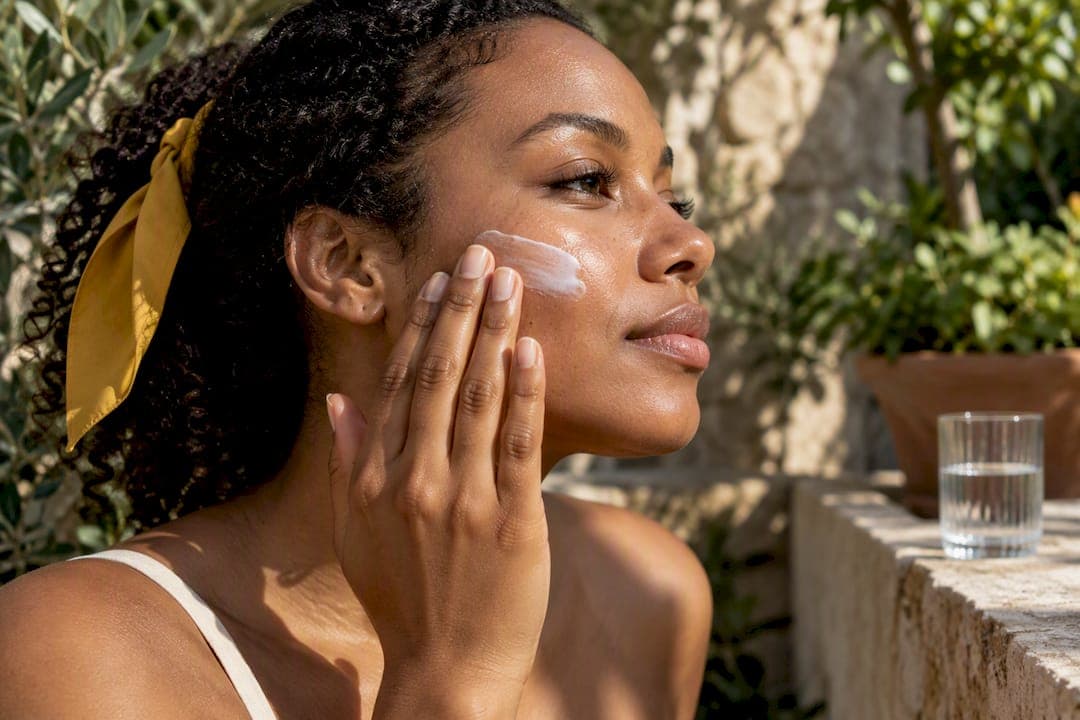
Start with daily photoprotection and a proven topical regimen. That combination fades most dark spots within three to six months. Escalate to oral tranexamic acid or in-office procedures only under dermatologic supervision, and only after safety screening, especially with melasma or darker skin tones where inflammation itself can trigger new pigment. Give it months, not weeks.
TL;DR:
- Superficial hyperpigmentation, like epidermal pigment, usually fades within three to six months of consistent topical treatment and sun protection.
- Deep dermal pigment may require 12 to 24 months to improve, and some cases might never fully clear with topicals alone.
- Topical agents like hydroquinone or triple-comb creams are most effective in the induction phase and require dermatologist supervision due to potential side effects.
- Gentle, early-stage treatments such as azelaic acid, niacinamide, and vitamin C are safer for skin of color and during pregnancy, with careful introduction to avoid irritation.
- Procedures like superficial chemical peels and microneedling can accelerate results but must be performed with caution, proper priming, and strict sun protection to prevent rebound pigmentation.
Table of Contents
- What Kind of Hyperpigmentation Treatment Do Women Actually Need?
- Which Topical Treatments Actually Fade Dark Spots?
- Do Chemical Peels and Lasers Actually Help With Dark Spots?
- What's the Safest Treatment Hierarchy for Darker Skin Tones?
- How Do You Treat Melasma Long-Term?
- What Should a Daily Skincare Routine Look Like?
- When Should You See a Dermatologist for Dark Spots?
- Who's Behind This Guide
- A Women-Centered Take on Treating Dark Spots
- Get Personalized Guidance for Your Skin
- Sources
- FAQ
What Kind of Hyperpigmentation Treatment Do Women Actually Need?
Not every dark patch responds to the same fix, and that's the first thing to sort out before spending money on serums. The plan depends on what's causing the discoloration and how deep it sits in your skin.
Melasma shows up as symmetrical, brownish-gray patches, usually across the cheeks, forehead, and upper lip. It's driven overwhelmingly by hormones: pregnancy, oral contraceptives, hormone therapy, and sun exposure all feed it. Post-inflammatory hyperpigmentation (PIH) follows an injury to the skin, acne, a bug bite, a wax burn, an aggressive facial. Anything that inflames the skin can leave a pigmented ghost behind. Lentigines, often called sun spots or age spots, are flat brown marks from cumulative ultraviolet exposure and tend to appear on the face, hands, and chest as women move into their 40s and beyond.
Depth matters just as much as cause. Epidermal pigment sits in the top layer of skin, near the surface, and responds fastest to treatment. Dermal pigment sits deeper, wrapped around blood vessels and skin structures, and it's far more stubborn. A dermatologist can sometimes tell the difference with a Wood's lamp exam, which makes epidermal pigment glow more distinctly under ultraviolet light while dermal pigment stays muted.
Here's what typically drives each type in women specifically:
- Melasma: pregnancy ("the mask of pregnancy"), birth control pills, hormone replacement therapy, and heat or visible light exposure.
- PIH: acne, eczema flares, cosmetic procedures done without proper aftercare, and plucking or waxing.
- Lentigines: decades of cumulative sun exposure, often showing up earlier in fair skin but appearing in every skin tone.
- Combination cases: many women have overlapping melasma and PIH, which is why a one-product approach rarely solves the whole picture.
Timelines vary just as widely. Epidermal hyperpigmentation generally shows measurable improvement within three to six months of consistent topical care and sun protection. Dermal pigment is a different story: it can take 12 to 24 months to fade meaningfully, and some of it may never fully clear with topical treatment alone. That's not a failure on your part. It's biology, and it's exactly why a dermatologist's assessment early on saves you from months of frustration with the wrong product.
Which Topical Treatments Actually Fade Dark Spots?
Sunscreen is the foundation everything else builds on. Skip it, and even the best serum in the world spins its wheels. From there, the treatment plan usually splits into an induction phase, meant to knock pigment down fast, and a maintenance phase, meant to keep it from coming back.
Topical therapy is the recommended first-line treatment for facial hyperpigmentation, and hydroquinone, used alone or combined with other agents, remains one of the most effective depigmenting compounds available. It works by slowing the enzyme that produces melanin. Triple-combination creams, pairing hydroquinone with tretinoin and a mild corticosteroid, are a common induction strategy prescribed for limited stretches under a dermatologist's care. They're powerful, and that's exactly why they need supervision rather than open-ended daily use.
Once pigment responds, or for women who need gentler daily options, non-hydroquinone agents carry the maintenance load:
- Azelaic acid (typically 15 to 20%) calms inflammation while inhibiting pigment production, making it a solid choice for acne-prone skin and pregnancy-safer routines.
- Niacinamide reduces the transfer of pigment to skin cells and strengthens the skin barrier, which matters if retinoids or acids have left skin reactive.
- Retinoids speed up cell turnover, pushing pigmented cells to the surface faster, but they need a slow introduction to avoid irritation that can ironically trigger more PIH.
- Vitamin C (usually L-ascorbic acid) works as an antioxidant and mild brightener, best layered in the morning under sunscreen.
- Topical tranexamic acid interrupts the signaling pathway between skin cells and pigment-producing melanocytes, and it's increasingly used as a gentler alternative to hydroquinone for long-term maintenance.
Application matters as much as ingredient choice. Patch test any new active on your inner arm for a few days before putting it on your face. Introduce retinoids two or three nights a week, then build up as tolerated. Layer antioxidants like vitamin C in the morning, save retinoids and stronger actives for night, and never stack two exfoliating or irritating actives in the same routine without easing in.
Pro Tip: If your skin gets red, flaky, or stingy within the first two weeks of starting a new active, that's not "purging." It's irritation, and irritation is a direct trigger for new pigment. Pull back to two nights a week and let your barrier catch up before pushing forward again.
Pregnancy and breastfeeding narrow the list considerably. Hydroquinone, retinoids, and oral tranexamic acid are typically avoided, while azelaic acid, niacinamide, and vitamin C are generally considered safer choices, always confirmed with your own physician. If you're pregnant or planning to be, this pregnancy-safe skincare guide walks through which ingredients dermatologists flag most often.
Know when to stop or switch. Persistent redness, peeling, or a burning sensation means the regimen is working against you, not for you. And unsupervised hydroquinone use over many months, particularly at higher concentrations without breaks, carries a rare but real risk of exogenous ochronosis, a bluish-gray discoloration that's difficult to reverse. That risk is exactly why hydroquinone belongs in a supervised, time-limited protocol rather than an indefinite daily habit.
Do Chemical Peels and Lasers Actually Help With Dark Spots?
Procedures can accelerate results that topicals alone would take much longer to achieve, but they cut both ways. Done carelessly, especially in darker skin, they can create more pigmentation than they remove.
Superficial peels, glycolic, lactic, and salicylic acid, work well as adjuncts for epidermal pigment. They exfoliate the top layer where surface-level melanin sits, and because they don't penetrate deeply, the risk profile stays relatively low when performed by an experienced provider. Medium-depth peels are a different calculation entirely. Procedures like medium-depth peels and aggressive laser settings can worsen post-inflammatory hyperpigmentation without proper priming, particularly in skin that pigments easily.
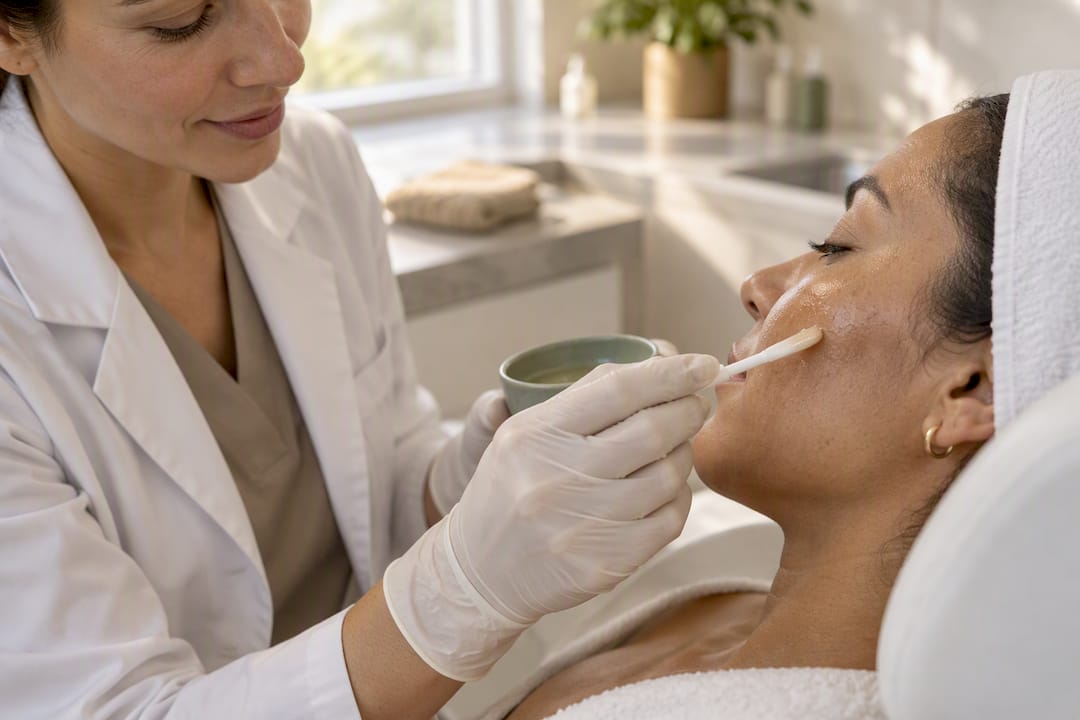
Microneedling has earned a place in many dermatology practices, largely because it creates controlled micro-injuries that stimulate collagen without the heat-based trauma of lasers. But it still counts as an inflammatory event to the skin, which means priming beforehand and strict sunscreen afterward aren't optional extras, they're the difference between improvement and a new round of dark marks.
Lasers and intense pulsed light (IPL) get the most attention and carry the most risk if chosen poorly. The rule that matters most: conservative settings, staged sessions, and an operator who has real experience treating pigmented skin.
- Superficial chemical peels suit epidermal pigment and tolerate a wider range of skin tones when dosed conservatively.
- Medium-depth peels require careful patient selection and are generally avoided in higher-risk skin without a priming period first.
- Microneedling works best paired with topical priming agents and diligent sun protection in the weeks after.
- Low-fluence, non-ablative lasers, run by an experienced dermatologist, minimize the thermal injury that triggers rebound pigmentation.
- Any procedure without a post-treatment sunscreen commitment is a procedure not worth doing.
Risk mitigation comes down to three habits: prime the skin with a topical lightening agent for two to four weeks beforehand, choose staged low-fluence settings rather than one aggressive session, and treat photoprotection afterward as non-negotiable, not optional. Skip any one of those three, and the odds of trading old pigment for new pigment climb fast.
What's the Safest Treatment Hierarchy for Darker Skin Tones?
Women with Fitzpatrick skin types IV through VI face a specific paradox: their skin produces more melanin as a defense mechanism, which means any inflammation, from a peel, a laser, an aggressive scrub, or even a popped pimple, is more likely to trigger new pigment than it would in lighter skin. A safer hierarchy that emphasizes priming and avoids proinflammatory interventions meaningfully reduces PIH risk in skin of color, and it's worth building your entire treatment plan around that principle rather than treating it as a footnote.
The safest approach moves in stages rather than jumping straight to the most aggressive option available:
- Stage one: daily tinted broad-spectrum sunscreen plus gentle, non-irritating topicals such as azelaic acid, niacinamide, and topical tranexamic acid are usually the best starting point.
- Stage two: superficial chemical peels and primed microneedling become reasonable additions once the skin has tolerated topicals well for several weeks without irritation.
- Stage three: selective, low-fluence laser treatment, and only after the skin has been optimized with priming agents, and only with a provider experienced specifically in treating skin of color.
Preferred agents for this population tend to skew toward the calmer end of the spectrum. Azelaic acid rarely causes the irritation that triggers rebound pigment. Topical tranexamic acid offers meaningful brightening without the harsh exfoliation of stronger acids. Niacinamide supports barrier function while still interrupting pigment transfer. Retinoids still have a place, but the introduction needs to be slower and more gradual than typical skincare advice assumes.
Pro Tip: If a product or treatment leaves your skin even mildly irritated for more than a day or two, stop. In melanin-rich skin, irritation is rarely a sign the product is "working." It's usually the trigger for the next round of dark spots.
Avoidance matters as much as active ingredient choice. Harsh physical scrubs, high-percentage glycolic acid used too frequently, and DIY lemon juice or baking soda remedies (still circulating widely online) can all provoke the exact inflammation this hierarchy is built to prevent. If you've read that certain hydroquinone alternatives or "natural remedies for hyperpigmentation" promise fast fading, treat that claim skeptically. The gentlest effective option, used consistently, beats the harshest option used once.
How Do You Treat Melasma Long-Term?
Melasma isn't a condition you cure once and move past. Experts increasingly frame melasma as chronic, requiring induction, maintenance, and ongoing photoprotection rather than a permanent one-time fix, and reframing your expectations around that reality changes how you judge success.
The protocol most dermatologists follow has a clear structure:
- Induction phase: a supervised course of hydroquinone or a triple-combination cream, typically running eight to twelve weeks, to knock visible pigment down as quickly and safely as possible.
- Transition to maintenance: once pigment has meaningfully faded, switching to gentler, non-hydroquinone agents, azelaic acid, topical tranexamic acid, niacinamide, keeps results stable without the ochronosis risk that comes with indefinite hydroquinone use.
- Oral tranexamic acid for refractory cases: when melasma doesn't respond adequately to topical care alone, oral TXA is an effective adjunctive therapy, typically prescribed for several months. It works systemically to interrupt the same inflammatory and vascular signals that feed melasma from beneath the skin, but it requires screening for clotting risk, personal or family history of thromboembolism, and current estrogen use before anyone starts it.
- Relapse prevention: since melasma is hormonally and light driven, ongoing daily photoprotection, specifically a tinted sunscreen containing iron oxides, is the single habit that determines whether results hold or unravel.
That last point deserves real weight. Visible light contributes meaningfully to melasma relapse, and standard sunscreens that block ultraviolet rays alone don't block it. Iron oxide pigments are what give tinted sunscreens their visible-light defense, which is part of why plain, untinted SPF often underperforms for melasma specifically compared with tinted formulas.
Set your expectations accordingly: most women see meaningful fading, not total disappearance, and stopping maintenance care entirely tends to invite the pigment back within months, especially with sun exposure, heat, or hormonal shifts like pregnancy or a new birth control prescription.
What Should a Daily Skincare Routine Look Like?
Consistency beats intensity here. A moderate routine followed every single day outperforms an aggressive one followed sporadically, and the order you apply products in actually affects how well they work.
Morning routine:
- Apply a vitamin C serum or another antioxidant while skin is still damp from cleansing.
- Follow with a tinted, broad-spectrum sunscreen rated SPF 30 to 50+, formulated with iron oxides for visible-light protection.
- Reapply every two hours if you're outdoors, and add a wide-brimmed hat or seek shade during peak sun hours for extra coverage.
Evening routine:
- Introduce a retinoid gradually, starting two or three nights weekly, or use azelaic acid or niacinamide if your skin runs sensitive.
- Follow with a barrier-supporting moisturizer, since irritated, compromised skin produces more pigment, not less.
- Skip additional exfoliating acids on retinoid nights to avoid overloading the skin barrier.
Sunscreen use, reapplied every two hours or after sweating and swimming, is the non-negotiable foundation of any hyperpigmentation plan, and dermatologists consistently point to inconsistent sun protection as the number one reason otherwise-good regimens stall out.
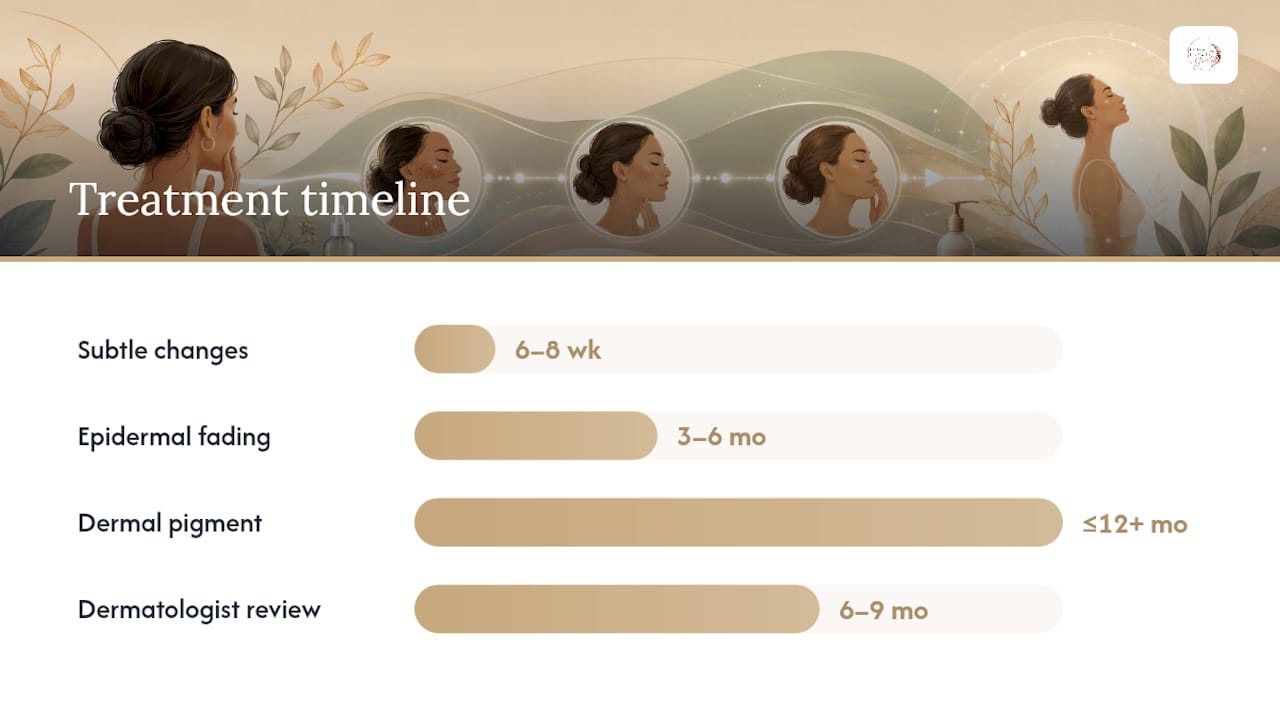
As for timelines: expect subtle changes within six to eight weeks, meaningful epidermal fading by three to six months, and up to a year or more for deeper, dermal pigment. If you've been diligent for six to nine months without any visible change, that's the signal to bring in a dermatologist rather than switching products again on your own. For women navigating perimenopause alongside pigment changes, this menopause skincare guide covers how hormonal shifts affect both barrier function and pigment behavior during that stage.
When Should You See a Dermatologist for Dark Spots?
Certain signals mean it's time to stop self-treating and get a professional opinion rather than trying yet another over-the-counter serum.
- No improvement after six to nine months of consistent topical care and diligent sun protection. At that point, the diagnosis or the regimen likely needs adjusting, not more patience.
- Diagnostic uncertainty. If you can't tell whether you're dealing with melasma, PIH, or something else entirely, a Wood's lamp exam and a trained eye save months of guessing.
- Any lesion that changes shape, color, or texture. Dark spots that evolve unpredictably need evaluation to rule out anything beyond routine pigmentation.
- Pregnancy, breastfeeding, or planning to conceive. Many effective agents, including hydroquinone, retinoids, and oral TXA, are typically avoided in these situations, and a dermatologist can map out what's actually safe for your stage.
- Considering oral tranexamic acid. This step requires a real screening conversation, not a quick prescription. Bring up any personal or family history of blood clots, current hormonal contraceptive or hormone therapy use, and smoking status, since all of these affect clotting risk.
At your visit, a short checklist keeps the conversation focused: ask for a clear diagnosis (epidermal versus dermal), a realistic timeline for your specific case, whether a priming period is needed before any procedure, the side-effect profile of whatever's prescribed, and what the maintenance plan looks like once the active treatment phase ends.
Who's Behind This Guide
This guide was compiled drawing on peer-reviewed dermatology reviews and patient guidance from organizations including the American Academy of Dermatology and Cleveland Clinic. It reflects consensus recommendations rather than any single practitioner's opinion, and it's written to be a starting point for conversations with your own dermatologist, not a replacement for one.
Theultimatebeauty-you's broader library includes dermatologist-backed pregnancy-safe skincare guidance, evidence-informed menopause skincare advice, and a curated list of tinted SPF picks for dark skin that avoid the chalky white cast that keeps too many women from wearing sunscreen consistently. If pigment concerns extend beyond your face, the platform's scalp health resource covers how irritation from styling or hair removal can trigger the same PIH response elsewhere on the body. Always bring specific treatment decisions, especially anything systemic or procedural, to a licensed dermatologist who can evaluate your skin directly.
A Women-Centered Take on Treating Dark Spots
Hyperpigmentation research rarely accounts for how much life stage shapes both the cause and the acceptable treatment. What's safe for a 24 year old on birth control isn't automatically safe during pregnancy or comfortable during perimenopause. A good plan asks about your hormones and your goals before it recommends an ingredient. That's the difference between a routine copied from someone else and one built around where you actually are right now.
— Ava
Get Personalized Guidance for Your Skin
Reading about hydroquinone concentrations and iron-oxide sunscreens is one thing. Knowing which combination is right for your skin tone, your hormonal stage, and your budget is another. Theultimatebeauty-you exists to close that gap: instead of piecing together advice from a dozen scattered sources, you get curated, dermatologist-backed product recommendations and direct access to vetted experts who understand pigmentation across every skin tone and life stage.

The platform's Experts & Partners directory connects you with specialists who can assess whether you're dealing with melasma, PIH, or lentigines, and build a plan around your specific hormonal history, whether that's pregnancy, hormonal contraception, or perimenopause. If you want a starting point stocked with dermatologist-endorsed picks rather than guesswork, browse the curated product recommendations. Ready to get matched with resources built for your stage of life? Join Theultimatebeauty-you and start building a plan that actually fits your skin.
Sources
- How to fade dark spots in darker skin tones — American Academy of Dermatology
- Dermatology: how to manage facial hyperpigmentation in skin of colour — PMC
- Clinical dermatology chapters on melasma and hyperpigmentation — NCBI Bookshelf (2026)
This article is general information, not a substitute for advice from a qualified doctor. Consult a qualified healthcare professional about your own circumstances before acting on anything here.
FAQ
What Is the Most Effective Treatment for Hyperpigmentation?
Daily broad-spectrum sunscreen combined with an evidence-backed topical regimen, often starting with a supervised hydroquinone or triple-combination cream, is widely considered the most effective first-line approach. For refractory melasma, oral tranexamic acid can add meaningful benefit after proper safety screening.
How Do Women in Korea Manage Hyperpigmentation and Dark Spots?
Korean skincare culture emphasizes gentle, consistent layering, hydrating essences, niacinamide, and vitamin C serums, paired with rigorous daily sunscreen use and reapplication. The core principle, prevention through consistent photoprotection plus gradual brightening actives, aligns closely with dermatology-backed approaches used elsewhere.
What Makes Hyperpigmentation Worse?
Unprotected sun and visible-light exposure, skin irritation from harsh scrubs or overly strong actives, and picking at acne or scabs all worsen pigmentation. Visible light specifically drives melasma relapse, which is why untinted sunscreen often underperforms for melasma compared with iron-oxide formulas.
Can Hyperpigmentation Be Permanently Removed?
Epidermal pigment often fades substantially within three to six months of consistent treatment, but melasma tends to be a chronic, relapsing condition rather than a one-time cure. Dermal pigment can take 12 to 24 months to improve and may never fully resolve with topical treatment alone, which is why ongoing maintenance and photoprotection matter more than chasing a permanent fix.
When Should I See a Dermatologist About Dark Spots?
See a dermatologist if six to nine months of consistent topical care and sun protection produce no improvement, if the diagnosis feels unclear, or if you're pregnant, breastfeeding, or considering oral tranexamic acid. A dermatologist can also determine whether your pigment is epidermal or dermal, which changes the entire treatment timeline.