
Menopause skincare that works starts with three priorities: hydrate the barrier, protect with daily sunscreen, and introduce a retinoid or gentler alternative slowly. Skin loses collagen rapidly during this stage, so the sequence matters. Pair fragrance-free ceramides and hyaluronic acid with cautious retinoid use, and talk to a dermatologist about hormone-related options if dryness, thinning, or irritation feels severe. Product picks and a full routine come next.
TL;DR:
- Menopausal skin rapidly loses about 30% of collagen in the first five years after menopause, emphasizing early intervention for best results.
- Key ingredients like hyaluronic acid, ceramides, niacinamide, and peptides support hydration and collagen production while minimizing irritation risks.
- Retinoids should be introduced gradually, starting with low strength one or two nights weekly, especially if the skin is reactive or barrier-compromised.
- A minimalist routine with five or six well-chosen products, applied in the correct order, outperforms crowded regimes for fragile menopausal skin.
- Hormonal therapies, including topical or systemic estrogen, may help improve skin health but require consultation with a healthcare professional due to associated risks.
Table of Contents
- Building Your Menopause Skincare Routine, Step by Step
- What to Buy for Every Step of Your Routine
- Why These Ingredients Matter for Menopausal Skin
- How to Introduce Retinoids Without Wrecking Your Barrier
- When Hormones and Dermatology Both Belong in the Conversation
- How Menopause Changes Your Skin's Microbiome
- Take on Menopausal Skin Care
- Get Curated Menopause Skincare Recommendations
- Sources
Building Your Menopause Skincare Routine, Step by Step
You don't need a twelve-step regimen to see real change. You need the right five or six steps, done consistently, in the right order. Menopausal skin is drier, thinner, and slower to bounce back from irritation than it used to be, so every product in your lineup has to earn its place.
Here's what dermatologists actually recommend for morning and night, according to the American Academy of Dermatology.
Morning routine:
- Cleanse with a gentle, low-foam formula, no hot water, no scrubbing.
- Apply a hydrating serum with hyaluronic acid while skin is still damp.
- Layer a ceramide-rich moisturizer to lock in that moisture and reinforce the barrier.
- Finish with broad-spectrum sunscreen, SPF 30 or higher, every single day, including cloudy ones.
Evening routine:
- Cleanse again to remove sunscreen, makeup, and the day's grime.
- On retinoid nights (start conservatively, more on pacing below), apply a pea-sized amount to fully dry skin.
- On off-nights, use a peptide or niacinamide serum instead, both of which support collagen without the irritation risk.
- Seal everything with a richer, occlusive night cream if your skin runs dry.
If your skin is reactive right now, a compromised barrier, active dermatitis, or a stretch of relentless flushing, skip the actives entirely for a few weeks. Cleanse, moisturize, and wear sunscreen. That's it. This "skinimalist" approach isn't a downgrade; it's often the fastest way to calm inflammation and get your skin ready for actives later.
A few layering rules make a real difference. Apply products thinnest to thickest: serum before cream, cream before oil. Wait a minute or two between hydrating steps so each one absorbs instead of pilling. And never introduce a new active on the same night you're testing a new cleanser or exfoliant. You want to know exactly what caused a reaction if one shows up.
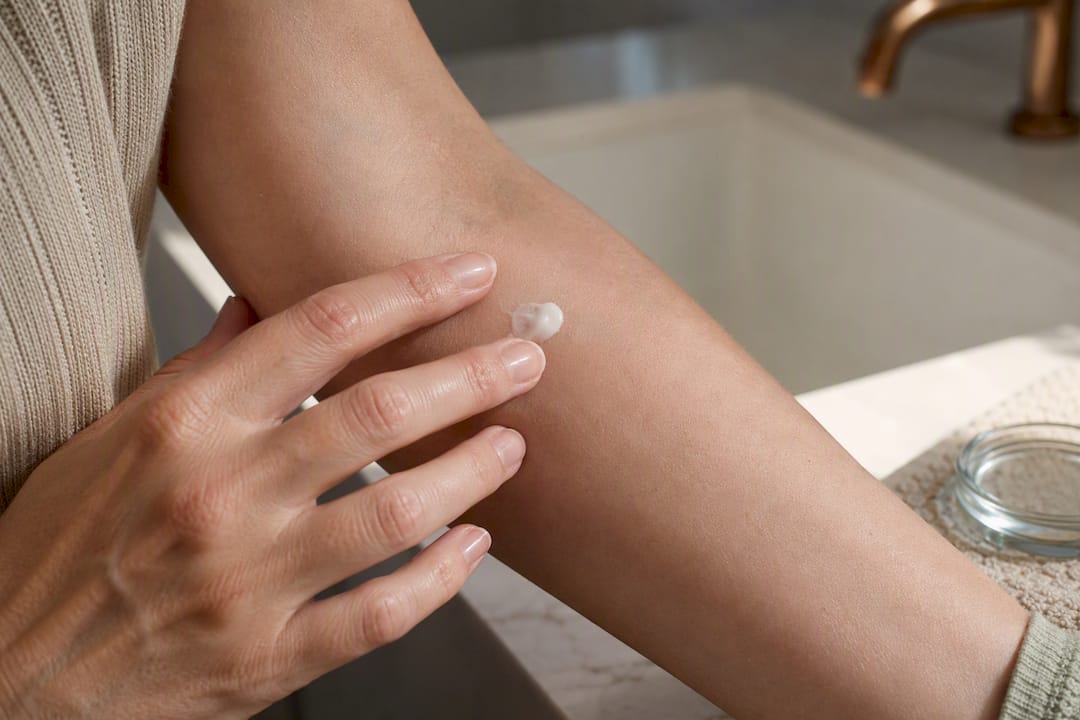
Patch testing matters more now than it did in your 30s. Dab a small amount of any new product on your inner arm or behind your ear for two to three nights before it touches your face. Menopausal skin's barrier is more permeable, which means it absorbs actives faster and reacts to irritants faster too.
Pro Tip: Apply retinoids to completely dry skin, not damp. Damp skin absorbs the active faster and deeper, which sounds good in theory but usually just means more redness and flaking. Dry skin slows delivery just enough to keep irritation in check.
One more practical note: don't stack a retinoid night with a strong chemical exfoliant like a glycolic or salicylic acid treatment. Alternate them across different nights, or you're asking a fragile barrier to handle two aggressive actives at once.
What to Buy for Every Step of Your Routine
Translating a routine into an actual shopping list is where most women get stuck. Here's how the categories break down, along with what to look for on the label and where menopause-specific collections fit in.
Cleanser. Look for fragrance-free, sulfate-free, low-foam formulas. CeraVe Hydrating Facial Cleanser and Vanicream Gentle Facial Cleanser are both built for compromised, reactive skin. La Roche-Posay Lipikar AP+ Gentle Foaming Moisturizing Wash works well if you want a bit more lather without stripping lipids.
Hydrating serum. Hyaluronic acid is the workhorse here. Neutrogena Hydro Boost Hyaluronic Acid Serum is an affordable, widely available option, and Murad Cellular Hydration Barrier Repair Serum adds barrier-supporting lipids on top of the humectant effect.
Barrier-repair moisturizer. This is where ceramides matter most. CeraVe Moisturizing Cream is the drugstore benchmark. Neutrogena Hydro Boost Hyaluronic Acid Water Gel Moisturizer suits oilier or combination skin, and Drunk Elephant Protini Polypeptide Cream pairs peptides with amino acids for a firmer feel. Kiehl's Ultra Facial Cream with Squalane and Naturopathica Gotu Kola Intense Repair Balm both suit drier, more mature skin types.
Retinoid or alternative. RoC Retinol Correxion Line Smoothing Max Hydration Cream and Olay Retinol24 MAX Night Serum for Face are accessible entry points. Murad Retinal ReSculpt Overnight Treatment and Murad Retinal ReSculpt Overnight Cream use retinaldehyde, generally gentler than retinol. Murad Retinol Youth Renewal Serum and CeraVe Skin Renewing Nightly Exfoliating Treatment round out the mid-tier options. Prescription-strength tretinoin, like Estriol+ Face Cream or Tretinoin Active Renewal Cream, both from Midi Health, requires a clinician's guidance.
Sunscreen. Non-negotiable, every morning, rain or shine.
Targeted concerns. Hydroquinone Even Tone Cream from Midi Health addresses pigmentation. Marie Veronique Vitamins C+E+Ferulic Serum adds antioxidant protection. Clinique Moisture Surge 100H Auto-Replenishing Hydrator works as a midday hydration boost under makeup.
Menopause-specific collections. No7's menopause skincare line includes the Firm & Bright Eye Concentrate and the Instant Radiance Serum, both formulated around hormonal skin changes rather than general anti-aging. Vichy's Neovadiol Meno 5 Serum is built specifically around the five biggest concerns women report during this transition: dryness, loss of density, dullness, sensitivity, and slackness. Olay Cleanse Detox & Glow Daily Cleanser, Olay Collagen Peptide MAX Day Cream Face Moisturiser, and eye options like Estee Lauder Advanced Night Repair Eye Supercharged Gel-Creme round out an affordable, widely available lineup.
A word of caution: no cream "replaces" collagen once it's applied topically. Marketing language that implies a jar can restore lost density is overselling what any topical formula can realistically do. What these ingredients can do, when used consistently, is support the skin's own repair processes and slow further decline. That's a meaningful outcome, just not a magic one.
Affordability spans a wide range. Drugstore ceramide creams and hyaluronic acid serums run under $25. Mid-tier menopause-specific lines like No7 and Vichy typically land between $20 and $40 per product. Prescription options through telehealth platforms cost more but come with clinical oversight, which matters if you're layering in tretinoin or hydroquinone.
Why These Ingredients Matter for Menopausal Skin
The numbers behind menopausal skin aging are worth knowing because they explain why waiting isn't a neutral choice. Skin loses approximately 30% of its collagen within the first five years after menopause, then continues losing about 2% per year for the next two decades, according to a collagen loss timeline study. That front-loaded decline is why dermatologists push early intervention rather than a wait-and-see approach.
The five-year window matters. Nearly a third of your postmenopausal collagen loss happens in the first sixty months. Starting a barrier-focused, actives-informed routine early captures more of what's still there.
Each core ingredient addresses a specific piece of that decline:
- Hyaluronic acid pulls water into the skin's upper layers, easing the dryness that comes from a weakened barrier.
- Ceramides rebuild the lipid matrix that holds moisture in and irritants out, which becomes more porous as estrogen drops.
- Niacinamide calms inflammation and supports barrier function with a much lower irritation profile than retinoids.
- Peptides signal skin cells to produce more collagen, offering a gentler complement to retinoid use rather than a replacement for it.
- Retinoids remain the gold-standard topical for stimulating collagen production and improving texture, though menopausal skin's thinner, more reactive state means they need careful pacing.
- Sunscreen prevents ultraviolet radiation from accelerating the collagen breakdown that's already happening hormonally, making daily SPF a preservation tool, not just a sunburn preventive.
None of this supports piling on more products. Dermatologists increasingly caution against the "more is better" instinct, especially while a barrier is already fragile from hormonal shifts. A minimalist, intentional routine, fewer products, chosen deliberately, tends to outperform a crowded regimen where six actives compete for absorption and irritate each other along the way.
How to Introduce Retinoids Without Wrecking Your Barrier
Retinoids work. They also cause more dropout and frustration in menopausal skin than in any other age group, mostly because people start too fast. A slower ramp-up almost always wins.
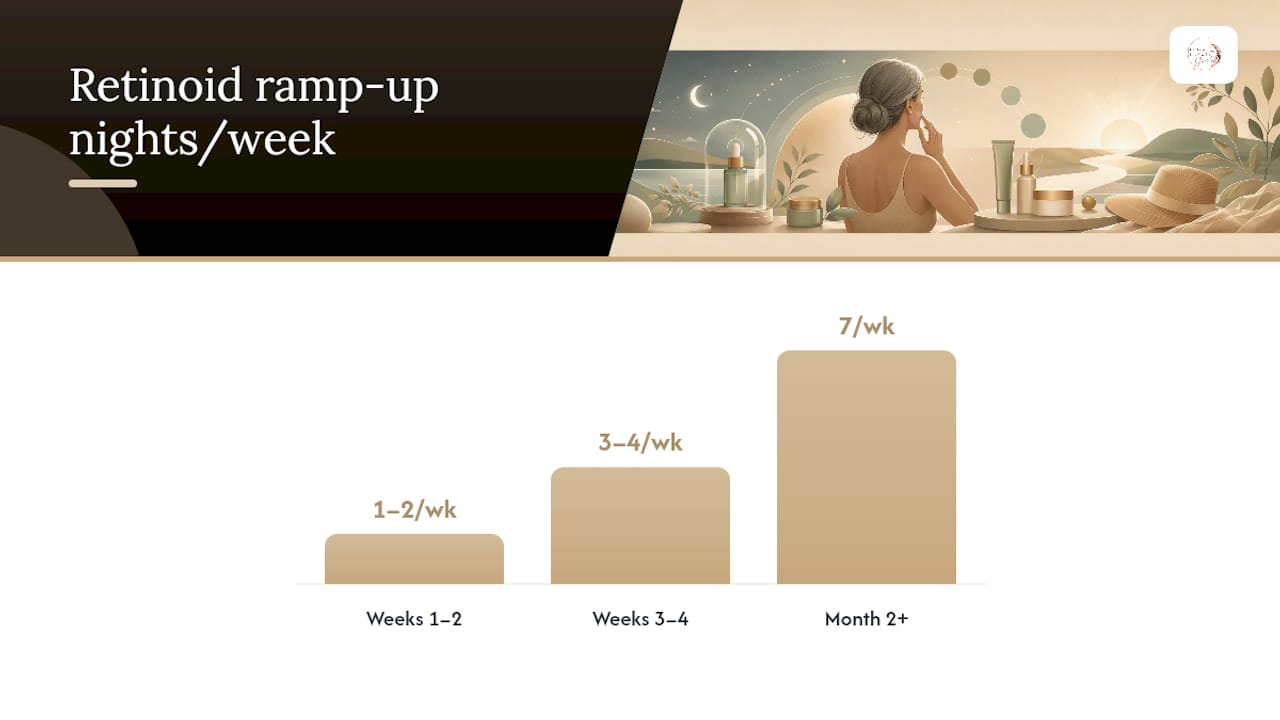
- Weeks 1 to 2: Apply a low-strength retinoid or retinaldehyde just one or two nights a week, always to dry skin, always followed by a ceramide moisturizer.
- Weeks 3 to 4: If there's no persistent redness or flaking, move to every other night.
- Month two onward: Progress to nightly use only if skin tolerates it well; many women do best staying at three to four nights a week indefinitely.
If your barrier is already compromised, active dermatitis, ongoing redness, or visible flaking, delay retinoids altogether. Reach for peptides, bakuchiol, or niacinamide instead. All three support collagen and calm signaling without the irritation risk that comes with vitamin A derivatives.
Knowing the difference between normal "retinization" and an allergic reaction saves a lot of unnecessary product abandonment. Retinization looks like mild, temporary flaking and pinkness in the first two to four weeks, generally the same pattern every time you increase frequency. A true reaction looks like burning, swelling, or hives, and it shows up fast, often within hours.
If irritation does happen, the fix is straightforward: stop the retinoid immediately, switch to a simple ceramide-based routine, and give the barrier one to two weeks to recover before trying again at a lower frequency. Topical steroids should only be used short-term and only under a clinician's direction, never as a self-managed fix.
Pro Tip: Buffer a new retinoid by applying moisturizer first, waiting five minutes, then applying the retinoid on top. It slightly slows absorption, which sounds counterproductive but often means you tolerate a higher strength over time instead of stalling out at the lowest dose.
When Hormones and Dermatology Both Belong in the Conversation
Topical skincare can only do so much when the driver of skin change is systemic. A literature review on menopausal skin care found that estrogen depletion reduces the skin's ability to control water loss and weakens dermal collagen production, and that both topical and systemic estrogen therapies showed some benefit in restoring skin measures in certain studies. That's a real signal, but it comes with real caveats: HRT carries contraindications and risks that vary significantly by personal and family history, so it's a decision to make with a doctor, not a decision skincare marketing should push you toward. Some research on topical estrogen also shows localized improvements in elastin and fiber thickness, though facial-specific results remain inconclusive, so treat this as an evolving area rather than a settled answer.
Common menopause-related skin conditions worth naming to a dermatologist rather than self-treating indefinitely:
- Xerosis or asteatotic eczema: persistent dry, cracked patches that don't respond to over-the-counter moisturizer alone.
- Generalized pruritus: itching without a visible rash, often tied to declining estrogen and nerve sensitivity.
- Rosacea flares: new or worsening flushing and visible vessels, sometimes triggered by hormonal shifts.
- Hair thinning: diffuse loss at the crown or part line, frequently addressed alongside skin concerns.
See a dermatologist promptly if you notice a rapidly spreading rash, a lesion that changes shape or color, dermatitis that doesn't improve after a few weeks of gentle care, or hair loss significant enough to change your part or ponytail thickness. Procedural options like laser resurfacing and microneedling can help with texture and collagen stimulation, but both carry real downtime and depend heavily on provider experience. Vet any provider's credentials before booking.
How Menopause Changes Your Skin's Microbiome
Your skin hosts its own ecosystem of bacteria and fungi, and estrogen decline disrupts that balance the same way it disrupts collagen production. Lower estrogen shifts skin pH and reduces sebum output, and both changes alter which microbial species thrive on the surface. A more alkaline, drier environment tends to favor different bacteria than the slightly acidic, well-lubricated skin of your 30s, which partly explains why previously calm skin can suddenly turn reactive or acne-prone during this transition.
The practical takeaway is simple: protect the barrier, and you protect the microbiome sitting on top of it. Fragrance-free, low-pH cleansers help maintain the acidic environment that keeps helpful bacteria in balance. Overwashing, hot water, and harsh exfoliants strip the very oils that beneficial microbes rely on, so cutting back on aggressive cleansing routines matters as much as adding new actives.
Adult acne during menopause often has a different root cause than teenage breakouts, hormonal fluctuation rather than excess oil alone, so treating it with the same harsh, drying products used in your twenties usually backfires. A gentler, barrier-supportive approach tends to calm both the acne and the surrounding sensitivity at the same time.
Take on Menopausal Skin Care
Skincare during menopause isn't a single fix. It's diet, sleep, stress, and topical care working together, which is exactly the 360-degree philosophy that Theultimatebeauty-you was built around. Inflammatory mediators and shifting lipid synthesis don't respond to a single serum; they respond to a fuller approach.
That's why this guide points women toward resources beyond the medicine cabinet. A 4-week evidence-based plan for perimenopause symptoms pairs well with any new routine, especially if you're rebuilding a barrier before introducing actives. Diet plays a bigger role than most routines acknowledge, and a supplement guide by life stage covers the fatty acids and vitamins that support skin from the inside. Stress and cortisol drive inflammation just as much as any missing ceramide, which is where a stress management guide comes in.
Beauty during menopause isn't about chasing what your skin used to be. It's about becoming fluent in what it needs now.
— Ava
Get Curated Menopause Skincare Recommendations
Sorting through dozens of ceramide creams and retinoid strengths shouldn't fall entirely on you. The platform curates menopause-friendly product picks so you're not guessing which formula fits a changing, more reactive barrier.

Beyond product lists, the platform can connect you with experts when a concern moves past what a serum can fix, whether that's a dermatology consult about retinoid strength or a broader conversation about hormonal skin changes. Browse the curated product collection to see menopause-specific picks organized by concern, or explore an experts and partners directory for personalized guidance before adding a new active to your routine. Start with whichever feels most useful right now: a curated shopping list or a conversation with someone qualified to answer your specific questions.
Sources
For readers who want to go deeper than product recommendations, these are the sources behind the clinical claims in this guide: the collagen loss timeline study, the American Academy of Dermatology's menopause skincare guidance, the PMC literature review on menopausal skin care and hormone therapy, and retinoid safety guidance for aging and sensitive skin. For ingredient-focused reading beyond menopause specifically, this breakdown of aging skin texture ingredients covers retinoids and their alternatives in more depth.
This article is general information, not a substitute for advice from a qualified doctor. Consult a qualified healthcare professional about your own circumstances before acting on anything here.
- Collagen loss timeline study (PMC)
- Caring for your skin in menopause — American Academy of Dermatology (AAD)