
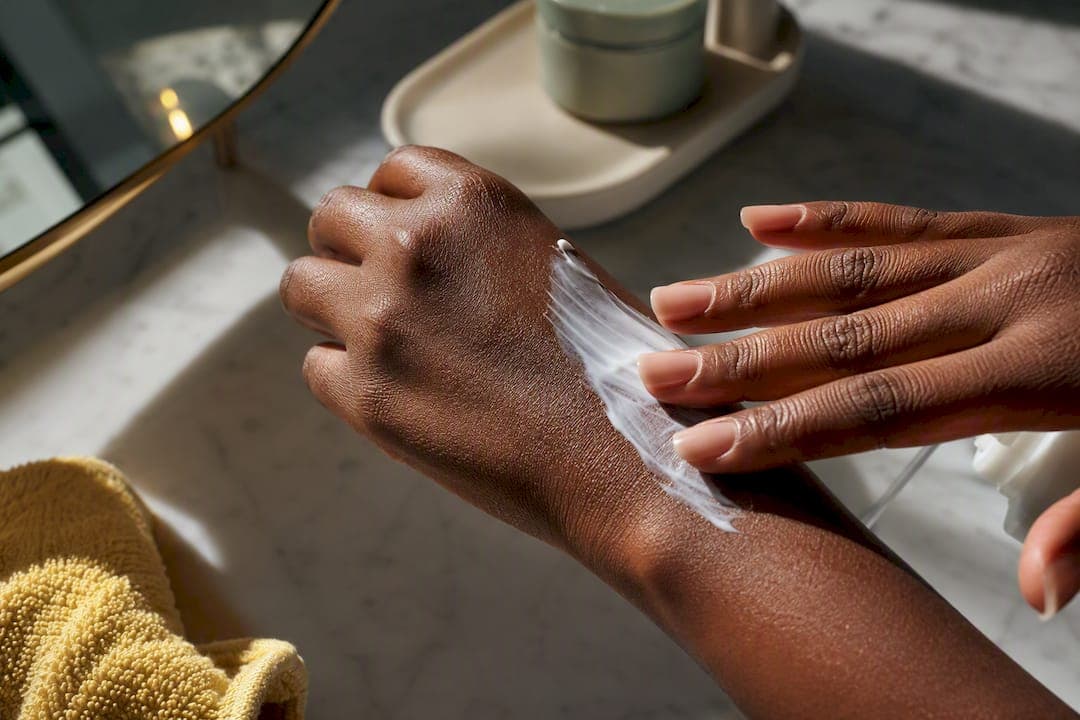
The best SPF for dark skin is a tinted mineral or hybrid formula with SPF 30 or higher, worn daily and reapplied without fail. Look for iron oxides in the tint. Five standouts that deliver on both protection and finish: EltaMD UV Clear Broad-Spectrum SPF 46, La Roche-Posay Anthelios UVMune 400 Invisible Fluid, Black Girl Sunscreen, Beauty of Joseon Relief Sun, and Merit The Uniform. Each disappears into deeper tones instead of sitting on top of them.
TL;DR:
- Tinted mineral or hybrid sunscreens with SPF 30 or higher containing iron oxides are best for dark skin due to their ability to blend seamlessly.
- Formulations with iron oxides effectively block visible light, reducing hyperpigmentation risks, especially for melasma and pigmented spots.
- Proper application of at least one ounce of sunscreen every two hours is essential to ensure protection and prevent chalkiness or streaking.
- Hybrid formulas combining mineral and chemical filters tend to minimize white cast and provide broad-spectrum UV and visible-light protection.
- Consistent daily use of SPF 30 or higher, especially in tinted or hybrid formulas, is crucial for reducing sun damage and managing pigmentation concerns.
Table of Contents
- Which SPF Products Actually Blend Into Dark Skin?
- How Do You Choose the Right SPF for Your Skin Tone?
- Why Do Some Sunscreens Leave a Cast and Others Don't?
- How Should You Apply SPF Without Chalkiness or Pilling?
- What Evidence Backs These SPF Recommendations?
- Do Antioxidants in Sunscreen Actually Help Dark Skin?
- Can Evening Skincare Undo Daytime Sun Damage?
- What SPF Myths Still Hold Dark Skin Back?
- Why Finish Matters As Much As Formula
- Want Curated SPF Picks Made Simple?
- Sources
Which SPF Products Actually Blend Into Dark Skin?
Melanin-rich skin needs sunscreen that disappears, not one that leaves a gray or purple film. That single requirement eliminates a huge share of drugstore mineral sunscreens, which is exactly why so many women with deeper skin tones gave up on SPF altogether or settled for makeup as their only sun defense. The good news: formulators have caught up, and a handful of products now consistently earn praise for going on clear.
Pro Tip: Swatch any new sunscreen on your inner forearm and let it sit for ten minutes before deciding its chalky. Some hybrid formulas oxidize slightly as they set, and what looks ashy at minute one can look invisible by minute ten.
Here's how the most talked-about options in this category stack up against each other.
A few of these deserve more than a table row. EltaMD's tinted lineup keeps showing up across dermatologist recommendation lists for a reason: the tint carries iron oxides, so it isn't just cosmetic camouflage, it's doing extra work against visible light. Black Girl Sunscreen built its entire brand identity around solving the ashy-cast problem, and that focus shows in how the formula sits on deeper tones without the grayish pull-back many mineral sunscreens still have. Beauty of Joseon's Relief Sun has become a cult favorite less because of any dark-skin-specific marketing and more because the rice and probiotic base leaves a genuine glow rather than a flat, chalky finish, which matters enormously when a product sits on the skin for eight hours.
Merit The Uniform takes a different approach, functioning almost like a skin tint with SPF folded in rather than a sunscreen that happens to have color. That makes it a strong pick for anyone who normally skips a separate tinted moisturizer step.
A quick note on shade-matching before you commit to a bottle: tinted sunscreens are usually formulated as universal or near-universal shades, not a full range like foundation. Buy the smallest size available first, apply it in daylight, and check how it oxidizes over a few hours before buying a full-size bottle. Sephora, Ulta, and most brand websites offer sample sizes or travel formats specifically because tint matching on darker skin is inconsistent across brands, even within the same company's product line.
How Do You Choose the Right SPF for Your Skin Tone?
Start with SPF 30 as your daily floor and move to SPF 50 or higher when you know you'll be outside for hours, at altitude, or near water. That jump matters more than it sounds. Most people apply far less sunscreen than the amount used in SPF testing, so the SPF number on the bottle is really a best-case ceiling, not a guaranteed number for real-world application, which is why dermatologists at Cleveland Clinic recommend SPF 30 or higher daily for darker skin tones and higher for prolonged exposure.
Tint and iron oxides matter most if you deal with melasma, post-inflammatory hyperpigmentation, or any dark spots that seem to worsen with sun and even indoor light near windows. Regular mineral sunscreen blocks UV rays but does little against visible light, which is one of the drivers behind stubborn pigmentation in Fitzpatrick skin types IV through VI, according to a review on photoprotection for skin of color. Iron oxides close that gap. Check the ingredient list for "iron oxides" specifically, not just "tinted," since some tinted formulas rely on dyes that don't offer the same visible-light defense.
Formulation type is a genuine trade-off, not a simple better-or-worse choice. Tinted mineral sunscreens tend to sit more on the surface and can require more careful blending, but they're gentler for reactive or acne-prone skin. Hybrid formulas split the difference. Chemical sunscreens usually spread thinnest and disappear fastest, but a 2020 review found dermatologists more often steer patients with skin of color toward chemical filters, partly out of habit rather than evidence, according to research on sunscreen recommendations for skin of color. That means your best formula depends on your skin's actual reactivity, not on what's fastest to recommend.
Run through this checklist before buying:
- Identify your main concern: dark spots, acne, dryness, or general daily protection.
- Decide on finish: matte for oily skin, dewy for dry skin, invisible for layering under makeup.
- Confirm the label says "non-comedogenic" if you're acne-prone.
- Check for "fragrance-free" if you have sensitive or eczema-prone skin.
- Compare price per ounce, since some premium tubes run out fast with proper application.
- Patch test on your jawline for 48 hours before applying it to your whole face.
Pro Tip: If a sunscreen claims to be "invisible" but still leaves a faint cast on your specific skin tone, it likely relies on micronized minerals without added tint. Micronization shrinks particle size to reduce cast, but that same shrinking can lower how much visible light the product blocks, so sheer doesn't always mean fully protective.
Why Do Some Sunscreens Leave a Cast and Others Don't?
Zinc oxide and titanium dioxide physically sit on top of skin and reflect UV rays, and that reflective quality is exactly what causes the whitish or grayish film on deeper tones. Reducing particle size through micronization helps the film blend in better, but shrinking particles too far can trade away some of the visible-light protection those minerals otherwise provide.
Hybrid formulas solve part of this by combining a smaller dose of mineral filters with chemical filters that absorb UV rather than reflect it, cutting the visible cast dramatically while keeping broad-spectrum coverage. That's the technical reason products like La Roche-Posay's Invisible Fluid line feel so different on skin than a classic zinc paste.
Iron oxides work through a separate mechanism entirely. Instead of reflecting UV rays, they absorb visible and high-energy visible light, the wavelengths that pass right through standard sunscreen but still trigger melanin production. Trials summarized in dermatology literature show tinted sunscreen containing iron oxides meaningfully reduces visible-light-induced pigmentation compared to non-tinted mineral formulas in people with melasma and darker skin, per the review on photoprotection for skin of color.
A few mechanics worth knowing before you shop:
- Larger mineral particles reflect more light but sit more visibly on skin.
- Micronized particles reduce cast but can reduce visible-light blocking unless paired with tint.
- Iron oxides absorb visible light rather than reflecting it, which is why they don't add a white cast.
- Chemical filters absorb UV at a molecular level and rarely cause any visible residue.
The FDA continues to review long-term data on several chemical filters, and its stance so far has been that more research is warranted rather than any confirmed safety issue for typical consumer use. Treat that as an open regulatory conversation, not a red flag on the ingredient itself.
How Should You Apply SPF Without Chalkiness or Pilling?
Most people apply roughly a quarter to half of the sunscreen needed to hit the SPF printed on the label, which is one reason sunscreen "doesn't work" for so many people who actually are wearing it daily.
- Use about a nickel-sized amount for your face and neck alone, more if you're also covering your ears and hairline.
- For the body, plan on roughly one ounce, a full shot glass, to cover exposed skin evenly.
- Apply sunscreen after moisturizer and before makeup, letting each layer set for a minute or two so it doesn't pill or streak.
- If you're using a tinted formula, treat it as your final base step and skip a separate foundation on lighter makeup days.
- Reapply every two hours outdoors using a setting spray, a brush-on mineral powder, or a compact tinted stick that won't disturb makeup.
- If a formula chalks up as the day goes on, switch to a hybrid or chemical option next time rather than fighting the same product.
Pro Tip: Keep a travel-size tinted stick sunscreen in your bag specifically for reapplication. Sprays work but rarely deliver a full, even coat over makeup, while a stick lets you press and blend in seconds without smudging anything underneath.
Shine and chalkiness usually come from two different problems, so they need different fixes. Excess shine is a formula issue, switch to a matte or gel-based option. A persistent cast that won't blend, even after rubbing, is almost always a mineral-heavy formula fighting your skin's undertone, and the fix there is a tinted or hybrid swap rather than more product.
What Evidence Backs These SPF Recommendations?
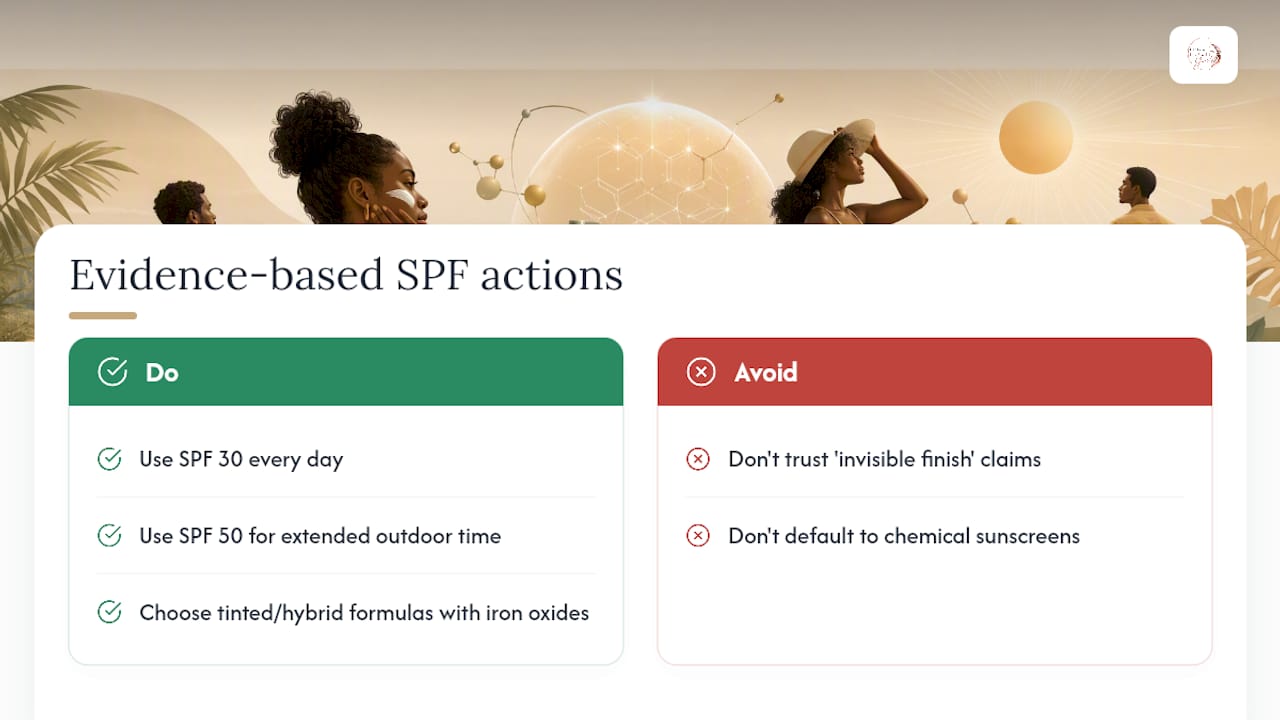
Dermatology guidance is fairly consistent on the fundamentals: daily SPF 30 minimum, SPF 50 for extended outdoor time, and tinted formulas with iron oxides for anyone managing melasma or post-inflammatory hyperpigmentation, according to Cleveland Clinic. Where the guidance gets more interesting is in how unevenly it's been applied. A 2020 survey found dermatologists frequently default to recommending chemical sunscreens for patients with skin of color, sometimes without weighing whether a tinted mineral or hybrid option would serve a specific pigmentation concern better, per the research on sunscreen recommendations for skin of color.
Consumer testing adds a layer that clinical guidance alone can't. Consumer Reports' testing on sunscreens for dark skin found real variability in SPF accuracy and visible residue among products marketed as broad-spectrum, with testers noting which formulas actually vanished on darker skin and which left a detectable film despite similar ingredient lists.
Real-world testing matters because marketing claims about "invisible finish" don't always hold up once a product is tested across a range of deeper skin tones under normal daylight conditions.
Public health data reinforce why none of this is cosmetic-only. Melanoma is diagnosed less often in Black and Brown populations, but mortality and delayed diagnosis rates run higher, according to CDC melanoma incidence and mortality data. The practical takeaway across all three evidence streams: choose tinted or hybrid formulas if pigmentation is your main concern, and treat SPF 30 as non-negotiable daily protection regardless of how deep your skin tone runs.
Do Antioxidants in Sunscreen Actually Help Dark Skin?
Antioxidants like vitamin C, niacinamide, and vitamin E don't block UV rays themselves, but they neutralize free radicals that UV and visible light generate on skin, and that matters specifically for pigment-prone skin. Free radical damage is one of the triggers behind excess melanin production, so an antioxidant riding alongside your SPF is doing cleanup work the sunscreen filters can't do on their own.
Niacinamide shows up in several formulas on this list, including EltaMD's tinted range, and it earns its spot for a second reason beyond antioxidant support: it has a calming effect that helps reduce redness and irritation, which is useful if you're already managing active breakouts or reactive skin alongside dark spots.
Vitamin C pairs particularly well with morning SPF application because it works best under daylight UV exposure, brightening tone over weeks of consistent use rather than overnight. If your sunscreen doesn't already include an antioxidant, layering a vitamin C serum underneath before your SPF step adds that protection without complicating your routine much.
None of this replaces sunscreen, and no antioxidant on its own prevents sun damage. Think of antioxidants as insurance against the damage that gets through despite your SPF, not a substitute for the SPF itself. A tinted formula with a built-in antioxidant simply saves you a step, which is worth factoring into which product you buy if your routine already feels crowded.
Can Evening Skincare Undo Daytime Sun Damage?
Nighttime is when skin does its repair work, which makes it the right time to target pigmentation directly rather than just protect against it. Retinoids, whether prescription tretinoin or over-the-counter retinol, speed up cell turnover and fade dark spots over months of consistent use, but they also make skin more sensitive to sun the next day, which loops right back to needing reliable SPF every morning.
Ingredients like azelaic acid, tranexamic acid, and alpha arbutin have grown popular specifically because they target melanin production without the sun sensitivity that comes with retinoids, making them easier to use daily without extra precautions. If you're managing melasma or PIH, a nighttime routine built around one of these actives, paired with a morning tinted SPF containing iron oxides, addresses the problem from both directions instead of relying on sunscreen alone to do all the work.
Consistency matters more than intensity here. Pigmentation that took months to form usually takes months to fade, and skipping sunscreen for even a few days during that process can undo weeks of progress from your nighttime actives. Building both halves into a single, repeatable routine, similar to the age-appropriate structure covered in beauty routines by age group, keeps the two halves working together instead of canceling each other out.
What SPF Myths Still Hold Dark Skin Back?
The most damaging myth is still the oldest one: that melanin alone provides enough sun protection to skip SPF entirely. Melanin does offer some natural defense, roughly equivalent to a low SPF, but it's nowhere near enough to prevent UV damage, visible-light pigmentation, or the skin cancer risk that still exists in darker skin, just with different presentation patterns and often later diagnosis, per CDC data on melanoma outcomes.
A second myth: that all sunscreen leaves a white cast, so there's no point shopping around. That belief made sense a decade ago when tinted and hybrid formulas barely existed on shelves. It doesn't hold up anymore given how many blendable options now exist across price points.
A third misconception treats sunscreen as optional indoors. Visible light from windows and screens still contributes to pigmentation in melasma-prone skin, which is exactly why tinted formulas with iron oxides have gained traction beyond just outdoor use. For a deeper look at where these myths came from and what the science actually supports, Common Beauty Myths Debunked breaks down several more that persist across skincare, not just sunscreen.
The last myth worth retiring: that higher SPF numbers mean you can apply less or reapply less often. SPF measures protection strength at a full, proper application, not a shortcut around the amount or frequency you actually need to use.
Why Finish Matters As Much As Formula
Beauty isn't a checklist, it's something you build day by day, and sunscreen only works if you actually wear it. That's why cosmetic elegance can be considered an important factor alongside SPF strength and iron oxide content, not just an afterthought. A product that protects perfectly on paper but gets skipped because it looks ashy in the mirror protects no one.
Blendability testing for this shortlist meant checking products in natural daylight, rubbing them in fully to watch how they set over ten minutes, and layering them under makeup to see whether they pilled or held. Skin isn't static, and neither is good skincare guidance. For readers refining how a tinted formula matches their exact undertone, foundation shade matching offers a useful next step for pairing SPF with the rest of your base routine.
— Ava
Want Curated SPF Picks Made Simple?
Finding the right tinted sunscreen shouldn't mean scrolling through fifty reviews and guessing which formula actually matches your undertone. Theultimatebeauty-you's curated product lists pull together vetted beauty and wellness picks, including SPF options chosen for real-world blendability, so you're not starting from scratch every time a new "holy grail" sunscreen trends online.

If your pigmentation concerns go beyond what a product page can answer, whether that's stubborn melasma, acne alongside dark spots, or building a full routine around your specific skin tone, the experts and partners directory connects you with vetted specialists who can give you personalized guidance instead of one-size-fits-all advice. For layering SPF with sun-protective clothing on beach days or long outdoor stretches, a resource like this UPF swimwear guide is worth a look too. Browse the curated product lists now and build a routine that actually holds up in daylight.
Sources
- The Importance of Sunscreen for Dark Skin Tones — Cleveland Clinic
- Sunscreen recommendations for patients with skin of color — PMC (2020)
- Review on photoprotection for skin of color — PMC
- The best sunscreens for dark skin: Consumer Reports roundup (via Quartz)