
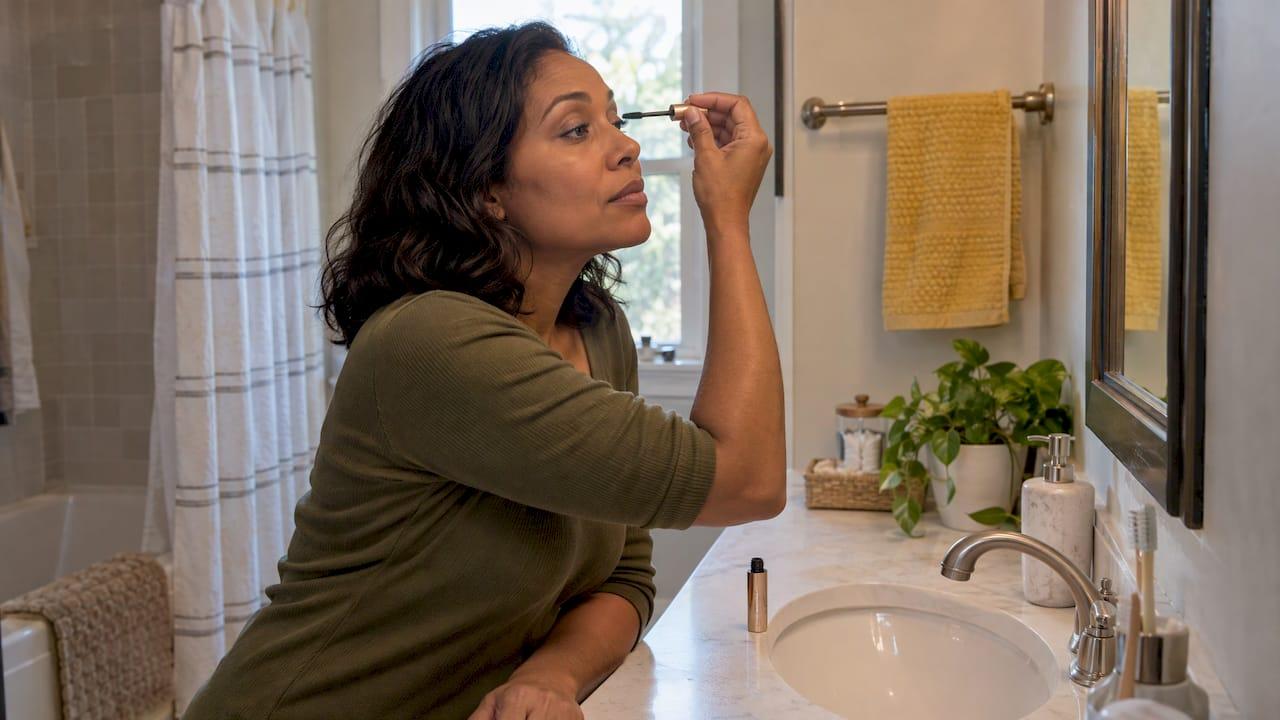
Lash serums are safe for most people when you pick the right type, apply it only along the upper lash line and stop at the first sign of irritation. The type matters most. Serums with a prostaglandin ingredient carry the most serious risks. Prostaglandin-free serums are gentler, but they are cosmetics, so no one reviews them for safety before they reach the shelf.
Beauty Is Not Perfection. Beauty Is a Verb. Beauty Is Becoming. Caring for your lashes can be part of that, and it works best when you know exactly what you are putting near your eyes. Here is what the research says, in plain words.
TL;DR
- Prescription bimatoprost (sold as Latisse) is the only FDA-approved lash growth drug. Over-the-counter serums with prostaglandin-like ingredients are not approved.
- Prostaglandin-free serums are likely safe for most eyes, but any serum can still irritate sensitive eyelid skin, so patch test first.
- Use the amount on the label, once a day at most unless it says otherwise. More does not mean faster growth.
- If a serum stings, swells or reddens your lids, stop using it. See a doctor if it does not settle.
- Skip lash serums if you have glaucoma, conjunctivitis or eye allergies, and talk to an eye doctor first.
Table of Contents
- Are lash serums safe? The short answer by type
- What the FDA does and does not check
- Lash serum side effects: the common and the serious
- Prostaglandin-free lash serums: how to choose well
- How to apply lash serum safely
- Is it okay to use lash serum every day?
- What to do if serum irritates or gets in your eye
- Who should skip lash serums or ask a doctor first
- Our perspective
- Join a community that makes beauty choices clearer
- FAQ
- Sources
Are lash serums safe? The short answer by type
There are three kinds of product behind the phrase "lash serum," and they do not carry the same risk.
| Type | What it is | Safety picture |
|---|---|---|
| Prescription bimatoprost | A drug with FDA approval for lash growth | Studied in trials; known side effects; used under a doctor's guidance |
| Over-the-counter serums with prostaglandin-like ingredients | Cosmetics that borrow the same drug family without approval | Not reviewed by the FDA for safety or effectiveness |
| Prostaglandin-free serums | Usually peptides, biotin, panthenol and conditioning oils | Likely safe for the eyes, but not backed by safety studies |
The American Academy of Ophthalmology answers this directly. An ophthalmologist writing for the academy says over-the-counter serums without prostaglandin are likely safe for the eyes. She also notes that, as cosmetics, they have no scientific studies validating their safety or effectiveness claims.
What the FDA does and does not check
In the U.S., a cosmetic does not need FDA approval before it is sold. A 2024 review in the Journal of Cosmetic Dermatology states that U.S. law does not require FDA efficacy or safety assessments for over-the-counter lash serums. Bimatoprost is the only molecule the agency has approved for eyelash growth.
That is why the wording on the box matters. Under FDA rules, "eyelash growth" is a drug claim, and the one approved drug is a prescription bimatoprost solution approved on December 24, 2008. Its labeling says extra applications will not increase growth and that results reverse when you stop.
The rules around cosmetics are getting stricter. The Modernization of Cosmetics Regulation Act of 2022 (MoCRA) requires companies to keep safety substantiation records, report serious adverse events within 15 business days, register facilities and list products. The FDA explains this on its MoCRA page, and it issued final guidance on October 29, 2026. Check that page for the current requirements, since the rules are still being phased in.
This helps you, but it is not a safety stamp. A brand that has filed paperwork has not necessarily proven its serum is good for your eyes.

Lash serum side effects: the common and the serious
Common, usually mild
Irritation is the most frequent complaint: redness, itching, burning, dryness and a gritty feeling. In the one-year trial of prescription bimatoprost covered in the 2024 review, 368 participants were followed. The most common side effects were:
- Conjunctival redness (the pink or red look of the white of the eye): 12.1%
- Punctate keratitis (tiny surface marks on the cornea): 5.6%
- Eyelid itching: 4.7%
- Eyelid redness: 4.2%
About 2.8% of people stopped because of side effects. Another report puts mild side effects at about 3% to 4% of Latisse users, and notes that the thinning-skin changes around the eye tied to prostaglandin serums can usually be reversed when you stop.
Less common, more serious
The prostaglandin family can cause changes that are slower to show. The American Academy of Ophthalmology lists skin and iris pigmentation changes and loss of fat around the eye with long-term use. A 2025 explainer from two eye researchers adds that eyelid skin darkening, a hollow look around the eye, permanent iris darkening and, rarely, a drooping upper eyelid have been reported. Unwanted hair can also grow where the serum spreads across the skin.
If you notice any of these, stop the product and see an eye doctor.
Can any serum cause a reaction?
Yes. A dermatologist quoted by Verywell Health says even prostaglandin-free serums carry a risk of irritant or allergic contact dermatitis from preservatives, fragrances and oils. Eyelid skin is among the thinnest on your body. One dermatologist told Prevention that a single application can trigger dermatitis lasting weeks in someone who is sensitive.
Prostaglandin-free lash serums: how to choose well
Many women look for prostaglandin-free serums, and it is a sensible filter. Here is how to apply it.
Read the label for "-prost"
EWG, a nonprofit that reviews cosmetic ingredients, advises checking the ingredient list for names ending in "-prost" or "-prostone". Those are prostaglandin analogs. If you see one in a cosmetic, that is a flag.
There is a reason to be careful. A study cited in the 2024 review found that 4 of 64 serums bought online contained undeclared bimatoprost and 8 contained unknown prostaglandin analogs. Stick to brands that list a full ingredient list and a way to contact the company.
Look for gentle, simple ingredients
For people avoiding prostaglandins, one dermatologist recommends looking for peptides, biotin or panthenol. Another advises avoiding fragrance. A 2025 Danish government risk assessment of lash and brow serums found that the peptide ingredients it assessed were generally not considered toxic at the low concentrations and daily amounts studied.
Set realistic expectations
EWG's scientists point out that conditioning serums make lashes look fuller but do not generally grow them. Think of them as lash care, not lash treatment. If your lashes are falling out or thinning suddenly, that is a reason to see a doctor, not to buy another serum.
How to apply lash serum safely
- Patch test first. Dab a small amount on your inner arm and watch it for a day or two. Experts recommend a patch test because eyelid skin is so thin. A patch test on the arm is not a perfect predictor for the lids, so go slowly at the start.
- Start clean. Wash your hands. The FDA's eye-cosmetic guidance says to wash your hands before applying and not to use a cosmetic near the eyes unless it is meant for that use.
- Remove contact lenses and makeup. Apply to a clean, dry lash line.
- Use the applicator the way the label says. Keep it along the base of the upper lashes, not on the eyeball or the lower lid unless the label directs it.
- Do not overload. One thin stroke is enough. Excess product runs, and that is how serum reaches your eye and skin.
- Keep the applicator clean and do not share it.
If you also get lash lifts or tints, lash lift aftercare steps are worth following so you are not stacking several products on freshly treated lashes.
Sensitive skin tends to react to many products at once. Our one-week test for sensitive skin shows how to introduce one new product at a time so you can tell what caused a reaction.
Is it okay to use lash serum every day?
Follow the label. Many serums are meant for nightly use, but your own product's directions rule. Healthline advises you not to exceed the label amount, because using more than directed usually does not speed growth but raises the chance of side effects. Results can take several weeks of steady use.
If your eyes feel irritated, take a break. Daily use is only good when your skin tolerates it.

What to do if serum irritates or gets in your eye
If serum causes irritation, the FDA's advice for any eye cosmetic is to stop using it right away and see a doctor if the irritation continues.
If serum gets into your eye:
- Rinse with lukewarm water.
- Do not rub.
- Stinging, redness, tearing and brief blurry vision are common and usually fade within minutes after rinsing.
- See a doctor if symptoms last, if your vision stays blurry or if pain gets worse.
Who should skip lash serums or ask a doctor first
Healthline advises people with sensitive eyes, allergies, glaucoma or conjunctivitis to avoid lash serums, and to stop and see a doctor if side effects appear. The American Academy of Ophthalmology also recommends talking with an ophthalmologist before using over-the-counter serums.
If you are pregnant or nursing, ask your doctor before adding any new product near your eyes. Our guide to ingredients dermatologists flag during pregnancy can help you prepare your questions.
What about teens?
A 2016 study found prescription bimatoprost was safe and well tolerated in children aged 5 to 17 with eyelash hypotrichosis (sparse lashes), with mild or moderate side effects. That was a doctor-supervised treatment, not a store-bought serum. For a 13-year-old, the first step is a conversation with a pediatrician or an eye doctor.
Our perspective
We believe beauty is not perfection. Beauty is a verb. Beauty is becoming.
That belief shapes how we talk about lash serums. Longer lashes are a fun choice, and you deserve to make it with full information. We built The Ultimate Beauty - You! as an inside-out, head-to-toe, 360-degree space so that advice about a product near your eyes sits alongside advice about your skin, your wellness and your confidence, not scattered across a dozen tabs.
Our approach to lash serums is simple. Know the type. Read the label. Test slowly. Listen to your eyes. Come back and share what you learned with other women.
That is the kind of trusted, shared knowledge we want our community to hold.
Ava
Join a community that makes beauty choices clearer
The Ultimate Beauty - You! is a women-centered platform, with an app on the way, for beauty, wellness, confidence and personal growth. It brings together expert advice, product and brand recommendations and a community of women at every age and stage. Explore The Ultimate Beauty - You! to see what we offer, and use our join page to connect with us.

If you are an expert, brand or organization that serves women, the same page is where you can ask about listings and partnerships.
For more evidence-based reading, see our look at common beauty myths and what science says.
FAQ
What are the downsides of using a lash growth serum?
The most common downsides are eyelid and eye irritation, redness, itching and dryness. Prostaglandin-based products can also cause skin darkening, iris color change and fat loss around the eye. Most irritation fades once you stop using the product.
Are prostaglandin-free lash serums safer?
They avoid the drug-family risks, and an ophthalmologist writing for the American Academy of Ophthalmology says they are likely safe for the eyes. They can still irritate, because preservatives, fragrance and oils can cause reactions. Patch test and watch your lids.
Is it okay to use lash serum every day?
Only if the label says so and your eyes tolerate it. Using more than directed does not usually speed growth and can raise your risk of irritation. If your lids feel sore or look red, pause and see a doctor if it persists.
What should I do if lash serum gets in my eye?
Rinse with lukewarm water and do not rub. Mild stinging and tearing usually settle within minutes. See a doctor if symptoms last or your vision stays blurry.
What do doctors recommend for eyelash growth?
The only FDA-approved option is prescription bimatoprost, used under a doctor's guidance. If your lashes are thinning or falling out, an ophthalmologist or dermatologist can look for the cause first.
Sources
- Eyelash serums: A comprehensive review (Journal of Cosmetic Dermatology, 2024)
- Eyelash serums: A comprehensive review, regulation and contaminants
- Are eyelash growth serums safe? American Academy of Ophthalmology
- Why Are My Eyelashes Falling Out? American Academy of Ophthalmology
- Longer lashes, lasting damage? The Conversation
- This Ingredient in Eyelash Growth Serums Might Cause Some Problems, Verywell Health
- 10 Best Eyelash Growth Serums of 2026, Prevention
- Do Lash Serums Work? Healthline
- Safer Choices: EWG's Guide to Toxic-Free Eyelash Serums
- Survey and risk assessment of eyelash and eyebrow serums, Danish Environmental Protection Agency
- Cosmetics Safety Q&A: Eye Cosmetic Safety, FDA
- Modernization of Cosmetics Regulation Act of 2022 (MoCRA), FDA
- Eyelash serum advertising rules: FDA and FTC
- Lash Serum in the Eye: Risks and Irritation
- An evaluation of the safety and efficacy of bimatoprost for eyelash hypotrichosis in pediatric subjects
- Lash Lift Aftercare: 24 to 48 Hour Rules