
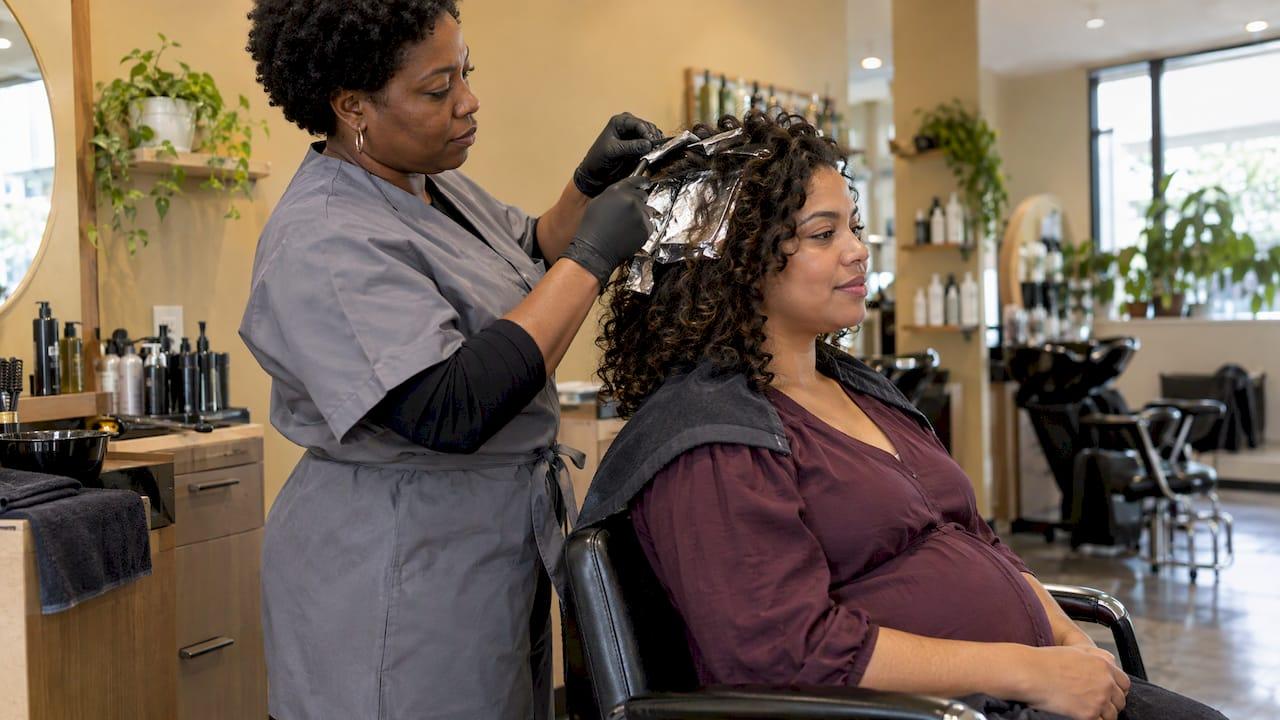
For most healthy women, coloring your hair during pregnancy is considered low risk. ACOG, the American College of Obstetricians and Gynecologists, says most experts think hair dye is not toxic for the fetus, because only a small amount is absorbed through the scalp. Many doctors still suggest waiting until the second trimester, and a few smart habits make the appointment gentler on you and your baby.
You are growing a person. You are also still you. Wanting your color, your gray coverage or your fresh highlights is part of feeling like yourself, and that is a reasonable thing to want. Here is how to do it with confidence.
TL;DR
- Major U.S. medical sources describe hair dye as generally low risk in pregnancy, since very little reaches the bloodstream through the scalp.
- Many doctors suggest waiting until week 13 (the second trimester) to be safe. This is a precaution, not a proven danger.
- "Ammonia-free" means a milder smell and often less irritation. It does not mean chemical-free.
- Highlights, balayage and plant-based dyes keep color off the scalp. Ventilation, gloves, a patch test and timing do the rest.
- Talk to your OB or midwife if you have eczema, psoriasis, a scalp wound or a high-risk pregnancy.
Table of Contents
- What the evidence says about hair dye and pregnancy
- Is the first trimester different?
- Ammonia-free hair dye in pregnancy: what the label does and doesn't tell you
- Lower-contact ways to color and cover gray
- How to color your hair more carefully, step by step
- What the newest research adds
- Being around hair dye: salon visits, partners and friends
- Beauty is becoming: our perspective
- Find trusted pregnancy-friendly beauty guidance with us
- FAQ
- Sources
What the evidence says about hair dye and pregnancy
The reassuring part first. ACOG notes that animal studies using high doses of these chemicals did not show serious birth defects. The American Pregnancy Association reports that most research finds the chemicals in semi-permanent and permanent dyes are not highly toxic, and that little would be able to reach the fetus because only small amounts are absorbed by the skin. MotherToBaby, a U.S. pregnancy exposure information service, says that when dye is used as directed, the amount absorbed through healthy scalp skin is small and not expected to cause problems in pregnancy.
So why does the advice still come with caution? Because the research has gaps. Columbia Doctors says there is not much research on dyes and perms in pregnancy, and recommends reducing exposure by keeping the room well ventilated. Cleveland Clinic explains the reason: pregnant women are usually left out of clinical studies for ethical and cost reasons, since it would be wrong to deliberately expose a pregnant person to possible harm. Less data means more careful advice. It does not mean danger has been found.

Is the first trimester different?
This is the question behind most searches for hair color while pregnant. The first trimester is when major organs, including the brain and spinal cord, form. Cleveland Clinic reports that many doctors recommend holding off on hair color until week 13, just to be safe.
The American Cancer Society gives the same reason: there isn't enough research to know whether hair dye is harmful in pregnancy, so some doctors advise waiting until the first trimester is over. Kaiser Permanente's maternity beauty tips say the same: if you are worried, wait until after the first trimester. A provider quoted by Novant Health calls dyes and perms completely fine, while still usually telling patients to wait. She adds that skin absorption is minimal and the space should be well ventilated.
Here is the practical read:
- Before week 13: waiting is the common, cautious choice. If your roots are bothering you, ask your OB or midwife what they prefer.
- Weeks 13 and later: this is the window most providers are comfortable with, using the habits below.
- Morning sickness: strong fumes can make nausea worse, so a milder-smelling formula and fresh air may matter as much as the chemistry.
The American Pregnancy Association notes that some physicians suggest waiting until the second or third trimester, or even until after pregnancy. If you feel uneasy, that is a good moment to talk to your doctor and decide together.
Ammonia-free hair dye in pregnancy: what the label does and doesn't tell you
Ammonia-free is one of the most searched phrases on this topic, so it is worth getting right.
Ammonia opens the hair cuticle so color can get in. It also gives many dyes their sharp smell. Ammonia-free formulas swap in other ingredients to do that job. Dr. Girija Wagh notes that these products are often less irritating and milder in scent, but still contain other coloring chemicals, so "ammonia-free" does not necessarily mean chemical-free.
That makes it a useful comfort feature, especially if smells make you queasy, but not a safety guarantee on its own. Here is what to check on the box:
- Directions and cautionary statement. The American Cancer Society explains that the FDA oversees cosmetics, including hair dyes, and that coal-tar hair dyes must carry a cautionary statement and directions to do a skin test before use.
- Formulas for sensitive skin. If your scalp has become more reactive, these are worth reading about.
- Origin. MotherToBaby warns that hair products made outside the U.S. might contain contaminants such as heavy metals, including lead, cadmium, nickel, arsenic or mercury. Choose products from labeled, traceable U.S. sources.
- Plant-based or vegan formulations. Our guide to vegan hair color explains what the term means and how to read an ingredient list.
If you want a broader way to compare labels across your whole routine, our natural beauty products comparison walks through it, and our guide to the ingredients dermatologists warn against in pregnancy covers skincare.
Lower-contact ways to color and cover gray
One of the simplest ways to cut exposure is to keep dye off your scalp. The American Pregnancy Association says highlights lower any risk because the dye is placed on the strands and does not touch the scalp. It also names pure vegetable dyes, including henna, as an alternative.
The American Cancer Society adds that plant-based dyes made from henna or indigo may not change hair color very much, but can be a good option if safety is your concern.
Here is how that plays out for common goals:
| Your goal | Lower-contact option | What to know |
|---|---|---|
| Cover a few grays | Highlights or balayage | Dye sits on the strands, not the scalp |
| Refresh your shade | Plant-based color | Gentler, but results are usually subtle |
| Full gray coverage | Wait until week 13, then use a milder formula with ventilation | Ask your stylist about root-only application |
| Soften roots between visits | Root touch-up with gloves, patch test and short timing | Follow the box directions exactly |
Gray coverage is often the real question. Some women use pregnancy as a turning point and let silver show for a while. If that appeals to you, our gray hair transition plan lays out a gradual approach.
How to color your hair more carefully, step by step
The American Pregnancy Association and the American Cancer Society (which relays FDA guidance) agree on a set of habits. Use them at home or in the salon.
- Choose your timing. Consider waiting until the second trimester, as many doctors suggest. Ask your provider if you are unsure.
- Prepare your scalp. The American Cancer Society advises avoiding scratching or brushing the scalp for 3 days before dyeing. If you have eczema, psoriasis or another skin condition, Cleveland Clinic says to ask your healthcare provider first, since tiny breaks in the skin can make you more sensitive to dye.
- Wait after other treatments. Leave at least 14 days after bleaching, relaxing or perming before using hair dye.
- Do a patch test. Do it before every use, since pregnancy can change how your skin reacts. Follow the product's directions for the test.
- Ventilate. Open a window or use a fan. Kaiser Permanente recommends a well-ventilated space so you aren't breathing in fumes. In a salon, say you are pregnant and ask about airflow.
- Wear gloves and follow the box. Do not leave the dye on longer than directed.
- Rinse well. Rinse your scalp thoroughly when the time is up.
- Skip brows and lashes. Both sources say never to dye eyebrows or eyelashes. The risk is to your eyes.
These steps are the same ones recommended for anyone. Pregnancy simply makes them worth following to the letter.
Salon or home?
Both work. At home, you control the product, the timing and the air. In a salon, the stylist can use foils or caps so the color stays off your scalp. Whichever you pick, tell the colorist you are pregnant before the appointment, and share your provider's guidance if you have been given any.
If you are a regular at the chair, one more point: the hair professional is the one with long-term exposure. A study cited by L'Oréal Paris from the NCBI database found that treatments three to four times during pregnancy don't appear to raise risk for the average pregnant woman. Hair pros who work long hours may want to talk to their own doctor.
What the newest research adds
In 2026, a systematic review and meta-analysis in PMC pooled studies on hair dye exposure around conception or in pregnancy. It reported associations with low birth weight (pooled odds ratio 2.30) and with neuroblastoma, a childhood cancer, in offspring (pooled odds ratio 1.79). The authors rate the certainty of the evidence as low or very low, say the findings are hypothesis-generating and cannot show cause, and note they come mostly from retrospective observational studies.

How should that change your decision? It supports what the cautious advice already says: use the lower-contact options, follow directions and consider waiting until the second trimester. If you have questions about your own situation, bring this study to your OB or midwife and decide together.
On the regulatory side, the 2022 Modernization of Cosmetics Regulation Act expanded FDA oversight of cosmetics, including adverse-event reporting. Because rules change, read the label closely and check the FDA's cosmetics pages for the latest.
Being around hair dye: salon visits, partners and friends
You do not have to avoid the salon. Kaiser Permanente's advice is to choose a well-ventilated space. Columbia Doctors suggests reducing exposure the same way. Book a window seat or an early slot when the space is quieter, and step outside while color processes if the smell bothers you.
Beauty is becoming: our perspective
We built The Ultimate Beauty - You! on the belief that beauty is not perfection. Beauty is a verb. Beauty is becoming. Pregnancy is one of the biggest becomings a woman goes through, and it deserves guidance that treats her as a whole person, not a list of restrictions.
That is why we look at hair color the way we look at everything: inside-out, head-to-toe, 360-degree. The question is not only "is it safe?" It is also "how will I feel?" Your scalp, your nausea, your confidence and your doctor's advice all belong in the same conversation. When advice is scattered across forums and conflicting posts, a mother-to-be ends up second-guessing herself. Our aim is to bring trusted experts and resources together in one community, so you can choose with clarity.
Our advice: wait if waiting feels right, choose lower-contact color if you want it now, ventilate, and ask your provider when something does not sit right. Pregnancy changes your body. It doesn't change your right to feel beautiful.
Ava
Find trusted pregnancy-friendly beauty guidance with us
The Ultimate Beauty - You! is a women-centered platform for beauty, wellness, confidence and community. We bring together expert advice, product and brand recommendations and a community of women at every age and stage, with an app on the way. If you are planning your pregnancy beauty routine, explore The Ultimate Beauty - You! to find resources made for this season of becoming.

When the baby arrives, your hair changes again. Our guides on postpartum hair loss and scalp health will help you through it, and our piece on what postpartum beauty means is for the days after.
FAQ
Is hair dye safe during pregnancy?
For most healthy women, major U.S. medical sources consider it low risk, since only a small amount is absorbed through the scalp. ACOG says most experts think it is not toxic for the fetus. Many doctors still suggest waiting until after the first trimester, just to be safe.
Is ammonia-free hair dye safer in pregnancy?
Ammonia-free dyes are often milder in smell and less irritating, which can help if you are nauseated. They still contain other coloring chemicals, so follow the same precautions: ventilation, gloves, a patch test and the directions on the box.
Can I color my hair in the first trimester?
It is a personal decision to make with your provider. Many doctors recommend waiting until week 13 because the first trimester is when major organs form, and there is less research on that stage. Highlights that avoid the scalp are one lower-contact choice if you decide not to wait.
Can I be around hair dye when pregnant?
Yes, in most cases. Choose a well-ventilated space, step outside if the fumes bother you and tell your stylist you are pregnant. If you have asthma or another breathing condition, ask your doctor first.
How can I cover gray during pregnancy?
Highlights or balayage keep dye on the strands and off the scalp. Plant-based dyes such as henna or indigo are another option, though they may not change color much. Many women also wait until week 13 for a root touch-up.
Sources
- ACOG: Is it safe to dye my hair during pregnancy?
- American Pregnancy Association: Hair Treatments in Pregnancy
- MotherToBaby: Can Beauty Products in My Bathroom Be Bad for Baby?
- Columbia Doctors: Pregnancy, Chemicals, Cosmetics and Radiation
- Cleveland Clinic: Is It Safe To Dye Your Hair While You're Pregnant?
- American Cancer Society: Hair Dyes and Cancer Risk
- Kaiser Permanente: Pregnancy Beauty Tips
- Novant Health: Most common pregnancy myths
- Dr. Girija Wagh: Can I Dye My Hair During Pregnancy?
- PMC: Hair Dyes in Pregnancy, A Systematic Review and Meta-Analysis