
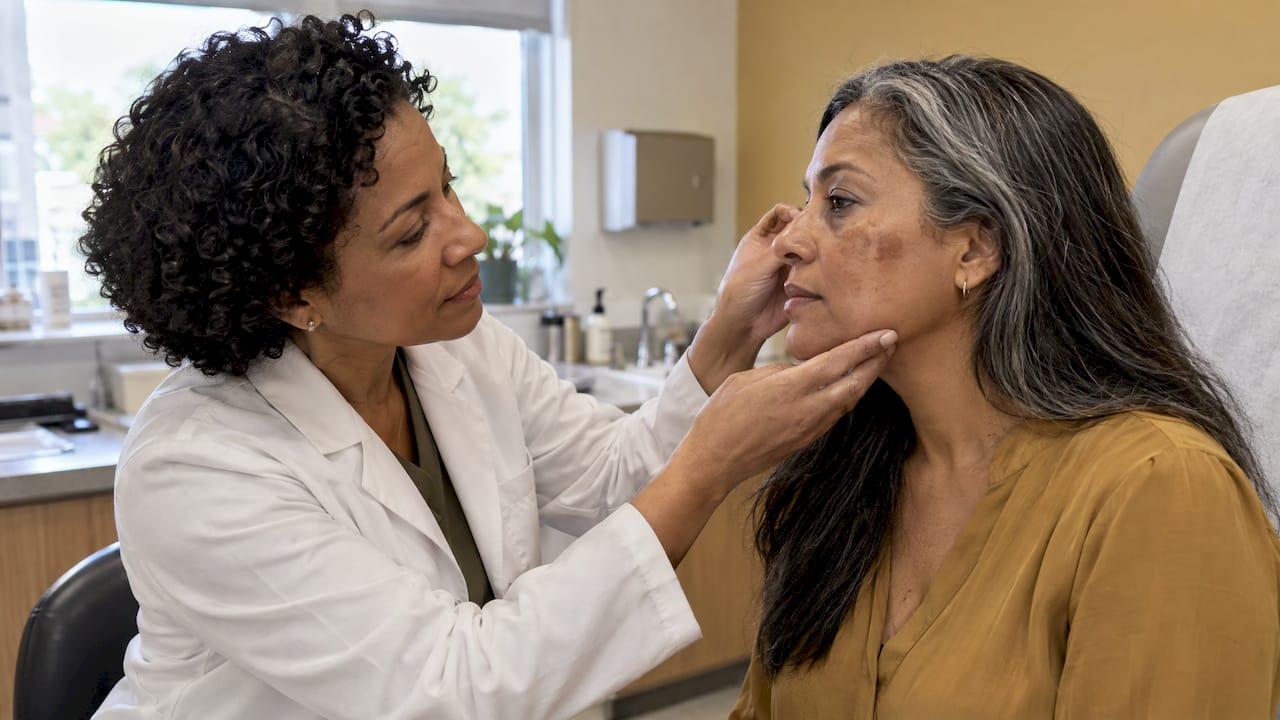
Melasma treatment works best as a combination: daily sun protection, a topical plan matched to your skin, and sometimes a procedure. The American Academy of Dermatology (AAD) says there is no one best treatment for melasma. The plan is tailored to your skin tone, how deep the pigment sits and what triggers it.
Beauty Is Not Perfection. Beauty Is a Verb. Beauty Is Becoming. Melasma is part of many women's becoming, and it is manageable. Here is how to approach it with clarity and kindness toward your skin.
TL;DR
- Sunscreen is the foundation. Use broad-spectrum SPF 30 or higher every day, and add a hat and shade. Mineral and tinted formulas with iron oxide add extra protection against visible light.
- Prescription topicals (hydroquinone, tretinoin, or a triple combination cream) are the standard first-line care. A dermatologist chooses and monitors them.
- Peels, microneedling and lasers are add-ons, not replacements for topical care and sunscreen.
- Pregnant or trying to conceive? Many melasma medications are not safe. Azelaic acid is the main one that is.
- Melasma tends to return. Maintenance and trigger management matter as much as fading.
Table of Contents
- What melasma is, and what it is not
- The foundation: sun and light protection
- Prescription topical treatments
- Procedures: peels, microneedling, lasers
- Over-the-counter and at-home care
- Melasma during pregnancy, postpartum and menopause
- How long it takes, and how to keep it away
- When to see a dermatologist
- Find your next step with us
- FAQ
- Sources
What melasma is, and what it is not
Melasma causes brown or gray-brown patches, mostly on the face. It is more frequent among women and people with darker skin tones, and it is a type of hyperpigmentation.
Three things help you recognize it:
- Symmetry. If it appears on one cheek, it usually appears on the other too.
- Texture. The AAD notes melasma is not skin cancer and typically feels flat and appears on both sides of the face.
- Pattern. A 2022 review found the centrofacial pattern (forehead, cheeks, nose, upper lip) in 50% to 80% of cases.
The Merck Manual describes melasma as dark brown, roughly symmetric patches with irregular borders. It occurs most often in pregnancy (sometimes called the mask of pregnancy) and in women taking oral contraceptives. It is also more common in, and lasts longer on, darker skin.
Melasma vs. hyperpigmentation vs. sun spots
Hyperpigmentation is the umbrella term for any patch of skin that is darker than the skin around it. Melasma is one kind. If you want a closer look at how clinicians tell melasma versus other hyperpigmentation, that overview is a good next read.
| Melasma | Sun spots | Freckles | |
|---|---|---|---|
| Look | Brown or gray-brown patches, often symmetric | More consistent color, more defined shape | Smaller, more uniform in color |
| Main driver | Hormones plus sun and light | Cumulative sun exposure | Genetics and sun |
| Behavior | Can persist and recur | Stays unless treated | Tends to fade without sun exposure |
The comparison of sun spots and freckles comes from a dermatology practice's guide. Because the look-alikes need different care, a clinician's diagnosis is worth it before you invest in products.
The foundation: sun and light protection
Every plan starts here. Without it, even the best cream struggles.
The AAD advises a broad-spectrum sunscreen of SPF 30 or higher throughout the day, a wide-brimmed hat and shade. It says dermatologists often recommend formulas with zinc oxide, titanium dioxide and iron oxide.
Some clinicians recommend going higher. Mayo Clinic experts suggest SPF 50 or higher daily with a physical blocker, reapplied every one to two hours. The Merck Manual adds a reason to choose tinted: most sunscreens do not block visible light. A tinted mineral sunscreen covers that gap. Merck also suggests clothing and hats with a UV protection factor of 50 or higher.
If deeper skin tones make mineral sunscreens look chalky, our guide to SPF for dark skin without a white cast walks through what to look for.
A simple daily habit:
- Apply sunscreen as the last step of your morning routine, to face, ears and neck.
- Reapply through the day, especially when outdoors or near windows.
- Wear a hat and seek shade during peak hours. Harvard Health's dermatologists point to 10 a.m. to 4 p.m. as the window to avoid direct sun.
Sun protection does not have to cost you your vitamin D awareness. If that worry holds you back, read this overview of sun exposure and vitamin D, then talk to your doctor about what is right for you.
Prescription topical treatments
The AAD lists hydroquinone, tretinoin with a mild corticosteroid, and triple combination creams as core options, plus azelaic acid, kojic acid or vitamin C as other medications.
Triple combination cream. The Merck Manual calls triple topical therapy first-line treatment. It combines hydroquinone, tretinoin and a topical corticosteroid. Your dermatologist sets the strengths.
Hydroquinone. It lightens skin by interfering with pigment production. Cleveland Clinic describes it as applied at night for two to four months. Harvard Health notes it can be used for up to six months for initial treatment, then occasionally if needed.
Tretinoin. A retinoid that speeds skin turnover. It is not for use in pregnancy.
Azelaic acid. Cleveland Clinic notes it is applied twice daily and is safe during pregnancy, which makes it a useful option for expecting and nursing mothers to discuss with a doctor.
Tranexamic acid. It may come as a cream, injection or tablet. Harvard Health says oral medications such as this are usually considered in more severe cases. They are thought to help by reducing pigment production and excess blood vessels in the skin.
Our deeper guide to fading dark spots safely over 3 to 6 months covers the wider hyperpigmentation picture.

Hydroquinone safety, in plain words
This ingredient deserves respect, and a professional's guidance.
- The Merck Manual says it should be used only under a doctor's guidance, because long-term use can sometimes cause a permanent form of hyperpigmentation.
- A 2024 clinical guide advises applying it only to the darker areas, for no more than 6 months at a time, and stopping if irritation or discoloration develops.
- The British Association of Dermatologists notes it may cause irritation and can occasionally darken skin.
Follow your prescriber's schedule and report any change early.
Procedures: peels, microneedling, lasers
The AAD lists chemical peels, microneedling, laser and light treatments, and platelet-rich plasma as procedural options. They are add-ons.
Mayo Clinic experts say topical treatment is the key to success and should be used before and alongside any light or laser procedure. They describe fractional nonablative lasers that treat as little as 5% of the skin at a time to slowly remove pigment, with a much lower risk of relapse.
If you have a medium to deep skin tone, ask any provider how often they treat melasma on your skin tone and what the plan is to protect against post-treatment darkening. Our guide to skincare for women of color can help you prepare questions.
Over-the-counter and at-home care
This is where many readers start, and where confusion is greatest.
Hydroquinone is not sold over the counter in the US. The AAD says it is no longer available in products you can buy without a prescription. A 2024 guide explains that most such products were withdrawn after the CARES Act of 2020, and no over-the-counter formulation is currently FDA-approved. Treat "hydroquinone" claims on unregulated marketplaces with caution.
Ingredients to look for on a shelf:
- Niacinamide. A 2026 narrative review reports that 4% niacinamide had efficacy comparable to 4% hydroquinone, with better tolerability, less redness and dryness, and no reports of ochronosis. Learn how it pairs with other actives in our guide to vitamin C versus niacinamide.
- Azelaic acid, kojic acid and vitamin C. All named by the AAD as helpful agents.
- Gentle retinoid alternatives. If a retinoid irritates you, see our comparison of retinol and bakuchiol over 12 weeks.
A simple melasma skincare routine
Morning
- Gentle cleanser.
- A brightening serum such as niacinamide or vitamin C.
- Moisturizer.
- Tinted mineral sunscreen, SPF 30 or higher (SPF 50 if your dermatologist advises it).
Evening
- Gentle cleanser.
- Your prescribed treatment, exactly as directed.
- Barrier-supporting moisturizer.
Keep it short. Irritation can worsen pigment, so fewer, steadier steps beat a crowded shelf.
Melasma during pregnancy, postpartum and menopause
Hormones drive much of melasma, so life stages matter.
Harvard Health advises that pregnant women avoid most melasma medications except azelaic acid. The Merck Manual says that during pregnancy azelaic acid cream and glycolic acid peels are safe, while hydroquinone, tranexamic acid, trichloroacetic acid peels and tretinoin are not.

For the ingredient picture in pregnancy, read our guide to ingredients to avoid during pregnancy. For the months after birth, a two-minute postpartum routine keeps things simple. If you are in midlife, see our menopause skincare guide. Hormone therapy and birth control are common triggers, so talk with your doctor before changing any medication. Never stop one on your own because of a skin concern.
How long it takes, and how to keep it away
Be patient. Cleveland Clinic says melasma may go away on its own, be permanent, or respond to treatment within a few months, depending on the person.
Harvard Health's dermatologists are honest: melasma cannot be fully prevented in people predisposed by genetics, skin type, hormones or sun exposure. Still, avoiding peak sun, using high-SPF sunscreen diligently and avoiding hormonal medications when possible may reduce flares and recurrence.
Maintenance habits:
- Sunscreen every day, year-round, not only in summer.
- A gentle maintenance product your clinician approves once the patches fade.
- Heat and irritation are worth minimizing. Skip harsh scrubs.
- Track flares against your cycle with our guide to cycle-syncing skincare.
When to see a dermatologist
Book an appointment with a board-certified dermatologist when:
- Patches are new, changing, raised, or on only one side of the face. Melasma is usually flat and symmetric, and the AAD says it is not skin cancer, but a clinician should confirm what you have.
- Sunscreen and gentle care have not helped after a few months.
- You are pregnant, nursing or planning a pregnancy and want a safe plan.
- You have darker skin and are considering peels or lasers.
- You want a prescription option such as hydroquinone or tranexamic acid.
Bring a list of your medications, hormonal products and current skincare. Acne treatments can also leave dark marks, so if breakouts are in play, see our guide to adult female acne.
Our perspective
We see melasma every day in the questions women bring to us, and it is rarely only about skin. It is about confidence, about feeling that your face no longer looks like yours.
Here is what we believe. Beauty is not perfection. Beauty is a verb. Beauty is becoming. Treating melasma well is an act of care, and care takes time.
That is why we take an inside-out, head-to-toe, 360-degree approach. Your sunscreen habit, your hormones, your stress, your sleep and your community all play a part. Advice scattered across the internet leaves women confused. We bring trusted experts, resources and recommendations together so you can ask better questions and make steadier choices.
Start with protection. Add what your dermatologist recommends. Be patient with your skin, and with yourself.
Ava
Find your next step with us
You should not have to piece this together alone. The Ultimate Beauty - You! is a women-centered platform that brings together expert advice, product and brand recommendations and a community of women at every age and stage. An app is on the way.

Explore our resources and join the community at The Ultimate Beauty - You!, or browse what is available on our products page.
FAQ
What is the best treatment for melasma?
There is no single best treatment. The AAD says the most effective approach often combines daily sun protection with prescription topicals and sometimes a procedure, tailored to your skin. A dermatologist can match the plan to you.
Can I get rid of melasma fast?
Melasma usually fades gradually. Cleveland Clinic describes some cases responding within a few months, while others persist or return. Consistent sunscreen and following your prescribed plan are the most reliable ways to move forward.
Can melasma be treated naturally?
Sun protection, shade and a gentle routine are the natural basics. Ingredients such as niacinamide have research behind them, and a 2026 review found it comparable to 4% hydroquinone in one comparison. Check with a dermatologist before relying on home remedies, since irritation can worsen pigment.
Is melasma the same as sun spots?
No. Melasma is usually symmetric, brownish or gray-brown, and driven by hormones plus sun and light. Sun spots have more consistent color and a more defined shape. Both are forms of hyperpigmentation, but they respond to different care.
Is melasma treatment safe during pregnancy?
Many treatments are not. Harvard Health says pregnant women should avoid most melasma medications except azelaic acid. Ask your obstetric provider and dermatologist before using any product.
Sources
- AAD: Melasma diagnosis and treatment
- AAD: Melasma overview
- Harvard Health: Melasma, what are the best treatments?
- Mayo Clinic: Q and A on treating melasma
- Merck Manual Professional: Hyperpigmentation
- Merck Manual Consumer: Melasma
- Cleveland Clinic: Melasma
- Practical guide to over-the-counter treatments for melasma (2024)
- Differential diagnosis of melasma and hyperpigmentation (2022)
- Topical niacinamide in the management of melasma (2026)
- British Association of Dermatologists: Melasma
- Melasma vs freckles and sunspots
- Understanding hyperpigmentation and melasma
- Melasma vs. hyperpigmentation overview
- Sun exposure and vitamin D guide