
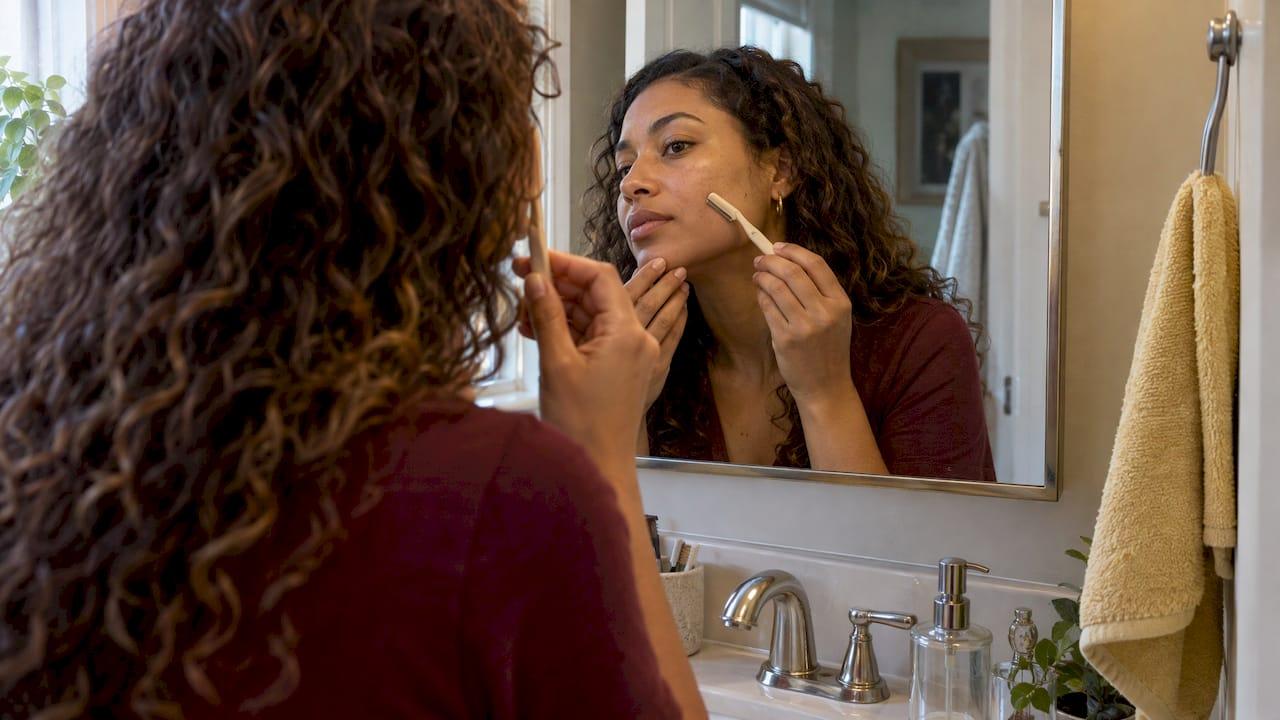
Dermaplaning at home means gently scraping peach fuzz and a thin layer of dead skin cells off your face with a small, single-blade razor. Done carefully, on clean, dry, calm skin, it is considered low-risk and leaves skin smoother, with makeup that sits better. Done too often, with a dull blade or on irritated skin, it can cause trouble. This guide gives you the full method, the timing, and the honest list of who should skip it.
Beauty Is Not Perfection. Beauty Is a Verb. Beauty Is Becoming. Caring for your skin is part of that, and it works best when you know exactly what you are doing.
TL;DR
- Dermaplaning removes vellus hair (peach fuzz) and surface dead skin. Cleveland Clinic describes it as an exfoliating process that leaves skin smoother and brighter.
- Start with a cleansed, completely dry face. Pull the skin taut and use short, light strokes at a 45-degree angle with a fresh, clean blade.
- Hair does not grow back thicker or darker. It can feel blunt for a short time because the tapered tip has been cut.
- Skip it during active acne, rosacea, eczema, cold sores, sunburn or open wounds. Go gentle on retinoids.
- Keep it occasional, then finish with a light moisturizer and sunscreen.
Table of Contents
- What dermaplaning at home actually is
- Is dermaplaning safe to do at home?
- What you need
- How to dermaplane at home, step by step
- Wet or dry: which is better?
- Aftercare that protects your glow
- How often should you dermaplane at home?
- Dermaplaning versus shaving your face
- If your skin protests
- Our perspective
- Keep growing with The Ultimate Beauty - You!
- FAQ
- Sources
What dermaplaning at home actually is
Dermaplaning is the removal of peach fuzz from the surface of your skin. According to Cleveland Clinic, the at-home version uses a tiny straight razor with a single blade on a plastic handle. As the blade glides across the skin, it lifts away fine hair and the top layer of dull, dead cells.
The result is a canvas that feels soft and looks brighter. Skincare can reach the skin more easily, and foundation tends to look more even without fuzz catching the product.
Professional versus at-home
In a clinic, a trained professional works with a surgical blade and precise technique. At home, you use a smaller, more protected tool. Dermatologist Dr. Ciraldo, quoted in Women's Health, explains that the at-home version is much more superficial than the in-office procedure because the tools differ.
That difference is not a flaw. It is why the at-home method suits regular, gentle upkeep. Healthline notes that professional sessions may cost $75 to $200, while the at-home route is quick and low-cost.
| At home | Professional | |
|---|---|---|
| Tool | Small single-blade razor with a handle | Surgical blade used by a trained provider |
| Depth | Superficial | More precise and more thorough |
| Cost | Low, mostly the price of the tool | $75 to $200 per session, per Healthline |
| Best for | Light, regular upkeep | A deeper, supervised treatment |
Is dermaplaning safe to do at home?
For most healthy skin, yes, when you are careful. Harvard Health says the technique is safe when done carefully. Cleveland Clinic dermatologist Dr. Melissa Piliang calls it generally safe, effective and low-risk, and adds that facial skin is delicate, so doing it too often can do damage.
The risk lives in the details: blade quality, angle, pressure and timing. Ohio State's health team points out that many over-the-counter blades are duller and more prone to nicks, cuts and microtears, which can lead to infection or scarring. A sharp, clean, purpose-made blade and a light hand matter more than any product you buy.

Who should skip it
Your skin has to be calm before you pick up a blade. Harvard Health advises that people with sensitive skin, or conditions such as rosacea, eczema or acne, should avoid dermaplaning. Cleveland Clinic says to skip it during an eczema flare-up, active acne or any other active skin issue.
So pause if you have:
- Active breakouts or inflamed skin
- A rosacea or eczema flare
- Cold sores
- Sunburn
- Cuts, scrapes or other open skin
If your skin is reactive, talk with a dermatologist first. In Cosmopolitan, Dr. Gohara suggests that people dealing with acne ask about gentle chemical exfoliants such as lactic acid or polyhydroxy acid as a way to smooth skin without a blade. For more on how a clinic thinks about this question, read about whether dermaplaning irritates skin.
A note on retinoids and active ingredients
If you use prescription retinoids or strong retinol, you are already speeding up cell turnover. Adding a blade on top can leave skin overly stripped. Check with your dermatologist about timing. If you are weighing gentler options, our guide to retinol versus bakuchiol shows how women compared them.
What you need
Keep the list short.
- A purpose-made dermaplaning tool with a safety guard. ABC News reports dermatologist Dr. Henry advises a clean, sterile blade designed for dermaplaning, replaced after each use.
- A gentle cleanser
- A clean towel
- A light, fragrance-free moisturizer
- Broad-spectrum sunscreen
- Good light and a mirror you can stand in front of calmly
How to dermaplane at home, step by step
Set aside ten unhurried minutes. Rushing is the real enemy here.
Step 1: Cleanse and dry
Wash your face to remove makeup, oil and dirt. CNN Underscored shares that licensed medical aesthetician Kristin Gunn recommends cleansing or double-cleansing, then letting skin air dry. Pat dry and wait until there is no dampness left.
Step 2: Keep your skin product-free
Medical News Today is direct about this: do not use products during the procedure, including dermaplane oil. Save your serums and creams for the end.
Step 3: Pull the skin taut
Use your free hand to stretch the area you are working on. Taut skin gives the blade a flat surface and lowers the chance of a nick.
Step 4: Glide with short, light strokes
Harvard Health describes pulling skin upward until taut, then moving the tool downward in short strokes with the razor at a 45-degree angle. Start near the top of the ear and work down. Avoid the hairline, eyelids and the sides of the nose. ABC News adds that strokes should be light and feather-like, in the direction of hair growth.

Let the blade do the work. No pressing. No going back over the same patch again and again.
Step 5: Check and finish
Look in good light for missed spots, but skip anything near the eyes. Rinse the tool and set it aside for replacement or proper disposal.
Wet or dry: which is better?
Dry. Dr. Ciraldo, in Women's Health, recommends cleaning the skin first to minimize surface oils and debris, then dermaplaning on dry skin. She notes that warming the skin with steam or a warm shower beforehand can make removal easier, but your face should not be wet to the touch when the blade touches it. Wet skin makes the blade more likely to slip.
Aftercare that protects your glow
Your skin has just lost a protective layer of dead cells. Treat it kindly for a few days.
- Moisturize. Harvard Health suggests moisturizing afterward. Medical News Today recommends a light moisturizer twice a day for the week and avoiding fragranced products.
- Wear sunscreen. Cosmopolitan advises avoiding direct sun for three days and using SPF 30 or higher, reapplied every two hours when outdoors.
- Hold the makeup. Give skin a little time before layering foundation.
- Pause the strong stuff. Harvard Health recommends avoiding acid- or retinol-based products for a few days.
- Skip other hair removal. Medical News Today says to avoid other types of hair removal during that week.
Slight redness that fades quickly is normal, according to Cosmopolitan. Dr. Doft also recommends a rich hyaluronic acid mask or moisturizer to keep skin hydrated. If you like a recovery-first approach, our guide to skin cycling shows how to build rest nights into your routine.
How often should you dermaplane at home?
Less often than you think. Experts give a range, so lean toward the gentle end.
- Cleveland Clinic's Dr. Piliang advises not doing it more than once a week so skin can recover.
- Healthline suggests limiting dermaplaning to once or twice a month.
Results last about two to three weeks depending on how fast your hair grows, according to Cosmopolitan. That means monthly is a natural rhythm for many women. Dermaplaning is one form of exfoliation, and your skin only needs so much of it. This guide to how often to exfoliate your face helps you count everything in your routine, not only the blade. And our piece on why exfoliation improves skin explains the science behind the glow.
Dermaplaning versus shaving your face
They look similar. They are not the same. WebMD explains that the two differ in tools, amount of skin removed and who performs it. Shaving cuts hair at skin level and should not remove skin layers. Dermaplaning also exfoliates by lifting off dead skin cells.
| Face shaving | Dermaplaning | |
|---|---|---|
| Removes hair | Yes | Yes |
| Exfoliates | Not meant to | Yes |
| Tool | Standard razor | Single-blade tool made for the face |
| Best for | Quick hair removal | Smoothness plus a brighter surface |
Will hair grow back thicker?
No. Healthline explains that dermaplaning cuts hair at the surface and leaves the papilla intact, so it does not make hair grow back thicker. Tweezing or waxing may remove the papilla, which is the opposite situation. Dr. Piliang adds that regrowth can feel coarser at first only because a blunt cut removes the soft, tapered tip. It softens as the hair grows.
This is a long-held worry, and it is a myth. You can stop carrying it.
If your skin protests
Some tingling or redness for a day can happen. Cleveland Clinic lists temporary irritation, exposure to bacteria if you nick the skin, and agitated or new acne among the possible side effects.
If your skin gets cranky:
- Pause actives such as retinoids, acids and vitamin C.
- Switch to a gentle cleanser and a rich moisturizer.
- Wear sunscreen daily.
- See a doctor if you notice spreading redness, pus, fever, severe pain or blisters.
Working on your body too? Our body exfoliation guide and body skincare routine keep barrier care at the center.
Our perspective
We believe beauty is an ongoing practice, not a finish line. Dermaplaning at home can be a lovely small ritual: a few quiet minutes, a smoother surface, a little more ease in the mirror.
But a ritual only serves you when it is informed. That is why we treat the skin as part of a bigger picture: inside-out, head-to-toe, 360-degree. Your blade technique matters. So do your sleep, your sunscreen, your stress and your sense of self.
We also know that advice online can feel fragmented. One site says weekly, another says monthly. One says glow, another says fear. We built The Ultimate Beauty - You! to bring trusted experts, brands and resources together in one community, so women of every age and stage can find guidance that fits their own skin and their own life.
Peach fuzz is not a flaw. Choosing to remove it, or keep it, is yours. Whatever you choose, we are here for it.
Ava
Keep growing with The Ultimate Beauty - You!
Smooth skin is one chapter. The Ultimate Beauty - You! is a women-centered beauty, wellness and confidence community with expert advice, brand recommendations and resources for every age and stage, and an app on the way.

Explore The Ultimate Beauty - You! to find trusted voices and ideas for your routine, or browse the offerings page to see what we have to offer.
Prefer to start with your stage of life? We have guides on menopause skincare, postpartum skincare, teen skincare and fading dark spots on deeper skin tones.
FAQ
Is dermaplaning at home a good idea?
For calm, healthy skin, it can be. Cleveland Clinic considers it generally safe, effective and low-risk when done carefully. Use a fresh, clean blade, keep strokes light, and skip it if your skin is irritated or inflamed.
What should I put on my skin before dermaplaning?
Nothing but a clean face. Cleanse, rinse and let your skin dry completely. Medical News Today advises against applying products, including dermaplaning oil, during the procedure. Save moisturizer and sunscreen for after.
Is it better to dermaplane wet or dry?
Dry. Dr. Ciraldo recommends cleaning skin first, then dermaplaning on dry skin. A warm shower beforehand can help, but your face should not be wet to the touch.
Does dermaplaning make hair grow back thicker?
No. Healthline explains that cutting hair at the surface leaves the papilla intact, so growth is unchanged. Regrowth may feel a bit coarser for a short while because the tapered tip is gone.
Is dermaplaning the same as shaving my face?
Not quite. WebMD notes that shaving cuts hair at skin level, while dermaplaning also exfoliates dead skin cells. The tools, the depth and the intent differ.
Sources
- Dermaplaning at Home: Benefits & How It Works, Cleveland Clinic
- What Is Dermaplaning? Women's Health
- Is it safe to dermaplane my face? Harvard Health
- Why clinical skin care treatments are safer than at-home options, Ohio State Health & Discovery
- What Is Dermaplaning? Cosmopolitan
- Nervous about dermaplaning at home? ABC News
- How to dermaplane at home, CNN Underscored
- Dermaplaning at home: Benefits, risks, instructions, Medical News Today
- Dermaplaning: Procedure, Benefits, and Risks, WebMD
- Is Dermaplaning Right For You? Healthline
- How often should I exfoliate my face?