

Cruelty-free beauty means no animal testing was performed on the product or its ingredients at any stage the brand controls or accepts responsibility for. Before you buy, check three places: a recognized third-party certification logo (Leaping Bunny or PETA's Beauty Without Bunnies), the brand's official cruelty-free policy page, and a trusted database like Good On You or Cruelty Free International's approved list. One important nuance: a "cruelty-free" label on the front of a package may cover only the finished product, not every ingredient or supplier in the supply chain.
- Third-party certification: Look for the Leaping Bunny or PETA bunny logo, both of which require documented brand commitments beyond a self-declared claim.
- Brand policy page: Search the brand's website for a cruelty-free or animal testing policy statement. A genuine policy names a global no-testing commitment, not just the finished product.
- Trusted databases: Good On You and Cruelty Free International maintain updated, searchable lists you can consult in seconds before checkout.
Table of Contents
- What does "cruelty-free" actually cover?
- Cruelty-free vs. vegan: what's the real difference?
- Which certifications and labels can you actually trust?
- How to verify a cruelty-free claim before you buy
- What does the FDA say, and why is "cruelty-free" not a legal term?
- Non-animal testing methods: are they as reliable?
- Common misconceptions and red flags to watch for
- Key Takeaways
- Why cruelty-free transparency matters to us
- Authoritative resources for further reading
What does "cruelty-free" actually cover?
The phrase sounds clear, but brands use it in at least three different ways, and the gap between them matters.
The narrowest version covers only the finished product: the brand did not test the final formula on animals. That sounds meaningful, but it says nothing about whether the ingredient suppliers tested raw materials on animals before selling them to the brand. A moisturizer can carry a cruelty-free claim on the box while containing an ingredient that was tested on animals at the supplier level years ago.
A broader interpretation adds a no-new-animal-testing commitment across the supply chain: neither the brand nor its current suppliers conduct new animal tests. This is closer to what most consumers expect when they see the label.
The most protective scope is a global no-testing policy: the brand and every supplier in its chain pledge no animal testing at any stage, and the brand does not sell in markets where animal testing is legally required. The FDA notes that some raw materials were tested on animals historically, which is why "not currently tested" phrasing appears on some labels. That phrase is technically honest but narrower than a full supply-chain commitment.
Cruelty-free vs. vegan: what's the real difference?
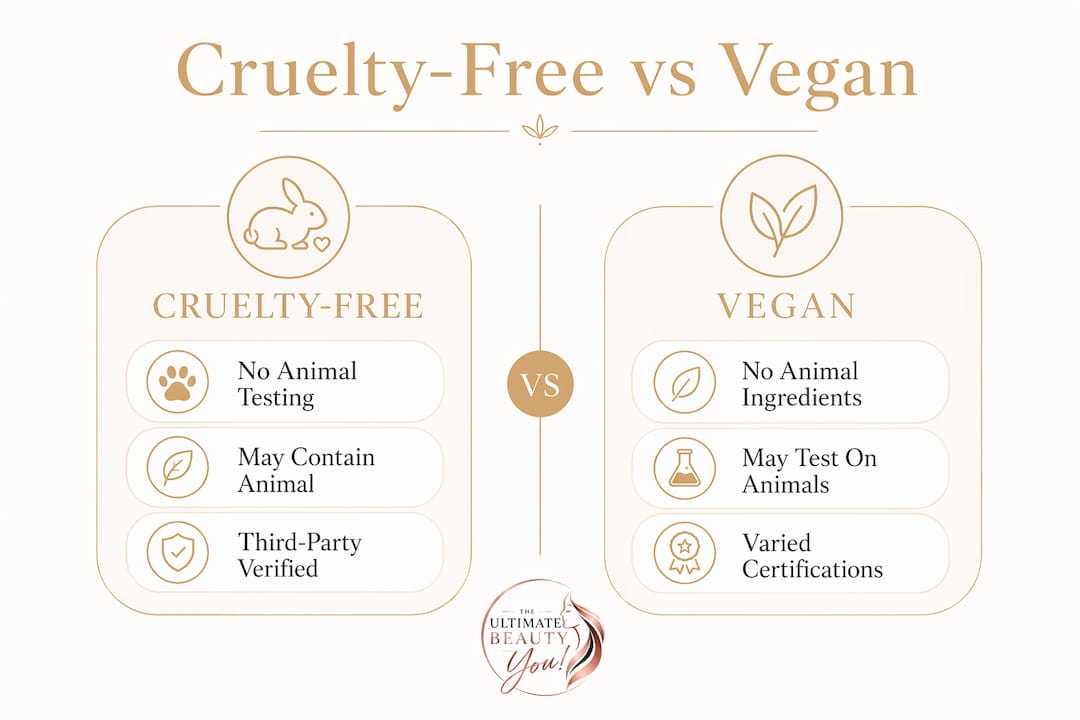
These two terms describe completely separate things. Knowing the distinction saves you from assuming one guarantees the other.

Cruelty-free refers to testing practices. It means no animal was used to test the product's safety. Vegan refers to ingredients. It means the formula contains no animal-derived substances, such as lanolin (from sheep's wool), carmine (from crushed beetles), or stearic acid (often from animal fat). A product can be cruelty-free but not vegan, and it can be vegan but have a complicated testing history.
Here is what each combination actually means for you:
- Cruelty-free + not vegan: No animal testing, but the formula may contain beeswax, lanolin, or carmine. Common in skincare and lip products.
- Vegan + not cruelty-free: No animal-derived ingredients, but the brand may have tested on animals, possibly to meet requirements in certain international markets.
- Both cruelty-free and vegan: No animal testing and no animal-derived ingredients. This is the combination to look for if both concerns matter to you.
- Neither: The product was tested on animals and contains animal-derived ingredients.
Reading a label in practice: if you see "vegan" but no cruelty-free certification, check the brand's testing policy separately. If you see a cruelty-free logo but want to avoid animal ingredients, scan the ingredient list for lanolin, carmine, beeswax, or stearic acid. As Livekindly explains, many cruelty-free brands still use these ingredients routinely. For fully animal-free products, look for both certifications.
For readers who want to align these choices with a broader self-care philosophy, mindful beauty is a useful framework for thinking through what your purchases reflect about your values.
Which certifications and labels can you actually trust?
Not all bunny logos are equal. Some are created by the brand itself with no outside verification. Here is what separates the credible ones.

Leaping Bunny
Leaping Bunny, administered by Cruelty Free International, is widely regarded as the most rigorous standard available to U.S. consumers. It requires brands to commit to no animal testing at every stage of production, including ingredient suppliers. Brands must monitor their suppliers and submit to audits. Leaping Bunny's certification process is more demanding than most self-declared claims precisely because of that supplier-monitoring requirement. The certification list is smaller than some programs, but that reflects stricter entry criteria, not lower awareness.
PETA's Beauty Without Bunnies
PETA runs two tiers: "cruelty-free" and "cruelty-free and vegan." Brands apply by signing a statement of assurance. PETA's program is broader in scope (more brands listed) but relies primarily on written commitments rather than on-site audits. PETA recommends a firm global no-testing policy and warns that selling in markets where animal testing is legally required undermines any cruelty-free claim, regardless of what the packaging says.
Brand-created logos and the selling-in-market caveat
A rabbit icon with no certifier name is a red flag. Any brand can design a bunny logo and print it on packaging without meeting an external standard. Good On You's research found that 78% of brands have no certification demonstrating they are not tested on animals. Of those, 31% have policies but no certification, 18% are opposed to testing but owned by parent companies that do test, and 30% make no meaningful disclosure at all.
| Certification | Administered by | Supplier auditing | Basis of verification |
|---|---|---|---|
| Leaping Bunny | Cruelty Free International | Required | Application + periodic audits |
| PETA Beauty Without Bunnies | PETA | Not required | Signed brand statement |
| Brand-created logo | Brand itself | None | Self-declaration only |
| Good On You rating | Good On You | Research-based scoring | Public data + brand disclosures |
How to verify a cruelty-free claim before you buy
Use this checklist every time you evaluate a new brand or product.
- Check for a named third-party certification. Look for the Leaping Bunny or PETA logo and confirm the brand appears on the certifier's official list at leapingbunny.org or PETA's Beauty Without Bunnies database.
- Read the brand's animal testing policy page. A trustworthy policy states a global no-testing commitment, names the scope (finished product and ingredients), and is dated or recently updated.
- Look for supplier auditing language. Phrases like "we monitor our ingredient suppliers" or "our suppliers have signed no-testing pledges" indicate a deeper commitment than finished-product claims alone.
- Check whether the brand sells in markets that may require animal testing. Some international markets have historically required animal testing for imported cosmetics. A brand that sells there without a verified exemption may be subject to those requirements.
- Review the ingredient list for animal-derived substances if vegan status also matters to you (lanolin, carmine, beeswax, stearic acid).
- Cross-reference with an updated certifier list. Certifications can lapse. Always verify on the certifier's current list, not just the packaging.
Sample questions to email a brand directly:
- "Does your cruelty-free commitment cover ingredient suppliers, or only the finished product?"
- "Do you sell in any markets where animal testing is required by law for imported cosmetics?"
- "Is your cruelty-free status certified by a third party, and if so, which one?"
Pro Tip: When reading a brand's supplier audit language, watch for the phrase "to the best of our knowledge." That qualifier signals the brand is relying on supplier self-reporting rather than independent audits. A stronger statement names the audit process and its frequency.
Beauty self-advocacy is exactly this: asking the right questions and expecting real answers.
What does the FDA say, and why is "cruelty-free" not a legal term?
The FDA is direct on this: "cruelty-free" and "not tested on animals" have no legal definitions under U.S. federal law. Any cosmetics brand can print either phrase on a label without meeting a defined standard. The FDA does not certify, approve, or verify these claims.
This regulatory gap is why third-party certification matters so much in the U.S. market. Without a legal definition, the phrase is only as trustworthy as the brand behind it or the certifier verifying it. Some U.S. states have passed or proposed legislation restricting the sale of cosmetics tested on animals, which reflects growing consumer and legislative pressure, but no federal standard currently exists.
The international dimension adds another layer. Certain markets have historically required animal testing for imported cosmetics as a condition of sale. A brand that chooses to sell in those markets may be subject to those requirements, regardless of its domestic cruelty-free policy. PETA's guidance is clear: selling in such markets undermines a cruelty-free claim unless the brand has a verified exemption.
Non-animal testing methods: are they as reliable?
Yes, and in many cases more so. Experts and industry reporting increasingly point to non-animal methods as providing more human-relevant safety data than traditional animal tests, because human biology and animal biology differ in ways that affect how a product or ingredient behaves.
The main validated methods include:
- In vitro human-cell assays: Testing on cultured human cells to assess irritation, toxicity, and absorption.
- Reconstructed human skin tissues: Lab-grown skin models that closely replicate human skin responses.
- Computer modeling and AI-assisted prediction: Algorithms trained on existing safety data to predict how a new ingredient will behave in human tissue.
- Human volunteer testing (where ethically appropriate): Patch tests and controlled exposure studies on consenting adults.
When you visit a brand's website, look for a "safety" or "science" page that names the specific methods used. A brand confident in its testing approach will describe it. Vague language like "rigorously tested" with no method named is worth questioning.
Common misconceptions and red flags to watch for
Cruelty-free marketing has outpaced cruelty-free practice in parts of the beauty industry. These are the warning signs worth knowing.
- An unidentified rabbit logo. If the bunny icon has no certifier name beneath it, it is a brand-created symbol with no external verification.
- "Finished product only" language. This phrase explicitly excludes ingredient suppliers and is a narrower claim than most consumers assume.
- Silence on ingredient sourcing. A brand that discusses its finished-product testing but says nothing about suppliers is leaving a significant gap.
- Selling in markets that may require animal testing without a stated exemption or policy addressing it.
- Parent-company testing policies that differ from the brand's. Some independent-seeming brands are owned by larger corporations with different testing practices. Check the parent company.
One common packaging example: a label reading "We do not test our products on animals" covers only the finished formula. It does not address what happened at the ingredient level or whether a third party tested on the brand's behalf. Another: "Not tested on animals where prohibited by law" is essentially an admission that the brand does test where it is legally required. Both phrases appear on real products.
Historical ingredient testing is a separate issue. Many cosmetic ingredients were tested on animals decades ago during their initial safety evaluation. A brand cannot undo that history, but it can commit to no new animal testing going forward. "Not currently tested" phrasing reflects this reality honestly.
Key Takeaways
Cruelty-free beauty requires a global no-testing commitment backed by third-party certification and supplier auditing, not just a label claim on the finished product.
| Point | Details |
|---|---|
| Definition | Cruelty-free means no animal testing at any stage the brand controls, ideally verified by a named certifier. |
| Certification matters | Leaping Bunny requires supplier audits; PETA's program uses signed statements; brand-created logos have no external standard. |
| Cruelty-free ≠ vegan | Cruelty-free covers testing only; vegan covers ingredients. Check both if both matter to you. |
| Verify before you buy | Confirm the brand appears on the certifier's current list, not just the packaging logo. |
| Ask the brand directly | Email three questions: scope of commitment, supplier auditing, and whether the brand sells in markets that may require testing. |
Why cruelty-free transparency matters to us
At Theultimatebeauty-you, we believe beauty is a becoming. It is not a static purchase. It is a series of choices that reflect who you are and who you are growing into. Cruelty-free transparency is one of those choices, and it deserves more than a logo.
Our community of women deserves clear, honest information so that every product decision feels confident, not confusing. That is why we curate resources, vetted experts, and brand recommendations you can trust. Explore our vetted beauty products and connect with the experts and partners on our platform who share this commitment to integrity, inside and out.
Authoritative resources for further reading
These sources are the most reliable places to verify claims, check certification lists, and go deeper on any topic covered here.
- FDA: "Cruelty Free"/"Not Tested on Animals" — The U.S. regulator's official guidance on why these phrases have no legal definition and what that means for consumers.
- Leaping Bunny / Cruelty Free International — The certifier's own explanation of its standards, supplier monitoring requirements, and searchable brand list.
- PETA's Beauty Without Bunnies — PETA's searchable database of certified brands and its explanation of what the program requires.
- Good On You: How Cruelty-Free Is the Beauty Industry? — Data-driven analysis of certification rates, parent-company ownership, and what "cruelty-free" actually looks like across the industry.
- Livekindly: The Complete Guide to Cruelty-Free Beauty — Consumer-facing guide covering animal-derived ingredients, vegan distinctions, and how to read labels.
- Vogue: The Truth Behind Beauty's "Cruelty-Free" Label — Industry reporting on non-animal testing methods and the gap between marketing claims and verified practice.
This article is general consumer information, not legal or regulatory advice. For the most current rules in your specific situation, consult the FDA's official guidance or a qualified professional.