

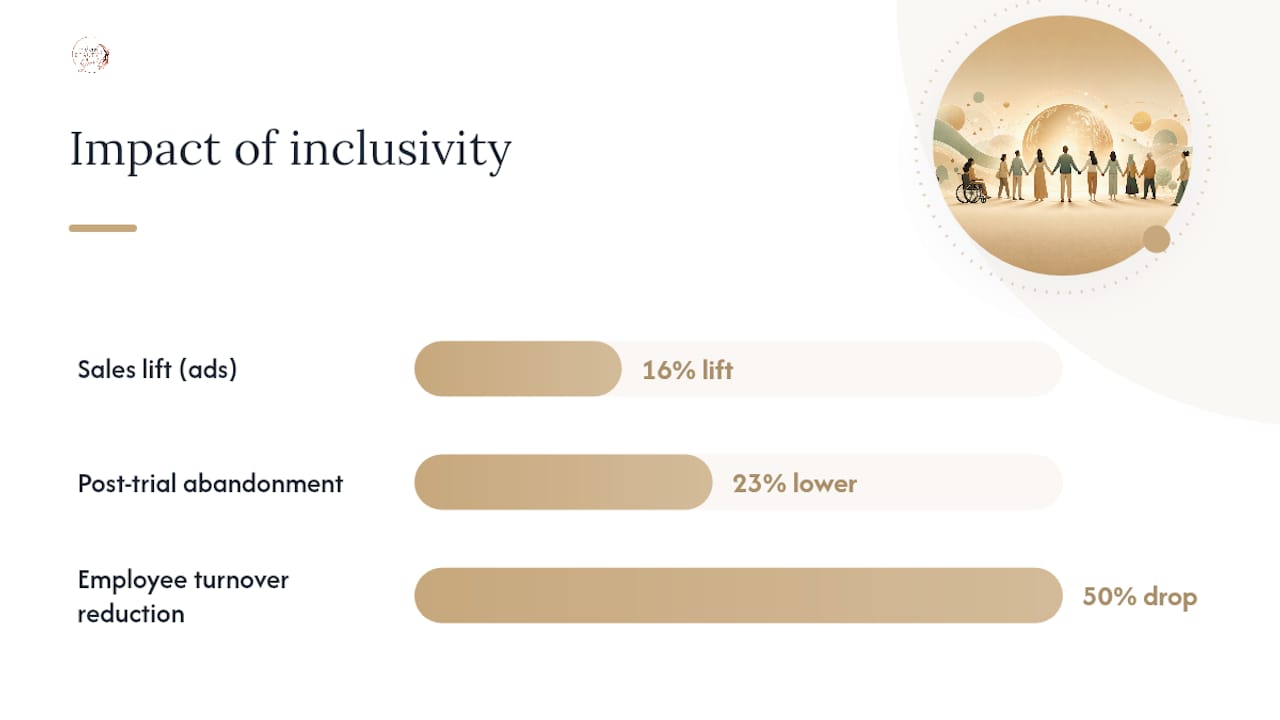
Inclusivity expands market share by widening the pool of customers who feel a brand is built for them, deepening loyalty once they arrive, and giving companies room to charge more without losing trust. This is not a branding nicety. Kantar's Brand Inclusion Index found that 75% of consumers say a brand's diversity and inclusion reputation shapes their purchase decisions, and progressive inclusive advertising correlates with roughly 16% higher long-term sales.
For a beauty and wellness brand, this math is not abstract. It is the difference between a product line that speaks to a narrow slice of women and one that reflects the actual range of skin tones, ages, body types, and life stages walking through the market every day.
Key Takeaways
Inclusivity expands market share because it widens who can buy from you, deepens why they stay, and builds the pricing power and talent base that keep both advantages compounding over time.
| Point | Details |
|---|---|
| Sales lift is consistent across studies | Kantar, Saïd Business School, and UN Women independently found roughly 16% long-term sales lift from inclusive advertising. |
| Loyalty gains outlast the campaign | Inclusive advertising drives 23% lower post-trial abandonment, according to Saïd Business School's analysis. |
| Workplace inclusion cuts costly turnover | BCG found moving from the lowest quartile to median inclusion scores can cut attrition risk by roughly 50%. |
| Start with one measurable pilot | Test one inclusive product or campaign change against a control group before committing to a full rollout. |
| Authenticity determines results | Token representation without real product or workplace change fails to produce the sales and loyalty gains research shows. |
Three moves a CMO or product leader can start this month: assign a segmentation review to identify one underserved customer group within 30 days, launch one A/B-tested inclusive campaign or product pilot within 90 days, and set a KPI reporting cadence with retention and conversion data by segment before scaling anything further. Evidence-based pilots beat company-wide mandates every time, because they tell you what is actually working before you spend the larger budget.
Table of Contents
- Why Inclusivity Expands Market Share: The Business Case
- How Does Inclusivity Expand Market Share?
- What Does the Research Say About Inclusivity and Sales?
- How Do You Measure Whether Inclusivity Is Growing Your Market Share?
- A Practical Roadmap for Turning Inclusion Into Growth
- What Mistakes Undermine Inclusivity's Market-Share Gains?
- Real Examples of Inclusivity Driving Market Share
- An Editorial Take on Inclusion as Growth Strategy
- Sources
Why Inclusivity Expands Market Share: The Business Case
The term "inclusivity" gets used loosely, so it helps to separate it into three distinct arenas where it actually shows up in a business: product, marketing, and workplace.
Product and accessibility. This means designing offerings, packaging, and experiences that work for people across ability levels, skin tones, ages, and body types without forcing anyone into an afterthought "special" line. A shampoo brand that only tests formulas on straight hair textures is not building an inclusive product. One that develops formulas and instructions tested across curl patterns and hair types is.

Marketing and creative representation. This covers who appears in campaigns, how copy speaks to different audiences, and whether imagery reflects the range of people who might actually buy the product. A skincare ad cast entirely with women under 30 tells everyone over 40 the product was not made with them in mind, even if the formula works just as well for their skin.
Workplace and operations. This is about who gets hired, promoted, and heard inside the company, along with how policies accommodate different life circumstances, from caregiving schedules to religious observance. It matters commercially because BCG's research found that companies moving from the lowest quartile to the median on inclusive-workplace measures cut attrition risk by roughly 50%. Fewer people quit, less institutional knowledge walks out the door, and product decisions stay sharper.
These three domains connect directly to market access rather than sitting in a separate "values" bucket. A brand that gets product and marketing right opens doors to customer segments a competitor's blind spots keep closed. A brand that gets workplace inclusion right builds the internal capability to keep noticing those doors as markets shift.
How Does Inclusivity Expand Market Share?
Five mechanisms turn inclusion from a value statement into a revenue line. Each one is a lever a leadership team can actually pull.
-
Audience expansion. When a brand's product and messaging work for more types of people, more types of people become potential customers. A hair care company that finally formulates for textured hair is not just doing the right thing. It is unlocking a customer segment that previously bought from someone else because no one else was speaking to them either.
-
Loyalty and retention. Customers who feel accurately represented stick around. The Saïd Business School / Unstereotype Alliance analysis found inclusive advertising drives 23% lower customer abandonment after a first purchase and 15% higher loyalty. That is the difference between a one-time buyer and someone who reorders for years.
-
Innovation and market anticipation. Teams with a wider range of lived experience catch shifts in customer need earlier. McKinsey's research points to inclusive teams being better positioned to anticipate changing consumer needs, which is a structural advantage rather than a one-campaign win. A product team with only one age group represented will miss what a 55-year-old customer actually wants from a "clean beauty" product until a competitor gets there first.
-
Pricing power. Kellogg Insight's research shows customers infer higher product and organizational capability from diverse representation in advertising, even when they are not the demographic depicted. That inference translates into willingness to pay more, not less.
-
Talent advantage. Inclusive workplaces attract and keep stronger people. Jobseekers increasingly weigh this directly: Intuit's summary of workplace research found 67% of jobseekers consider a diverse workforce an important factor when evaluating an employer. Better talent builds better products, which feeds back into mechanism three.
Pro Tip: Treat these five mechanisms as levers you can pull independently. A brand with a tight budget might start with one inclusive product line extension rather than a full campaign overhaul, then measure the segment lift before scaling further.
What Does the Research Say About Inclusivity and Sales?
The numbers here are consistent enough across independent sources that a business leader can treat them as a reasonable planning baseline, not just a single study's optimism.
Three independent analyses landing on roughly the same 16% long-term sales figure is not a coincidence worth dismissing. It suggests inclusive advertising's payoff compounds over time rather than spiking and fading, which matters more for a brand building a customer base than a brand chasing a single quarter's numbers.
The UN Women press summary drew its findings from 392 brands, giving the pattern real breadth rather than a handful of cherry-picked case studies. Even so, context matters. These figures come primarily from advertising and consumer packaged goods categories, and the effect size depends heavily on execution quality. A tone-deaf inclusive campaign will not produce these results, and neither will a token gesture that customers can spot as performative. HBR's analysis frames the underlying opportunity clearly: brands that adapt product lines and marketing to demographic change unlock value from customers competitors overlook, but the adaptation has to be genuine to work.
How Do You Measure Whether Inclusivity Is Growing Your Market Share?
Good intentions do not show up on a balance sheet. You need KPIs that connect directly to revenue and retention, tracked by segment rather than averaged into a single number that hides where the gains are actually happening.
The KPIs worth tracking include:
- Conversion lift by segment — compare conversion rates for the audiences your inclusive changes targeted against your historical baseline.
- Repeat-purchase rate — a direct proxy for the loyalty gains the research consistently points to.
- Pricing elasticity by segment — test whether customers in newly reached segments tolerate the same price points as your core audience.
- Net Promoter Score by segment — a single blended NPS can mask a segment that loves you and one that does not.
- Market-entry revenue — track revenue specifically attributable to a new segment or product line within its first two quarters.
Three experimental designs work well for isolating these effects. A/B testing creative variations lets you compare an inclusive campaign against a control version with the same offer and media spend, isolating the message's effect from everything else. Phased rollouts of accessibility features let you compare adoption and satisfaction between an early cohort and a later one, which shows whether the feature actually drives usage rather than just goodwill. Cohort comparisons on workplace changes, tracking retention and productivity for teams that went through an inclusion initiative against ones that have not yet, connect internal culture work to external business outcomes over a longer horizon.
| Method | What it measures | Typical timeline | Best used for |
|---|---|---|---|
| A/B test | Direct response to specific creative or product variants | 2 to 4 weeks | Testing a single campaign or feature change |
| Cohort analysis | Behavior differences between groups over time | 3 to 6 months | Tracking loyalty and retention shifts |
| Brand lift study | Shifts in perception, preference, and consideration | 4 weeks | Measuring reputation and pricing power effects |
Pro Tip: Never run an inclusivity measurement test across a seasonal spike or holiday period without a matched control group. Beauty and wellness sales swing hard around gifting seasons, and that swing will swamp a real signal if you are not comparing against a segment that saw the same seasonal pattern without the change.
A Practical Roadmap for Turning Inclusion Into Growth
Big transformation plans stall. Small, owned, time-boxed pilots do not. Here is a sequence that moves from proof of concept to company-wide practice without betting the whole budget on an unproven idea.
-
Days 1 to 30: Research and segmentation. The head of product or CMO leads a review of which customer segments your current product and marketing genuinely serve, and which ones you are missing. Pull purchase data, run customer interviews, and identify one clear segment gap worth testing against.
-
Days 31 to 90: Pilot creative or product changes. Launch one inclusive campaign variant or one accessible product feature against a control group. Keep the scope narrow enough that a small marketing or product team can own it without a steering committee slowing things down.
-
Days 91 to 180: Validate and build capability. Review the pilot's KPIs against your baseline. If the segment lift or loyalty numbers hold up, the head of people begins building longer-term capability: hiring practices, supplier diversity, and internal training that make inclusive decisions the default rather than a special project.
-
Beyond 180 days: Scale and govern. Stand up a small cross-functional steering group, ideally the CMO, head of product, and head of people, meeting monthly with a fixed budget guardrail and a reporting cadence tied to the KPIs from your measurement plan. This keeps inclusion work from drifting back into a one-off campaign every time leadership attention shifts elsewhere.
At each phase, a short checklist keeps the work honest: has the segmentation research actually surfaced an underserved group, does the creative or product change reflect that group's real needs rather than a stereotype of them, and is someone accountable for reporting the results back to leadership regardless of whether they are good news? For brands looking to strengthen the creative and community side of this roadmap, resources on inclusive beauty brand marketing and women consumer segments offer tactical starting points for the research phase.
What Mistakes Undermine Inclusivity's Market-Share Gains?
Inclusion done poorly does not just fail to help. It can actively damage a brand's reputation and waste the budget that could have funded a real pilot. Watch for these recurring failure patterns:
- Token representation — casting one model from an underrepresented group in a single campaign without changing the product, messaging, or company behind it.
- Surface-level campaigns — running inclusive advertising while the actual product still fails the audience it claims to serve.
- Poor community engagement — launching a campaign aimed at a community without input from anyone in that community during development.
- Ignoring accessibility — treating accessible design as a compliance checkbox rather than a usability improvement that benefits a much wider customer base.
- Weak internal inclusion — marketing inclusivity externally while internal hiring, promotion, and culture tell a different story employees will eventually leak.
Each of these carries a real commercial cost, not just a reputational one. Berkeley faculty research on employee-customer demographic match found the effect of workforce composition on sales varies significantly by local community and language context, meaning a one-size-fits-all diversity hiring push without local relevance can underperform expectations. A 2025 review from Mercuri Urval draws a similar distinction: diversity alone shows mixed effects in the academic literature, while inclusion, meaning people from different backgrounds actually being heard and given opportunity, shows clearer positive results. Representation without inclusion is the gap where tokenism lives.
Before any campaign or product launch goes out the door, ask whether the initiative would survive scrutiny from the community it claims to represent, whether it changes anything beyond the marketing layer, and whether the internal team behind it reflects the same values being marketed outward. If any answer is no, the campaign needs more work before it ships.
Real Examples of Inclusivity Driving Market Share
Numbers from large-scale studies are convincing on their own, but the pattern shows up clearly in specific brand behavior too.
The Saïd Business School analysis of inclusive advertising campaigns found not just a sales lift but a 23% reduction in customer abandonment after a first purchase, meaning brands that got representation right in their first touchpoint kept significantly more of those new customers coming back. That is a retention story as much as an acquisition one, and it matters more for a subscription or repeat-purchase category like beauty and wellness than a one-time sale.
The UN Women summary of the Unstereotype Alliance's 392-brand analysis found the sales and preference effects held across multiple categories, not just one industry, which suggests the mechanism is broader than any single brand's clever campaign. HBR's reporting on inclusive brand strategy frames this as brands catching up to demographic change that has already happened in the market, rather than getting ahead of some future trend. The audience these brands are reaching was already there. The product and message just were not, until inclusion closed the gap.
For beauty and wellness specifically, the lesson translates directly into product line decisions and campaign casting. A brand that finally develops shade ranges or formulas for a previously ignored skin tone or hair type is not chasing a niche. Based on the research above, it is capturing demand a less inclusive competitor left on the table. Resources on multicultural beauty and niche targeting strategy walk through how smaller and mid-sized beauty brands can apply this same logic without a Fortune 500 marketing budget.
An Editorial Take on Inclusion as Growth Strategy
The gap between what most companies say about inclusion and what actually moves market share comes down to one thing: most inclusion work stops at the marketing layer. A campaign gets cast well, a hashtag gets used, and leadership calls it done. The research tells a different story. The 16% long-term sales lift that keeps showing up across the Kantar, Saïd Business School, and UN Women analyses is not a reward for a good ad. It is a reward for a brand that changed something real, whether that is a product formula, a hiring pipeline, or who gets a seat at the table when decisions get made.
At Theultimatebeauty-you, this connects directly to why we built a platform around representing women across every age, stage, and background rather than a single narrow ideal of beauty. Women who feel genuinely seen by a brand do not just buy once. They stay, they refer, and they tell a brand's story better than any campaign can. That loyalty is not a soft metric. It is the compounding engine behind every sales figure in this article.
If you are a brand or expert looking to reach a broad, engaged community of women rather than a narrow slice of one, our experts and partners page is where that conversation starts.
Sources
- Three quarters of consumers say inclusion and diversity influence their purchase decisions
- Is inclusive and diverse advertising worth it? | Saïd Business School
- New research proves that inclusive advertising boosts sales and brand value | UN Women – Headquarters
- An inclusive workplace is good for business | BCG
- How inclusive brands fuel growth | Harvard Business Review