
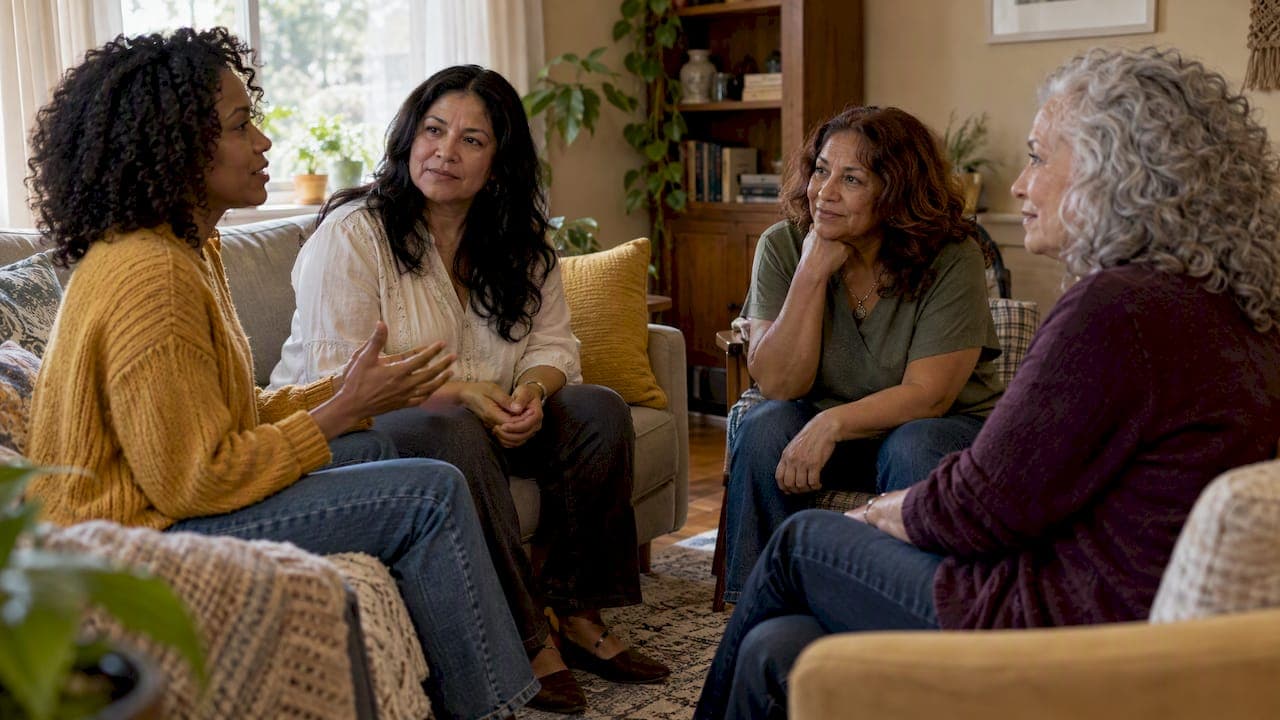
A women's circle is a regular gathering where women sit together, listen without judgment and share what is true for them. The benefits women report most often are connection, relief from isolation, stronger confidence and a calmer response to stress. Some of these have early research behind them. Others rest on personal experience. Below, we separate the two, so you can decide what a circle might offer you.
Beauty Is Not Perfection. Beauty Is a Verb. Beauty Is Becoming. A circle is one of the oldest ways women have practiced that.
TL;DR
- A women's circle is a recurring, non-hierarchical gathering for sharing, listening, reflection and sometimes ritual or meditation.
- Women commonly describe belonging, feeling heard, confidence, and a space to rest and reflect.
- U.S. studies of structured peer circles report high satisfaction and perceived benefit. The authors call this encouraging, not definitive.
- Circles are not therapy. If you are struggling with depression, trauma or anxiety, a licensed professional is the right first call.
- You can join one, or start your own with six to ten women and a simple structure.
Table of Contents
- What a women's circle is
- The benefits women report
- What the research actually supports
- What happens at a women's circle
- Women's circle topics and ideas
- What the circle symbolizes
- Our perspective on circles
- How to find or start a circle
- When a circle is not enough
- Bring the circle spirit into your day
- Find your community with us
- FAQ
- Sources
What a women's circle is
A women's circle is a recurrent, often monthly, gathering outside any formal institution. Women meet to relax, meditate, share stories and sometimes take part in rituals. An academic study of circles in Europe, published in the journal Religions, describes participants seeking reconnection with one another, their bodies, their inner selves and, for some, the sacred.
The shape matters as much as the people. Chairs or cushions are set in a ring. Nobody sits at the head. Everyone is seen, and everyone gets a turn to speak or to pass.
Circles take many forms:
- Wellness circles focused on rest, stress relief and self-care.
- Support circles built around a shared experience, such as veteran service, pregnancy or midlife.
- Spiritual circles, including moon circles that link lunar rhythms with the cycles of the body.
- Community and creative circles organized around crafts, writing, movement or friendship.
What they share is a belief that women grow faster when they are not doing it alone.
The benefits women report
The list below combines what researchers describe with what women say about circles. Each is a possibility, not a promise. Circles differ, and so do women.
Belonging and connection
This is the benefit that comes up again and again. Many women move through their days with plenty of contact and very little closeness. A circle offers a place where nobody is performing.
The need is real. In May 2023 the U.S. Surgeon General issued an advisory on loneliness and isolation, noting that they are independent risk factors for several major health conditions, including cardiovascular disease, dementia and depression. A circle is not a medical treatment. It is one way to build the kind of connection that advisory calls for.
Being heard without being fixed
In most circles, one woman speaks and the others simply listen. No advice unless it is asked for. No interrupting. Some groups pass a talking stick, so the speaker holds the floor and the silence belongs to her too.
For women who spend their lives caring for everyone else, being listened to is rare. It is also quietly powerful.
Confidence and self-esteem
When you say something true out loud and the room receives it, something shifts. You learn that your story is not too much and not too little. In a peer-reviewed evaluation of a sister-circle program for pregnant Black women, participants reported greater confidence, self-empowerment and personal growth, along with better stress-management skills and improved mood.
If building confidence is your goal, our guide to confidence building habits for women pairs well with a circle practice.
Rest and reflection
Many women say a circle is the only hour of their month with no task attached. You are not producing, hosting or fixing. You are resting and thinking, which is part of why circles feel restorative even when the conversation is serious.
Perspective and shared wisdom
Hearing five other women describe their own version of your struggle changes how you carry it. You see that shame, doubt and overwhelm are common, not personal failings. You also hear what has helped others, from women who actually lived it.
Gentle accountability
Stating an intention in front of a group makes it real without making it a burden. Next month, someone asks how it went. That kind of accountability feels like support rather than pressure.
What the research actually supports
We care about honesty here. The research on women's circles is promising, and it is also young. Most studies are small, many are pilots, and the groups studied are specific. Here is what we can responsibly say.
Women veterans in structured peer groups
The Women Veterans Network, known as WoVeN, is a U.S. peer-support program. Its designers built it around relationship-building because focus groups showed isolation and loneliness were central needs among women veterans. The program runs eight 90-minute sessions covering introductions, transitions, balance, stress relief, connections, trust, esteem and reflection or celebration.
Among women who attended at least five meetings, 88.89% said they enjoyed the content quite a bit or extremely, and 78.63% said they gained quite a bit or extreme value. Overall, 73.16% reported a positive impact on two or more major life domains. The authors describe these as global reports and indirect evidence, and say further evaluation with standardized measures is needed.

Sister circles for Black women
Sister circles draw on friendship, fictive kinship and community networks. A peer-reviewed review of sister circles as a culturally relevant intervention explains that they provide help, support, knowledge and encouragement.
The National Heart, Lung, and Blood Institute reported in 2020 on Prime Time Sister Circles, 12-week health and wellness groups for Black women ages 40 to 75. Reported changes included stress management, blood pressure, weight and exercise.
Culturally grounded circles for immigrant women
Researchers designed Tertulias, conversational gatherings for female Mexican immigrants, to address isolation. A randomized trial protocol describes how the study measures depression, stress, resilience, social support, connectedness, knowledge and empowerment. It describes the plan for testing, not final results.
Indigenous communities in Guatemala
A pilot randomized study found that women in culturally safe women's circles reported higher wellbeing and self-care self-efficacy than women in a control group. The authors called the approach feasible, acceptable and potentially efficacious, not proven. They credit co-design, culturally safe facilitation, active listening, problem-solving, relaxation, art and social-cohesion activities.
What this adds up to
| Evidence | What it suggests | What it does not show |
|---|---|---|
| WoVeN (U.S. women veterans) | High satisfaction and perceived value | Measured clinical change |
| Sister circles (U.S. Black women) | Support, knowledge, stress and health-related changes reported | That every circle works the same way |
| Tertulias (Mexican immigrant women) | A thoughtful design to reduce isolation | Results, since the cited paper is a protocol |
| Guatemala pilot | Higher wellbeing and self-care self-efficacy | Definitive proof |
The fair summary: women who join well-designed circles often find them valuable, and early studies are encouraging. The design seems to matter. Safe facilitation, shared culture or experience, and a clear structure appear in the programs that report the most.
What happens at a women's circle
No two circles are identical, but most follow a familiar rhythm. Researchers describe many beginning with a welcome, introductions, and each woman stating an intention or sharing an experience.
A typical evening might look like this:
- Arrival and settling. Tea, snacks, a few quiet minutes.
- Opening. The host welcomes everyone and names the agreements, such as confidentiality and no interrupting.
- Check-in. Each woman says her name and how she is arriving.
- Theme or sharing. A topic is offered and women speak in turn, or pass.
- Practice. A guided meditation, journaling, movement or a creative activity.
- Closing. A word or a gratitude, then goodbye.
Some circles add singing, chanting, drumming, dancing, crafts, or touch such as massage. Others are quiet and simple. Both are valid.
If the meditation part is new to you, our guide to the types of mindfulness practices for women will help you find a style that suits you. Guided meditation and gentle self-care routines also connect to sustainable self-care ideas that support emotional wellbeing, which is worth reading if you want to carry the calm of a circle into daily life.
Women's circle topics and ideas
A good theme gives the conversation a doorway without forcing anyone through. Researchers have documented topics that include birth, menstruation, sexuality, relationships with mothers and sisters, visibility, vulnerability, shame, gratitude, letting go, the power of the heart, seasonal themes and self-actualization. A common thread is making time and space for yourself within relationships and family life.
Ideas you can borrow:
- Gratitude and letting go. What am I ready to release this season?
- Visibility. Where do I shrink, and where do I want to be seen?
- Mothers and daughters. What did I inherit, and what do I choose to keep?
- Rest. What would a truly restful week look like for me?
- Self-compassion. How do I speak to myself on a hard day?
- Seasons of life. What is this stage teaching me?
- Confidence. When did I last feel fully myself?
For the self-compassion theme, our self-compassion exercises for busy women include scripts you can use as prompts. For stress-focused evenings, our stress management guide for women offers a starting point.
What the circle symbolizes
The circle has no head and no foot. Everyone faces everyone. In spiritually oriented circles, that shape stands for equality, wholeness and return. Researchers note that these circles may treat the circle as nonhierarchical and as a way of reconnecting with one another, with the body, with the inner self and sometimes with the sacred.
Moon circles go further and connect lunar symbolism with the cycles of the female body. You do not need to share those beliefs to benefit from a circle. Many women join secular circles and simply value the shape: a place where nobody is above anyone else.
Our perspective on circles
We built The Ultimate Beauty - You! on a simple conviction: beauty is more than what you see in the mirror. It is inside-out, head-to-toe, 360-degree. It includes how you rest, how you speak to yourself and who surrounds you.
Circles fit that belief. They treat self-care as something shared, not something you squeeze in alone at midnight. They do not ask a woman to become someone else. They ask her to show up as she is, and let the others do the same.
We also believe in honesty. A circle can be a lifeline, but it is not a substitute for care from a licensed therapist or physician when you need one. The best circles know that, and say it out loud.

We think the future of women's wellness is less fragmented. Advice from many places, brought together in one trusted community, so you are not piecing it together alone. That is what we are building, one conversation at a time.
Beauty Is Becoming. And becoming is easier together.
— Ava
How to find or start a circle
Finding one
Start close to home. Look at local wellness studios, community centers, libraries, places of worship, women's organizations and veteran or cultural associations. Ask what the format is, who facilitates it, and whether it has a clear confidentiality agreement.
A few signs of a healthy circle:
- A clear start and end time.
- Agreements about confidentiality and respect.
- A facilitator who keeps the space balanced, so no one dominates.
- No pressure to share, spend money on extras or adopt beliefs.
- Honest language about what a circle is and is not.
Starting your own
You do not need credentials to gather friends, but you do need care. Keep it small, six to ten women, so everyone has time to speak. Pick a regular rhythm, such as monthly, and a consistent place. Write down your agreements and read them aloud at the start.
Keep the first evening simple: a check-in, one prompt, one short practice, a closing. Let the form grow with the group.
If you are thinking bigger about building a women's community, our women community platform guide walks through the principles.
Making it last
Circles fade when no one is responsible for them. Share the hosting. Rotate who picks the theme. Send a short reminder a few days ahead. A little structure protects the warmth.
When a circle is not enough
Circles are peer spaces. They can ease loneliness and help you feel steadier, but they are not treatment. If you notice persistent low mood, panic, trauma reactions or thoughts of harming yourself, reach out to a licensed mental health professional or your doctor. In the U.S., you can call or text 988 to reach the Suicide and Crisis Lifeline at any time.
A circle can sit beside professional care beautifully. Many women find it helps them keep going between appointments.
Bring the circle spirit into your day
You do not need a monthly gathering to practice what circles teach. Three small habits borrow their best parts:
- Check in honestly. Ask yourself how you are arriving, before you ask how you are performing.
- Listen fully. In your next conversation, let the other person finish, then pause.
- Say one true thing. Share something real with a friend this week.
If you want to build these into a routine, our mental health habits for resilience and what mindful beauty means are good next reads.
Find your community with us
The Ultimate Beauty - You! is a women-centered platform bringing together trusted experts, brands, resources and community, built for women at every age and stage. If you are looking for expert advice, recommendations and a place to belong, start at our homepage. If you are an expert or organization who wants to reach women, see our Experts & Partners page. You can also keep exploring on our blog.
FAQ
What is the purpose of a women's circle?
The purpose is to give women a regular, safe space to share, listen and reflect. Depending on the circle, that may mean healing, support, empowerment, sisterhood or personal growth. Some add meditation or ritual, while others keep it simple.
What do you do at a women's circle?
Most begin with a welcome and introductions, then women state intentions or share a story or theme, often taking turns. Many include a meditation or creative practice, and some use a talking stick. Tea, snacks, singing or crafts are common extras.
Do I need to share to take part?
No. Most circles let you pass or simply listen, and silence is welcome. Many women find that listening in the first few sessions helps them feel ready to speak later.
Is a women's circle the same as therapy?
No. A circle is peer support, while therapy is delivered by a licensed professional who can diagnose and treat. The two can complement each other. If you are dealing with depression, trauma or intense anxiety, see a licensed professional.
Sources
- Women's Circles and the Rise of the New Feminine (Religions, MDPI)
- Surgeon General Advisory on Epidemic of Loneliness and Isolation (AHRQ)
- WoVeN, the Women Veterans Network (PMC)
- Sister Circles as a Culturally Relevant Intervention (PMC)
- Circles of Healing: Prime Time Sister Circles (NHLBI)
- Tertulias randomized control trial protocol (PMC)
- Sister-circle intervention for pregnant Black women (PMC)
- Women's circles as a culturally safe psychosocial intervention (PMC)