
A brand ambassador program is a long-term partnership where a company gives real customers products, pay, or perks in exchange for authentic content and word-of-mouth reach. This guide is for two audiences at once: individuals and students who want in, and marketers who need to build or fix a program. Below, you will find verified examples, application steps, pay structures, and the metrics that separate a thriving program from a stalled one.
TL;DR:
- Most successful ambassador programs rely on authentic long-term relationships with existing product users rather than follower count or paid campaigns.
- Combining genuine engagement with niche-specific content, cadre-based selection, and geographic or category filters enhances program quality and authenticity.
- Clear application windows, structured tiers, and transparent reward systems—like commissions or perks—improve both applicant motivation and program management.
- Metrics such as referral conversions, engagement relative to audience size, and content reuse accurately measure program impact beyond vanity follower counts.
- Legal disclosures, inclusive practices, and well-defined content expectations are essential to maintain trust, avoid disputes, and ensure program longevity.
Table of Contents
- What Is a Brand Ambassador Program, Really?
- Verified Ambassador Program Examples and What Each One Teaches You
- How to Become a Brand Ambassador: A Step-by-Step Guide
- How Ambassador Compensation and Rewards Usually Work
- How Brands Build, Manage, and Scale an Ambassador Program
- Who Actually Qualifies to Apply?
- Where Ambassador Programs Go Wrong
- Legal and Ethical Rules Every Program Needs
- Metrics and KPIs That Actually Prove a Program Works
- Publisher Perspective: How We Think About Ambassador Fit
- Find Your Next Ambassador Opportunity or Partner
- Sources
- FAQ
What Is a Brand Ambassador Program, Really?
A brand ambassador program is an ongoing relationship, often lasting several months or more, where a brand equips a real customer or fan to represent it consistently across content, events, and word-of-mouth. That distinction, ongoing versus transactional, is the entire point.
Brand ambassador vs. influencer comes down to origin and duration. An influencer is hired for reach; a brand deal starts because someone already has an audience. An ambassador is often recruited because they already love the product. Influencity's comparison of the two models notes that brands increasingly favor genuine long-term users over creators with the biggest follower counts, because authenticity outperforms raw reach in trust and conversion.
Here is how the four adjacent models actually differ:
- Ambassador: long-term, brand-initiated, built on existing product love, compensated through gifting, commission, or pay.
- Influencer: typically shorter campaigns, creator-initiated reach, paid per post or package.
- Affiliate: transactional and often anonymous to the brand, paid purely on tracked sales, no ongoing relationship required.
- Employee advocate: an internal hire, not a customer, posting about the brand as part of their job.
Ambassador missions vary by brand but usually include content creation (unboxings, tutorials, before/after posts), attending or hosting local events, referring friends with a personal code, and giving product feedback before public launch. Selection criteria matter more than most applicants expect. Brands scan for authenticity signals first: Does this person already use the product? Is their engagement rate solid relative to their following, not just their follower count? Do their captions sound like a real person, or a script? A micro-influencer with tight engagement often beats a mid-tier account with passive followers, and beauty brands in particular have caught on to that math.
Verified Ambassador Program Examples and What Each One Teaches You
These programs are active or recently documented, and each one carries a specific lesson worth stealing, whether you're applying or building.
1. Sephora Squad. This is a 12-month paid partnership open to applicants who are 18 or older and reside in the US, with an annual application window rather than rolling admission. Sephora Squad's structure shows the beauty-specific model at its most refined: a defined cohort, a fixed term, and paid compensation rather than pure gifting. Lesson for applicants: mark the annual window on your calendar and apply the day it opens, since seats fill fast. Lesson for brands: a capped cohort with a real end date creates urgency and makes each spot feel earned.
2. Gymshark Athletes. Gymshark built one of the most recognized ambassador tiers in fitness by combining product gifting with genuine athlete storytelling rather than transactional posts. Lesson for applicants: a niche-specific portfolio (training footage, transformation content) matters more than general lifestyle posts. Lesson for brands: tiering ambassadors by commitment level, not just follower size, keeps the program from feeling like a discount club.
3. Red Bull Student Marketeer. These are paid, part-time campus roles posted directly on Red Bull's careers portal, and they are campus-specific rather than open to anyone with a social account. Lesson for applicants: this is closer to a real job than a content deal, so a resume and interview performance matter as much as your feed. Lesson for brands: treating ambassadors as paid staff, not gifted fans, buys sharper accountability.
4. Dutch Bros Besties. This program lists concrete perks, including app funds, exclusive merchandise, and reward challenges, and sets eligibility at 18 and older with a proximity requirement to a physical store for campus and local variants. Lesson for applicants: local, in-person programs often have less competition than national ones, since only nearby fans qualify. Lesson for brands: geographic eligibility filters keep community programs authentic rather than diluted by distant applicants who never visit a location.
5. S'well Ambassador Program. The application flow here is straightforward: apply, receive product, get a custom tracked link, and earn commission on every sale that link generates. Lesson for applicants: this is a good entry point if you have modest reach but strong conversion, since payout is tied to sales, not vanity metrics. Lesson for brands: a simple affiliate-style link removes ambiguity about what counts as a win.
6. Club Target. Target's 2026 pilot uses gamified creator challenges with points and rewards, including gift cards and commission opportunities, and the retailer announced the program in May 2026. Lesson for applicants: gamified tiers often reward consistency over one viral post, so steady participation beats sporadic bursts. Lesson for brands: game mechanics (points, badges, leaderboards) keep a large, dispersed ambassador base engaged without one-on-one management.
7. Xbox Ambassadors. Microsoft's community-based ambassador structure rewards forum help, event participation, and community moderation rather than pure follower reach. Lesson for applicants: not every ambassador role is content-first; some reward service and community presence instead. Lesson for brands: a program built around community contribution, not just posts, can extend loyalty beyond people with large followings.
If you're aiming specifically at beauty ambassador programs, Sephora Squad remains the clearest benchmark for what a structured, paid, cohort-based beauty program looks like, and it's worth studying even if you apply elsewhere first.
How to Become a Brand Ambassador: A Step-by-Step Guide
Getting selected is rarely about luck. It's about showing up prepared when a window opens, and knowing how to pitch when it doesn't.
- Build a portfolio before you need one. Collect three to five pieces of content that show you using the product category naturally: a tutorial, an unboxing, a before/after, or a short review video. Brands want proof you can create, not a promise that you will.
- Track brand pages, not just job boards. Programs like Sephora Squad and Dutch Bros Besties run on their own websites, so bookmark the brand's ambassador page and check it monthly. Following beauty brand social growth tactics will also help you understand what content format each brand tends to reward.
- Know the four access types. Programs run on open application forms, direct email pitches, brand scouting with no application at all, or a periodic cohort window. If a brand has no visible application, that usually means it scouts, so your job is to make yourself easy to find and easy to say yes to.
- Apply the day windows open. Cohort-based programs like Sephora Squad fill quickly once the annual window opens, so have your materials ready in advance rather than scrambling.
- When there's no open door, pitch by email. A short pitch should include who you are, three metrics that show real engagement (comment rate, saves, or link clicks matter more than follower count), two content samples, and a one-line idea for what you'd create for them.
- Follow up once, not five times. A single polite follow-up after two to three weeks is appropriate; more than that reads as pressure, not persistence.
Pro Tip: *Lead your pitch with your conversion numbers, not your follower count.
How Ambassador Compensation and Rewards Usually Work
Pay expectations vary widely, and most of the confusion in this space comes from applicants assuming every program pays the same way.
Brands generally use four compensation structures, and which one you land depends heavily on the brand's size and category:
- Product gifting only: common with smaller or newer brands, and often the entry point before paid tiers open up.
- Commission or affiliate-style pay: tied to a tracked link or code, common at brands like S'well, where payout depends on sales generated, not audience size.
- Flat fee or retainer: a set payment per campaign or month, more common in established beauty cohorts and mid-size brands with defined budgets.
- Paid employment: roles like Red Bull's Student Marketeer positions function as actual part-time jobs with wages, not gifted perks.
According to SocialRails' review of active programs, affiliate-style compensation is explicitly tied to conversion rather than follower count, which is good news if your audience is small but engaged. Before accepting any offer, ask three questions: how and when payouts are processed, whether you're responsible for reporting the income for taxes, and how the brand tracks your contribution (a unique link, a discount code, or manual reporting). Vague answers to any of those three questions are a signal to negotiate harder or walk away.
How Brands Build, Manage, and Scale an Ambassador Program
Marketers building a program from scratch face a different set of decisions than applicants do, starting with recruitment.
Recruitment usually happens through one of three channels: an open application form on your own site, direct scouting of existing customers and taggers, or a referral system where current ambassadors nominate new ones. Eligibility checks should confirm authentic product use, not just follower count, since genuine long-term customers convert better than rented reach.
Program architecture needs a few fixed pieces before launch:
- Missions: defined content types, event appearances, or referral goals ambassadors are expected to deliver.
- Tiers: entry, established, and top-performer levels, each unlocking better rewards as commitment grows.
- Reward structure: pick from gifting, commission, flat fee, or a hybrid, and be transparent about it upfront.
- KPIs: engagement rate, referral conversions, and content volume, tracked consistently across the cohort.
At scale, ad hoc spreadsheets stop working. Dedicated ambassador management platforms handle recruitment, mission assignment, content tracking, and payment automation, which is the real operational line between a boutique program and one that can run with hundreds of participants. Churn is the biggest scaling risk: ambassadors drift away when missions feel repetitive or rewards stagnate. Rotating challenges, recognizing top performers publicly, and revisiting reward tiers every few months keeps a program from going stale. Brands looking to formalize this can also draw on UGC strategy frameworks to turn ambassador content into paid and organic assets simultaneously.
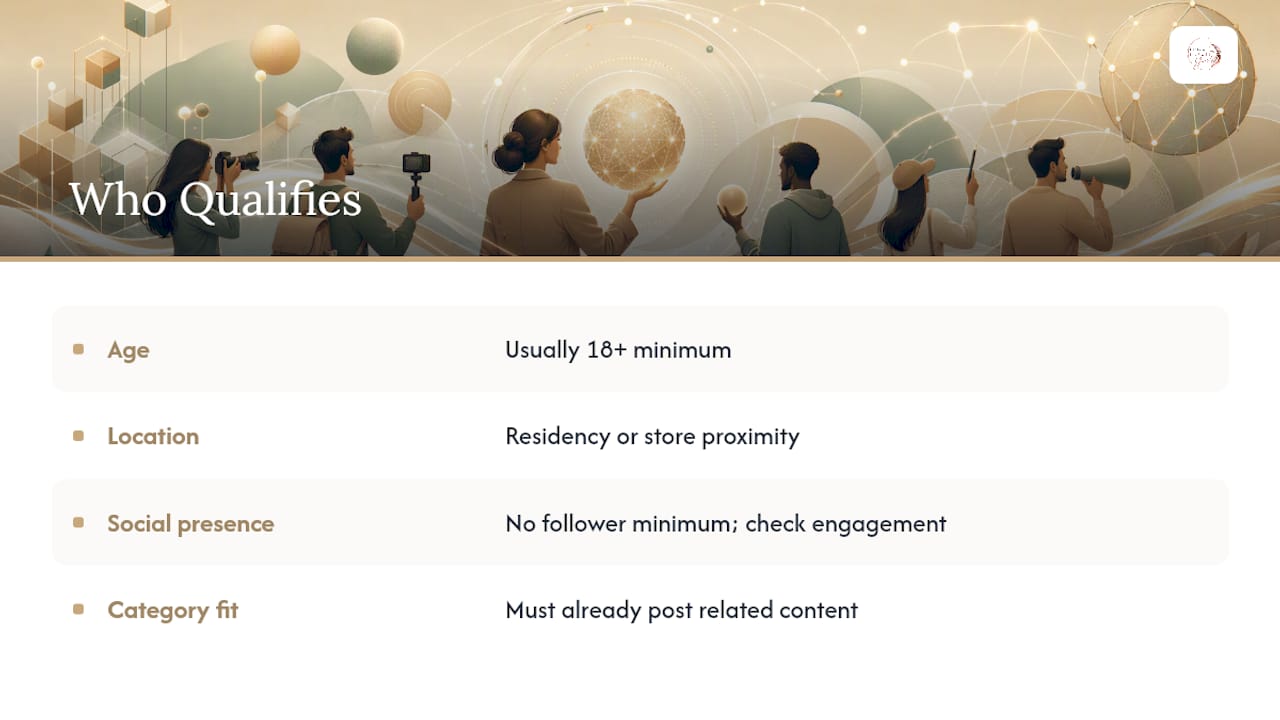
Who Actually Qualifies to Apply?
Eligibility rules are more specific than most first-time applicants expect, and they vary by program type.
Age is the most consistent gate: most programs, including Sephora Squad and Dutch Bros Besties, set a minimum of 18. Location matters just as much, sometimes more. National programs like Sephora Squad restrict eligibility to US residents, while local or campus programs like Dutch Bros Besties require proximity to a physical store location, since the whole point is grassroots, in-person presence.
Social presence requirements are looser than people assume. Very few programs post a hard follower minimum. What they actually screen for is engagement quality: comment authenticity, save and share rates, and whether your audience looks real rather than purchased. A modest account with consistent posting and genuine interaction frequently beats a larger one with flat numbers.
Category fit also functions as an unofficial eligibility filter. A skincare brand wants applicants who already talk about skincare; a fitness brand wants people who train. If your existing content has nothing to do with the product category, most brands will pass regardless of your numbers. Before applying anywhere, audit your last ten posts and ask honestly whether a stranger could guess what you're passionate about. If the answer is no, that's the fix to make first.
Where Ambassador Programs Go Wrong
The most common failure on the applicant side is chasing every open program instead of a handful that fit. Spreading yourself across ten mismatched brands dilutes your content and makes you forgettable to all of them. Pick three to five brands that genuinely match your existing habits and go deep instead of wide.
On the brand side, the most frequent mistake is treating ambassadors like unpaid marketing labor with no clear missions. Vague expectations ("just post about us sometimes") produce vague content and quiet attrition. A second common pitfall is rewarding follower count over performance, which fills a program with people who never convert and quietly resent the low payout once they realize it.
Communication breakdowns cause a lot of quiet churn on both sides. Ambassadors who don't hear back for weeks assume they've been dropped and stop posting; brands that don't track content assume ambassadors have gone silent when messages simply got buried. Setting a monthly check-in, even a short one, solves most of this before it becomes a real problem. Finally, programs that never rotate rewards or recognize top performers tend to lose their best people first, since the strongest ambassadors are also the ones with the most other options.
Legal and Ethical Rules Every Program Needs
Disclosure is not optional, and it applies to gifted product just as much as paid posts. Ambassadors need to clearly mark sponsored or gifted content, typically with a plain-language disclosure like "gifted" or "ambassador" in the caption, not buried in a hashtag string at the end.
A written agreement protects both sides even for informal gifting arrangements. At minimum, it should spell out what content is expected, how often, what compensation looks like, who owns the content afterward, and how either party can exit the relationship. Brands that skip this step often end up in disputes over content usage rights months later, when an ambassador's gifted post gets reused in a paid ad campaign without their knowledge.
Ethical selection matters just as much as legal compliance. Programs built exclusively around one body type, skin tone, or aesthetic tend to alienate the exact audience beauty brands claim to serve. Inclusive recruitment practices widen the pool of authentic voices and tend to produce content that resonates with a broader customer base, not a narrow slice of it. Ambassadors, for their part, should be honest in reviews even when product is gifted for free. Trust erodes fast the first time an audience senses a review was scripted rather than felt.
Metrics and KPIs That Actually Prove a Program Works
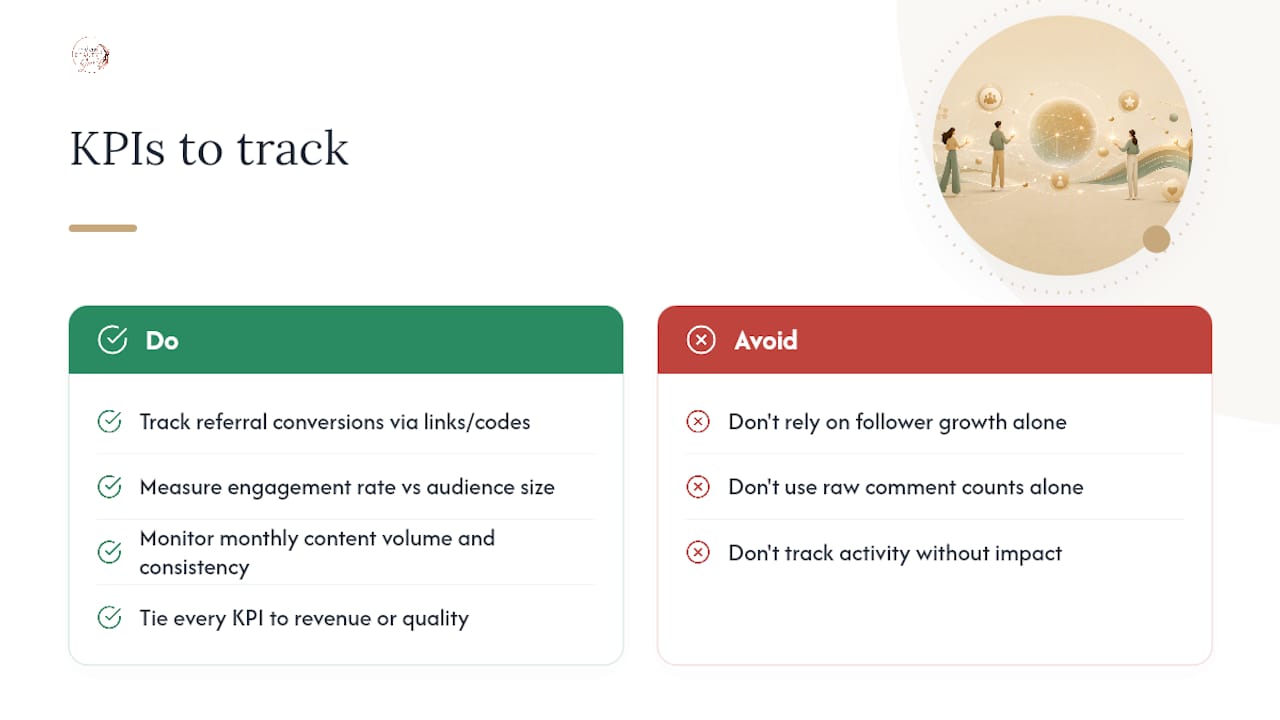
Vanity metrics are the easiest to track and the least useful. Follower growth on an ambassador's personal account tells you almost nothing about whether the partnership is generating sales or trust.
The metrics worth tracking fall into a few clear buckets. Referral conversions, tracked through unique links or discount codes, show direct revenue attribution, the same mechanism S'well uses to pay its ambassadors. Engagement rate relative to audience size, not raw comment count, shows whether content resonates or just gets scrolled past. Content volume and consistency over a defined period (monthly posts, story mentions, event check-ins) shows whether an ambassador is actually active or has gone dormant. Cost per acquisition, calculated by dividing total program spend by new customers generated through ambassador links, tells you whether the program is cheaper than paid ads, which it usually is once it matures.
Sentiment and UGC reuse rate matter too, though they're harder to quantify. How often does ambassador-generated content get repurposed into the brand's own paid or organic channels? A high reuse rate signals the content is strong enough to work outside its original context, which is the clearest sign a program has moved past gifting and into genuine creative value. Programs that track only follower growth and post frequency are measuring activity, not impact. The fix is simple: tie every KPI back to either revenue or content quality, and drop anything that doesn't.
Publisher Perspective: How We Think About Ambassador Fit
Most articles on this topic treat ambassador programs as a numbers game: hit a follower threshold, submit an application, wait. That framing misses what actually predicts success, on either side of the relationship.
Authenticity is not a soft metric. It is the entire mechanism. A program filled with people who already loved the product before they were recruited produces content that reads as real, because it is. A program filled with people chasing free product produces content that reads as an ad, because that's what it is to them. Brands that screen for genuine use over reach consistently outperform the ones chasing scale first.
For beauty specifically, this matters more than most categories, because audiences can spot a scripted skincare review from a mile away. The strongest ambassador relationships we've seen come from creators and brands who treated the partnership as a real collaboration rather than a transaction. That means clear missions, honest feedback loops, and rewards that grow with commitment rather than staying flat forever. If you're building a program, start there before you touch a spreadsheet of follower counts.
— Ava
Find Your Next Ambassador Opportunity or Partner
Landing the right ambassador program takes more than a good pitch. It takes knowing which brands are actively looking, and getting in front of the right people before a window closes. A platform exists to close that gap by connecting beauty creators with brands and experts building real partnerships, rather than leaving you to cold-email a generic inbox and hope.
Creators can browse active expert and brand partnership listings to see who's currently recruiting, while brands looking to launch or scale a program can explore Theultimatebeauty-you's offerings to reach a community of women actively engaged in beauty, wellness, and personal growth. If you're ready to stop guessing which brands might say yes, start by browsing what's live right now.
Sources
- Best Brand Ambassador Programs in 2026: 9 Verified Programs and How to Join
- Dutch Bros Besties
- S'well Ambassador Program
FAQ
How Do You Become a Brand Ambassador?
Build a small content portfolio showing real product use, track brand ambassador pages for open windows, and apply immediately when a cohort opens, or send a short pitch with engagement metrics if the brand only scouts.
What Are Brand Ambassador Programs?
They are long-term partnerships, typically six months or longer, where a brand supplies product, pay, or perks to real customers in exchange for consistent content, referrals, or community presence, rather than a single sponsored post.
Do Brand Ambassadors Get Paid?
It depends on the program: some, like Sephora Squad, offer paid 12-month partnerships, others like S'well pay commission on tracked sales, and many smaller programs offer product gifting only, so it's worth asking about compensation before joining.
Do Ambassadors for Major Retail Brands Get Paid?
Retail ambassador structures vary widely: some, like Target's 2026 Club Target pilot, offer points-based rewards including gift cards and commission opportunities rather than flat pay, so applicants should check each brand's specific terms directly rather than assuming a standard rate.