
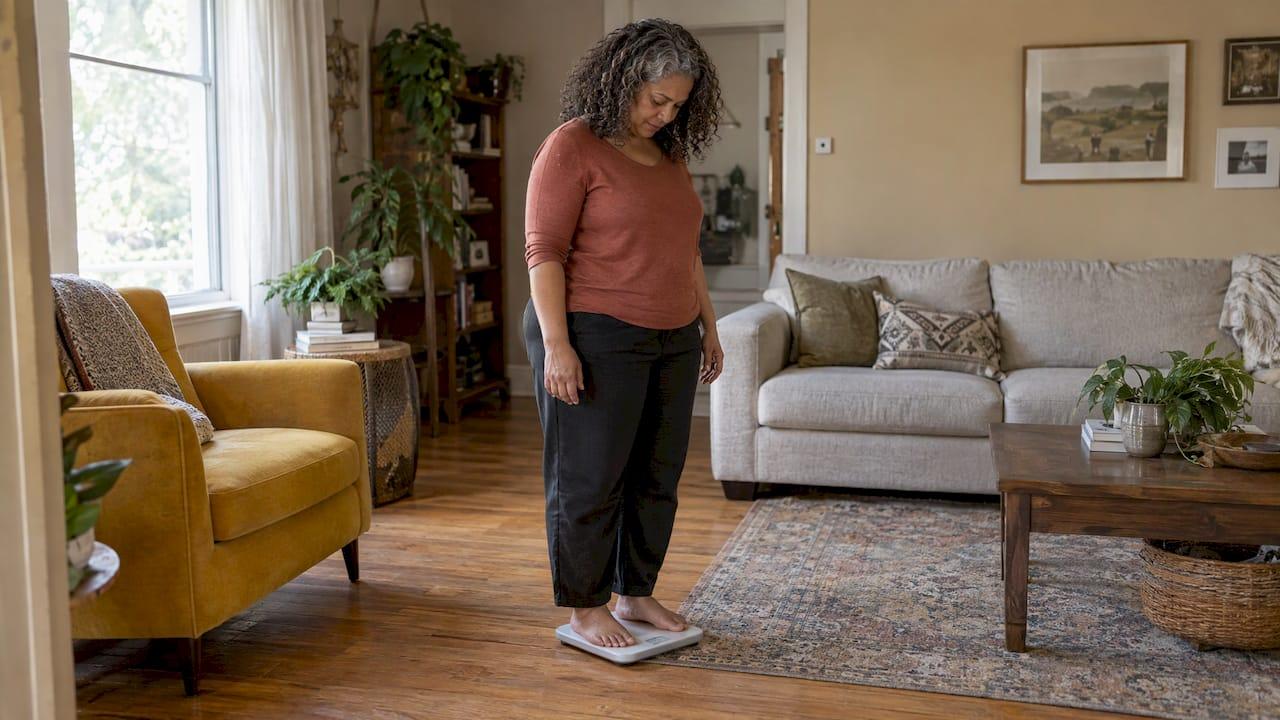
If the scale is creeping up and your waistline is changing while you eat and move the way you always have, you are not imagining it, and you are not failing. Perimenopause shifts your hormones, your muscle, your sleep and where your body stores fat, all at once. The good news: the biggest levers are ones you can pull. Strength training, enough protein, steady movement, better sleep and a modest calorie adjustment, started one at a time, are what the medical research points to.
Beauty is not perfection. Beauty is a verb. Beauty is becoming. This season of life is part of that becoming, and your body deserves a plan built for it.
TL;DR
- Weight gain often starts a few years before your final period. Mayo Clinic puts the typical pace at about 1.5 pounds a year through the 50s.
- Falling estrogen nudges fat toward your abdomen, while aging muscle loss slows your metabolism.
- Strength training twice a week or more, 150 minutes of moderate cardio, enough protein and seven to nine hours of sleep are the core habits.
- Change one habit at a time. Small, steady shifts hold up better than an overhaul.
- If lifestyle changes fall short, talk with your doctor about all your options, including medical ones.
Table of Contents
- What is actually happening in your body
- Why the belly changes first
- What helps: the habits that move the needle
- A sample week that fits a busy life
- What about hormone therapy and weight-loss medicines?
- You are more than a number
- Find your people and your plan
- Our perspective
- FAQ
- Sources
What is actually happening in your body
Perimenopause is the transition before menopause, when your ovaries make less steady amounts of estrogen and progesterone. Menopause itself is defined as 12 months without a period. The years leading up to it are when many women first notice the change on the scale.
Mayo Clinic says it is common for weight gain to start a few years before menopause and to continue at about 1.5 pounds a year through the 50s. A 2022 review found women gain 2 to 3 kilograms (roughly 4.5 to 6.5 pounds) on average over the transition, with big differences from woman to woman. Some gain very little. Some gain a lot more.
Hormones are one piece, not the whole story. Mayo Clinic staff stress that hormone changes alone do not necessarily cause weight gain. It is usually a mix of aging, diet, activity, genetics and sleep, with muscle loss as a key driver.
Muscle loss slows your metabolism
Muscle burns more energy than fat, even at rest. A 2024 review notes that after age 30 you lose muscle at 3 to 8 percent per decade, and that resting metabolic rate declines with age. In plain terms, the same meals and the same routine add up to a small surplus over time.
Mayo Clinic notes you may need about 200 fewer calories a day in your 50s than in your 30s and 40s just to maintain your weight. That is roughly a small snack, which is why the creep feels so sneaky.
Activity tends to drift down
The same 2024 review reports that in the large SWAN study, a quarter of midlife women became less physically active over 15 years, and that group gained the most weight. Busy seasons, sore joints and exhaustion all play a part. This is the habit we can most easily win back.
Hot flashes, night sweats and sleep
In SWAN, frequent hot flashes and night sweats were linked to later weight gain, a higher BMI and a larger waist. The review reports that sleep problems accounted for almost 30 percent of that effect. Mayo Clinic adds that too little sleep tends to mean more snacking and more calories. If your nights are broken, your weight plan starts with your nights. Our 4-week perimenopause symptom relief plan is a good companion here.
Why the belly changes first
Many women say the number matters less than where the weight lands. Johns Hopkins Medicine explains that before menopause, estrogen encourages fat storage in the hips and thighs. As estrogen falls, the body tends to store more fat around the abdomen, including deep around the organs. Abdominal fat cells also become more active, and insulin sensitivity can decrease, which makes belly fat easier to gain.
A 2019 meta-analysis comparing women before and after menopause found:
| Measure | Change after menopause |
|---|---|
| Body weight | about +1 kg |
| Body fat percentage | +2.88% |
| Waist circumference | +4.63 cm |
| Visceral (deep abdominal) fat | +26.90 cm² |
| Leg fat percentage | -3.19% |
The total weight change was modest. The shape change was not. That is why your jeans can fit differently even when the scale barely moves, and why tracking your waist can tell you more than weight alone.
Why belly fat deserves attention
This is about health as much as appearance. A 2026 review states that central fat accumulation raises the risk of cardiovascular disease, type 2 diabetes and obstructive sleep apnea, and can worsen hot flashes. Mayo Clinic also lists breathing problems, heart and blood vessel disease, type 2 diabetes and higher risks of breast, colon and endometrial cancers. Ohio State Health and Discovery notes that fat around the organs can raise blood pressure and cholesterol.
This is not meant to frighten you. It is the reason that moving your waist in the right direction is worth the effort, and why a checkup with your doctor during perimenopause is a smart investment. Ask about blood pressure, cholesterol and blood sugar.
What helps: the habits that move the needle
Ohio State's Dr. Randee Masciola advises changing one thing at a time instead of overhauling everything, and prioritizing sleep, diet quality and moderate exercise as the foundation. We agree. Pick the first habit below, make it routine, then add the next.
One honest note from the research: a 2024 review says there is limited data on specific interventions in midlife women, and that exercise has a modest effect on the scale but a real effect on body composition. It reduces visceral fat and protects lean mass. So judge your progress by strength, energy, waist and how your clothes fit, not only by pounds.
1. Lift something heavy, twice a week or more
Strength training is the direct answer to muscle loss. Mayo Clinic recommends strength training at least twice a week. The 2026 review finds combined aerobic and resistance training gives the best body-composition results.
You do not need a gym membership. Squats, hip hinges, rows, presses and carries with dumbbells, bands or your own body weight cover the major muscle groups. Aim for a weight that feels challenging by the last few reps, and raise it gradually. Our 3-day strength plan for women lays out a simple weekly structure.

Muscle and bone work as a team. Resistance and impact loading also support your skeleton as estrogen drops, which is worth reading about in this guide to bone loss during menopause and in our own bone health guide.
2. Make protein a priority
Protein helps you hold on to muscle while you lose fat. The 2026 review recommends at least 1.2 grams per kilogram of fat-free mass, or about 80 to 120 grams a day, to preserve lean mass. A professional summary from the A4M Women's Health Summit suggests 1.0 to 1.6 grams per kilogram of body weight daily.
What does that look like? Spread it across the day:
- Breakfast: Greek yogurt or eggs with fruit.
- Lunch: a salad or bowl with chicken, beans, tofu or salmon.
- Snack: cottage cheese, edamame or a handful of nuts.
- Dinner: fish, lean meat or lentils with vegetables and a whole grain.
If you have kidney disease or another medical condition, ask your doctor before raising your protein.
3. Keep moving, every week
Mayo Clinic recommends at least 150 to 300 minutes a week of moderate aerobic activity, or 75 to 150 minutes of vigorous activity. The 2026 review suggests at least 150 minutes weekly while losing weight and up to 250 minutes to maintain the loss. Brisk walking, cycling, swimming and dancing all count.

If 150 minutes sounds like a mountain, it is five 30-minute walks. Or ten-minute walks after meals, three times a day, on most days.
4. Protect your sleep
Ohio State advises seven to nine hours a night. Try a cool bedroom, a consistent bedtime, light layers for night sweats and less alcohol in the evening. If hot flashes keep waking you, bring it up with your doctor, because better sleep is part of better weight management. Stress also feeds poor sleep and cravings, so our stress management guide for women is worth a look.
5. Adjust your calories gently
You may not need to eat much less. You may need to eat a bit differently. Ohio State suggests a diet high in fruits and vegetables, smaller portions, and limiting alcohol and sugary drinks.
For active weight loss, the 2026 review suggests a daily deficit of 500 to 750 calories, which works out to about 1 to 1.5 pounds a week. Crash diets work against you in this season because they can cost you muscle. The Pittsburgh Women's Healthy Lifestyle Project, described in the 2024 review, showed that a behavioral program combining a 1,300-calorie daily diet with more physical activity prevented weight gain during the menopause transition. Programs like that are structured and supported, which is a hint about what works: guidance and consistency, not willpower alone.
Even a modest loss matters. A 2021 review states that losing 5 to 10 percent of body weight brings real health benefits for postmenopausal women. For a woman at 170 pounds, that is 8.5 to 17 pounds.
6. Tend to your mind as well
Ohio State lists addressing mental health as part of the plan. Mood swings, anxiety and low confidence can drive emotional eating and skipped workouts. Our guide to mental health habits for real resilience offers small daily practices.
A sample week that fits a busy life
Here is one way to put it together without overhauling your life. Treat it as a template to adapt, not a prescription.
| Day | What to do |
|---|---|
| Monday | 30-minute full-body strength session |
| Tuesday | 30-minute brisk walk |
| Wednesday | Rest or gentle stretching, early bedtime |
| Thursday | 30-minute full-body strength session |
| Friday | 30-minute brisk walk or bike ride |
| Saturday | Longer walk, dance class or swim |
| Sunday | Plan protein-rich meals for the week |
That adds up to 150 minutes of aerobic movement plus two strength sessions, in line with the guidance above. Layer in the protein target, and start with one habit if the whole table feels like too much.
What about hormone therapy and weight-loss medicines?
These are medical decisions for you and your own doctor, ideally one who knows midlife women's health. Here is what the research says so you can walk into that conversation prepared.
The 2026 review lists FDA-approved obesity medications, including orlistat, phentermine/topiramate, naltrexone/bupropion, liraglutide, semaglutide, tirzepatide and, newly, oral options such as oral semaglutide and orforglipron. It notes these should be considered long-term therapies, because stopping them leads to weight regain. Guidance today treats lifestyle change as the cornerstone, with medicines as an addition when lifestyle alone is not enough. The 2024 review also notes that U.S. screening guidance recommends weight interventions for adults with overweight or obesity, while preventive guidance encourages women with a healthy BMI to maintain or limit weight gain through the midlife years.
The NAMS 2023 guideline, as summarized by Medscape, recommends considering weight loss, when appropriate, to ease hot flashes and night sweats. Bring up hot flashes, sleep, your family history and any medications you take. Do not start or stop any prescription, including hormone therapy, without medical advice.
Supplements deserve the same care. Check with your doctor or pharmacist about interactions first, and see our supplement guide by life stage for the basics.
You are more than a number
Weight is one measure of a whole woman. Your skin is changing too, and our menopause skincare guide covers hydration, repair and SPF. Self-acceptance, community and care for your body are all part of how you feel in your own skin. Our piece on embracing natural beauty at every age is a place to start.
Find your people and your plan
Habits stick when you are not doing them alone. The Ultimate Beauty - You! is a women-centered beauty, confidence and wellness platform, with an app on the way, built around an inside-out, head-to-toe, 360-degree approach. It brings expert advice, product and brand recommendations and a community together in one place, so the guidance you need in this season is not scattered across a dozen tabs.

Explore The Ultimate Beauty - You! to see the resources, or join us through the contact page to be part of the community.
Our perspective
Perimenopause weight gain is not a character flaw. It is biology, plus a busy life, meeting a body that is changing.
We believe the answer is never one hack. Muscle, sleep, food, stress, skin, confidence and connection all pull on each other, and that is why we built The Ultimate Beauty - You! around an inside-out, head-to-toe, 360-degree view of beauty. Advice that treats your waistline apart from the rest of you is advice that leaves something out.
So start with one habit. Lift twice this week. Add protein to breakfast. Move your bedtime earlier. Then invite a friend. Beauty is not perfection. Beauty is a verb. Beauty is becoming.
Ava
FAQ
When does perimenopause weight gain start, and does it stop?
It often begins a few years before your final period. Mayo Clinic describes a gain of about 1.5 pounds a year continuing through the 50s. It is not inevitable at that pace, and strength training, protein, sleep and steady activity can slow or reverse it.
Why am I gaining belly fat when my weight has barely changed?
Lower estrogen shifts fat storage from hips and thighs toward the abdomen, as Johns Hopkins Medicine explains. At the same time you may be losing muscle. Your weight can stay close to the same while your waist grows, so measure your waist and watch strength, not just the scale.
How fast should I try to lose weight?
The 2026 review suggests a deficit of 500 to 750 calories a day, about 1 to 1.5 pounds a week, with plenty of protein and strength work to protect muscle. Slower is fine. Even a 5 to 10 percent loss has health benefits.
Can I lose weight during perimenopause without a strict diet?
Many women make progress by changing a few habits at once: strength training, more protein, more vegetables, less alcohol and sugary drinks, and better sleep. Ohio State's advice is to change one thing at a time. If you have a health condition, check with your doctor before major changes.
Sources
- The reality of menopause weight gain, Mayo Clinic
- Weight Gain in Midlife Women, 2024 review (PMC)
- Weight management in midlife women during the menopause, 2026 review (PMC)
- Roles of estrogens, estrogen-like compounds, and endocrine disruptors, 2022 review (PMC)
- Menopause and Weight Gain, Johns Hopkins Medicine
- Fat mass changes during menopause: a meta-analysis, PubMed
- Managing weight gain during menopause, Ohio State Health and Discovery
- Featured Takeaways From The A4M Women's Health Summit
- Weight Regulation in Menopause, 2021 review (PMC)
- Menopausal Vasomotor Symptoms, Nonhormonal Management: NAMS guideline summary, Medscape