
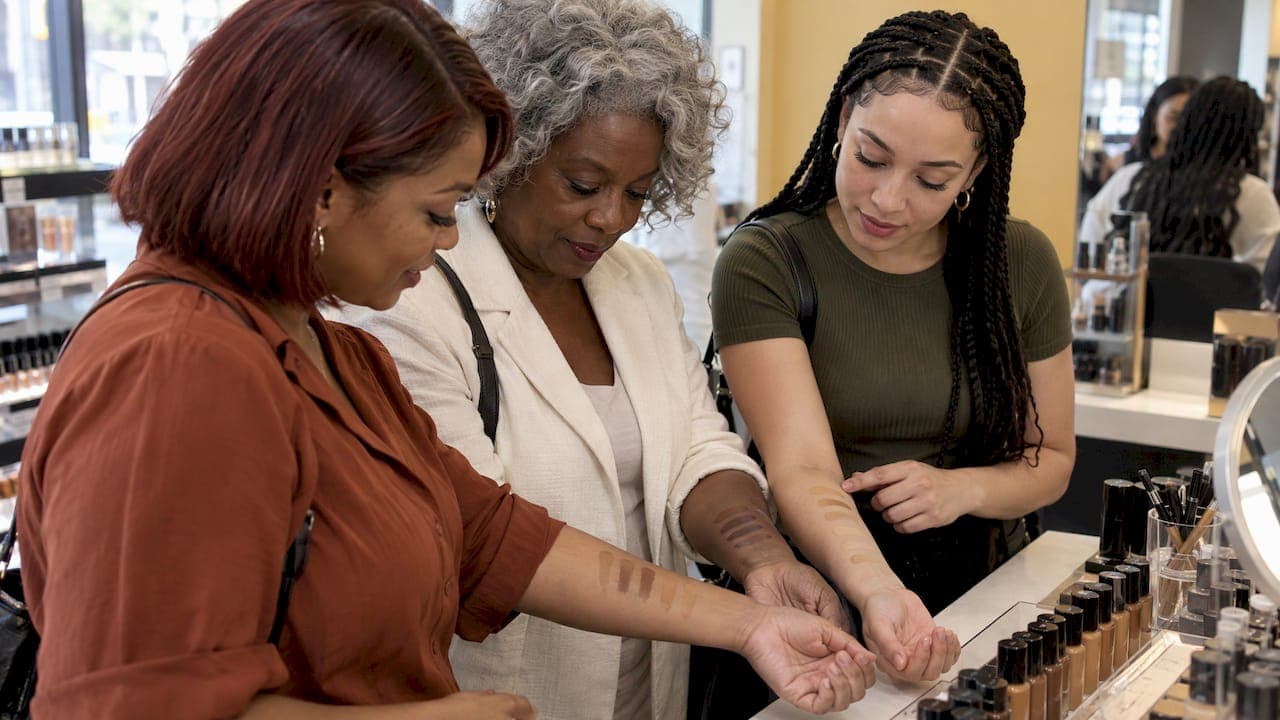
Shade range diversity means a complexion line matches the full spectrum of human skin, from the lightest to the deepest depths and across warm, cool, neutral and olive undertones. It is not the same as a big number on the box. A range with 40 shades can still leave millions of women without a match, and a thoughtfully built range with fewer shades can serve more of them.
Beauty Is Not Perfection. Beauty Is a Verb. Beauty Is Becoming. And becoming starts with a product that actually sees you. Here is how to tell whether a range does.
TL;DR
- True shade diversity covers depth evenly, offers more than one undertone at the depths that need it, and is tested on real skin.
- Shade count alone misleads. Spread, undertone options and consistency matter more than the headline number.
- Research on U.S. brands has found light and medium shades far more common than deep ones.
- Limited ranges are not a small inconvenience. They affect access, representation and, for women with skin conditions, confidence.
- You can audit any range in minutes using the checklist below, and brands can use the same lens to improve.
Table of Contents
- What shade range diversity actually means
- Why the number on the box can mislead
- What the research shows about U.S. beauty brands
- Depth, undertone, finish: the three-part check
- Why this matters beyond the makeup bag
- How to audit a shade range as a shopper
- How brands can evaluate and improve shade diversity
- Our perspective
- Find your people, your products and your match
- Speak up for your shade
- FAQ
- Sources
What shade range diversity actually means
Think of a shade range as a map. Depth is the north-to-south axis: how light or deep a shade is. Undertone is the east-to-west axis: whether the color beneath the surface leans pink, peach, yellow, golden, olive or neutral. A diverse range covers the whole map, not one crowded corner.
Two ideas get blurred together, so let's separate them:
- Shade range: how many shades exist and how far they stretch from fair to deep.
- Shade diversity or inclusivity: how well those shades are distributed, how many undertone choices they give, and whether they work on real skin.
A researcher's analysis of the 2019 market made the point plainly: the 40-shade standard that became popular did not make a brand diverse or inclusive on its own when the shades were unevenly distributed or lacked varied undertones (Western Kentucky University honors thesis, 2019).
So when you see "40 shades," ask a better question. Forty shades of what, and where do they sit?
Why the number on the box can mislead
It is tempting to treat shade count like a score. More must be better. But three things can go wrong.
Crowding. A line can pack ten shades into the light-to-medium zone and add two at the deep end. The total looks generous. The coverage is not.
One-note undertones. If every shade at a given depth leans the same direction, a woman with a different undertone has no real option at that depth. She gets close, but not right.
Redundancy. Shades so near each other that you cannot tell them apart on skin add to the count without adding reach. One 2026 complexion audit, published by an industry analytics firm, reported that brands with 12 to 20 strategically placed shades often covered actual skin tone variation better than those with 40 or more, and said expanding a range without rethinking its distribution adds redundancy, not reach (Chromallogy 2026 Complexion Brand Audit). Treat that as one perspective rather than settled law, but it lines up with academic work.
A Harvard Business School research summary on product-line design found that full inclusivity could be reached with 37 shades when you account for how shades are distributed, the skin tones in the population and how much mismatch shoppers will tolerate (Harvard Business School Working Knowledge). The lesson is not that 37 is a magic number. It is that design beats volume.
Industry voices interviewed by BeautyMatter in 2026 argue something similar: the conversation should move beyond a numbers game toward better education about undertones and clearer information on how a product behaves on skin, such as oxidation and finish (BeautyMatter).

What the research shows about U.S. beauty brands
The imbalance is measurable. A content analysis of 49 brands in 2019 counted 267 light shades, 247 medium shades, 96 dark-brown shades and 31 black shades (Black and Beautiful content analysis, 2019). Light and medium shades together far outnumbered the deepest ones.

That is a snapshot from a specific year, and the market has moved since. Still, it shows the pattern many women already know from experience: the deeper your skin, the fewer choices you tend to see on the shelf.
Another study, published in a dermatology journal in 2022, examined how inclusive beauty brands are in the U.S. and found that, on average, inclusivity and range of shades were similar between BIPOC-owned and white-owned brands (Journal of the American Academy of Dermatology). In other words, who owns a brand is not a shortcut. You still have to look at the range itself.
Retail adds a wrinkle. BeautyMatter reports that retailers often carry minimum stock levels in slow-moving shades, which is one reason a brand's full range may never reach a given shelf (BeautyMatter). A range that exists online but not in the store you can walk into is only partly accessible.
Depth, undertone, finish: the three-part check
Use this lens on any foundation or concealer.
1. Depth: is the spread even?
Look at the full swatch lineup. Group the shades loosely into fair, light, medium, tan, deep and very deep. Count how many fall in each group. You are looking for steady steps from one end to the other, not a thick cluster in the middle and a thin tail.
A good sign: the deepest shades have as many undertone and step options as the lightest ones. A warning sign: the range ends abruptly, or the deep shades jump in big leaps.
2. Undertone: is there a real choice?
At a given depth, does the brand offer at least two directions, such as warm and neutral, or golden and olive? Undertone is what makes a shade look like skin rather than a mask. Research on skin color perception suggests undertone is something people read consistently: a study using early-2020 U.S. surveys found that observers perceived red and yellow undertones reliably (PubMed Central study on skin undertone). If we can see it, our makeup should respect it.
Shade names can help or hurt. Letters, numbers and descriptors like "W," "N" or "C" are only useful if the brand explains them. Look for a guide on the product page.
3. Finish and behavior: does it stay true?
A shade that matches in the store and turns orange in two hours is not a match. Product pages that describe oxidation, finish and coverage help you choose with confidence. The BeautyMatter experts above call for exactly this kind of transparency.
Consistency matters too. A manufacturing guide on shade development notes that brands should keep retained physical standards for approved shades so customers receive the same color match in future purchases (Harrods Health shade range development guide). If you found your perfect shade and the next bottle looks different, that is a repeatability problem, not a you problem.
Why this matters beyond the makeup bag
Shade range is about access. It is also about being seen.
The dermatology review above notes that women with conditions such as vitiligo, melasma or hyperpigmentation depend on appropriate shades when they use makeup for camouflage, and that a lack of them can hurt self-esteem and quality of life (JAAD). For these women, a match is not cosmetic vanity. It is comfort in their own skin.
If you manage dark spots or uneven tone, our guide to fading dark spots in 8 to 12 weeks with skincare for women of color pairs well with the complexion tips here.
There is a social side as well. The same skin-undertone study found that yellowness was associated with a higher predicted likelihood of discrimination in certain social settings, even after accounting for lightness and darkness (PubMed Central). Skin tone is never only about color. How the world responds to it is part of why representation in beauty carries weight. We explore that wider picture in what multicultural beauty means in 2026.
How to audit a shade range as a shopper
You do not need a lab. You need ten minutes and a few questions.
- Scan the lineup. Are the swatches spread evenly from light to deep, or bunched?
- Check the deep end. Do the deepest shades have undertone variety, or one option?
- Look for undertone labels. Does the brand explain its naming system?
- Read the behavior notes. Oxidation, finish and coverage should be described honestly.
- Read real reviews at your depth. Search reviews for people with your skin tone, not the average rating.
- Ask about samples and return policy. A brand confident in its match will usually help you test.
- Test on your jawline in daylight. Our guide to foundation shade matching with tech and a 20 to 30 minute jawline test walks you through it.
If a brand passes most of these, you have found a range worth your time. If it fails the first two, it may be built for a narrower audience than its marketing suggests.
How brands can evaluate and improve shade diversity
If you build, sell or recommend complexion products, the same audit works from the other side.
- Map your current range on a depth by undertone grid. Mark the empty cells.
- Compare to the population you want to serve, not to a competitor's shade count.
- Cut redundancy where two shades sit too close to tell apart, and move that effort to gaps.
- Test on real skin across the grid, not only in digital swatches.
- Keep physical standards for each approved shade so batches stay consistent.
- Publish clear guidance on undertone, finish and oxidation.
- Plan for retail reality. If stores will not stock slow-moving shades, make sure your online and sampling options close the gap.
Inclusion also has to show up in how you talk to women. Our 2026 strategy guide to inclusive beauty brand marketing and the beauty industry trends 2026 overview go deeper on the business side.
Our perspective
Shade diversity is a promise. When a brand says "for every woman," a woman with a deep, olive or hard-to-match skin tone hears it differently from anyone else. She has heard it before. She knows what the shelf looks like.
We believe beauty is an inside-out, head-to-toe, 360-degree experience. That means the foundation on your face and the confidence behind your face belong in the same conversation. A mismatch is more than a color problem. It is a message about who was considered.
That is why we built The Ultimate Beauty - You! as a place where women of every age and stage can find trusted experts, brands and resources in one community, and where brands and experts who care about real inclusion can reach the women they want to serve. We would rather see a range that is thoughtfully built than one that is merely large. We would rather you leave with a match than a compromise.
Beauty Is Not Perfection. Beauty Is a Verb. Beauty Is Becoming. Your shade should be part of that becoming, not a hurdle in front of it.
Ava
Find your people, your products and your match
Choosing complexion products should not feel like guesswork. At The Ultimate Beauty - You!, we bring together expert advice, brand and product recommendations and a community of women who understand the search for a true match. Brands and experts can also connect with the audience that cares about inclusive beauty.

Explore what we offer on our products page, visit The Ultimate Beauty - You!, or contact us and join the community.
Speak up for your shade
Shoppers hold more power than they think. Telling a brand which shades are missing, leaving specific reviews and asking for samples all push ranges to improve. Practicing that voice is a skill, and we cover it in what beauty self-advocacy is and why it matters.
If you are a brand thinking about who your customers really are, types of women consumer segments is a useful place to start mapping your audience before you map your shades.
FAQ
What is shade range diversity in makeup?
It is how well a foundation, concealer or other complexion line covers the real variety of skin tones, across depth and undertone. A diverse range has evenly spaced shades from fair to deep, more than one undertone at relevant depths, and testing on real skin. The total count is only part of the picture.
Is a bigger shade range always more inclusive?
No. Shades that crowd one part of the spectrum or repeat the same undertone add to the count without helping more women. A 2019 academic analysis found that a 40-shade standard did not make a brand inclusive by itself (Western Kentucky University). Distribution and undertone choice matter as much as quantity.
How can I tell if a brand's shades will work for me?
Check whether the range has several options at your depth, read the undertone guide, and look for reviews from people with your skin tone. Then test a sample on your jawline in daylight and see how it looks after a few hours. Our jawline test guide shows the steps.
Why are deeper shades harder to find?
Research on U.S. brands has found lighter and medium shades outnumber deeper ones, with one 2019 sample of 49 brands counting 267 light shades against 31 black shades (Black and Beautiful study). Retailers also tend to stock minimum quantities of slower-selling shades, which can thin out the shelf further.
Sources
- Beyond Light, Medium, and Dark: Diversity and Inclusivity, Western Kentucky University
- 2026 Complexion Brand Audit, Chromallogy
- Design Smarter, Not Bigger Product Lines, Harvard Business School Working Knowledge
- Why More Foundation Shades Aren't Solving Beauty's Problem, BeautyMatter
- Black and Beautiful: A Content Analysis, Scientific Research Publishing
- Diversity in makeup: How inclusive are beauty brands, Journal of the American Academy of Dermatology
- Variation in Skin Red and Yellow Undertone, PubMed Central
- Foundation & Concealer Shade Range Development, Harrods Health