

A brand funnel is a framework that maps how people move from first noticing your brand to actively recommending it. Most models use five stages: Awareness, Familiarity/Consideration, Purchase, Loyalty, and Advocacy, and this structure gives marketers a standardized way to track brand health over time.
The real insight isn't how many people sit at the top of the funnel. It's the conversion ratio between each stage, which tells you whether your brand is actually building momentum or just generating noise.
- Awareness: people know your brand exists
- Familiarity/Consideration: they think of you when the need arises
- Purchase: they buy
- Loyalty: they buy again
- Advocacy: they tell others to buy too
Key Takeaways
A brand funnel diagnoses brand health through stage-to-stage conversion ratios, not raw audience volume, and the five-stage model (awareness, familiarity, purchase, loyalty, advocacy) gives marketers a consistent framework to find and fix growth leaks.
| Point | Details |
|---|---|
| Definition | A brand funnel tracks perception and behavior across five stages, from awareness to advocacy. |
| Ratios over volume | Conversion ratios between stages reveal where a brand loses people; raw reach numbers hide that gap. |
| Stage-specific KPIs | Track branded search, consideration scores, conversion rate, repeat purchase rate, and NPS separately. |
| Funnel shape diagnoses problems | A fat-top, thin-middle funnel signals a messaging fix; a thin purchase layer signals a friction fix. |
| Brand funnel ≠ sales funnel | Sales funnels measure transactions; brand funnels measure long-term perception and equity. |
Table of Contents
- Why the Brand Funnel Matters for Long-Term Growth
- What Are the Stages of a Brand Funnel?
- What Metrics Should You Track at Each Stage?
- What Does Your Funnel's Shape Tell You?
- Brand Funnel vs. Sales Funnel: What's the Difference?
- How Do You Run a Brand Funnel Review?
- How Community and UGC Move Members From Loyalty to Advocacy
- Do Brand Funnels Work the Same Way Across Every Industry?
- Why Does Emotional Connection Drive People Through the Funnel?
- What Is a Brand Funnel, Explained for Marketers
- Sources
Why the Brand Funnel Matters for Long-Term Growth
Volume feels good in a slide deck. Ratios are what actually predict revenue.
A brand can have massive reach and still stall out if only a sliver of aware consumers ever move to consideration. That's a positioning problem, not a distribution problem, and no amount of extra ad spend fixes it. The funnel gives you a way to spot that gap, instead of guessing at it.
Conversion ratios between stages (consideration divided by awareness, purchase divided by consideration, and so on) reveal exactly where a brand loses people. That number is more diagnostic of brand health than raw audience size, because two brands with identical reach can have wildly different business outcomes depending on how well each stage converts.
This is where funnel thinking earns its place in budget conversations:
- If awareness is high but consideration is low, the fix is usually messaging or positioning, not media spend
- If consideration is strong but purchase lags, the friction is often price, availability, or a weak call to action
- If purchase is solid but repeat rate is thin, the product experience or post-purchase communication needs attention
A brand manager who tracks this shape can walk into a budget meeting with a specific ask: fix the consideration gap before adding more top-of-funnel spend.
What Are the Stages of a Brand Funnel?
Each stage represents a distinct mental and behavioral shift, and each one needs its own tactics and its own success metric. Treating them as interchangeable is one of the fastest ways to waste a marketing budget.
-
Awareness. The consumer knows your brand's name exists, nothing more. Behavior here is passive: a glance at an ad, a scroll past a post, a mention from a friend. The primary KPI is branded search volume or unaided brand recall. For a skincare brand, this often means investing in visual identity that sticks and in organic search visibility, since a searchable name is the clearest proof awareness has landed.
-
Familiarity/Consideration. The consumer now associates your brand with a category or need. She might not buy today, but she'd put you on a shortlist. Preference scores and consideration survey results are the standard KPIs here. Storytelling does heavy lifting at this stage: a clear brand narrative turns a name into a reason to care, and consistent, inclusive messaging keeps that reason relevant across different audiences.
-
Purchase. The consumer converts. Conversion rate is the obvious metric, but don't ignore friction points like checkout flow, price perception, or product availability. A well-timed review, a limited offer, or a frictionless site experience often decides this stage more than the ad that got someone there in the first place.
-
Loyalty. The consumer buys again, without a fresh round of persuasion. Repeat purchase rate is the KPI to watch, and it's often the most underrated number in a brand's dashboard. Practitioners increasingly find that loyalty and advocacy stages deliver stronger ROI than fresh acquisition, especially for community-driven brands where retained customers cost far less to keep than new ones cost to win.
-
Advocacy. The consumer actively recommends your brand, unprompted. Net Promoter Score (NPS) is the standard measure, but reviews, referrals, and user-generated content are the visible evidence. This is where community programs, ambassador partnerships, and micro-influencer relationships tend to outperform paid media, because the recommendation carries more weight coming from a peer than from an ad.
Pro Tip: Don't wait until advocacy to start listening to your customers. Ask loyal repeat buyers directly what convinced them to come back. Their answer usually reveals your strongest consideration-stage message, one you can reuse further up the funnel.
What Metrics Should You Track at Each Stage?
Measurement doesn't need to be elaborate to be useful. It needs to be consistent and tied to the right stage.
The standard KPI set looks like this: branded search volume or unaided recall for awareness, preference or consideration survey scores for familiarity, conversion rate for purchase, repeat purchase rate for loyalty, and NPS for advocacy. Each metric answers a different question, and none of them substitutes for the others.
The calculation that turns raw numbers into a diagnostic is simple division: consideration divided by awareness, purchase divided by consideration, repeat purchase divided by first purchase.
- Start with a lean baseline: awareness, purchase, and repeat rate
- Add consideration and NPS once measurement habits are in place
- Segment every metric by acquisition channel, since different channels convert at different rates and need different fixes
Marketers who phase in measurement maturity this way get useful diagnostic signal early, without building a research operation before they've proven the model's value.
What Does Your Funnel's Shape Tell You?
The shape of your funnel is a health report, and it usually points to one of three problems.
A fat top, thin middle funnel (high awareness, weak consideration) signals a messaging or positioning failure. People know your name but don't know why they should care. A healthy middle, steep bottom funnel (strong consideration, weak purchase) points to friction at the point of sale: price, availability, or a clunky buying experience. A strong purchase, weak loyalty funnel suggests the product or the post-purchase experience isn't delivering on what got someone to buy in the first place.
A high-awareness brand with weak transition rates into consideration is showing a positioning problem, not a distribution problem. No amount of extra reach fixes a message that doesn't land.
- Fat top, thin middle: revisit brand story and core message before spending more on reach
- Thin purchase layer: audit checkout friction, pricing clarity, and availability
- Weak loyalty despite strong purchase: invest in post-purchase experience and retention communication
Brand Funnel vs. Sales Funnel: What's the Difference?
The two get confused constantly, and the confusion costs real budget.
A sales funnel tracks a transaction: lead, qualified lead, opportunity, close. A brand funnel tracks perception and long-term equity: how people feel about you, whether they'd recommend you, whether they'll come back without a discount code. Using sales-funnel logic to judge brand health leads teams to chase short-term conversion spikes while brand equity quietly erodes.
Three mistakes show up again and again:
- Treating raw volume as success instead of watching the conversion ratios between stages
- Assuming the funnel is strictly linear, when real consumers move back and forth between stages, especially in lifestyle categories
- Ignoring loyalty and advocacy because they're harder to attribute directly to a single campaign
Avoiding these takes discipline: report ratios alongside volume, expect non-linear movement, and give loyalty and advocacy their own budget line instead of leftover spend.
How Do You Run a Brand Funnel Review?
A first funnel audit doesn't need a research department. It needs a sequence.
- Collect baseline numbers for each stage: awareness, consideration, purchase, repeat rate, and advocacy signals like NPS or reviews.
- Calculate the conversion ratio between each pair of stages and sketch the shape.
- Identify the one or two biggest leaks and design a targeted experiment for each.
- Set a KPI and a measurement cadence (monthly or quarterly) for each stage.
- Report results to stakeholders and repeat the review on a fixed schedule.
Pro Tip: Resist the urge to fix every leak at once. Pick the single largest gap, run one focused test against it, and measure before moving to the next stage. A funnel review is a living document, not a one-time diagram you file away.
How Community and UGC Move Members From Loyalty to Advocacy
Theultimatebeauty-you was built around a simple premise: beauty brands grow fastest when real women, not just campaigns, do the talking. The platform connects members with expert contributors across beauty, wellness, and confidence topics, and that expert layer gives consideration-stage visitors a credible reason to trust a recommendation.
- User-generated content and member stories turn loyal customers into visible advocates, following the same UGC playbook many beauty brands rely on
- Expert and brand partnerships give consideration-stage audiences a trusted signal before they buy
- Community engagement shortens the distance between a loyal customer and one who actively recommends the brand to others
Do Brand Funnels Work the Same Way Across Every Industry?
They don't, and treating every category like it follows the same funnel shape is a common analytical mistake.
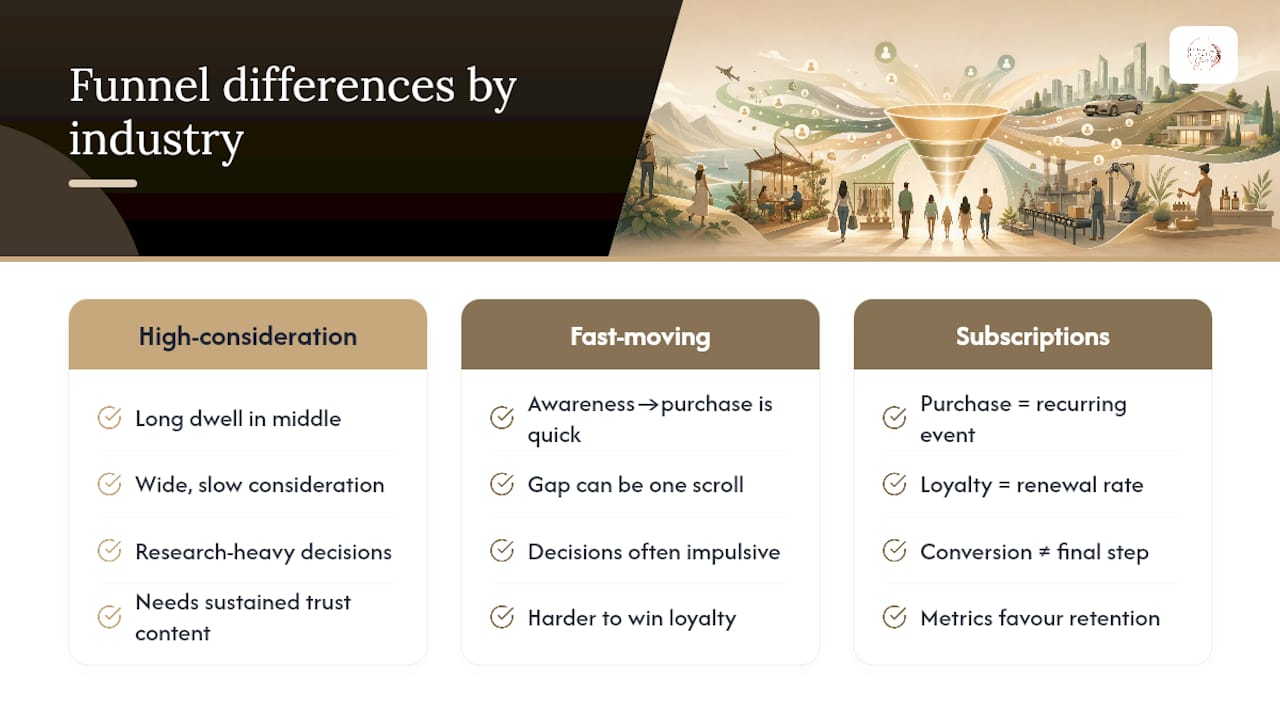
High-consideration purchases, cars, mattresses, financial services, tend to show long dwell times in the familiarity and consideration stages. Consumers research extensively, compare options, and delay purchase for weeks or months. The funnel's middle section is wide and slow, and marketers in these categories often need sustained content and trust-building rather than short bursts of promotion.
Fast-moving consumer categories, including much of beauty and personal care, behave differently. Purchase decisions happen quickly, sometimes on impulse, and the gap between awareness and purchase can compress into a single scroll session. But loyalty and repeat purchase become the harder stages to win, since consumers have dozens of similar options one click away. This is also where lifestyle and wellness categories tend to defy the strict linear order: someone might already be an advocate for one skincare product while still just considering a competing serum from the same brand.
Subscription and membership businesses add another wrinkle. Purchase isn't a single event, it's a recurring decision, so loyalty metrics like renewal rate carry more weight than a one-time conversion rate. Whatever category you're in, the stages stay the same. What changes is which stage deserves the most attention and the fastest measurement cycle.
Why Does Emotional Connection Drive People Through the Funnel?
Data moves people from awareness to consideration. Emotion moves them from consideration all the way to advocacy.
A consumer might recall a brand's tagline because of a clever ad, but she recommends a brand because it made her feel understood. That distinction shapes where storytelling belongs in a brand funnel strategy: not as a top-of-funnel gimmick, but as the connective tissue between every stage. A brand story that consistently reflects who the customer is, and who she's becoming, gives her a reason to stay loyal even when a cheaper alternative shows up.

This matters most at the stages metrics struggle to capture. NPS tells you someone would recommend your brand, but it doesn't tell you why. Usually, the why is emotional: she felt seen, she felt supported, she felt like the brand understood a stage of her life that other brands ignored. Building that connection consistently, through visual identity, tone, and shared values, is what turns a repeat customer into someone who posts about you unprompted.
Brands that treat storytelling as a one-time campaign miss this. The ones that win advocacy treat every touchpoint, from the first ad to the loyalty email, as another chapter in the same story.
What Is a Brand Funnel, Explained for Marketers
The conventional advice on brand funnels treats every stage as equally important, and that's where most marketers get it wrong. Awareness gets the biggest budget line because it's the easiest to buy and the easiest to report. Loyalty and advocacy get whatever's left over, even though the research suggests they're where the real return sits.
I'd push back harder on the linear assumption too. Real consumers, especially in beauty and wellness, don't move neatly from box to box. Someone can be a raving advocate for your serum and still be sitting in consideration for your new moisturizer. Funnel models that ignore this end up misreading healthy, non-linear behavior as a broken funnel.
If you take one thing from this framework, make it the ratio, not the stage names. Calculate your conversion rate between every pair of stages before you touch your media plan. That single number will tell you more about where your brand is actually stuck than any awareness metric ever will.
— Ava
Sources
- Umbrex — Brand-tracking funnel overview
- Beloved Brands — Marketing funnels guide
- 23HubLab — Funnel mapping for consumer brands