
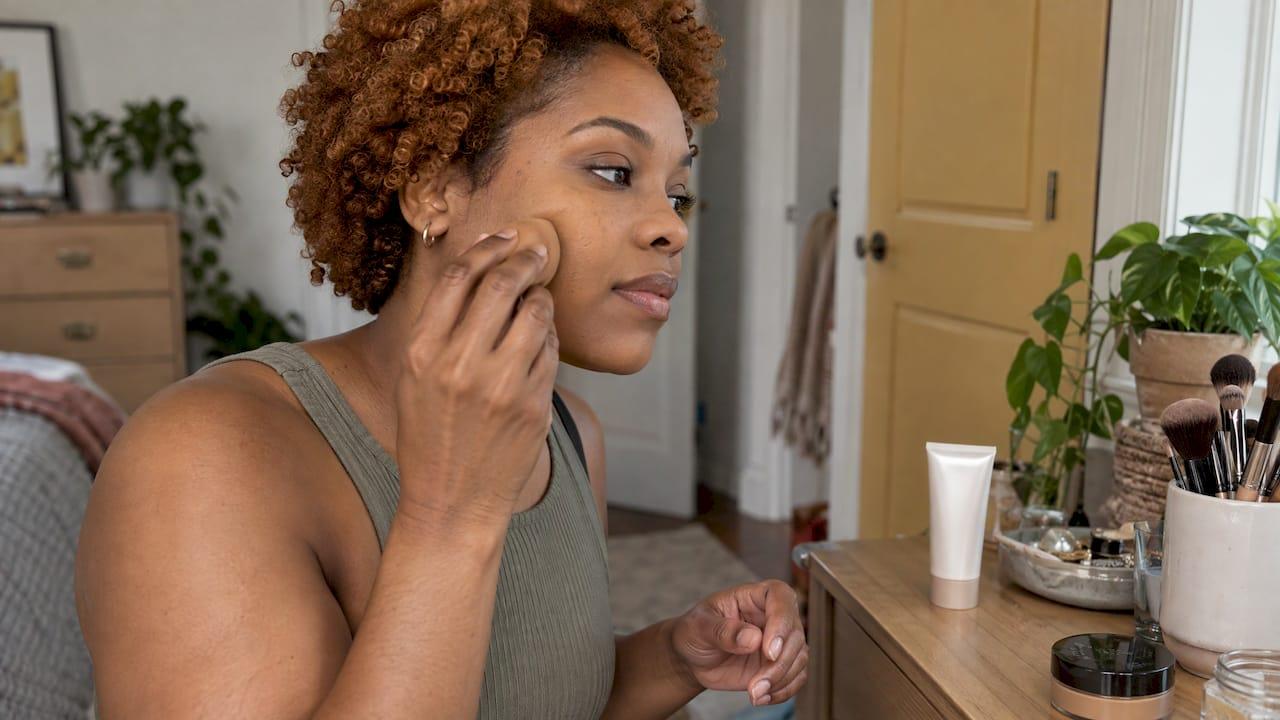
Sunscreen goes on after your moisturizer and before your makeup. Use a lightweight facial formula, give it a few minutes to set, then press your foundation on instead of rubbing it in. That is the whole routine. The details below, from how much to use to how to top up at noon, are what keep your skin protected and your makeup looking the way you planned.
Beauty Is Not Perfection. Beauty Is a Verb. Taking care of your skin each morning is part of becoming, and sunscreen is the step that protects everything else you do.
TL;DR
- Order: cleanse, moisturize, sunscreen, wait, then makeup. Sunscreen is the last skincare step.
- Choose a facial sunscreen in a fluid, serum, gel or lightweight lotion texture, ideally with a matte finish.
- Wait about 60 to 90 seconds for light formulas and 2 to 3 minutes for richer ones, then press makeup on.
- Makeup with SPF is a bonus layer, not your sunscreen. Use about half a teaspoon for face and neck, and reapply about every two hours outdoors.
Table of Contents
- Why sunscreen comes first and makeup comes second
- Sunscreen before or after moisturizer?
- How much sunscreen you really need on your face
- Is makeup with SPF enough?
- What to look for in a sunscreen that works under makeup
- How to apply sunscreen under makeup without pilling
- How to reapply sunscreen over makeup
- A sample morning routine
- Perspective
- Take the next step with The Ultimate Beauty - You!
- FAQ
- Sources
Why sunscreen comes first and makeup comes second
Makeup sits on top of your sunscreen because sunscreen needs to form an even, unbroken film on your skin. Foundation, powder and blush are decoration. Sunscreen is protection. If you layer them the other way around, you dilute the protective layer and the product you spent money on stops doing its job.
The Skin Cancer Foundation's guidance is simple: after cleansing in the morning, apply your moisturizer or facial sunscreen, then your makeup. Facial sunscreens tend to be lighter than the body versions and are often made to go under cosmetics.
Sunscreen before or after moisturizer?
After. Dermatologists interviewed for one widely shared guide agreed that, in general, sunscreen is the last skincare product you apply, and that putting moisturizer on top can interfere with how well it blocks UV rays.
So your morning looks like this:
- Cleanse your face.
- Apply any serum you use, then your moisturizer.
- Apply sunscreen.
- Wait for it to set.
- Apply makeup.
Some moisturizers and tinted creams already contain SPF. If yours does, it can stand in for the separate step only if you apply it as generously as you would a sunscreen. Most of us put on far less moisturizer than that, which is why a dedicated sunscreen is the safer base.
If you are building a fuller routine, our guide to skin cycling shows how morning SPF fits around a night-time rhythm of actives and recovery.
How much sunscreen you really need on your face
Most people under-apply. Johns Hopkins Medicine advises about half a teaspoon to protect your face and neck. Allure's dermatologist source, Jane Yoo, MD, puts it a little higher, about a teaspoon for face and neck. Either way, it is more than a thin dab, and a pea-sized amount will not get you the number on the bottle.
A practical way to get there: apply in two thin layers, or dot the sunscreen across your forehead, cheeks, nose, chin and neck before you blend. Do not forget your ears, the sides of your face and your hairline, which makeup routines tend to skip.
For the face and body together, the FDA says to use at least one ounce, about a shot glass for an average adult, and to apply it 15 minutes before sun exposure. Under makeup you will usually be heading out soon after getting ready, so build the sunscreen step into the start of your routine and do your hair or get dressed while it sets.

Is makeup with SPF enough?
No. Johns Hopkins explains that makeup is not enough protection even with a high SPF, because you would have to wear much more makeup than you normally do to reach the labeled number. The Skin Cancer Foundation adds that most cosmetic formulas do not give enough protection against UVA rays on their own.
Dr. Yoo points out that people apply less product when a foundation, BB or CC cream contains SPF, so a separate face sunscreen should be your main protection and the makeup SPF an extra layer. If you like a foundation with SPF, the Skin Cancer Foundation suggests choosing one with SPF 30 or higher for that added layer.
What to look for in a sunscreen that works under makeup
The best sunscreen is the one you will actually wear every day. The Skin Cancer Foundation puts it this way: the right texture, whether cream, gel or stick, depends on your personal preference and skin type, because consistency is what protects you.
For makeup, a few features matter most.
Texture and finish
Dr. Yoo says fluid, essence, serum and gel sunscreens work best under makeup, while rich cream or balm formulas can be too emollient and make foundation slide. She also notes that matte formulas typically play better under makeup than dewy or satin ones. If you love a glow, you can add it with a highlighter on top instead of through the sunscreen.
Broad-spectrum and SPF 30 or higher
Northwestern Medicine's Dr. Quan sums up the standard: SPF 30 or greater, broad-spectrum UVA and UVB protection, used generously and applied at least every two hours. The FDA's baseline recommendation is broad-spectrum SPF 15 or higher together with protective clothing, a hat and shade. Most daily facial sunscreens sit well above that.
Matching your skin type
- Oily or combination skin: look for gel, fluid or serum textures with a matte finish.
- Dry or mature skin: a light lotion on top of a well-hydrated moisturizer keeps skin comfortable under foundation. Our menopause skincare guide covers hydration and SPF for skin that changes with hormones.
- Sensitive skin or rosacea: the American Academy of Dermatology recommends fragrance-free sunscreens with zinc oxide, titanium dioxide or silicones to minimize irritation.
- Deeper skin tones: a formula that blends clear matters, because a white cast shows up under foundation. See our picks in no white cast SPF for dark skin.
- Melasma or dark spots: daily SPF is part of any plan, and our melasma treatment guide explains where it fits.
- Pregnancy: check ingredients with your OB-GYN or midwife, and read our pregnancy-safe skincare guide.
A new ingredient on the shelves
In June 2026 the FDA added bemotrizinol to the list of permitted sunscreen active ingredients, and the first products containing it are reaching US stores. Northwestern Medicine's Dr. Quan notes that it is a large molecule that sits on top of the skin with low absorption, which makes it a good option for sensitive skin. On September 10, 2026, the FDA also issued a final order removing PABA and trolamine salicylate. The agency says consumers do not need to take any action. Whatever the filter, the rules stay the same: use enough, and reapply.
How to apply sunscreen under makeup without pilling
Pilling is when sunscreen or foundation rolls into little crumbs on your face. It is frustrating, and it is usually fixable. Two things cause it: products that do not get along, and technique.
Match your formulas
Dr. Yoo explains that pilling happens when two products have film-forming systems that do not bind. Her rule of thumb is silicone-to-silicone or water-to-water. If your foundation feels silky and slippery, it is likely silicone-based, so pair it with a silicone-based sunscreen or primer. If your foundation is water-based, a lightweight water-based sunscreen is a safer match.
Sunscreens contain silicones and film-forming agents that create a protective barrier. Tama Tran, NP-C, tells Vogue that this barrier can roll or ball up when it is disturbed, and that rubbing instead of pressing breaks the sunscreen layer apart.
Wait, then press
Let the sunscreen set. Tran recommends waiting at least 60 to 90 seconds for lighter formulas and about 2 to 3 minutes for richer textures, until the film is even and no longer tacky. Dr. Yoo agrees that waiting three to five minutes can make a bigger difference than you would think.
Then apply foundation by pressing, dabbing or gently brushing it on. A damp sponge or a soft, dense brush works well. Rubbing drags the sunscreen around and thins it out in patches.
Check your skin prep
A chemist's testing found that drier skin, higher pH and smoother texture increase pilling. Well-moisturized skin gives sunscreen something to glide over, so do not skip moisturizer. Keep your layers thin, too: stacking a primer, a serum, a rich cream and a sunscreen is how most pilling starts.
If you are curious about thicker occlusive layers, read our guide to slugging skincare. It is a night-time technique, and it is not one to use under daytime makeup.
A quick troubleshooting list
- Foundation slides or streaks: the sunscreen is too rich or has not set. Wait longer or switch to a gel or fluid.
- Crumbs when you blend: you are rubbing, or your layers do not match. Press instead, and match silicone with silicone.
- Shine by noon: try a matte-finish sunscreen and set your T-zone lightly with powder.
- White cast under foundation: blend with a lighter hand, give it time to set, or choose a sheer or tinted formula. Do not over-rub, because that thins the layer you are counting on.
- Mismatched shade: a tinted or mineral sunscreen can change how your foundation reads. Check your match in daylight with our foundation shade matching guide.
How to reapply sunscreen over makeup
The standard advice does not change because you are wearing makeup. The American Academy of Dermatology says to reapply about every two hours when outdoors, and after swimming or sweating. The FDA gives the same two-hour guidance, more often when swimming or sweating.
If you spend your day indoors, away from windows, you may not need a midday top-up. If you are walking, commuting, at an outdoor lunch, at a game or driving in sun, plan to reapply.
The easiest ways to do it over a finished face:
- Press, never rub. Dab a sunscreen stick or a small amount of lotion with fingertips or a sponge. Rubbing moves your foundation.
- Blot first. Take off excess oil with a tissue so the new layer sits evenly.
- Use a spray carefully. The Skin Cancer Foundation's expert guidance is to mist the spray into your hands first and apply it manually to your face, rather than spraying directly, to avoid inhaling it and to cover evenly. Hold your breath, or step outdoors, while you do it.
- Do not count on makeup alone. Because most people use too little SPF powder, spray or foundation, treat it as a boost and not a full reapplication.
Water-resistant labels also come with a limit. Sunscreens cannot be called waterproof or sweatproof, because those terms are misleading, and water-resistant products still need reapplying after swimming or sweating.
Simple travel kit for the workday: a sunscreen stick or a compact bottle in a fluid texture, a tissue and a small sponge. It takes less than a minute.

A sample morning routine
Here is how it looks in real time, from wake-up to out the door.
| Step | What to do | Why it matters |
|---|---|---|
| 1 | Cleanse and pat dry | Gives products a clean surface |
| 2 | Apply moisturizer | Hydrated skin helps products glide and prevents pilling |
| 3 | Apply sunscreen, about half to one teaspoon for face and neck | Your main protection |
| 4 | Get dressed, do hair, or have coffee for 2 to 3 minutes | Lets the film set and lose tackiness |
| 5 | Press on primer, foundation or tint | Keeps the sunscreen layer intact |
| 6 | Finish with powder, blush, mascara | Makeup SPF is a bonus only |
| 7 | Reapply about every two hours outdoors | Filters wear off with time, sweat and touching |
Pair this with a hat, sunglasses and shade where you can. The FDA recommends sunscreen along with protective clothing, a hat and shade, not instead of them.
Perspective
Beauty Is Not Perfection. Beauty Is a Verb. Beauty Is Becoming.
We see a flawless-looking face as the end of a routine, but the real work happens in the layer you cannot see. Sunscreen is that layer. It is not a chore standing between you and your makeup. It is the step that lets you keep becoming, year after year, in skin that is cared for from the inside out.
That is why we bring the pieces together in one place: skincare, makeup, wellness and confidence, for women at every age and stage. Your skin at 19, 39 and 59 asks for different things, and our approach is head-to-toe and 360 degrees because advice is more useful when it connects instead of scattering across a dozen tabs.
Start small. One sunscreen you like, worn every morning, beats a perfect plan you abandon by Wednesday.
Ava
Take the next step with The Ultimate Beauty - You!
The Ultimate Beauty - You! is a women-centered platform for beauty, wellness, confidence and personal growth, with expert advice, product and brand recommendations and a community of women who want to feel their best at every age and stage. Whether you are fine-tuning your morning routine or looking for trusted voices on skin, makeup and self-care, you will find a home with us.

Join us at The Ultimate Beauty - You! and explore the resources built to help you become your best self, inside and out.
FAQ
Can I put sunscreen over makeup instead of under it?
Under is the foundation of your routine, because sunscreen needs to form an even layer on bare skin. Over makeup is for reapplying during the day, using a stick, a gentle press of lotion or a spray misted into your hands first. Pressing, not rubbing, keeps your makeup in place.
How long should I wait between sunscreen and foundation?
Wait about 60 to 90 seconds for light fluids and gels, and 2 to 3 minutes for richer textures, until your skin no longer feels tacky. Some dermatologists suggest up to three to five minutes. Use that time to do your hair or brush your teeth.
Is a foundation with SPF enough for daily wear?
No. Most people apply far less foundation than the amount needed to reach the labeled SPF, and many cosmetic formulas lack enough UVA protection. Use a separate facial sunscreen as your base, and treat the SPF in your makeup as an extra layer.
What kind of sunscreen is best under makeup?
Fluid, serum and gel facial sunscreens with a matte finish and broad-spectrum SPF 30 or higher tend to work best. If your skin is sensitive, choose fragrance-free formulas with zinc oxide or titanium dioxide. Pick a texture you enjoy, since the one you wear every day protects you most.
Sources
- Making Your Sunscreen Work With Your Makeup, Skin Cancer Foundation
- Ask The Expert: How to Apply Sunscreen, Skin Cancer Foundation
- Sunscreen and Your Morning Routine, Johns Hopkins Medicine
- 7 Best Sunscreens Under Makeup That Won't Pill, Peel, or Feel Heavy, Allure
- 9 Best Sunscreens Under Makeup That Never Pill, Vogue
- Sunscreen: How to Help Protect Your Skin from the Sun, FDA
- Questions and Answers: FDA's regulatory actions on over-the-counter sunscreen
- Americans get a new sunscreen option, AP News
- A New Era of Sunscreen: Why Bemotrizinol Is Getting So Much Attention, Northwestern Medicine
- Sunscreen FAQs, American Academy of Dermatology
- Rosacea skin care tips dermatologists recommend, American Academy of Dermatology
- Do you put sunscreen on before or after makeup? The Chemist's Guide
- This Is the Correct Order You Should Be Applying Moisturizer and Sunscreen, AOL