
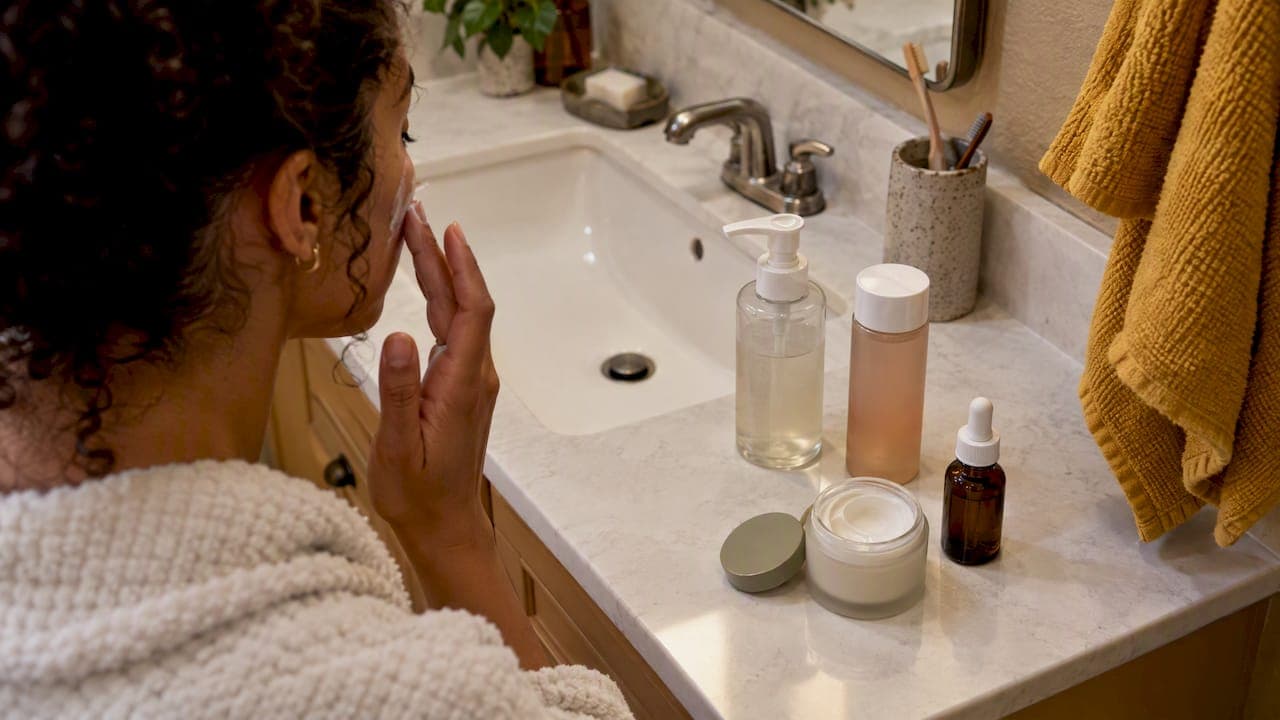
Skin cycling is a nighttime routine that rotates your strong active ingredients with rest nights, so your skin gets the benefits of exfoliants and retinoids without being pushed past its limit. The classic version runs on a four-night loop: exfoliate, retinoid, recover, recover. Then you start again.
Beauty Is Not Perfection. Beauty Is a Verb. Beauty Is Becoming. That is exactly how we see skin cycling: not a quick fix, but a rhythm you build and keep. Below you will find the schedule, how to start, how to adjust it for your skin and your life stage, and when to skip the trend and see a dermatologist instead.
TL;DR
- Skin cycling alternates active nights (an exfoliating acid, then a retinoid) with recovery nights, usually in a four-night loop.
- The point is consistency and a protected skin barrier, not faster results.
- Daily broad-spectrum SPF 30+ is not optional, because acids and retinoids can make skin more sensitive to the sun.
- Pause the retinoid night if you are pregnant or breastfeeding, and talk to a board-certified dermatologist if you have acne, rosacea, eczema, or psoriasis.
- Start slow, add one active at a time, and adjust the number of recovery nights to your skin.
Table of Contents
- What skin cycling actually is
- The classic 4-night schedule
- How to start skin cycling, step by step
- Sun protection is part of the routine
- How to adjust the cycle for your skin
- When skin cycling is not the right fit
- Skin cycling at every age and stage
- Our perspective: rhythm beats intensity
- Build your routine with trusted guidance
- Common mistakes to avoid
- How long until you see results
- FAQ
- Sources
What skin cycling actually is
Skin cycling is a skin care regimen you repeat in a three-to-five-night cycle. Dermatologist Dr. Whitney Bowe coined the term, and the idea went viral on TikTok. Healthline describes it as a routine that alternates exfoliants, retinoids, and hydrating creams so your skin has time to recover between the strong steps.
The logic is simple. Exfoliating acids and retinoids are two of the most talked-about ingredients in skin care. Used too often, or layered together, they can leave skin red, tight, flaky, and stinging. Skin cycling spaces them out.
An honest note: skin cycling is not a clinical protocol with its own large body of trials. Acibadem Hospitals Group notes there are limited studies on skin cycling itself, though its principles line up with reducing irritation from actives. In other words, the method is sensible and widely used, but it is a framework, not a prescription.

The classic 4-night schedule
Here is the structure most dermatology guidance describes, as outlined by Healthline. Do it at night. Mornings stay simple.
| Night | What you do | What it is for |
|---|---|---|
| Night 1: Exfoliate | Cleanse, then apply a chemical exfoliant such as an AHA or BHA | Loosens dead skin cells so skin looks smoother and brighter |
| Night 2: Retinoid | Cleanse, then apply a pea-sized amount of retinol or a prescription retinoid | Supports skin renewal over time |
| Night 3: Recover | Cleanse, skip all actives, apply a hydrating moisturizer with ceramides or hyaluronic acid | Repairs and supports the skin barrier |
| Night 4: Recover | Same as night 3 | Gives skin a second full rest before the loop restarts |
Then it begins again on night 5, which is night 1.
Why the recovery nights matter most
It is tempting to treat recovery nights as wasted nights. They are the whole point. Your skin barrier is the outer layer that holds in moisture and keeps out irritants. When it is stressed, you feel it: tightness, burning when you apply even gentle products, and a dull, rough look.
On recovery nights, keep it boring on purpose. Gentle cleanser, a moisturizer you like, and nothing else. That is not doing less. That is doing what your skin needs.
Why the order works
Exfoliation comes first because it clears away the buildup that sits on the surface. The retinoid comes the next night, separately, so the two do not pile irritation on top of each other in a single evening. Ohio State dermatologist Dr. Susan Massick points to product overload as the most common pitfall she sees: too many high-strength actives at once, leading to a damaged barrier and inflammation instead of glow.
How to start skin cycling, step by step
You do not need a shelf full of products. You need four types, and you may already own two of them.
- Pick a gentle cleanser. Look for fragrance-free, hypoallergenic, and noncomedogenic formulas, as Healthline suggests.
- Choose one chemical exfoliant. Lactic acid is often milder; salicylic acid (a BHA) suits oilier, congestion-prone skin. Start with a low strength.
- Choose one retinoid. An over-the-counter retinol is a common starting point. If you are curious about gentler plant-based options, our look at retinol vs bakuchiol for women compares how each felt over 12 weeks.
- Choose a barrier-friendly moisturizer. Ceramides and hyaluronic acid are the ingredients to look for.
- Pick a broad-spectrum sunscreen, SPF 30 or higher, for every morning.
- Start with one loop, and watch your skin. If it feels tight or stings, add a recovery night before you add anything else.
A sample first month
If your skin is new to actives, ease in rather than jumping to the full loop.
- Week 1: Moisturizer only on most nights. Try the exfoliant once, at a low strength.
- Week 2: Run the exfoliant night, then two recovery nights. No retinoid yet.
- Week 3: Add the retinoid night, using a pea-sized amount for the whole face.
- Week 4: Run the full four-night loop and note how your skin feels on each night.
There is no prize for speed. Becoming is a process, and so is skin.
Sun protection is part of the routine
This is the step women skip most, and it matters most. The FDA has considered evidence that products with alpha hydroxy acids may increase skin sensitivity to the sun while you use them and for up to a week after you stop.
So your nightly routine only works if your morning routine protects it:
- Apply broad-spectrum SPF 30 or higher every day, including cloudy days.
- Reapply if you are outdoors for long stretches.
- Add a hat or shade when you can.
Sunscreen is not only a face matter. If you have tattoos, the same UV logic applies to inked skin, and this guide to SPF for tattoos covers healing rules and daily care.
How to adjust the cycle for your skin
The four-night loop is a starting point. Healthline notes the structure is flexible: people with dry or sensitive skin may need two or three recovery nights, while those with oily skin may prefer a shorter recovery stretch.
| If your skin is... | Try this |
|---|---|
| Dry or sensitive | Extend recovery to 2 or 3 nights, use a milder acid, and start the retinoid at a low strength |
| Oily or congestion-prone | Keep the standard loop or shorten recovery slightly, if your skin stays comfortable |
| Combination | Use the standard loop and apply the exfoliant where you need it most |
| Easily irritated | Pause the loop, rebuild with a simple routine, and read our guide on clean beauty for sensitive skin |
Signs to slow down
Skin that is working with you feels comfortable. Slow down or stop actives if you notice:
- Stinging when you apply moisturizer
- Persistent redness or peeling
- A tight, shiny look
- New breakouts that feel sore rather than like usual blemishes
Back off to recovery nights only until your skin feels normal again. If irritation does not settle, see a board-certified dermatologist.
When skin cycling is not the right fit
Skin cycling is a reasonable tool for some people. It is not a diagnosis, and it is not a cure-all.
Pregnancy and breastfeeding
Retinoids need special care during pregnancy. The American Academy of Dermatology's pregnancy skin care guidance, from board-certified dermatologist Shoshana Marmon, MD, PhD, FAAD, centers on a basic routine of gentle cleansing, moisturizing, and sun protection. Skip the retinoid night and ask your OB-GYN or dermatologist which ingredients are safe for you. If you are a new mom, our five-step postpartum skincare routine takes about two minutes.

Acne, rosacea, eczema, or psoriasis
If you have inflammatory acne, rosacea, eczema, or psoriasis, a standard four-night loop may not match your treatment. Many medical treatments for these conditions are meant to be used on a schedule your dermatologist sets. Do not swap that schedule for a trending one. Ask your dermatologist how to fit any new actives around your plan.
Prescription retinoids
If you already use a prescription retinoid, follow your prescriber's directions first. The label for a prescription product such as Differin (adapalene) gel gives its own instructions for use, and those come before any social media routine.
Trend caution
A video going viral does not make a routine right for everyone. A Wayne State University research summary on TikTok skincare trends found that about 13% of educational skincare videos come from board-certified dermatologists. Enjoy the inspiration. Check the advice.
Skin cycling at every age and stage
Women do not have one skin story. Your needs shift with your decade, your hormones, and your life.
- Teens: Most do not need a retinoid-and-acid rotation. Simple is stronger; start with our three-step teen skincare routine.
- 20s and 30s: Often the sweet spot for building a consistent loop. If you are 35 or older, you may want to look at how antioxidants support skin as part of a bigger picture, and talk to a dermatologist about personalizing your routine.
- Hormonal shifts: Skin can behave differently across the month. Our guide to cycle syncing skincare shows how to adapt without weekly overhauls.
- Menopause and beyond: Skin often needs more hydration and repair. See our menopause skincare guide before adding more actives.
- Deeper skin tones: Irritation can leave dark marks, so gentle pacing matters. Our guide to skincare for women of color covers fading dark spots.
For a bigger view, beauty routines by age group runs from teens through the 60s.
Our perspective: rhythm beats intensity
We talk to women every day who feel pressure to do more. More serums. More steps. More everything. Skin cycling resonates because it says the opposite: do less, on purpose, and let it work.
We see it as a beauty habit built on respect. You are not punishing your skin into compliance. You are giving it a rhythm, with effort on some nights and rest on others.
Here is what we believe about it:
- Consistency is the real active ingredient. A gentle loop you keep for months beats an aggressive routine you abandon in two weeks.
- Rest is part of progress. Recovery nights are not a gap in your routine. They are the routine.
- Skin is not separate from you. Sleep, stress, nutrition, and hormones all show up on your face. That is why we take an inside-out, head-to-toe approach. If your nights are short, our piece on sleep and skin is a good companion to this routine.
- Trends are invitations, not orders. Try what fits. Skip what does not. Ask an expert when something feels off.
Beauty Is Not Perfection. Beauty Is a Verb. Beauty Is Becoming.
— Ava
Build your routine with trusted guidance
Choosing products and experts you can trust is half the work. At The Ultimate Beauty - You!, we bring together expert advice, brand recommendations, and a community of women at every age and stage, so you do not have to piece it together alone. Explore the Ultimate Beauty - You! homepage, browse more articles on our blog, or meet the professionals on our experts and partners page.
Common mistakes to avoid
- Using actives on recovery nights. Rest means rest. No "just a little" acid.
- Using too much retinoid. A pea-sized amount covers the face.
- Layering acid and retinoid the same night while your skin is still learning the routine.
- Skipping sunscreen. Sun sensitivity is the biggest hidden cost of actives.
- Changing everything at once. If you add three new products and your skin reacts, you will not know which one caused it.
- Ignoring what your skin tells you. The calendar is a guide. Your skin has the final word.
How long until you see results
Expect weeks, not days. Skin renewal takes time, and Ohio State's dermatologists frame the goal as better adherence and safety, not a faster result. Take a photo in the same light once a month. Judge your skin by how it feels and behaves over a few months, not by one night.
FAQ
Do dermatologists recommend skin cycling?
Many see it as a reasonable way to space out strong ingredients, and it is a version of an old principle: alternate active nights with recovery nights. It is not a medical treatment, though. If you have a skin condition or persistent concerns, a board-certified dermatologist can build a personalized plan.
Can I skin cycle with sensitive skin?
Yes, with changes. Extend recovery to two or three nights, choose gentle, fragrance-free products, and start with low-strength actives. If your skin stings or stays red, pause the actives and see a dermatologist.
Do I need to use sunscreen with skin cycling?
Yes, every morning. AHAs may raise sun sensitivity while you use them and for up to a week after you stop, according to the FDA. Use a broad-spectrum sunscreen with SPF 30 or higher.
Can I do skin cycling while pregnant?
Skip the retinoid night and keep to gentle cleansing, moisturizing, and sun protection, as the American Academy of Dermatology's pregnancy guidance describes. Ask your OB-GYN or dermatologist before using any exfoliating acid.
Do I need to cycle the same way forever?
No. Your routine can change with the seasons, your hormones, and your life stage. Check in with your skin often, and adjust the number of recovery nights to match.
Sources
- Skin Cycling: Products Needed, Routine, Benefits, and Precautions (Healthline)
- A step-by-step guide on how to skin cycle (Ohio State Health & Discovery)
- Guidance for Industry: Labeling for Cosmetics Containing Alpha Hydroxy Acids (FDA)
- Dermatologist-approved pregnancy skin care (American Academy of Dermatology)
- Differin (adapalene) gel label (FDA)
- TikTok Skincare Trends and Their Clinical Evidence (Wayne State University)