
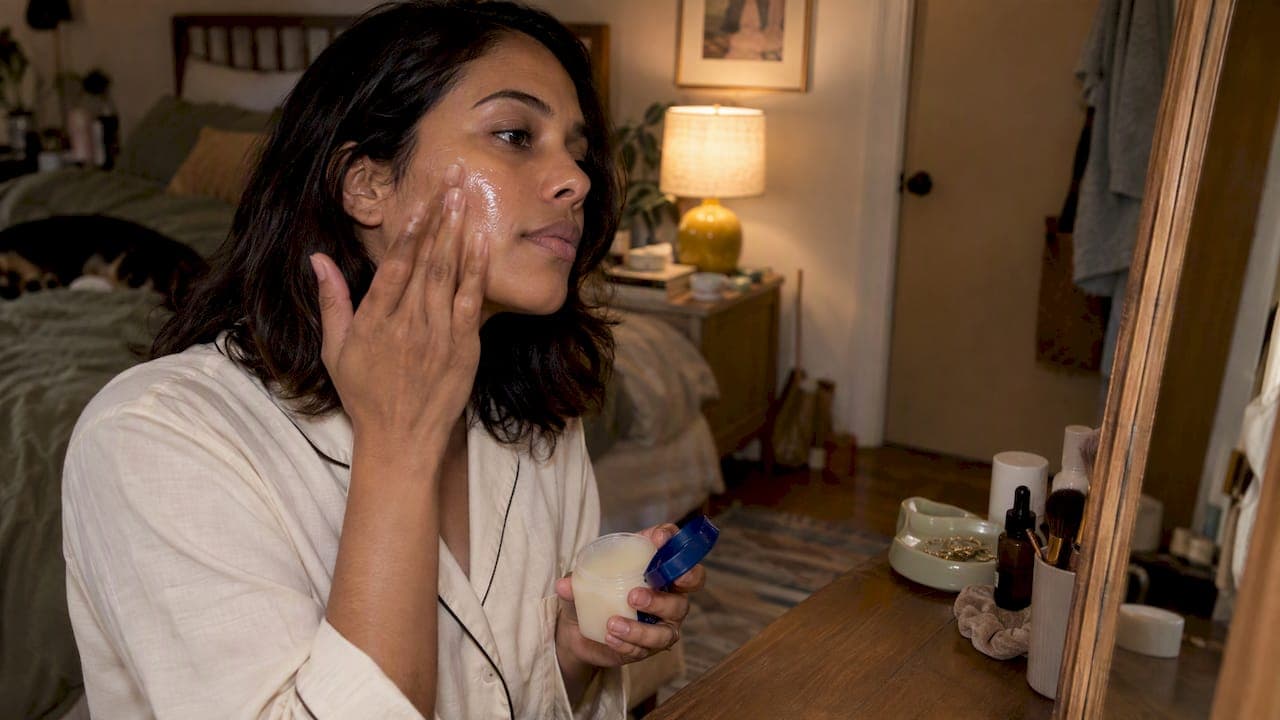
Slugging means sealing your face with a thin layer of an occlusive, usually petroleum jelly, as the very last step of your night routine. It works by slowing moisture loss while you sleep. It can be a real comfort for dry, tight, or eczema-prone skin, and it asks for some care if your skin is oily, acne-prone, or already using strong actives.
Beauty is not perfection. Beauty is a verb. And caring for your skin barrier is one of the quietest, most practical ways to act on that. Here is how slugging works, how to do it well, and how to know whether it belongs in your routine.
TL;DR
- Slugging is applying an occlusive, most often petroleum jelly, as the final step of your nighttime routine to help lock in moisture.
- It suits dry skin and eczema-prone skin best. Oily or acne-prone skin, infections, and open wounds are reasons to skip it.
- Use a thin layer. Start with 2 to 3 nights a week, or once a week if you are acne-prone, and wash your face in the morning.
- Be careful with retinoids, acids, and bakuchiol underneath. An occlusive can make them more irritating.
- Slugging seals. It does not replace a moisturizer with humectants and ceramides.
Table of Contents
- What slugging actually is
- What slugging does for your skin
- Is slugging right for your skin type?
- How to slug your skin, step by step
- How often should you slug?
- What to avoid layering under an occlusive
- Slugging with Vaseline or Aquaphor
- Common slugging mistakes
- Our perspective
- Find your next step with us
- FAQ
- Sources
What slugging actually is
The term comes from K-beauty, and it is exactly as simple as it sounds. Slugging is a practice of covering your face with petroleum jelly at night to lock in moisture. The name nods to the glossy, snail-like shine you wear to bed.
The product is an occlusive. That is a category of ingredient that sits on top of the skin and forms a physical barrier. Slugging is typically the final step of a nighttime routine, placed over everything else you have applied.
Petrolatum is the classic choice, and it is the one behind most of the searches for slugging with Vaseline. Other thick ointments can play the same role. What matters is the job: sealing, not treating.
What slugging does for your skin
Your skin constantly loses water to the air. That process has a name, trans-epidermal water loss, and the main function of slugging is to prevent it, which helps hydrate the skin.
In practice, that can mean a few things:
- Less dryness. For dry skin, petroleum jelly can relieve dryness and make skin look and feel smoother.
- A protective layer. Petroleum jelly helps seal in hydration and keeps skin from drying out. It can also help prevent outside molecules from getting in and causing irritation.
- A boost for what is underneath. According to Neutrogena's skincare team, creating an occluded environment can enhance how well products under the layer work. That is helpful with a gentle hydrating serum. It is also the reason to be careful with strong actives, which we cover below.
An honest note on limits keeps expectations healthy. Dermatologist Dr. Ronald Sulewski of Nebraska Medicine notes that slugging may help with severe dryness or eczema, but may give little extra benefit to the average person with healthy skin. Slugging is a tool for a specific need, not a requirement for glowing skin.
It also does one job. White petrolatum reduces water loss but does not provide humectancy or replenish lipids by itself, so it should not replace a ceramide-based routine. If you want the full picture of how humectants and ceramides work together, read our guide to layering hyaluronic acid and ceramides.
Is slugging right for your skin type?
The answer depends on where you are right now. Skin changes with seasons, hormones, climate, and life stages. What worked at 25 may not fit at 45.
Who tends to benefit
People with dry, parched skin or eczema may benefit from slugging. Winter skin, windburned cheeks, and chapped patches around the nose and mouth are common places to start. Many women in perimenopause and menopause also notice drier skin, and our menopause skincare guide walks through hydrating and repairing steps in more detail.
Who should skip or be cautious
- Oily or acne-prone skin. Those with oily or acne-prone skin, an infection, or an open wound should avoid slugging. Dermatologic surgeon Anthony Rossi suggests reserving it for extremely dry or chapped skin rather than daily moisturizing, to avoid occlusive acne.
- Sunburned skin. Thick ointments can trap heat over sunburned skin, which can make you more uncomfortable and prolong the burning sensation.
- Tattooed skin. UPMC advises not using petroleum-based products on tattooed skin because they can cause the ink to fade.
- Skin that turns red or irritated. If your skin gets red or irritated after slugging, see your dermatologist.
The pore question
You may have heard that petroleum jelly clogs pores. UPMC says that claim rests on an outdated study and is a myth, and that current evidence finds it non-comedogenic. Still, breakouts after slugging are possible. Sealing in a layer of oil, sweat, or leftover product underneath can contribute to what dermatologists call occlusive acne. So the guidance above for oily and acne-prone skin still stands. If you want a deeper look at beauty claims like this one, our piece on common beauty myths is a good companion.
A quick patch test
Before you commit, check how your skin responds. Apply a small amount to your forearm or face and see whether irritation shows up the next day. It takes one night and saves you a rough morning.
How to slug your skin, step by step
Here is a simple nighttime routine. Keep it gentle. Keep it consistent. Let it evolve with your skin.
- Cleanse. Wash your face with a gentle cleanser and pat it dry. Everything you trap under the occlusive stays there, so start clean.
- Hydrate. Dermatologist Heather Rogers of the American Academy of Dermatology suggests dampening the skin before moisturizing and sealing to trap hydration effectively.
- Moisturize. Apply your usual serum or moisturizer. The usual order is that you complete your nighttime steps, including cleansing and moisturizing, and then apply the occlusive last.
- Seal. Warm a small amount of petroleum jelly between your fingers and press it over your face in a thin, even layer. Think of a sheer glaze, not a mask.
- Protect your pillow. A little goes a long way, and overapplication can wreak havoc on pillowcases. A clean cotton pillowcase you do not mind washing helps.
- Wash in the morning. Cleanse your face to remove anything stuck to the petroleum jelly. That also helps dead skin cells, oils, and bacteria slough away.
Then finish with a moisturizer and sunscreen as usual. Your night habits and your sleep matter too, and our post on night habits that support better skin shows how rest and routine work together.
How often should you slug?
There is no single rule. Cleveland Clinic notes there is no hard-and-fast rule for frequency, and slugging is rarely necessary every night.
A reasonable way to think about it:
| Skin situation | A sensible starting point |
|---|---|
| Dry or eczema-prone, tolerating it well | Up to nightly, as your skin allows |
| Generally dry, wants maintenance | 2 to 3 nights a week |
| Combination or acne-prone, curious | Once a week, then adjust |
| Oily, active breakouts, infection, open wound | Skip it |
The first rows and the once-a-week guidance for acne-prone skin follow Vaseline's own guidance: you can slug every night if your skin tolerates it, many people find 2 to 3 times a week enough, and acne-prone or oily skin should start with once a week. Watch how your skin looks in the morning. Calm and soft means you are on track. Congested or irritated means pull back.
What to avoid layering under an occlusive
This is the part many trend videos skip. An occlusive does not only seal in moisture. It can also push active ingredients deeper and make them stronger.
Ingredients to avoid under an occlusive include retinoids, bakuchiol, and alpha and beta hydroxy acids because they have greater irritation potential. Healthline echoes the caution about retinoids, AHAs, and BHAs beneath an occlusive layer, since it can enhance their penetration. A dermatology practice makes the same point about retinol: applying petroleum products over retinoids at night may increase their potency, causing irritation and dryness.
So what do you do if you love your retinol? Separate the nights. Use your active on one night and slug on another. If you like a structured plan, skin cycling is built for this, with recovery nights designed for barrier-friendly steps like sealing. If you are weighing gentler alternatives, see how retinol and bakuchiol compared in our look at tolerance, and remember that bakuchiol also belongs on the caution list under an occlusive.
If you are pregnant, ingredient choices deserve extra care. Our pregnancy skincare guide covers what dermatologists warn against, and your own doctor should have the final word on what is right for you.
Slugging with Vaseline or Aquaphor
The most searched version of slugging uses Vaseline, and for good reason. It is simple, and petrolatum has been trusted for barrier care for a long time. NatGeo notes that petroleum jelly is typically inexpensive and generally well tolerated, though occlusive acne is possible.
Here is the practical difference between the two best-known ointments. Vaseline is pure petrolatum, while Aquaphor contains 41% petroleum jelly plus panthenol, glycerin, and lanolin alcohol. Dr. Desai of U.S. Dermatology Partners notes that Aquaphor may be preferred for eczema or extra-dry skin because its glycerin helps draw moisture into the skin.

There is one catch to know. Lanolin in Aquaphor can rarely cause an allergy, with red, itchy bumps or blisters. If you know you react to lanolin, choose a lanolin-free ointment.
A simple way to choose:
- Pure petrolatum if you want the simplest, single-ingredient seal.
- A petrolatum ointment with added humectants if your skin is very dry and you do not react to lanolin.
- A fragrance-free, ceramide-rich cream if you are unsure about heavy occlusives. It will not seal as completely, but it is a gentler first step.
Whatever you choose, use a clean spatula or clean fingers so you do not contaminate the jar.
Common slugging mistakes
Using too much. A thick layer feels dramatic and does little extra. It mostly ends up on your pillow.
Skipping the cleanse. Makeup, sunscreen, and oil sealed under an occlusive have nowhere to go. Always start with clean skin.
Pairing it with strong actives every night. Because of the penetration effect described above, keep retinoids and exfoliating acids on separate nights.
Treating it as a moisturizer replacement. Petrolatum seals water in. It does not add humectants or lipids. Layer it over a real moisturizer.
Ignoring warning signs. Persistent redness, stinging, itching, or new bumps are signals. Stop and talk with a dermatologist.
Using it on the body without a plan. The same logic carries over to very dry elbows, shins, and heels. Our five-step body skincare routine shows where a sealing step fits for barrier care.

If you have concerns about uneven tone or dark spots, slugging will not treat them, and it should never be a substitute for sunscreen. See our guide to skincare for women of color and fading dark spots for what supports even tone.
Our perspective
We believe beauty is not perfection. Beauty is a verb. Beauty is becoming.
Slugging is a good example of why we built The Ultimate Beauty - You! as an inside-out, head-to-toe, 360-degree space. A trend goes viral, and suddenly every woman is told to try it. But your skin at 22, at 38, and at 56 asks for different things. Your skin in January is not your skin in July.
That is why we bring trusted experts, brands, and resources together in one community. Instead of chasing every hack alone, you can find guidance that respects your life stage, your skin, and your goals. Slugging can be one helpful step for dry, tired skin. It sits inside a bigger picture of barrier care, sleep, sun protection, and self-acceptance.
Our advice is simple. Start gently. Listen to your skin. Ask an expert when something feels off. And let your routine grow with you.
Ava
Find your next step with us
Skincare advice should not feel scattered. The Ultimate Beauty - You! is a women-centered platform that brings together beauty, wellness, confidence, and community, so you can explore expert guidance and recommendations in one place.

Ready to build a routine that fits you? Explore our platform for women, or join our community to stay connected. If you are an expert or brand who serves women, learn about our experts and partners.
FAQ
What does slugging do for your skin?
Slugging puts an occlusive barrier over your skin so less water escapes overnight. That can leave dry skin feeling softer and more comfortable by morning. It does not add moisture on its own, so it works best over a moisturizer.
Is it safe to slug every night?
Some people with very dry or eczema-prone skin tolerate nightly slugging, but it is rarely necessary. Many people do well with 2 to 3 nights a week, and acne-prone skin is best started at once a week. If you see redness, itching, or breakouts, scale back and check in with a dermatologist.
Can I slug if I use retinol?
It is wise to separate them. An occlusive can enhance the penetration of retinoids, acids, and similar actives, which raises the chance of irritation and dryness. Use your active on one night and slug on a different one.
Does Vaseline clog pores?
Current evidence finds petroleum jelly non-comedogenic, and the clogging claim traces back to an outdated study. Even so, sealing in oil or leftover product can lead to occlusive acne in some people. If you break out easily, patch test first and keep the layer thin.
Why do people in Korea use Vaseline on their faces at night?
Slugging is known as a K-beauty trend. The goal is to lock in moisture and support the skin while you sleep. The same idea applies anywhere: seal in hydration after your regular routine, and choose what suits your own skin.
Sources
- What is slugging? Explaining the viral skincare trend (National Geographic)
- What is slugging? (CNN Underscored)
- What Is Slugging in Skin Care? (UPMC HealthBeat)
- Slugging: Does This Skin Care Trend Work? (Cleveland Clinic)
- What Is Skin Slugging? (Neutrogena)
- Is the slugging beauty trend beneficial for everyone? (Nebraska Medicine)
- Social Media Mythbusters: Slugging (Dermatology Times)
- What Is Slugging in Skincare (CeraVe)
- Slugging: What to know about this skincare technique (Curology)
- What is slugging and how to do it? (Vaseline)
- Vaseline vs. Aquaphor: Which is Best? (U.S. Dermatology Partners)
- Slugging Skin: What It Means and How to Try It (Healthline)