
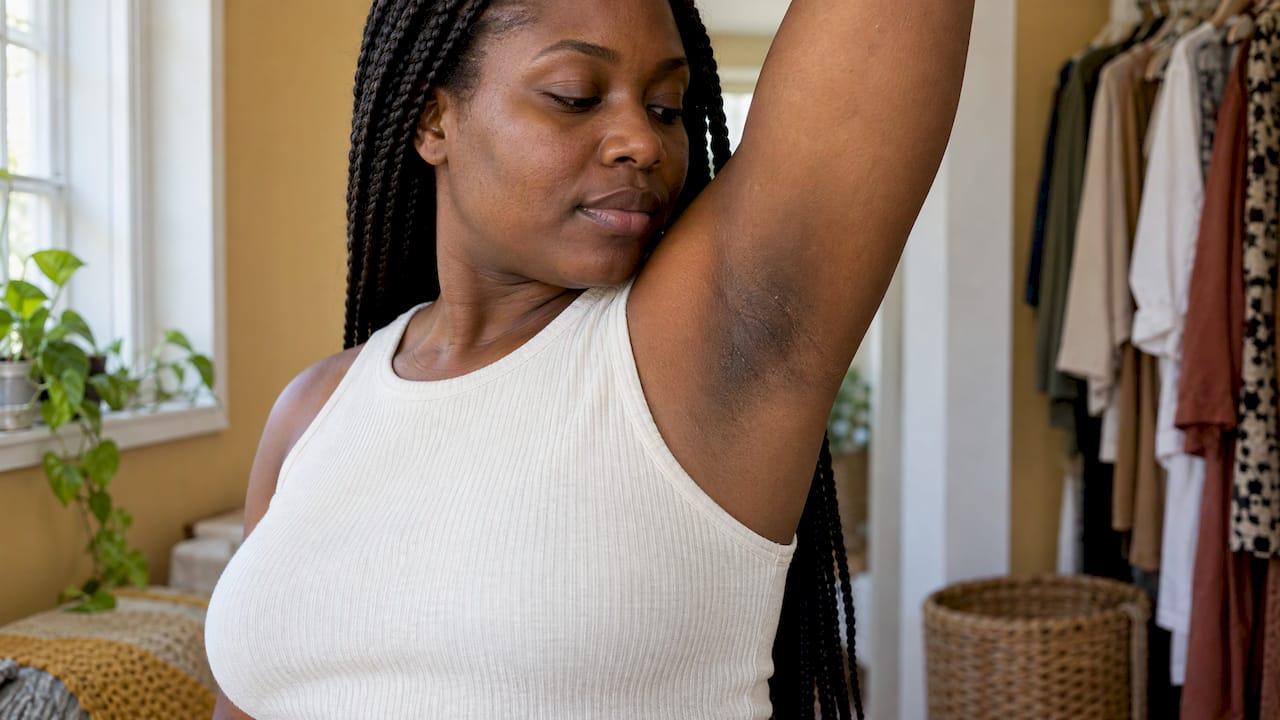
Underarm dark spots are common, and most of the time they come from everyday irritation: shaving, friction, sweat or a product your skin doesn't love. Remove the irritation, be gentle and be patient, and the skin can often even out over several months. Sometimes, though, dark, velvety underarms are your body's signal about insulin or hormones, and that deserves a doctor's visit. Here is how to tell the difference and what to do next.
Beauty Is Not Perfection. Beauty Is a Verb. Beauty Is Becoming. That includes the skin you've been quietly worried about, and we're here to help you care for it from the inside out.
TL;DR
- Most underarm darkening is post-inflammatory hyperpigmentation: skin reacting to friction, shaving, sweat or product irritation by making extra melanin.
- Fading takes patience. Expect many months, not days, and keep irritation away so it doesn't return.
- Skip harsh scrubs. Aggressive exfoliation can add inflammation and make pigmentation worse.
- Thick, velvety, dark patches in the armpit can signal insulin resistance, so ask a healthcare provider about testing.
- Sudden changes in your skin are always worth a professional look.
Table of Contents
- Why do dark spots show up on your underarms?
- Can your deodorant cause dark underarms?
- Could dark underarms be a sign of diabetes?
- How to lighten dark underarms safely
- Does exfoliation help dark underarms?
- How long do underarm dark spots take to fade?
- When to see a dermatologist
- Our perspective
- Beauty advice that sees the whole you
- FAQ
- Sources
Why do dark spots show up on your underarms?
The underarm is a perfect storm. It's a skin fold, it sweats, it rubs against clothing, and it gets shaved or waxed again and again. Cleveland Clinic lists friction, shaving, excessive sweating, genetics and reactions to personal care products as common reasons for dark underarms.
The mechanism behind most of it is post-inflammatory hyperpigmentation (PIH). When skin is inflamed or injured, it can produce excess melanin, the pigment that gives skin its color. That is why a patch that was irritated, even mildly, can stay darker long after the irritation is gone.

Why PIH can be stronger in deeper skin tones
The International Hyperhidrosis Society explains that skin of color is more susceptible to post-inflammatory hyperpigmentation, because it reacts to irritation by producing more melanin. This is biology, not a flaw. If this is you, our guide to skincare for women of color walks through gentle, fade-friendly habits.
The usual suspects, one by one
- Shaving and waxing. Repeated nicks, razor burn and ingrown hairs inflame the skin. If bumps are part of your story, see our ingrown hair prevention guide.
- Friction. Tight bras, fitted sleeves and workout gear rub the same spot daily.
- Sweat and moisture. Constant dampness in a fold can irritate skin.
- Genetics. Some of us simply make more pigment in this area.
- Products. Fragrances, dyes and preservatives can trigger reactions.
- Underlying health conditions. We cover these below, because they matter.
Can your deodorant cause dark underarms?
It can contribute. Cleveland Clinic notes that fragrances, dyes and preservatives in deodorants and other products may play a role in dark underarms. The pattern to watch for: your underarms feel itchy, stingy, red or flaky after applying, and the darkening follows.
How to check whether a product is irritating you
The American Academy of Dermatology suggests testing a product on an inconspicuous spot, such as the underside of the arm or the bend of the elbow, twice a day for 7 to 10 days, before using it more widely. Do this for any new deodorant, body wash or lotion you plan to use on your underarms.
If you suspect a true allergy, healthcare providers diagnose contact dermatitis from deodorants and antiperspirants through patch testing. That is a conversation for a dermatologist, especially if the rash keeps coming back.
Practical swaps
- Choose fragrance-free formulas while the skin is recovering.
- Introduce only one new product at a time, so you know what caused what.
- Apply deodorant to clean, fully dry skin.
- Stop anything that burns, itches or leaves a rash, and let the area calm down.
Could dark underarms be a sign of diabetes?
Sometimes, yes, and this is the part of the topic we never want you to skip.
A specific kind of darkening called acanthosis nigricans (AN) looks different from simple irritation. The American Academy of Dermatology describes it as areas of skin that darken and thicken, often feeling velvety. It is not contagious or harmful in itself. The CDC explains that AN is a sign of insulin resistance and can be a sign of prediabetes or type 2 diabetes, and that it often appears in body creases such as the armpits.

The AAD advises that if you notice a dark patch of velvety skin on your neck, armpit or groin, you should get tested for diabetes, since it may be the first sign of diabetes or prediabetes.
How to tell AN from ordinary discoloration
| Clue | Irritation-related darkening (PIH) | Possible acanthosis nigricans |
|---|---|---|
| Texture | Usually flat, same texture as nearby skin | Thick, velvety, sometimes with skin tags |
| Where | Where you shave, rub or apply products | Often in folds: armpits, neck, groin |
| Trigger | Follows a shave, rash or new product | Develops gradually, often with no clear trigger |
| Next step | Remove the irritant, be gentle and patient | See a healthcare provider about testing |
This table is a guide for starting a conversation, not a diagnosis. Only a healthcare provider can tell you what you have.
Other conditions that can be linked
Mayo Clinic notes that people with AN are much more likely to develop type 2 diabetes, and that insulin resistance is also related to polycystic ovary syndrome (PCOS). The Merck Manual adds that hormonal changes can increase melanin production in Addison disease, in pregnancy or with hormonal contraceptive use. Verywell Health lists a wider range of associations, including thyroid disease, Cushing's syndrome and certain medications such as corticosteroids and oral contraceptives.
Don't start or stop any medication because of skin changes. Bring the question to the provider who prescribes it.
What helps when AN is the cause
The CDC says the most effective approach is to address the root cause, such as obesity or insulin resistance, through physical activity and maintaining a healthy weight. Cleveland Clinic explains that treating the underlying condition often clears the patches, and that weight loss, exercise and a nutritious diet can lower insulin levels and improve or even eliminate them. Mayo Clinic agrees that treating the cause might restore the skin's usual color and texture.
That is empowering news. When the skin is a signal, listening to it is a form of self-care.
How to lighten dark underarms safely
Safe treatment depends on the cause. Verywell Health notes that the approach can involve addressing a contributing health condition or avoiding irritating products, and that professional options may include prescription lighteners, retinoids or laser procedures. Those are decisions to make with a dermatologist, who can match the option to your skin tone and history.
For everyday care, start with the habits that stop new pigment from forming.
Step 1: Calm the area
Pause shaving, waxing and new products for a couple of weeks if you can. Skin that isn't being re-irritated has room to recover.
Step 2: Shave smarter
Use a clean, sharp razor with a lubricant and shave in the direction of hair growth, as dermatology guidance recommends to limit irritation. Replace blades often. Our ingrown hair prevention guide covers waxing and other hair removal methods too.
Step 3: Reduce friction
Loose, breathable fabrics reduce rubbing, which can minimize irritation and discoloration. On workout days, choose smooth seams and change out of damp clothes soon after.
Step 4: Moisturize and protect the barrier
Healthy skin handles stress better. A simple, gentle moisturizer helps, and our five-step body skincare routine shows how to build barrier care that fits the whole body, underarms included.
Step 5: Be consistent with a plan
Pigment fades slowly and steadily. Our hyperpigmentation safety plan for women explains how to approach fading dark spots on a realistic timeline, and what to watch for along the way.
If you're curious about the science behind skin renewal ingredients, you can read about anti-aging peptide research to see what is being studied. Anything you apply to underarm skin that is already sensitive deserves a conversation with your dermatologist first.
Does exfoliation help dark underarms?
Here's the surprise: more scrubbing usually doesn't mean more fading. Dermatology guidance warns that aggressive scrubbing or exfoliation can create more inflammation and worsen underarm pigmentation. Verywell Health adds that exfoliants may irritate the skin or make acanthosis nigricans worse, so talk to a healthcare provider before trying them and avoid scrubbing.
The skin you are trying to calm is already reacting. Treat it like it's recovering, because it is.
A gentle approach
- Skip gritty scrubs, loofahs and brushes on the underarm.
- Use light pressure and lukewarm water.
- Pat dry rather than rubbing.
- Follow with a gentle moisturizer.
- Check with your provider before adding any chemical exfoliant, especially if your skin is velvety or thickened.
For the rest of your body, our 30-second body exfoliation steps show a dermatologist-backed way to smooth skin without overdoing it.
How long do underarm dark spots take to fade?
Longer than we'd all like. Harvard Health notes that underarm post-inflammatory hyperpigmentation may take many months to fade, and that removing the irritation helps keep it from returning. The International Hyperhidrosis Society says PIH and similar tone changes may fade on their own over 6 to 12 months.
A realistic mindset helps:
- Weeks 1 to 4: The skin settles as you stop the irritation.
- Months 2 to 6: Gradual change appears if you stay consistent.
- Months 6 to 12: Many patches continue to even out.
These are general ranges, not promises. Your skin tone, the depth of the pigment and the cause all shape your timeline.
Keeping it from coming back
Prevention is the same set of habits: gentle hair removal, breathable clothing, fragrance-free products and a calm skin barrier. If a new product brings the darkening back, patch test and stop using it.
When to see a dermatologist
Book an appointment if any of these sound like you:
- The skin feels thick or velvety, not just darker.
- Dark patches also appear on your neck, groin or other folds.
- The darkening came on suddenly or is spreading.
- You have other symptoms such as irregular periods, fatigue, unusual thirst or weight changes.
- Rash, itching or burning keeps coming back after deodorant.
- Months of gentle care haven't helped.
Cleveland Clinic advises seeing a healthcare provider or dermatologist any time you notice changes in your skin. Mayo Clinic notes that, rarely, AN can be a sign of cancer in an internal organ, so consult a healthcare provider if skin changes are sudden. Most cases are not that, but speed matters when the change is fast.
Our perspective
Underarm discoloration is one of those things women carry quietly. We hide it, we cover it, we skip the sleeveless dress. We would rather you understand it.
At The Ultimate Beauty - You!, we believe in an inside-out, head-to-toe, 360-degree approach to beauty. A dark patch is not just a cosmetic problem. It can be a reaction to a razor or a deodorant, or it can be a message from your body about hormones or insulin. Treating only the surface can miss the real story.
That is why we bring trusted experts, brands and resources together in one place, so advice isn't scattered across a dozen tabs. Gentle care, patience and the right professional when you need one: that is the path we stand behind.
Beauty Is Not Perfection. Beauty Is a Verb. Beauty Is Becoming.
Ava
Beauty advice that sees the whole you
The Ultimate Beauty - You! is a women-centered beauty, confidence and wellness platform, with an app on the way. We bring together expert advice, product and brand recommendations and a community for women of every age and stage. If you want skin care guidance that looks beyond appearance, explore our platform.

Browse more of what we offer on our products page, and keep going with our guides on melasma treatment and SPF for dark skin, since sun exposure can deepen pigment anywhere it shows.
FAQ
Why do I get dark spots on my armpits?
The most common causes are friction, shaving, sweat, genetics and reactions to deodorants or other products. Irritation makes skin produce extra melanin, which leaves a darker patch. If the skin is thick and velvety, ask a healthcare provider about acanthosis nigricans.
Is a dark armpit a sign of diabetes?
It can be. The CDC says acanthosis nigricans is a sign of insulin resistance and can signal prediabetes or type 2 diabetes. It doesn't always mean you have diabetes, so the right step is to ask your healthcare provider about testing.
Can I scrub my underarms to lighten them?
Scrubbing is more likely to hurt than help. Aggressive exfoliation can increase inflammation and worsen pigmentation. Use light pressure, skip gritty tools and check with a healthcare provider before adding any exfoliating product.
How long until dark underarms fade?
Post-inflammatory hyperpigmentation can take many months, and the International Hyperhidrosis Society cites a window of 6 to 12 months for tone changes to fade on their own. Removing the source of irritation is what helps most.
Is underarm lightening safe?
It is when it starts with the cause. Gentle habits like smarter shaving, loose clothing and fragrance-free products are low-risk. Prescription lighteners, retinoids and lasers belong with a dermatologist who can match them to your skin.
Sources
- How to Get Rid of Dark Armpits, Cleveland Clinic
- Acanthosis nigricans: Overview, American Academy of Dermatology
- Tips for Best Results-OTC, International Hyperhidrosis Society
- How to test skin care products, American Academy of Dermatology
- Is Deodorant Causing Your Armpit Rash?, Verywell Health
- Diabetes and Your Skin, CDC
- Diabetes: 10 warning signs that can appear on your skin, American Academy of Dermatology
- Acanthosis Nigricans: Causes, Diagnosis and Treatment, Cleveland Clinic
- Acanthosis nigricans: Symptoms and causes, Mayo Clinic
- Hyperpigmentation, Merck Manual Consumer Version
- What Causes Dark Underarms and How Are They Treated?, Verywell Health
- How to Lighten Dark Underarms, Dr. Raechele Cochran Gathers
- What causes dark patches after skin irritation?, Harvard Health
- Anti-Aging Peptides for Research, Data Peptides