

Email marketing converts women because it creates a private, trusted channel for curated, personalized, story-driven content that respects their time and builds genuine relationship-driven purchase intent. Email marketing delivers a high return on investment—industry statistics show that email returns $42 for every $1 spent, and women in SendIQ's B2B dataset converted at an average of 3.8% compared to 2.9% for males, engaging faster (6.2 hours vs. 9.1 hours) and more across extended sequences. The inbox is not a feed. It is an invitation.
The primary conversion drivers:
- Trust and permission: She chose to be there. That opt-in is the beginning of a relationship.
- Curation and clarity: Short, distilled content that saves time wins over volume every time.
- Psychographic personalization: Values, goals, and life stage matter more than age or zip code.
- Storytelling and relational copy: A friend's recommendation converts better than a polished ad.
- Mobile-first accessibility: Most women read email on their phones, often between responsibilities.
Table of Contents
- Why email resonates with women in beauty, wellness, and personal growth
- High-converting email tactics tuned to women in beauty and wellness
- Email design and accessibility: mobile-first rules that protect conversion
- Timing, segmentation, and lifecycle messaging that increase conversions
- What to track and how to A/B test for real results
- Privacy, permissions, and trust signals you must include
- Build an Ideal Reader Avatar: a practical template
- How Theultimatebeauty-you applies these principles
- How cultural and generational differences shape email responses
- How user-generated content and testimonials from women convert
- Multisensory language and visuals that connect with women
- Frequency and cadence best practices for women's engagement patterns
- Key Takeaways
- The email approach we believe in at Theultimatebeauty-you
- What Theultimatebeauty-you offers women who want more
- Useful sources and further reading
Why email resonates with women in beauty, wellness, and personal growth
The inbox feels different from a social feed. There is no algorithm deciding what she sees. No competing posts. Just a quiet, intentional message she chose to receive. That permission-based dynamic is the foundation of why women respond to email marketing at the rates they do.
Busy women respond to curated, time-efficient summaries over long-form content dumps. TheSkimm built a media company on exactly this insight: short, consistent voice, distilled value, no fluff. The same principle applies to beauty and wellness emails. When you respect her time, she trusts you more.
Email also functions as a low-friction ritual. A morning wellness newsletter, a Friday skincare roundup, a midweek confidence check-in. These touchpoints become part of her routine. That repetition builds emotional connection in a way that a single Instagram post never can.
Relying on surface-level "pink marketing" actively undermines that trust. Pastel palettes and generic "girl boss" copy feel hollow. Women recognize when a brand has assumed rather than listened. Psychographic personalization, grounded in her actual values and goals, is what builds loyalty. See our guide on inclusive beauty brand messaging for how to apply this in practice.
- Women evaluate email information content and visual presentation differently than men, and privacy matters more to them.
- Community-building language outperforms transactional copy in beauty and wellness categories.
- Authenticity signals, such as a real author byline and consistent brand voice, lift engagement.
Pro Tip: Before writing your next email, ask: "Would she forward this to a friend?" If the answer is no, the content is not personal enough.
High-converting email tactics tuned to women in beauty and wellness
Subject lines and preview text
Collaborative language outperforms commands. "We found your next ritual" converts better than "Buy now." Specificity beats cleverness. Personalized subject lines lift open rates noticeably, so use her name, her interest, or a detail tied to where she is in her journey. Preview text is the second subject line. Never waste it on "View this email in your browser."

Story-first body copy
Text-based, conversational emails create a friend-to-friend feel that converts better than design-heavy layouts, especially in skincare and wellness. Open with a brief scene or relatable moment. Move to the insight. Then the offer. Keep paragraphs to two or three sentences. One idea at a time. For deeper guidance on voice and narrative, the beauty brand storytelling guide covers this in full.
CTA framing that converts
One email. One action. A single, clear CTA matched to the email's purpose converts better than three competing links. If the email educates, the CTA should invite her to learn more, not buy immediately. Match the ask to the trust level.
Sequence design and the 80/20 rule
Adopting an 80/20 content-to-promo balance helps promotional emails feel like useful solutions rather than interruptions. Practitioner guidance recommends about 80% educational or community content and 20% promotional, which prevents 'salesy' fatigue and improves conversion long-term.
A three-line email example:
"Last week I tried a five-minute face massage before bed. My skin looked different by morning. Here's the technique, plus the one product that made it easier." CTA: "Show me the technique →" Social proof: "Loved by 2,400 women in our community."
Quick A/B test ideas:
- Subject line: collaborative ("We picked this for you") vs. curiosity ("You haven't tried this yet")
- CTA placement: above the fold vs. after the story
- Email length: 150 words vs. 300 words
- Send time: Tuesday 8 AM vs. Thursday 7 PM
Pro Tip: Run one A/B test per send. Change only one variable. Wait for statistical significance before declaring a winner.
Email design and accessibility: mobile-first rules that protect conversion
Most women read email on a phone, often in a brief window between tasks. Design for that reality first.
- Single-column layout, 600px max width, with generous white space.
- CTA buttons at least 44px tall, high-contrast, and thumb-friendly.
- Font size 16px minimum for body copy; 22px or larger for headlines.
- Alt text on every image so the message lands even when images are blocked.
- Color contrast ratio of at least 4.5:1 for body text against background.
Text-forward emails also build intimacy. A clean, readable message feels personal. A heavily designed template feels like a catalog. In beauty and wellness, where trust drives purchase, that distinction matters.
Pro Tip: Send yourself a test email and read it on your phone with images turned off. If the message still makes sense, you are ready to send.
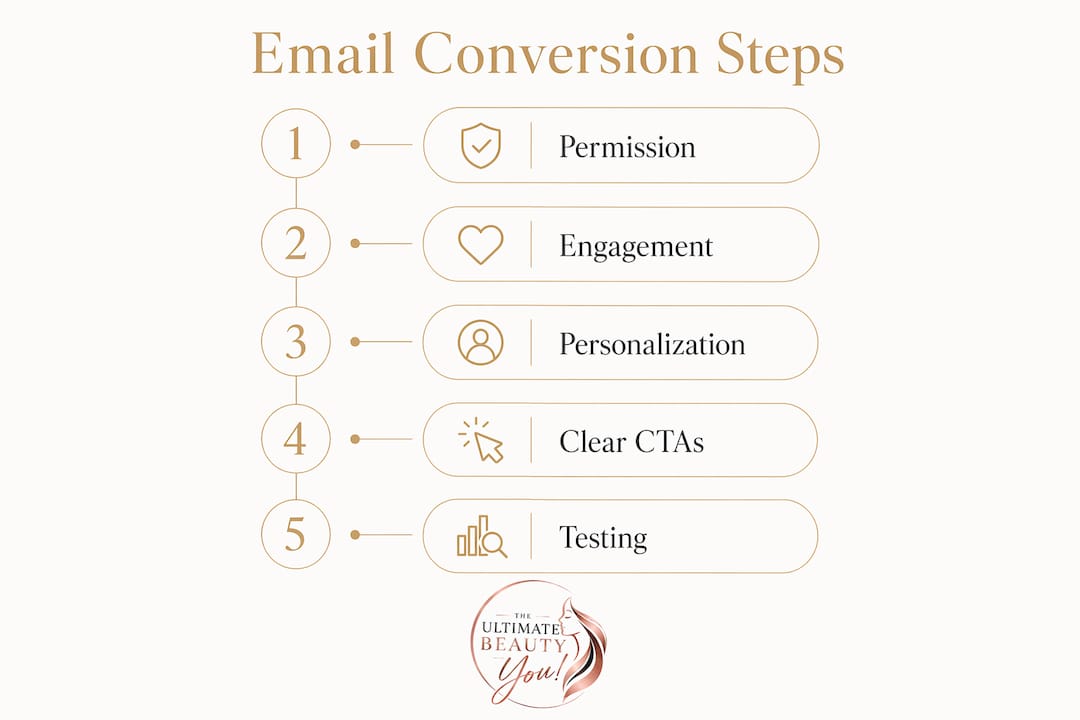
Timing, segmentation, and lifecycle messaging that increase conversions
Segmentation beyond gender is where real lift happens. Life stage, purchase behavior, content interests, and psychographics all predict engagement better than demographics alone.
- Welcome flow (days 1–3): Deliver the promised value immediately. Introduce your voice. Set expectations for what she will receive and how often.
- Education sequence (weeks 1–4): Build trust with useful, non-promotional content. This is where she decides whether you are worth her inbox.
- Ritualization (ongoing): Consistent, scheduled sends become part of her routine. Predictability builds anticipation.
- Offer sequence: Introduce a product or service after she has received value. Frame it as a natural next step, not an interruption.
- Re-engagement (90+ days inactive): A single honest email: "We miss you. Here's something we think you'll love." No pressure.
Female recipients often convert on the fourth or fifth touchpoint, showing greater lift on later touches than male recipients. Plan for multi-touch nurture. A two-email sequence is rarely enough.
- Best send windows for women in wellness: Tuesday through Thursday, 7–9 AM or 7–9 PM local time.
- Frequency sweet spot: one to two times per week for engaged lists; once per week for new subscribers.
What to track and how to A/B test for real results
Metrics tell you where the relationship is working and where it is not.
- Deliverability rate: Industry deliverability averages 82%. Below that, your list or domain needs attention.
- Open rate: Personalized subject lines lift open rates by around 26%. Use your own trend as a benchmark.
- Click-through rate (CTR): The truest measure of content relevance. Low CTR with high opens means the body copy is not delivering on the subject line's promise.
- Conversion rate: For female recipients, average conversion rates are 3.8%, compared to 2.9% for males (SendIQ data). Track it per sequence, not just per send.
- Revenue per recipient: Divide total email-attributed revenue by the number of recipients—email drives trillions in retail sales globally, underscoring its strong ROI.
- Unsubscribe and complaint rates: Rising rates signal a mismatch between what she expected and what she received.
Data analytics enables A/B testing, predictive modeling, and real-time campaign adjustments that continuously improve results. Industry data shows consumers prefer email for promotions (67%). Cohort analysis, grouping subscribers by join date or behavior, reveals which lifecycle stage drives the most revenue and where women disengage.
Privacy, permissions, and trust signals you must include
Trust is the currency of email. Spend it carefully.
- Clear opt-in language: Tell her exactly what she is signing up for. "Weekly beauty and wellness insights from our experts" is better than "Join our list."
- Visible unsubscribe link: Make it easy to leave. Women who stay because they want to are worth ten who feel trapped.
- Brand domain sending: Emails from a recognizable domain build sender trust and protect deliverability.
- Author byline: A named expert or editor signals accountability. Anonymous brand emails feel corporate.
- Contact link: One click to reach a real person. This alone lifts trust signals measurably.
- List hygiene: Remove hard bounces promptly. Suppress unengaged subscribers after 90 days of silence.
The CAN-SPAM Act and, where applicable, state privacy laws govern U.S. email marketing. This guide is general information; confirm your specific compliance obligations with a qualified legal professional.
Pro Tip: Add a one-line "why you're receiving this" note at the bottom of every email. It reduces spam complaints and reinforces the permission relationship.
Build an Ideal Reader Avatar: a practical template
Moving from demographics to psychographics is the single biggest lever in effective email strategies for women. An Ideal Reader Avatar gives every email a specific person to speak to.
Avatar worksheet fields:
- Goals: What does she want to feel, achieve, or become in the next 90 days?
- Frustrations: What is slowing her down or making her feel unseen?
- Daily routine: When does she check email? What else is competing for her attention?
- Decision triggers: What moves her from "interested" to "yes"? Social proof? Expert validation? A clear outcome?
- Purchase barriers: Price? Time? Skepticism? Not knowing where to start?
- Language and tone: Does she respond to warmth and humor, or precision and authority?
- Trusted sources: Who does she already follow and why?
Example avatar: Maya, 38, balancing a career in healthcare with two kids and a commitment to her own wellness. She reads email at 6:30 AM with coffee. She trusts recommendations from real women, not celebrities. She will click on a subject line that promises a specific, time-saving tip. She unsubscribes from anything that feels like a sales pitch disguised as content.
Use survey micro-tests, reply rates, and click-map data to refine Maya over time. She will tell you what she wants if you listen to the data. For deeper segmentation thinking, the niche targeting in beauty guide is a strong companion resource.
Pro Tip: Print your avatar and keep it next to your keyboard. Before every send, ask: "Would Maya open this? Would she click?"
How Theultimatebeauty-you applies these principles
At Theultimatebeauty-you, every content decision starts with the woman we are writing for. Our Experts & Partners page reflects a commitment to vetted, real contributors, not anonymous brand voices. Every expert who contributes carries a name, a specialty, and a perspective grounded in lived experience.
Two principles guide our email approach. First, welcome flows introduce our voice and deliver immediate value before any offer is made. Second, story-driven content, often text-forward and conversational, mirrors the friend-to-friend recommendation model that converts in beauty and wellness. Women on our platform receive curated insights, expert perspectives, and community content that respects the 80/20 balance.
What members can expect: curated beauty and wellness content, access to vetted expert contributors, community connection across life stages, and resources that support the whole woman, inside and out.
Pro Tip: If you are building your own email program, start with one welcome email that delivers real value. No pitch. Just proof that you are worth her time.
How cultural and generational differences shape email responses
A 24-year-old Gen Z woman and a 52-year-old Gen X woman may both care about wellness, but they arrive at the inbox with different expectations, communication styles, and trust signals.
Gen Z readers tend to respond to transparency, social accountability, and peer-generated proof. They are skeptical of polished brand language and respond better to raw, honest copy. Millennial women often balance multiple roles and respond to efficiency, community, and content that acknowledges complexity. Gen X and Boomer women tend to value expertise, credibility markers, and clear, direct communication over trend-chasing.
Cultural context shapes tone and imagery just as much as age. A wellness email that resonates with one community may feel tone-deaf to another if the imagery, language, or values it assumes do not reflect her reality. The types of digital content women engage with vary significantly by generation and cultural background. Segmenting by these signals, not just by purchase history, is what separates good email programs from great ones.
How user-generated content and testimonials from women convert
Women trust other women. This is not a sentiment; it is a conversion principle. User-generated content (UGC) placed inside an email, a real photo, a short quote, a specific result, functions as social proof that no brand copy can replicate.
The most effective UGC in email is specific and unpolished. "I tried the five-step morning routine and my skin stopped breaking out after two weeks" converts better than a generic five-star rating. Name, context, and a concrete outcome make it real.
Place UGC near the CTA, not buried at the bottom. She is closest to clicking when she feels validated by someone like her. For a deeper look at building a UGC strategy, the beauty brand UGC playbook covers sourcing, permissions, and placement. Micro-influencer content, when authentic, functions the same way inside an email as it does on social. See our guide on micro-influencers in beauty marketing for how to source and use it.
Multisensory language and visuals that connect with women
Women process beauty and wellness experiences holistically. Multisensory language, words that evoke texture, scent, warmth, and sensation, activates emotional engagement in a way that product specs never do. "The cream melts into skin like a second layer of warmth" outperforms "moisturizing formula with hyaluronic acid" for conversion in a wellness context.
Visuals should feel aspirational but attainable. Real skin. Real light. Real women at real life stages. For botanical and ritual-driven content, beauty rituals with botanical blends offers a strong model for sensory-rich language that feels grounded rather than aspirational to the point of alienation.
When using images in email, keep them purposeful. One strong image that sets a mood outperforms a grid of product shots. Always pair visuals with alt text that carries the same emotional weight as the image itself.
Frequency and cadence best practices for women's engagement patterns
Consistency beats frequency. She does not need to hear from you every day. She needs to know when to expect you.
One to two emails per week is the sweet spot for most engaged beauty and wellness lists. New subscribers benefit from a slightly higher-touch welcome sequence, then a natural cadence reduction as the relationship matures. Sending too often signals desperation. Sending too rarely signals you forgot about her.
Cadence should also reflect her life rhythm. Avoid sending during high-stress periods like Sunday evenings or Monday mornings. Tuesday through Thursday, early morning or early evening, consistently outperforms other windows for women in wellness categories. Seasonal and life-stage moments, a new year, a birthday, a season change, are natural re-engagement triggers that feel timely rather than manufactured.
The goal is to become a welcome ritual, not an obligation she dreads.
Key Takeaways
Email converts women in beauty and wellness because it builds trust through permission, delivers curated value on her schedule, and uses story-driven personalization that no social algorithm can replicate.
| Point | Details |
|---|---|
| Permission drives conversion | Women who opt in convert at higher rates; the opt-in is the start of the relationship, not a formality. |
| Curation beats volume | Short, distilled emails with one clear CTA outperform long-form content dumps for busy women. |
| Story-first copy wins | Text-based, conversational emails create a friend-to-friend feel that outperforms design-heavy layouts in beauty and wellness. |
| Plan for multi-touch nurture | Female recipients often convert on the fourth or fifth touchpoint; a two-email sequence is rarely enough. |
| Theultimatebeauty-you applies these principles | The platform uses vetted experts, story-driven content, and curated formats to build the trust that converts. |
The email approach we believe in at Theultimatebeauty-you
Email is not a broadcast. It is a conversation. And for women navigating beauty, wellness, and personal growth, the quality of that conversation is everything.
We believe every email you send is a chance to show up for her, not sell at her. The tactics in this guide work because they are built on respect: for her time, her intelligence, and her right to choose what enters her life. When you write with that intention, the metrics follow.
Try one thing from this guide this week. Build your first Avatar. Write one welcome email that delivers real value before any ask. Run one subject-line test. Growth in email is cumulative. Every send is a chance to get closer to the woman you are writing for.
We would love to hear what you try and what you learn.
What Theultimatebeauty-you offers women who want more
You have spent time learning how email builds trust, drives conversion, and creates lasting connection with women in beauty and wellness. Theultimatebeauty-you is where those principles come to life.
Our platform connects women with vetted beauty, wellness, and personal growth experts, curated resources, and a community that celebrates every age and stage of becoming. You get expert-backed content, real community connection, and a space that was built for you, not for an algorithm.
- Curated beauty and wellness insights from vetted contributors
- Access to our Experts & Partners network
- Community formats that support confidence, self-care, and growth
- Resources for every life stage, inside-out, head-to-toe
Ready to experience it? Visit Theultimatebeauty-you and see what's waiting for you, or explore our offerings to find the right fit.
Useful sources and further reading
These are the strongest resources behind the recommendations in this guide.
- Email Newsletter Statistics — Source for the $42 ROI figure, deliverability averages, and personalized subject line lift data cited throughout.
- How Carly Zakin leverages email marketing to engage busy women — The foundation for the curation and clarity argument; TheSkimm's model applied to beauty and wellness.
- Beyond pink marketing: Why data should drive women-centric campaigns — Expert commentary on why stereotyped creative fails and psychographic personalization wins.
- Email conversion rates vs. gender: What our data really shows — SendIQ's dataset showing female conversion rates, response speed, and multi-touch lift.
- Email marketing for women entrepreneurs — Source for the Ideal Reader Avatar framework and the 80/20 educational-to-promotional rule.
- Nadia Ngoma: Email strategy for women-focused brands — Practitioner perspective on text-based, story-driven emails in skincare and wellness.
- Data analytics in email campaigns for women in business — Women in Tech Network's breakdown of segmentation, A/B testing, and predictive modeling.
- Impact of Gender Differences on Promotional Emails — Academic research on how women and men evaluate email information content and visual presentation differently.