
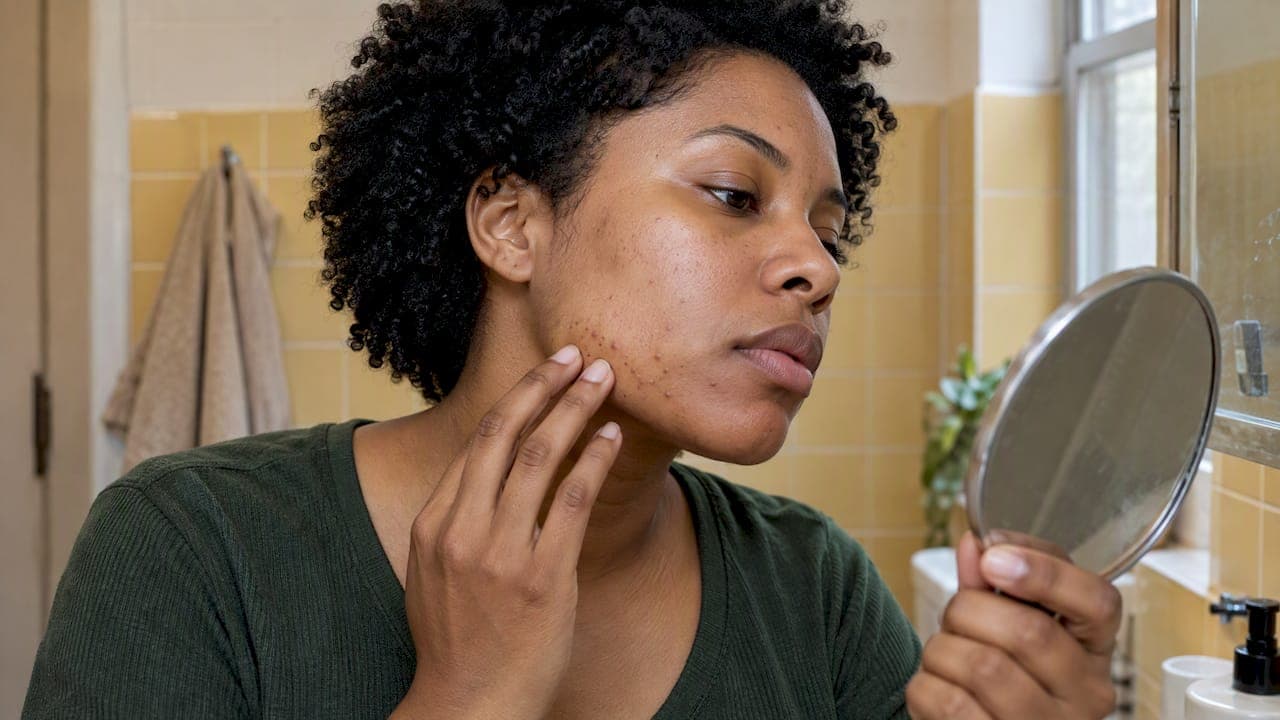
Acne does not end with high school. It can linger into your 30s, 40s and 50s, or show up for the first time as an adult, and dermatologists call that adult-onset acne. It is common, it is treatable, and it says nothing about how well you care for your skin. This guide explains what drives breakouts in grown women, which treatments have the strongest evidence, how to build a gentle routine, and when to book a dermatologist.
TL;DR
- Adult acne often comes from a mix of hormone shifts, stress, family history, products and medications. It is not a hygiene problem.
- Proven first-line options include benzoyl peroxide, topical retinoids and, for some women, hormone-based prescriptions.
- Give any new treatment four to six weeks before judging it, and skip harsh teen-targeted products.
- See a dermatologist if nothing clears your skin, if you are scarring, or if breakouts weigh on your mood.
- Persistent or sudden adult acne can point to an underlying condition, so ask about testing.
Table of Contents
- What adult female acne really is
- What causes acne in women over 30
- How to tell hormonal acne from something else
- Treatments that work for adult acne
- Build a gentle routine
- When to see a dermatologist
- Our perspective: beauty is more than clear skin
- Find trusted help and community with us
- Frequently asked questions
- Sources
What adult female acne really is
Adult acne is acne that continues past your teen years or begins in adulthood. The same pimples, blackheads and deeper bumps appear, but the pattern and the triggers often differ from adolescence.
Researchers prefer the phrase "adult acne" to "post-adolescent acne," because the latter suggests only people just past 19. Many women live with it for decades. The NIAMS notes that when acne continues into adulthood, it is more common in women. The NIAMS acne overview is a good place to read the basics.
Beauty Is Not Perfection. Beauty Is a Verb. Beauty Is Becoming. Clear skin is a fair goal. Shame is not part of the plan.
What causes acne in women over 30
There is rarely one cause. The American Academy of Dermatology lists fluctuating hormones, stress, family history, hair and skin care products, medication side effects and an undiagnosed medical condition as possible drivers.
Hormones
Hormones are the headline. Fluctuations can cause breakouts around your period, during pregnancy, in perimenopause and menopause, and after starting or stopping birth control pills. If your skin flares in the same part of the month, your cycle is a clue. Our guide to cycle syncing skincare shows how to adjust your routine by phase without overhauling it each week.
Sometimes the hormone story goes deeper. A 2022 report from a multidisciplinary committee on androgen excess and PCOS notes that dermatologists see adult female acne as an inflammatory skin disease, while endocrine specialists often see it as a possible sign of androgen excess. The same report recommends that total testosterone, free testosterone and DHEAS be measured in all women with adult acne to check for hyperandrogenism. That is a conversation to have with your clinician, especially if you also have irregular periods or extra hair growth.

Stress
Stress can worsen acne by shifting hormones. Cleveland Clinic explains that higher cortisol may aggravate an underlying skin condition. One physician quoted by the AMA says stress and diet are not direct causes, but they play a strong role in people already predisposed to acne. So stress is a lever, not a villain. Our stress management guide for women offers realistic ways to turn the volume down.
Diet
Cleveland Clinic notes that a diet high in sugar and dairy can contribute to acne. Notice the word "can." Food affects people differently. If you suspect a link, change one thing at a time and watch your skin for several weeks rather than cutting out everything at once.
Products and medications
Heavy hair oils, rich moisturizers and some makeup can clog pores. Certain medications can also trigger breakouts. If you suspect one, speak with the doctor who prescribed it rather than stopping it on your own.
What about hormone replacement therapy?
Women in perimenopause and menopause often ask whether hormone therapy can cause breakouts. Hormone levels shift in those years, and starting or stopping any hormone product can change your skin. Because formulations differ widely, we cannot give you a one-size answer. If breakouts began after you started hormone therapy, tell the clinician who prescribed it. Adjusting the type or dose is their call, not something to change alone. Our menopause skincare guide covers hydration, repair and sun protection for this stage.
How to tell hormonal acne from something else
Hormonal acne has a typical look. In adult women, lesions are more often mild to moderate, with few deep cysts, and concentrated along the jawline and lower face. Many women notice tender bumps that return in the same spots.
Patterns are only clues. Not every lower-face breakout is hormonal, and not every hormonal flare shows up on the jaw. Here is a simple way to sort what you see.
| What you notice | What it may suggest | Next step |
|---|---|---|
| Tender bumps on the jaw and chin that flare before your period | Cycle-related hormone changes | Track for two to three cycles, then discuss with a clinician |
| New breakouts plus irregular periods or excess hair | Possible androgen excess such as PCOS | Ask about hormone testing |
| Redness, flushing and bumps on the cheeks and nose | Possibly rosacea, which has different triggers and treatments | See a dermatologist for a diagnosis |
| Breakouts that began after a new product | Pore-clogging ingredients | Pause the product and switch to non-comedogenic options |
| Breakouts after a new prescription | Possible medication effect | Talk to the prescriber |
One caution: the AMA source notes that older people are more likely to develop rosacea, and it is often mistaken for acne. Treating rosacea like acne can make it worse, which is a good reason to get a diagnosis.
Treatments that work for adult acne
The 2024 guidelines from the American Academy of Dermatology strongly recommend benzoyl peroxide, topical retinoids and topical antibiotics for acne vulgaris. The same guidelines cover oral doxycycline, combined oral contraceptives, spironolactone, and isotretinoin for severe acne, scarring, psychological burden or failure of standard therapy.
Start with topicals
For mild to moderate adult acne, dermatologists often suggest products with adapalene, azelaic acid, benzoyl peroxide starting at 2.5%, or salicylic acid. Starting low matters. Adult skin tends to be drier and more reactive.
A practical way to begin:
- Pick one active ingredient, not three.
- Apply it to clean, dry skin, a few nights a week at first.
- Add frequency slowly as your skin tolerates it.
- Pair it with a plain moisturizer and daily sunscreen.
- Hold steady. Improvement can take four to six weeks.
Patience is the hardest part. Switching products every week keeps your skin irritated and your results unclear.
Prescription options
When over-the-counter products are not enough, a dermatologist can prescribe stronger topicals or oral medicines. For women with adult acne and confirmed hyperandrogenism, the 2022 committee report recommends oral combined estroprogestins, with spironolactone sometimes added. These are prescription medicines with their own risks and who-should-avoid-them lists, including considerations around pregnancy plans. Your clinician should review your history before recommending any of them.
The same task force emphasizes that a clinical grading tool helps optimize the treatment plan rather than relying on observation alone. In plain terms: a good provider will assess how severe your acne is and tailor the plan, not guess.
Quick comparison
| Option | Best suited to | Good to know |
|---|---|---|
| Benzoyl peroxide (start at 2.5%) | Mild to moderate inflamed pimples | Can bleach fabric and dry skin |
| Adapalene or other topical retinoid | Clogged pores and recurring breakouts | Introduce slowly, use sunscreen |
| Azelaic acid | Breakouts with lingering marks | Often gentler on sensitive skin |
| Salicylic acid | Blackheads and whiteheads | Can dry out if layered with other actives |
| Oral hormonal treatment | Hormone-linked acne under clinician care | Needs a prescription and medical review |
| Isotretinoin | Severe or scarring acne, or failed standard therapy | Specialist-supervised only |
Build a gentle routine
More is not better. Experts caution against the strongest over-the-counter products, since formulas made for teenagers' oily skin can be too drying and irritating for adult skin.
A simple framework:
- Morning: gentle cleanser, light moisturizer, broad-spectrum sunscreen.
- Evening: cleanser, your one active treatment, moisturizer.
- Everything you apply: choose skin and hair products labeled non-comedogenic, non-acnegenic, oil-free or "won't clog pores".
Don't forget your hairline and body. Styling products can drift onto the forehead and jaw, and chest and back breakouts need their own care. Our five-step body skincare routine covers barrier-friendly habits below the neck. If your routine has to change with your decade, our guide to beauty routines by age group is a helpful map.
After breakouts heal, marks can linger, especially on deeper skin tones. Our guide to skincare for women of color explains how to fade dark spots safely. And if your skin changed after a baby, see our postpartum skincare routine.
When to see a dermatologist
Book an appointment if nothing you try clears your acne. The AAD says exactly that: see a dermatologist if nothing is working.
Do not wait if:
- Your breakouts are deep, painful or leaving marks.
- Your periods are irregular or you notice new hair growth along with acne.
- You think a medication is the trigger. Talk to the prescriber first.
- Acne is affecting your confidence or mood.
That last point is not minor. The Office on Women's Health says acne is not a serious health threat, but it can cause permanent scarring and significant psychological effects, including poor body image and depression. Early help protects your skin and your spirit. If low mood is heavy, tell your doctor about that too.
Our perspective: beauty is more than clear skin
We hear from women every day who feel blindsided by breakouts at 35, 42 or 55. They did everything "right." They still feel like they are back in the bathroom mirror at 15.
Here is what we believe. Adult acne is not a failure. It is information. Sometimes it is telling you about your hormones. Sometimes it is telling you about stress, sleep, a new product or a season of life. Our job is to help you listen, then get you to the right expert.
That is why we take an inside-out, head-to-toe approach. Skincare matters. So do rest, movement, nourishment and the people who lift you up. Our holistic beauty routine guide and our healthy beauty habits show how small, steady habits add up.
We also believe you should never have to figure it out alone. Bring your questions, your photos and your cycle notes to a professional. Come back to a community that gets it.
Beauty Is Not Perfection. Beauty Is a Verb. Beauty Is Becoming.
— Ava
Find trusted help and community with us
The Ultimate Beauty - You! is a women-centered platform that brings beauty, wellness and confidence together in one place. We connect women with trusted experts, brands and resources, so advice is no longer scattered across a dozen tabs. Our app is on the way, and in the meantime you can explore the platform and our blog.

Ready to take the next step? Visit The Ultimate Beauty - You! to join the community, browse our blog, or meet the experts and partners who share our vision.
Frequently asked questions
Is it normal to get acne for the first time in my 30s or 40s?
Yes. Acne can continue from your teens or appear for the first time in adulthood. Shifts in hormones, stress and products are common reasons. A dermatologist can help find your pattern and plan.
How long until a new acne treatment works?
It can take four to six weeks to see improvement. Early irritation or dryness is common with retinoids and benzoyl peroxide, so start slowly. If you see no change after several weeks, ask a dermatologist about the next step.
Can stress and food really cause breakouts?
They can contribute. Stress may raise cortisol, and a diet high in sugar and dairy can contribute to acne. Experts describe both as strong influences rather than sole causes, especially if you are already prone to acne.
Should I get hormone testing for adult acne?
A 2022 committee report recommends measuring androgen levels in all women with adult acne. Whether that makes sense for you depends on your symptoms and history. Ask your dermatologist, primary care clinician or gynecologist.
Can I use the same products I used as a teen?
Usually not at full strength. Adult skin is often less supple, and teen-focused oily-skin products can be too drying and irritating. Choose gentler formulas, and see our teen routine guide only for how simple a good routine can be.
Sources
- Adult acne, American Academy of Dermatology
- Adult acne versus adolescent acne: a narrative review
- Female Adult Acne and Androgen Excess: A Report From the Multidisciplinary Androgen Excess and PCOS Committee
- Adult Acne: Causes and Treatments, Cleveland Clinic
- What doctors want patients to know about acne treatment, AMA
- Etiology of Adult Female Acne: Systematic Review
- Guidelines of care for the management of acne vulgaris, JAAD
- Adult acne treatment dermatologists recommend, AAD
- Hormonal Acne, Cleveland Clinic
- Acne, Office on Women's Health
- Acne overview, NIAMS